.png)
.png)

Daniel Saks
Chief Executive Officer


Venture capital has concentrated in AI to a degree with no recent precedent. Crunchbase reported that global startup funding reached a record $510 billion in the first half of 2026, more than the $440 billion invested in all of 2025, with more than 70% of second-quarter capital going to AI-focused companies. In the third quarter, AI startups raised $102 billion, or 64% of global venture funding, and a record 27 companies raised rounds of $1 billion or more.
Funding announcements show where investors are placing bets. Hiring shows which companies are converting that capital into teams, which is why headcount change is one of the more useful recent funding signals to track alongside round size and valuation.
This list ranks venture-backed AI-native startups across every category by 12-month headcount growth, using a Landbase snapshot of 1,480 companies, and then verifies each company's funding and operating evidence against public sources.
The starting universe was 1,480 venture-backed AI-native companies tracked in Landbase data as of August 30, 2026.
Every company on the list had to meet four criteria:
The top 10 below come from a ranked top 60, all of which grew headcount by more than 200%. Landbase CEO Daniel Saks published the full top 60 as a LinkedIn carousel.
Headcount growth is calculated from professional-profile data and can differ from company-reported figures, particularly for companies with contractors or distributed teams. Funding, valuation, and revenue figures below come from company announcements and press coverage rather than headcount data. Funding alone does not establish growth, so it is treated as one of several company buying signals.
CEO: Bar Winkler
Latest round: $550 million Series C, September 2026
12-month headcount growth: +956%
Category: Enterprise AI agents
Wonderful describes its product as an AI operating system for building, connecting, and monitoring enterprise AI agents. The agents work across voice, chat, and email, are tuned to local languages and regulations, and are deployed mostly in customer support.
The company reported about 650 employees at the time of its Series C and operations in more than 35 countries.
Its valuation moved from $700 million in November 2025 to $2 billion in March 2026 and then to $5 billion with its September Series C.
Insight Partners led the $550 million Series C, with Index Ventures, IVP, Vine Ventures, 9Yards, and Bessemer Venture Partners returning and Salesforce joining as a new investor. Earlier rounds included a $150 million Series B in March 2026.
Wonderful reached a $5 billion valuation in under two years, and its model depends on local deployment teams in each market, which drives hiring.
CEO: Brendan Foody
Latest round: $350 million Series C, October 2025
12-month headcount growth: +885%
Category: AI training data and expert marketplace
Mercor connects AI labs with domain experts, including scientists, doctors, and lawyers, who produce data used to train and evaluate AI models.
Foody said in July 2026 that Mercor's annualized revenue run rate had crossed $2 billion, roughly double the level four months earlier. The figure reflects gross customer spend before payouts to contractors.
The same month, Mercor announced the acquisition of Deeptune, which helps train AI agents.
Felicis Ventures led the $350 million Series C at a $10 billion valuation, up from $2 billion at its Series B. Bloomberg reported in July 2026 that Mercor was in early talks to raise at a $20 billion valuation.
Mercor's growth tracks frontier-lab spending on expert data. Its headcount figure likely includes some contractors, so the revenue evidence is more informative than the hiring rate.
CEO: Mukund Jha
Latest round: $130 million Series C, July 2026
12-month headcount growth: +712%
Category: AI app builder
Emergent provides an agentic app-building platform that turns natural-language prompts into full-stack applications. The company says roughly 70% of its users have no prior coding experience.
Emergent reported $50 million in annual recurring revenue in January 2026. By July, it reported an annualized run rate of approximately $120 million, more than 200,000 paying customers, and over 12 million apps built on the platform.
Its valuation moved from $300 million at its January Series B to $1.5 billion at its July Series C.
Creaegis led the $130 million Series C, with Khosla Ventures, SoftBank Vision Fund 2, and Lightspeed participating, bringing total funding to roughly $230 million.
Emergent is the fastest-growing developer tools company in the dataset. Its customers are mostly non-technical builders.
CEO: Eric Foster
Latest round: $250 million Series B, March 2026
12-month headcount growth: +665%
Category: AI-native managed detection and response
TENEX.AI runs an AI-native managed detection and response service. Its platform handles triage, investigation, threat hunting, and response, while human analysts oversee each decision.
TENEX.AI reported 318% year-over-year growth since founding and ranked first on IT-Harvest's 2026 Cyber 150 list of fastest-growing cybersecurity companies.
Crosspoint Capital Partners led the $250 million Series B, following a 2025 seed round led by Andreessen Horowitz.
TENEX.AI pairs AI automation with human analysts rather than replacing them, and the company said the funding will expand its team of defenders and engineers.
CEO: Nico Laqua
Latest round: Series B extension at a $4 billion valuation, July 2026
12-month headcount growth: +642%
Category: AI-native insurance carrier
Corgi is a full-stack insurance carrier for startups. It writes its own policies, underwrites its own risk, and uses AI to shorten quoting from days to minutes.
Its first customers were mainly early-stage technology companies, and trucking is its first announced new vertical.
Corgi's valuation rose from $630 million in early 2026 to $1.3 billion in May, $2.6 billion in late May, and $4 billion in July. The company said it expects its revenue run rate to grow from $45 million to $450 million by the end of 2026.
TCV led a $160 million Series B in May 2026 and a $106 million extension later that month. The size of the July extension was not disclosed. In January 2026, Corgi announced $108 million in combined seed and Series A funding.
Corgi shows AI-native companies entering regulated industries as licensed operators rather than software vendors. Owning the carrier requires underwriting, claims, and compliance staff.
CEO: Jake Stauch
Latest round: $75 million Series B, December 2025
12-month headcount growth: +556%
Category: AI-native IT service management
Serval provides an AI-native IT service management platform that combines help desk, access management, and workflow automation.
The company has expanded into HR, finance, and legal workflows.
Serval reported that revenue grew 500% and headcount more than tripled between its Series A and Series B.
Named customers include Perplexity, Clay, Together AI, Verkada, and Mercor.
Sequoia led the $75 million Series B at a $1 billion valuation, following a $47 million Series A in August 2025 led by Redpoint, bringing total funding to $127 million.
Serval competes directly with established IT service management systems of record. Its customer list is weighted toward other fast-growing AI companies.
CEO: Alex Atallah
Latest round: $113 million Series B, May 2026
12-month headcount growth: +538%
Category: AI model gateway
OpenRouter provides a single API for more than 400 AI models, letting teams route requests between providers based on cost, latency, and quality.
OpenRouter reported processing about 25 trillion tokens per week, a fivefold increase over six months, and about 8 million users. Its valuation rose to roughly $1.3 billion from about $547 million a year earlier.
CapitalG, Alphabet's growth fund, led the $113 million Series B. NVentures, ServiceNow Ventures, Snowflake Ventures, and Databricks Ventures participated. The prior $40 million round was led by Andreessen Horowitz and Menlo Ventures.
OpenRouter's growth reflects how many teams now use several models at once. Related companies appear in Landbase's ranking of fast-growing AI infrastructure companies.
CEO: Varun Vummadi
Latest round: $61 million Series A, November 2025
12-month headcount growth: +532%
Category: AI customer support agents
Giga builds voice AI agents for enterprise customer support. Its orchestration layer handles listening, reasoning, and database lookups in under half a second.
Giga counts DoorDash as a customer and is live with several financial services clients. At the time of its Series A, the company planned to expand within Fortune 100 enterprises and into healthcare and finance.
Redpoint Ventures led the $61 million Series A, with Y Combinator and Nexus Venture Partners participating. The company, previously known as Giga ML, raised a $3.6 million seed round led by Nexus Venture Partners in 2023.
Giga and Wonderful are the two companies in the top 10 whose main product automates customer conversations.
CEO: Alex Mashrabov
Latest round: $400 million Series B, August 2026
12-month headcount growth: +509%
Category: AI video and image generation
Higgsfield provides AI image and video generation tools, including storyboard and keyframe products and agentic tools for marketing video production.
Higgsfield reported an annualized run rate of about $700 million in August 2026, up from about $20 million a year earlier, along with more than 30 million users. The company said corporate clients now generate the majority of its revenue, up from less than 25% in January.
DST Global led the $400 million Series B at a $5.4 billion valuation with Goldman Sachs and Intel Capital participating, about four times the $1.3 billion valuation reported in January 2026.
Higgsfield's shift from consumer creators to business customers requires enterprise sales and support teams, which shows up in hiring.
CEO: Josh Payne
Latest round: $3.36 billion pre-IPO convertible financing, September 2026
12-month headcount growth: +503%
Category: AI cloud infrastructure
Nscale is a London-based, vertically integrated AI cloud provider that combines data centers, power, GPU compute, and software to sell capacity for AI training and inference.
Nscale reported first-half 2026 revenue of $140.6 million, more than 13 times the same period in 2025, and a contracted backlog of $103.4 billion, up from $38 billion at the end of 2025. It filed for a New York Stock Exchange listing in September 2026.
Reported contracts include about 200,000 Nvidia GPUs for Microsoft and a roughly $45 billion compute agreement with Anthropic.
Third Point led the convertible financing, which includes a $1 billion commitment from Nvidia and converts to equity at the IPO. In March 2026, Aker ASA and 8090 Industries led a $2 billion Series C at a $14.6 billion valuation, following a $1.1 billion Series B in September 2025.
Nscale is the only infrastructure operator in the top 10. Running data centers requires power and operations staff alongside engineers.
The ten companies span categories from insurance to data centers, but several patterns repeat.
First, the fastest hiring sits with companies that replace a service rather than sell a tool. Wonderful, Giga, TENEX.AI, and Serval each automate work that was previously done by support, security, or IT staff, and several of them still deploy people alongside the software. Teams comparing agent vendors can review Landbase's ranking of fast-growing agentic AI platforms.
Second, valuations are moving faster than funding cycles. Wonderful, Corgi, and Higgsfield each raised more than once in 2026, and Corgi's valuation rose more than sixfold between January and July.
Third, AI companies are selling to each other. Mercor sells to frontier labs, OpenRouter sells to developers using those labs' models, Nscale sells compute capacity to Anthropic, and Serval counts several AI startups among its customers. Developer tools also remain a large share of the wider top 60, which Landbase covers separately in its list of top AI coding and developer tools startups.
For GTM teams, rapid hiring is more useful when paired with hiring, leadership, technology, and data enrichment signals than when funding is viewed on its own.
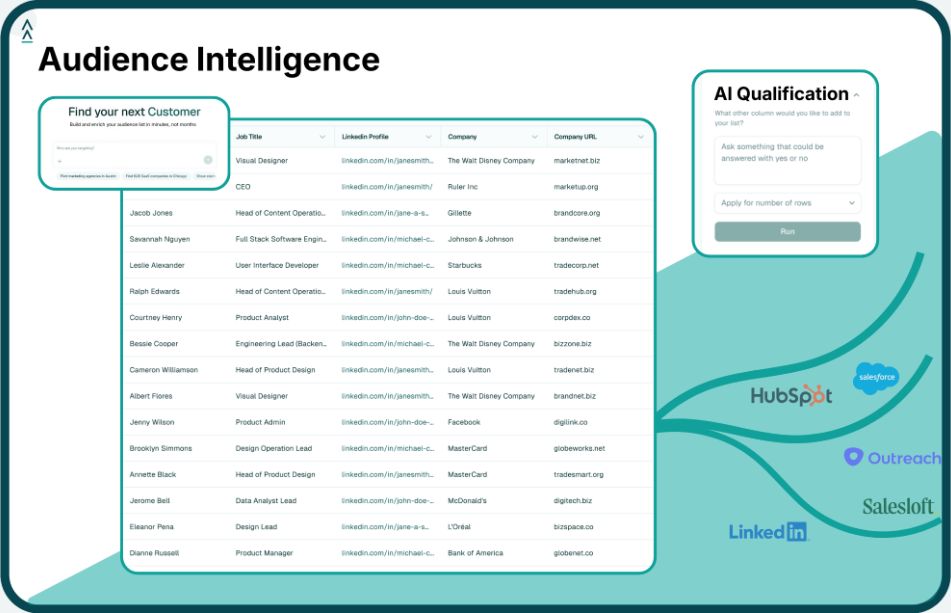
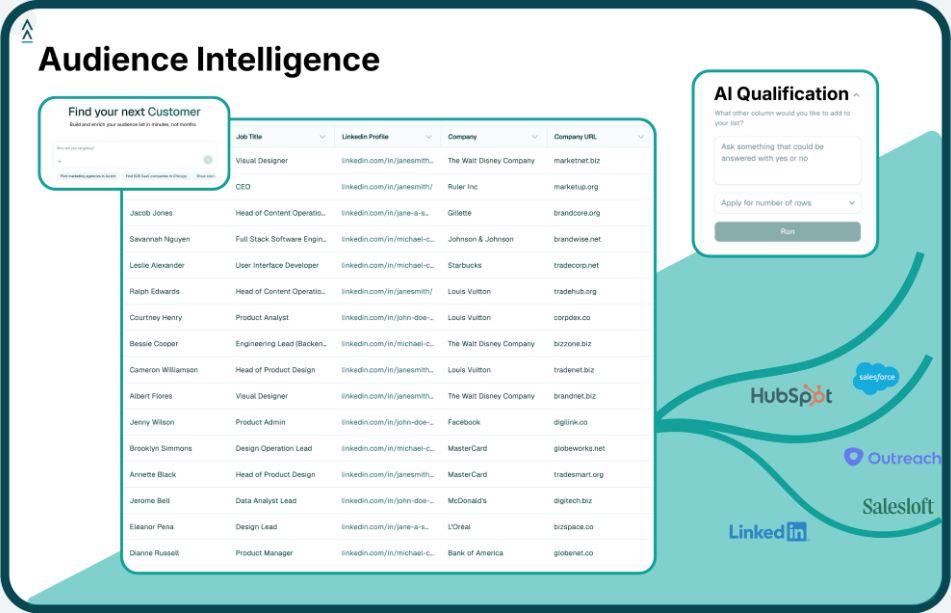
The ranking in this article was built with Landbase. Search and enrichment identified 1,480 venture-backed AI-native companies, added founding year, funding, category, and 12-month headcount change, and sorted the results into a structured dataset.
Landbase's web and CLI interfaces access the same account, datasets, and saved work. An audience created in the web app can move into a repeatable terminal workflow, and CLI-generated datasets remain available in the web app.
For more complex requirements, the Advanced Dataset Creator supports natural-language instructions involving filters, calculations, ratios, and custom output fields.
Landbase's data infrastructure includes more than 800 million contacts and more than 40 million companies across more than 1,500 fields, with enrichment from more than 20 providers.
An AI startup workflow could, for example, identify AI-native companies that raised a Series B or later in the past year, more than tripled headcount, recently hired a head of IT or security, and are headquartered in the United States or Europe.
The Landbase CLI setup supports these workflows from a standard terminal and from AI coding environments including Claude Code and Codex.
This ranking covers the fastest-growing AI startups overall. Each category and industry below has its own ranked list built with the same method: Landbase 12-month headcount growth, verified against public funding and growth evidence.
An AI-native startup is a company whose core product depends on AI models, rather than a company that added AI features to an existing product.
Wonderful recorded the highest 12-month headcount growth in Landbase data among the 1,480 companies analyzed, at more than 950%. The enterprise AI agent company reported about 650 employees at the time of its $550 million Series C in September 2026, which valued it at $5 billion.
Many of the fastest-growing companies sell outcomes, such as resolved support tickets or monitored security alerts, rather than software seats. Delivering those outcomes requires deployment and support teams, and record venture funding has paid for them.
Not on its own. Headcount data is based on professional profiles and can differ from company-reported figures, especially for companies such as Mercor that work with large contractor networks. This list therefore pairs headcount growth with disclosed funding, revenue, customer, and valuation evidence wherever it is available.
Teams can start with a category definition, such as venture-backed AI-native companies, and then filter by headcount growth, funding stage, recent rounds, geography, technology usage, and hiring activity. Landbase can combine these criteria into reusable datasets and return company and contact information through web and CLI workflows.
Tool and strategies modern teams need to help their companies grow.