.png)
.png)

Daniel Saks
Chief Executive Officer


Venture investors put more money into security startups in 2025 than in most recent years, and much of it went to companies applying AI to security work. Crunchbase News reported that security and privacy startups raised about $18 billion in 2025, up roughly 26% from 2024, with Series A and B investment up 63% on what it described as enthusiasm for deals at the intersection of AI and security. In the first half of 2026, the same publication counted another $10.6 billion, still dominated by large rounds for AI-focused companies.
Large security vendors have been buying in as well. In 2025, Palo Alto Networks completed its acquisition of Protect AI, and CrowdStrike and Check Point announced deals for Pangea and Lakera on the same day. For teams that sell into security buyers, these companies sit alongside the broader set of fast-growing cybersecurity companies, but they hire and buy on a different timeline.
This list ranks AI-native security companies by 12-month headcount growth measured in Landbase data, then verifies each company's funding and operating evidence against public sources.
The starting pool was AI-native security companies whose primary product is an AI SOC or managed detection service, autonomous penetration testing, security for AI models and agents, or AI-driven application security.
Every company on the list had to meet four criteria:
Headcount growth is calculated from professional-profile data and can differ from company-reported figures, particularly for companies with contractors, distributed teams, or recent hiring changes. Funding, valuation, and revenue figures below come from company announcements and press coverage rather than headcount data. Funding alone does not establish growth, so it is treated as one of several company buying signals.
CEO: Pavel Gurvich
Latest round: $75 million seed, November 2025
12-month headcount growth: +6,300%
Category: Autonomous penetration testing
Tenzai builds an agentic penetration-testing platform, which it describes as an AI hacker, that continuously finds, exploits, and helps fix vulnerabilities in web applications, APIs, and AI applications, including AI-written code.
Tenzai was founded in May 2025 and emerged from stealth with a $75 million seed round in November 2025. At that point it had 18 employees and was running pilots with large financial services, healthcare, and technology organizations.
In June 2026, the company extended its platform to test AI applications and said its system ranks in the top 1% against 125,000 human hackers across six bug bounty and competition platforms.
Greylock, Battery Ventures, and Lux Capital co-led the $75 million seed, with Swish Ventures and individual investors participating. No later round has been confirmed.
Tenzai's headcount growth is measured from a near-zero base, but the size of its seed round signals how much investors are willing to commit to autonomous offensive security before a company has broad commercial sales.
CEO: Henry Comfort
Latest round: $30 million Series A, May 2026
12-month headcount growth: +1,900%
Category: AI agent security and governance
Geordie AI provides a security and governance platform for enterprise AI agents. It builds an inventory of the agents running across an organization, shows what each one can access and how it behaves, and uses its Beam remediation suite to constrain agents at runtime.
Geordie won the RSAC 2026 Innovation Sandbox contest in March 2026. By May, it was deployed in about 30 customer environments, including AlphaSense and Owkin.
The company had 37 employees across London and New York at the time of its Series A and planned to reach 50 within three months. The round set a reported post-money valuation of $155 million.
Balderton Capital led the $30 million Series A, with Crosspoint Capital joining and General Catalyst and Ten Eleven Ventures following on. Geordie previously raised a $6.5 million seed round from General Catalyst and Ten Eleven Ventures.
Agent governance is becoming its own security category. Geordie's customer base shows that enterprises deploying agents at scale want an inventory and a set of runtime controls before they expand usage further.
CEO: Alon Kollmann
Latest round: $36 million in seed and Series A funding, announced November 2025
12-month headcount growth: +938%
Category: Design-stage product security
Clover places AI agents inside Jira, Confluence, GitHub, Cursor, and Slack to catch security design flaws before code is written.
In March 2026, Calcalist reported that Clover had about 50 employees, mostly in Israel, and a revenue run rate above $1 million per quarter. ServiceNow made a strategic investment and agreed to become a customer at the same time.
The company reports dozens of customers, including Fortune 500 companies. Named customers include Udemy, ServiceTitan, Lemonade, Plaid, Notion, and Virgin Money.
Notable Capital and Team8 led the funding announced when Clover came out of stealth, with SVCI participating. Angel investors include Wiz co-founders Assaf Rappaport and Yinon Costica and Shlomo Kramer. ServiceNow's 2026 investment amount was not disclosed.
Most application security tools scan code after it exists. Clover moves review to the design and ticketing stage, which becomes more important when AI agents can turn a specification into working code within hours.
CEO: Eric Foster
Latest round: $250 million Series B, March 2026
12-month headcount growth: +665%
Category: AI-native managed detection and response
TENEX.AI provides an AI-native managed detection and response service. Agentic AI triages, investigates, and responds to security alerts, while human analysts oversee decisions. Its offerings include Agentic MDR, Overwatch, and Optimize.
TENEX.AI reported more than $10 million in revenue within six months of entering the market in early 2025. By March 2026, it reported more than $25 million in contracted revenue and nearly 100 employees, with a plan to reach 300 by the end of 2026, according to Dealroom's coverage of the Series B.
Crosspoint Capital Partners led the $250 million Series B, with Shield Capital, DTCP, DeepWork Capital, and the Florida Opportunity Fund also backing the company. It followed an a16z-led seed round and a $27 million Series A in September 2025, bringing total funding to roughly $277 million. Dealroom reported a valuation above $1 billion, which the company has not disclosed.
TENEX.AI shows that AI SOC technology is also being sold as a managed service. Buyers that lack a large security team can purchase outcomes rather than software, which expands the market beyond organizations with mature SOCs.
CEO: Qasim Mithani
Latest round: $80 million Series B, April 2026
12-month headcount growth: +473%
Category: AI application security
depthfirst describes itself as an applied AI lab. Its platform uses agents to find, triage, and fix vulnerabilities across code, infrastructure, and systems.
depthfirst closed its $80 million Series B less than 90 days after its Series A. Named customers include ClickUp, Lovable, Supabase, incident.io, Moveworks, and AngelList.
The company said 80% of its fix recommendations are merged by customers, and that it serves Fortune 500 companies.
Meritech Capital led the Series B, with Forerunner Ventures and The House Fund joining Accel, BoxGroup, Liquid 2 Ventures, Alt Capital, and Mantis VC. Accel led the $40 million Series A in January 2026. Total funding is $120 million.
Two rounds in one quarter show investor demand for security products that fix issues rather than only report them, a gap that grows as AI coding tools increase code volume.
CEO: Jack Cable
Latest round: $25 million Series A, March 2026
12-month headcount growth: +429%
Category: Security for AI coding agents
Corridor provides security guardrails that run inside AI coding agents. It catches vulnerabilities as code is generated and enforces security policy on pull requests, with integrations for Cursor, Claude Code, Codex, GitHub Copilot, Devin, and Factory.
Corridor's Series A came at a reported $200 million valuation, about seven months after its seed round.
Customers listed on its website include Etsy, ElevenLabs, Lovable, Mercor, LangChain, and Qlik, and the product is available through AWS Marketplace.
Felicis led the $25 million Series A, with Conviction, Timeless, Lux Capital, Sunflower Capital, Datadog, and SV Angel participating, along with angel investors from Anthropic, OpenAI, Cursor, and Cognition. Conviction led Corridor's $5.4 million seed round in 2025.
Corridor sells into the same workflows as the AI coding tools themselves. Several of its customers and angel investors are AI developers, which suggests security is being built into coding agents rather than added after deployment.
CEO: Vineet Edupuganti
Latest round: $42 million Series A, February 2026
12-month headcount growth: +381%
Category: AI vulnerability management
Cogent provides AI agents that handle vulnerability work after detection. The agents identify asset owners, map vulnerabilities to services, prioritize them, create and track fix tasks, and verify remediation, with audit trails throughout.
Cogent raised its $42 million Series A about seven months after emerging from stealth with an $11 million seed round in July 2025.
The company said it works with dozens of large enterprises, including Upwind Security, Alteryx, and CSC Generation, and that Fortune 500 customers reduced the exposure window for critical vulnerabilities by 97%.
Bain Capital Ventures led the Series A, with Greylock and Definition participating. Greylock led the seed round after incubating the company. Total funding is $53 million.
Vulnerability management has long been limited by the manual work of routing and tracking fixes. Cogent applies agents to that coordination problem rather than to detection, which already produces more findings than most teams can handle.
CEO: Oege de Moor
Latest round: $120 million Series C, March 2026, plus a $35 million strategic extension in May 2026
12-month headcount growth: +355%
Category: Autonomous offensive security
XBOW provides an autonomous AI penetration tester that uses adversarial reasoning to find, exploit, and validate vulnerabilities in applications on a continuous basis.
In June 2025, XBOW became the first autonomous system to reach the top of HackerOne's U.S. leaderboard. Its Series C valued the company at more than $1 billion.
By May 2026, the company reported more than 100 customers, including Moderna and Seznam, and more than 250 employees.
DFJ Growth and Northzone led the Series C, with Sofina and Alkeon joining Altimeter, NFDG, and Sequoia. The extension came from Accenture Ventures, NVentures, Samsung Ventures, SentinelOne's S Ventures, and others. XBOW previously raised a $75 million Series B led by Altimeter in June 2025, bringing disclosed funding to more than $230 million.
XBOW turned a public benchmark result into enterprise demand. Strategic investment from a security vendor, a consultancy, and a chipmaker suggests autonomous testing is expected to sit inside larger security programs.
CEO: Ari Herbert-Voss
Latest round: $40 million, March 2026
12-month headcount growth: +338%
Category: AI offensive security
RunSybil provides an AI agent, Sybil, that runs autonomous penetration tests against live applications. Herbert-Voss was OpenAI's first security hire, and co-founder Vlad Ionescu previously led offensive security work at Meta.
RunSybil raised $40 million led by Khosla Ventures in March 2026. Named customers include Cursor, Notion, Turbopuffer, Baseten, and Thinking Machines Lab.
The company also said it works with several major financial institutions and Fortune 500 companies, without naming them.
S32, Anthropic's Anthology Fund, Menlo Ventures, Conviction, and Elad Gil participated in the round, along with angel investors including Nikesh Arora and Jeff Dean. The round type and valuation were not disclosed, and no earlier institutional round has been reported.
RunSybil's early customers are largely AI companies. That pattern shows AI developers buying autonomous testing for their own fast-moving products before the approach reaches more conservative industries.
CEO: Matt Fredrikson
Latest round: $40 million Series A, May 2026
12-month headcount growth: +218%
Category: AI model and agent security
Gray Swan AI, a Carnegie Mellon spinout, provides three products: Cygnal for runtime guardrails and monitoring of models and agents, Shade for automated red-teaming including in CI/CD pipelines, and Arena, a red-teaming competition network that feeds threat intelligence back into its products.
At the time of its $40 million Series A, Gray Swan reported more than 20 customers across frontier labs and enterprises, and said its work had been cited in 11 recent frontier-model system cards, including those from Anthropic, OpenAI, and Meta.
Wing Venture Capital and Madrona co-led the Series A, with Obvious Ventures, Snowflake Ventures, Hudson River Trading, Samsung Next, and Magarac Venture Partners participating. Technical.ly, citing PitchBook, reported two earlier rounds of $5 million each, putting total funding at roughly $50 million.
Gray Swan sells to the companies building frontier models as well as to enterprises deploying them. Its role in model release processes shows AI safety testing turning into a commercial security category.
The ten companies cover different parts of the security stack, but three patterns repeat.
First, AI is being used to attack as well as defend. Tenzai, XBOW, and RunSybil all build autonomous systems that find and exploit vulnerabilities the way a human penetration tester would.
Second, application security is moving earlier and closer to AI coding tools. Clover reviews designs before code is written, Corridor runs inside coding agents, depthfirst fixes vulnerabilities rather than only reporting them, and Cogent automates the remediation work that follows detection.
Third, AI systems are becoming something to secure in their own right. Geordie AI governs enterprise agents and Gray Swan tests and monitors models for frontier labs. On the defensive side, TENEX.AI sells AI-driven detection and response as a managed service. Just outside the top ten, 7AI (AI SOC agents) and Straiker (agentic application security) each grew headcount by more than 200%.
For GTM teams, these companies are hiring quickly, closing rounds months apart, and building sales and security functions at the same time. That combination is more useful when paired with hiring, leadership, technology, and data enrichment signals than when funding is viewed on its own. Teams researching adjacent categories can also compare this list with Landbase's rankings of fast-growing cloud security companies and AI coding and developer tools startups.
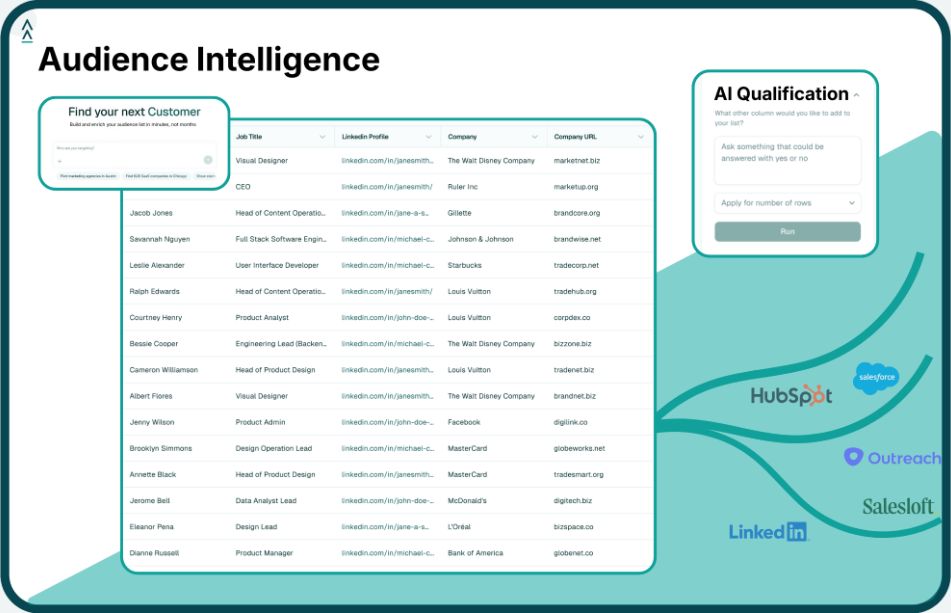
The ranking in this article was built with Landbase. A natural-language search identified AI-native security companies, an enrichment step added founding year and 12-month headcount change, and the results were filtered and sorted into a structured dataset.
Landbase's web and CLI interfaces access the same account, datasets, and saved work. An audience created in the web app can move into a repeatable terminal workflow, and CLI-generated datasets remain available in the web app.
For more complex requirements, the Advanced Dataset Creator supports natural-language instructions involving filters, calculations, ratios, and custom output fields.
Landbase's data infrastructure includes more than 800 million contacts and more than 40 million companies across more than 1,500 fields, with enrichment from more than 20 providers.
An AI security workflow could, for example, identify AI SOC, autonomous pentesting, and AI agent security companies that raised a Series A or later in the past year, grew headcount by more than 100%, recently hired a CISO or VP of Sales, and are headquartered in the United States, United Kingdom, or Israel.
The Landbase CLI setup supports these workflows from a standard terminal and from AI coding environments including Claude Code and Codex.
In this list, an AI security company is a venture-backed company founded in 2019 or later whose core product applies AI to security work or secures AI systems. The category includes AI SOC and managed detection services, autonomous penetration testing, AI-driven application and vulnerability security, and security and governance for AI models and agents.
Tenzai recorded the highest 12-month headcount growth in Landbase data among the companies that met this list's criteria, at more than 6,000%. The figure reflects growth from a very small team after the company's 2025 founding and its $75 million seed round.
Traditional penetration tests are periodic and depend on scarce human specialists, while AI coding tools increase the volume of code that needs testing. Autonomous testing platforms such as XBOW, Tenzai, and RunSybil run continuously and validate findings by exploiting them, addressing both the capacity gap and the false positives common in automated scanning.
Not on its own. Headcount data is based on professional profiles and can differ from company-reported figures, and percentages for companies founded in 2024 or 2025 are measured from very small teams. This list therefore pairs headcount growth with disclosed funding, revenue, customer, and valuation evidence wherever it is available.
Teams can start with a category definition, such as AI-native security companies, and then filter by headcount growth, funding stage, recent rounds, geography, technology usage, and hiring activity. Landbase can combine these criteria into reusable datasets and return company and contact information through web and CLI workflows.
Tool and strategies modern teams need to help their companies grow.