.png)
.png)

Daniel Saks
Chief Executive Officer


Customer service has become one of the first business functions where AI agents are expected to do the work, not just assist with it. Gartner predicts that by 2029, agentic AI will autonomously resolve 80% of common customer service issues without human intervention, leading to a 30% reduction in operational costs. A February 2026 Gartner survey found 91% of service leaders under executive pressure to implement AI.
Venture capital has moved into the category quickly. Sierra, Decagon, and Wonderful each raised rounds at multibillion-dollar valuations in 2026. For B2B teams, that combination of funding and hiring is one of the clearest recent funding signals in enterprise software.
This list ranks AI-native customer support and customer experience agent companies by 12-month headcount growth measured in Landbase data, then verifies each company's funding and operating evidence against public sources.
The starting pool was AI-native companies whose primary product is an AI agent that handles customer conversations, including chat and email support agents, voice agents for inbound and outbound calls, and AI-native support platforms.
Every company on the list had to meet four criteria:
Headcount growth is calculated from professional-profile data and can differ from company-reported figures, particularly for companies with contractors, distributed teams, or recent hiring changes. Funding, valuation, and revenue figures below come from company announcements and press coverage rather than headcount data. Funding alone does not establish growth, so it is treated as one of several company buying signals.
CEO: Daniel Keinrath
Latest round: $17 million seed, June 2026
12-month headcount growth: +1,071%
Category: AI phone agents for small businesses
fonio.ai, based in Vienna, provides AI voice agents that answer and handle phone calls for small and medium-sized businesses, including support, booking, and lead qualification.
In August 2026, fonio.ai said it had passed $10 million in annual recurring revenue in under 12 months, after moving from a prepaid model to subscriptions in February 2026.
20VC led the $17 million seed round at a reported $140 million valuation, with founders and executives from Synthesia, HubSpot, and Revolut participating. It followed an angel round in December 2025, bringing total funding to more than $20 million, according to the company.
fonio.ai shows that AI phone agents are not only an enterprise purchase. For small businesses, a subscription voice agent replaces voicemail or an outsourced answering service.
CEO: Bar Winkler
Latest round: $550 million Series C, September 2026
12-month headcount growth: +956%
Category: Enterprise AI customer service agents
Wonderful provides AI agents that handle customer conversations across voice, chat, and email, built for local languages and markets. The Israeli-Dutch company now also sells Wonderful AI OS, a platform for coordinating agents and workflows.
Wonderful's valuation moved from $2 billion at its March 2026 Series B to $5 billion with its September Series C, less than six months later.
Globes reported in August 2026, citing unnamed sources, that annual recurring revenue had reached about $55 million, up from $7 million at the end of 2025. The company did not comment on those figures.
Insight Partners led the $550 million Series C, with Salesforce joining as a new investor alongside Index Ventures, IVP, Bessemer Venture Partners, Vine Ventures, and 9Yards. Wonderful previously raised a $34 million seed, a $100 million Series A, and a $150 million Series B, for total funding of roughly $840 million.
Wonderful's early traction came from non-English-speaking markets that larger U.S. vendors served less directly, which suggests localization is becoming a competitive advantage.
CEO: Varun Vummadi
Latest round: $61 million Series A, November 2025
12-month headcount growth: +532%
Category: Voice AI agents for enterprise support
Giga, formerly GigaML, provides voice-first AI agents that automate customer support for large enterprises.
At the time of its Series A, Giga said it handled millions of customer interactions per month across e-commerce, financial services, healthcare, and telecom. DoorDash is a named customer, using Giga for Dasher delivery issues and customer calls, according to Fortune's coverage of the round.
Redpoint Ventures led the $61 million Series A, with Y Combinator and Nexus Venture Partners participating. It followed a $3.6 million seed round in 2023.
Giga's DoorDash deployment shows enterprises putting AI agents on high-volume, time-sensitive calls rather than only on chat.
CEO: Jesse Zhang
Latest round: $250 million Series D, January 2026
12-month headcount growth: +291%
Category: Enterprise AI customer service agents
Decagon provides AI "concierge" agents that resolve customer inquiries autonomously across chat, email, and voice.
Decagon's valuation tripled from $1.5 billion at its June 2025 Series C to $4.5 billion with its Series D. In March 2026, the company completed its first employee tender offer at the same valuation, when it reported more than 100 large customers, including Avis Budget Group and Oura Health.
Coatue and Index Ventures led the $250 million Series D, with a16z, Accel, and Bain Capital Ventures among existing investors. Total funding is roughly $480 million.
Decagon is one of the clearest examples of an AI-native vendor competing directly with established helpdesk platforms for enterprise customer service budgets.
Latest round: $25 million Series A, February 2026
12-month headcount growth: +286%
Category: AI receptionists for small businesses
Newo.ai provides AI voice and text agents that act as always-on front desks for small businesses, answering calls, SMS, web chat, and WhatsApp messages and handling bookings and handoffs.
Newo.ai said more than 15,000 AI agents had been created on its platform at the time of its Series A, with more than 200 certified partners. It also said revenue doubled in the final two months of 2025.
Ratmir Timashev, co-founder of Veeam, led the $25 million Series A. Total funding is about $32 million, including earlier angel, seed, and SAFE financing.
Like fonio.ai, Newo.ai targets businesses that never had a contact center, and it distributes partly through agencies and phone providers that already serve them.
CEO: Bret Taylor
Latest round: $950 million Series E, May 2026
12-month headcount growth: +224%
Category: Enterprise AI customer experience agents
Sierra provides a platform for enterprises to build branded AI agents that handle customer service and other customer experience workflows, priced on outcomes rather than seats.
Sierra said it reached $100 million in annual recurring revenue in November 2025 and $150 million by February 2026. Taylor said in May that more than 40% of the Fortune 50 use the platform.
The company raised $950 million at a valuation above $15 billion, up from $10 billion in September 2025.
Tiger Global and GV led the Series E, with Benchmark, Sequoia, and Greenoaks participating. Sierra previously raised $350 million led by Greenoaks in September 2025, bringing total funding to roughly $1.6 billion.
Sierra is the category's reference point for enterprise deals. Its outcome-based pricing ties vendor revenue to resolved conversations, which changes how buyers compare AI agents with staffing costs.
CEO: Bing Wu
Latest round: $4.6 million seed, 2024
12-month headcount growth: +183%
Category: Voice AI agent platform
Retell AI provides a platform for building, testing, deploying, and monitoring AI voice agents for inbound and outbound phone calls.
Retell said in December 2025 that it was powering more than 40 million AI phone calls per month. In an April 2026 release, it reported $50 million in annual recurring revenue for 2025 and more than 50 million calls per month.
Alt Capital led Retell's $4.6 million seed round, with Y Combinator and angel investors participating. The company has not announced a Series A, and total disclosed funding is about $5 million.
Retell reports revenue comparable to much better-funded peers on little outside capital, which points to strong developer demand for voice-agent infrastructure.
CEO: Nicolás Camhi
Latest round: $14 million Series A, December 2025
12-month headcount growth: +181%
Category: Conversational commerce and service agents
Vambe, based in Chile, provides a no-code platform of AI agents that manage sales and customer service conversations for B2C businesses, mostly over WhatsApp and other messaging channels.
Vambe reported more than $11 million in annual recurring revenue in August 2026, including a record $1.7 million in new annual recurring revenue in June alone.
Monashees led the $14 million Series A, with Cathay Latam and Atlantico participating. Total funding is about $18 million.
In Latin America, customer service and sales already run through WhatsApp. Vambe shows AI agents being built for messaging-first markets.
CEO: Marty Kausas
Latest round: $31 million Series B, August 2025
12-month headcount growth: +132%
Category: AI-native B2B support platform
Pylon provides a support platform built for B2B companies, combining ticketing in shared Slack, Teams, and email channels with AI agents, a knowledge base, and account intelligence.
In July 2026, the company relaunched its product as an agentic support platform in which human staff and AI agents work cases together.
At the time of its Series B, Pylon said it served more than 750 customers and had grown revenue more than five times year over year for two consecutive years. Named customers include Cognition and Temporal.
a16z and Bain Capital Ventures co-led the $31 million Series B, with General Catalyst and Y Combinator participating. Pylon previously raised a $17 million Series A led by a16z, for total funding of about $51 million.
Most AI support agents target consumer volume. Pylon is aimed at B2B support, where conversations are fewer, more technical, and tied to account revenue.
CEO: Isaiah Granet
Latest round: $50 million Series C, June 2026
12-month headcount growth: +94%
Category: Enterprise AI phone agents
Bland provides AI agents for phone calls, SMS, and chat, built on voice models it develops in-house. It focuses on long, complex conversations in regulated sectors such as healthcare and financial services.
With its Series C, Bland reported more than 250 enterprise customers and more than 3.5 million calls per week.
Named customers include Samsara, Kin Insurance, and CNO Financial Group.
Dell Technologies Capital led the $50 million Series C, with HubSpot Ventures joining existing investors including Emergence Capital and Scale Venture Partners. Total funding is more than $100 million.
Bland's decision to own its voice models reflects a bet that reliability on high-stakes calls requires vertical integration.
First, voice is where much of the headcount growth sits. fonio.ai, Giga, Newo.ai, Retell AI, and Bland all build agents for phone calls, the channel where labor costs are highest and where earlier chatbots had the least impact.
Second, the market is splitting by customer size. Sierra, Decagon, Wonderful, and Giga sell into large enterprises with long deployments, while fonio.ai, Newo.ai, and Vambe sell subscription agents to small businesses that never had a contact center.
Third, regional specialists are scaling alongside U.S. leaders. Wonderful's localization model and Vambe's WhatsApp-first platform show that language and channel fit still create room for new entrants.
For GTM teams, these companies are hiring quickly, adding enterprise customers, and building new functions. That combination is more useful when paired with hiring, leadership, technology, and data enrichment signals than when funding is viewed on its own. Teams researching the wider category can compare this list with Landbase's rankings of fast-growing customer support companies and CX automation platforms, or with its list of AI coding and developer tools startups.
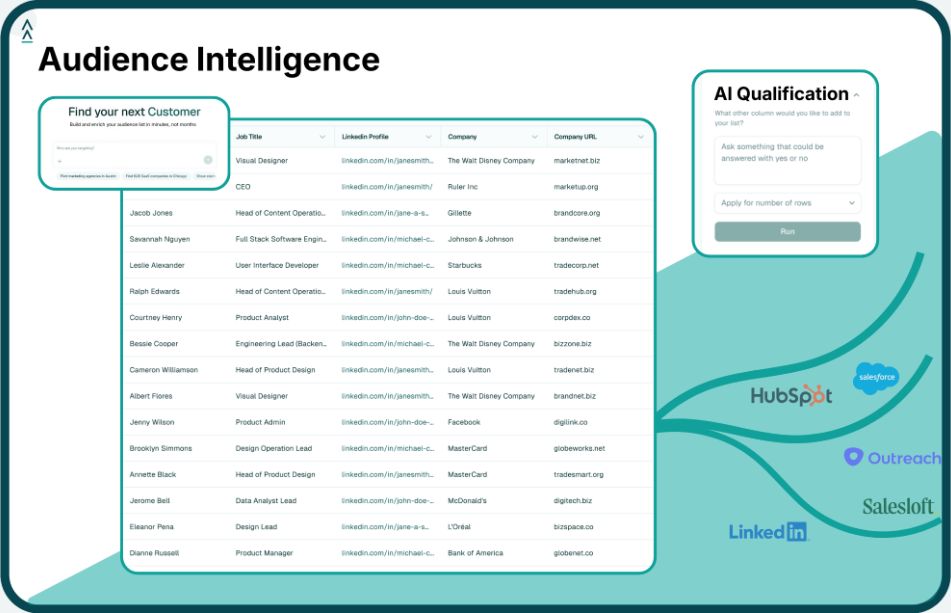
The ranking in this article was built with Landbase. A natural-language search identified AI-native customer support and voice-agent companies, an enrichment step added founding year and 12-month headcount change, and the results were filtered and sorted into a structured dataset.
Landbase's web and CLI interfaces access the same account, datasets, and saved work. An audience created in the web app can move into a repeatable terminal workflow, and CLI-generated datasets remain available in the web app.
For more complex requirements, the Advanced Dataset Creator supports natural-language instructions involving filters, calculations, ratios, and custom output fields.
Landbase's data infrastructure includes more than 800 million contacts and more than 40 million companies across more than 1,500 fields, with enrichment from more than 20 providers.
A customer support workflow could, for example, identify AI voice-agent companies that raised a Series A or later in the past year, grew headcount by more than 50%, recently hired a head of customer success or solutions engineering, and sell into healthcare or financial services.
The Landbase CLI setup supports these workflows from a standard terminal and from AI coding environments including Claude Code and Codex.
An AI customer support agent company builds software agents that handle customer conversations directly, rather than tools that only assist human agents. The category includes enterprise chat and email agents, voice agents, AI receptionists, messaging-based commerce agents, and AI-native support platforms.
fonio.ai recorded the highest 12-month headcount growth in Landbase data among the companies that met this list's criteria, at more than 1,000%. The Vienna-based company also reported passing $10 million in annual recurring revenue in under 12 months.
Phone support is labor-intensive, and improvements in speech recognition, voice synthesis, and latency have made AI agents usable on live calls. Bland, Retell AI, and Giga report call volumes in the millions, which suggests buyers are moving from pilots to production.
Not on its own. Headcount data is based on professional profiles and can differ from company-reported figures, and fast hiring does not guarantee revenue growth. This list therefore pairs headcount growth with disclosed funding, revenue, customer, and valuation evidence wherever it is available.
Teams can start with a category definition, such as AI-native customer service agents, and then filter by headcount growth, funding stage, recent rounds, geography, technology usage, and hiring activity. Landbase can combine these criteria into reusable datasets and return company and contact information through web and CLI workflows.
Tool and strategies modern teams need to help their companies grow.