.png)
.png)

Daniel Saks
Chief Executive Officer


AI has become the dominant theme in financial-services venture funding. Gallagher Re's Global InsurTech Report found that AI-focused companies attracted 99.1% of insurtech funding in the second quarter of 2026, or $2.42 billion of a $2.44 billion total, the highest quarterly figure since 2022. On the finance side, Gartner's 2025 survey of 183 CFOs and senior finance leaders found that 59% were using AI in their finance function, up from 37% in 2023.
The companies capturing that capital are hiring quickly, which makes headcount one of the more useful recent funding signals to track alongside new rounds.
This list ranks AI-native fintech and insurance companies by 12-month headcount growth measured in Landbase data, then verifies each company's funding and operating evidence against public sources.
The starting pool was AI-native companies whose primary product serves accounting and finance operations, insurance underwriting and distribution, banking, investment banking, or payments.
Every company on the list had to meet four criteria:
Headcount growth is calculated from professional-profile data and can differ from company-reported figures, particularly for companies with contractors, distributed teams, or recent hiring changes. Funding, valuation, and revenue figures below come from company announcements and press coverage rather than headcount data. Funding alone does not establish growth, so it is treated as one of several company buying signals.
CEO: Nico Laqua
Latest round: $106 million Series B1, May 2026
12-month headcount growth: +642%
Category: AI-native insurance carrier
Corgi is a full-stack, AI-native business insurance carrier built initially for startups. It writes and underwrites its own policies, covering general liability, cyber, technology and AI liability, and other commercial lines.
Corgi's founders reported a revenue run rate of roughly $40 million in January 2026, and the company said in May that it had turned profitable. Named customers include Deel and Artisan.
Its valuation moved from roughly $630 million in January to $1.3 billion at its May Series B, and then to $2.6 billion with its Series B1 three weeks later.
TCV led both the $160 million Series B and the $106 million Series B1. Those rounds followed a $108 million combined seed and Series A in January 2026.
Corgi is building a carrier rather than software for carriers. Its expansion into trucking and small-business lines will test whether AI underwriting scales beyond startups.
CEO: John Glasgow
Latest round: $65 million Series B, October 2025
12-month headcount growth: +473%
Category: AI-native ERP
Campfire provides an AI-native ERP and general ledger positioned as an alternative to NetSuite. The platform is built on its own Large Accounting Model.
Campfire reported a tenfold year-to-date increase in revenue at the time of its Series B, and its team grew from about 12 people in June 2025 to roughly 40 by October, according to Crunchbase News. Named customers include Replit, Decagon, and PostHog.
Accel and Ribbit Capital co-led the $65 million Series B, with Foundation Capital and Y Combinator participating. The round came about 12 weeks after a $35 million Series A led by Accel, bringing total funding to roughly $100 million.
The ERP is one of the stickiest systems in a company. Campfire's growth shows that fast-growing startups are willing to replace it when an AI-native ledger shortens the close.
CEO: Yogi Goel
Latest round: $41 million Seed and Series A, November 2025
12-month headcount growth: +440%
Category: AI accounting automation
Maxima provides agentic AI for enterprise accounting teams. Its agents handle month-end close tasks such as journal entries and reconciliations, and sit on top of existing ERP systems rather than replacing them.
Maxima reported processing more than $255 billion in transaction volume by January 2026, a figure that rose to more than $400 billion by June, when it launched an always-on accounting agent called Max.
Customers include Scale AI, Rippling, and SpotOn.
Kleiner Perkins, Redpoint Ventures, and Audacious Ventures backed the combined $41 million Seed and Series A. The company was founded in 2024.
Maxima targets the close process at larger companies that are not ready to change ERPs.
CEO: Chaz Englander
Latest round: $75 million Series A, November 2025
12-month headcount growth: +400%
Category: AI for investment banking and financial services
Model ML provides an AI agent platform for investment banks, consultancies, private equity firms, and asset managers. It generates documents and spreadsheets from a firm's internal data, working inside Excel, PowerPoint, and Outlook.
The company says its platform is deployed at several of the world's largest banks, asset managers, and consultancies, including two of the Big Four accounting firms.
In August 2026, Model ML announced an investment from HSBC Asset Management and said it had raised more than $100 million to date.
FT Partners led the $75 million Series A, with QED Investors, Y Combinator, and LocalGlobe participating. It followed a $12 million seed round led by Y Combinator and LocalGlobe earlier in 2025.
Banking analyst work is document-heavy and repetitive. Strategic capital from a major bank's asset manager signals buyer interest in automating it.
CEO: Dakotah Rice
Latest round: $46.8 million Seed and Series A, February 2026
12-month headcount growth: +321%
Category: AI-native commercial insurance brokerage
Harper is a licensed commercial insurance agency that uses AI to run most of the brokerage process, from quoting to binding, for small businesses, placing coverage with more than 160 carriers.
Harper said it had served more than 5,000 businesses within about a year of launching in 2024, and that it can handle more than 1,000 customers a month, compared with 20 to 30 deals for a typical human sales team, according to TechCrunch.
Emergence Capital led the Series A portion of the $46.8 million raise, with Y Combinator, Peak XV Partners, and Lobster Capital participating.
Small commercial policies are often too small for traditional brokers to service profitably. Harper's model tests whether AI can make that segment economical at scale.
CEO: Vishal Sankhla
Latest round: $34.5 million Series B, October 2026
12-month headcount growth: +247%
Category: AI for insurance brokers
Outmarket AI provides workflow software for insurance agencies and brokers, covering quote comparison, coverage gap analysis, proposals, and certificates of insurance.
In May 2026, Outmarket reported fivefold year-over-year ARR growth since its March 2025 launch and more than 250 brokerages using the platform. By October, it reported more than 10,000 active users and more than 300 agency customers.
SignalFire led the $34.5 million Series B, with Fika Ventures, Permanent Capital Ventures, TTV Capital, and Dash Fund participating. The round came about five months after a $17 million Series A led by Permanent Capital Ventures, bringing total funding to $56.5 million.
Two rounds in five months show how quickly independent agencies are adopting AI tools that plug into systems they already use.
CEO: Rafael Broshi
Latest round: $30 million Series A, March 2026
12-month headcount growth: +229%
Category: AI agents for insurance and financial services
Notch builds AI agents that run end-to-end workflows for insurers, brokers, and financial institutions, including claims intake, submission triage, and policy servicing. The company began in 2021 as a specialty insurance provider before shifting to its agent platform.
Notch reported that its annual recurring revenue grew 12-fold over the 12 months before its March 2026 round, with adoption across global insurers and financial-services firms.
Headline led the $30 million Series A, with Lightspeed Venture Partners, Jibe Ventures, Illuminate Financial, and Phoenix Insurance participating. Total funding is $45 million.
Notch's insurance background shapes its product. It builds agents for regulated, document-heavy back-office work that general-purpose AI tools rarely handle.
CEO: Nicolas Kopp
Latest round: $100 million Series C, August 2026
12-month headcount growth: +229%
Category: AI-native ERP
Rillet provides an AI-native ERP and real-time general ledger. AI agents run inside the ledger and work from the same accounting data and controls as finance staff.
Rillet reported more than 200 customers in August 2025 and more than 600 customers by August 2026, with new ARR doubling in the three months before its Series C. Named customers include Mercor, Function Health, and Temporal.
ICONIQ led the $100 million Series C at a $1 billion valuation. It was Rillet's third round in about 14 months, following a $25 million Series A led by Sequoia and a $70 million Series B, for total funding above $200 million.
Rillet and Campfire compete for the same buyer, and both crossing $100 million in funding suggests the ERP market is open to new entrants.
CEO: Gabriel Stengel
Latest round: $160 million Series D, April 2026
12-month headcount growth: +223%
Category: AI platform for investment banking and finance
Rogo provides an agentic AI platform for investment banks, private equity firms, and asset managers. Its Felix agent handles tasks such as deal screening, marketing-document drafting, and diligence.
Rogo reported more than 25,000 finance professionals using the platform in January 2026 and more than 35,000 across over 250 institutions by April. Clients include Rothschild & Co, Lazard, and Moelis.
The company reached a $2 billion valuation with its Series D, about three months after its January Series C.
Kleiner Perkins led the $160 million Series D, with Sequoia, Thrive Capital, and J.P. Morgan Growth Equity Partners participating. The round followed a $75 million Series C led by Sequoia and brought total funding above $300 million.
Rogo has the largest disclosed user base among the banking-focused companies on this list. Its growth shows that elite advisory firms are deploying AI agents in core deal work, not only in pilots.
CEO: Aman Gour
Latest round: $25 million Series A, October 2025
12-month headcount growth: +191%
Category: AI workspace for insurance operations
FurtherAI provides an AI workspace for insurance carriers, MGAs, and brokers that automates submission processing, underwriting audits, claims handling, and policy comparisons.
FurtherAI said its platform processes billions of dollars in premiums each year and named Accelerant, MSI, and Leavitt Group as customers. The company reported 15% improvements in submission-to-quote ratios.
Andreessen Horowitz led the $25 million Series A. It followed a $5 million seed, bringing total funding to $30 million.
FurtherAI sells into the operations layer of insurance rather than distribution. Its mix of carrier, MGA, and broker customers shows the same workflows can be automated across the value chain.
First, AI-native companies are replacing systems of record, not only adding features. Campfire and Rillet sell full ERPs, Corgi operates as a carrier, and Harper operates as a licensed brokerage.
Second, insurance distribution is a crowded growth segment. Harper, Outmarket AI, Notch, and FurtherAI all target broker and agency work.
Third, investment banking has become a distinct AI category. Rogo and Model ML both sell agent platforms to banks and advisory firms.
For GTM teams, these companies are hiring quickly, raising repeat rounds within months, and building new sales and operations functions. That combination is more useful when paired with hiring, leadership, technology, and data enrichment signals than when funding is viewed on its own. Teams researching the wider category can compare this list with Landbase's rankings of fast-growing fintech companies and fast-growing insurtech companies, and with its list of top AI coding and developer tools startups.
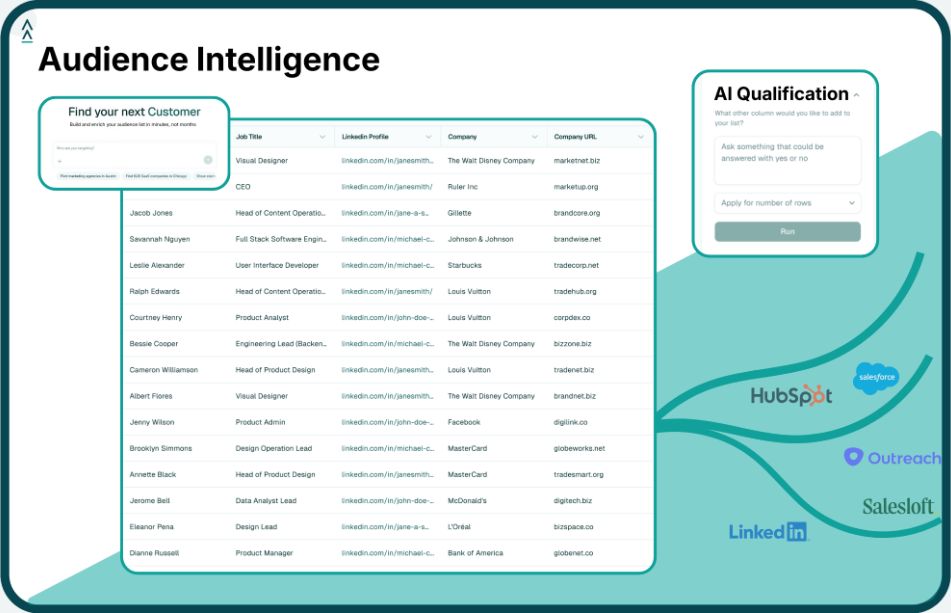
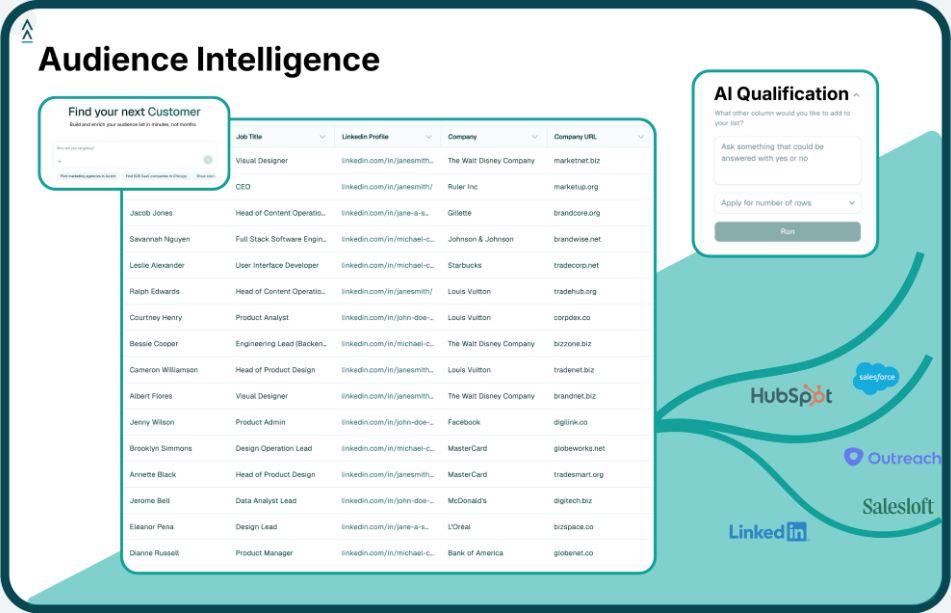
The ranking in this article was built with Landbase. A natural-language search identified AI-native fintech and insurance companies, an enrichment step added founding year and 12-month headcount change, and the results were filtered and sorted into a structured dataset.
Landbase's web and CLI interfaces access the same account, datasets, and saved work.
For more complex requirements, the Advanced Dataset Creator supports natural-language instructions involving filters, calculations, ratios, and custom output fields.
Landbase's data infrastructure includes more than 800 million contacts and more than 40 million companies across more than 1,500 fields, with enrichment from more than 20 providers.
A fintech workflow could, for example, identify AI-native insurance brokerages and accounting platforms that raised a Series A or later in the past year, grew headcount by more than 100%, recently hired a head of finance or compliance, and are headquartered in the United States or United Kingdom.
The Landbase CLI setup supports these workflows from a standard terminal and from AI coding environments including Claude Code and Codex.
An AI fintech or insurance company builds its core product around AI for financial services. The category includes AI-native ERPs and accounting automation, AI insurance carriers and brokerages, workflow software for insurers and agencies, AI platforms for investment banks and asset managers, and AI tools for banking and payments.
Corgi recorded the highest 12-month headcount growth in Landbase data among the companies that met this list's criteria, at more than 600%. Over the same period, its valuation moved from roughly $630 million in January 2026 to $2.6 billion in May 2026, and the company reported that it had turned profitable.
Insurance relies on manual work across submissions, quoting, underwriting, servicing, and claims, much of it handled through email and documents. AI agents can automate large parts of that work, and Gallagher Re reported that AI-focused companies took 99.1% of insurtech funding in the second quarter of 2026.
Not on its own. Headcount data is based on professional profiles and can differ from company-reported figures, and fast hiring does not guarantee revenue growth. This list therefore pairs headcount growth with disclosed funding, revenue, customer, and valuation evidence wherever it is available.
Teams can start with a category definition, such as AI-native insurtech or AI accounting software, and then filter by headcount growth, funding stage, recent rounds, geography, technology usage, and hiring activity. Landbase can combine these criteria into reusable datasets and return company and contact information through web and CLI workflows.
Tool and strategies modern teams need to help their companies grow.