.png)
.png)

Daniel Saks
Chief Executive Officer


An ORTEC survey of more than 2,000 North American transportation, logistics, and supply chain executives found that 42% are not yet exploring agentic AI, while 23% plan an agentic AI pilot within 12 months.
That gap between interest and deployment is where a new group of AI-native logistics, freight, and procurement startups is hiring. Their growth sits within a broader set of AI startups adding headcount fastest in 2026, and many pair hiring with recent funding signals.
This list ranks vertical AI startups serving logistics, freight brokerage, trucking, supply chain operations, and procurement by 12-month headcount growth measured in Landbase data, then verifies each company's funding and operating evidence against public sources.
The starting pool was venture-backed AI startups whose primary product serves logistics, freight, trucking, warehousing, supply chain planning, or procurement teams. General-purpose robotics foundation-model companies and autonomous vehicle makers were excluded and are covered in a separate mobility ranking.
Every company on the list had to meet four criteria:
Headcount growth is calculated from professional-profile data and can differ from company-reported figures, particularly for small teams where a handful of hires produces a large percentage change. Funding, valuation, and customer figures below come from company announcements and press coverage rather than headcount data. Funding alone does not establish growth, so it is treated as one of several company buying signals.
CEO: Vladimir Keil
Latest round: $30 million Series A, March 2026
12-month headcount growth: +383%
Category: Agentic procurement
Lio, formerly askLio, builds AI agents for enterprise procurement teams. The agents triage purchase requests, compare suppliers, negotiate, and onboard vendors.
Lio said its agents help companies manage billions of dollars in enterprise spend. According to the company, one global manufacturer automated 75% of its previously outsourced procurement operations within six months.
The company raised a $30 million Series A led by Andreessen Horowitz and said it would use the capital for U.S. expansion.
Andreessen Horowitz led the Series A, with SV Angel, Harry Stebbings, and Y Combinator participating. Total funding is about $33 million.
Procurement has long relied on outsourced operations and manual request handling. Lio is betting that agents can absorb that work directly inside large manufacturers.
CEO: Sam Basu
Latest round: $4.5 million seed, February 2026
12-month headcount growth: +333%
Category: Customs brokerage automation
Amari AI builds AI agents for customs brokers. The software automates customs data entry and paperwork and monitors changes to trade rules, updating its analysis when tariffs or classifications shift.
When it emerged from stealth, Amari reported more than 30 customers, including GHY International, a customs broker founded more than 125 years ago. The company said customers had moved more than $15 billion of goods through its system, as reported by TechCrunch.
First Round Capital and Pear VC co-led the $4.5 million seed round, with Hustle Fund and Character Capital participating.
Frequent tariff changes have increased the workload on customs brokers. Amari targets a narrow, document-heavy step in cross-border trade where rule changes directly create labor demand.
CEO: Abdul Basharat
Latest round: $3.3 million seed, October 2024
12-month headcount growth: +275%
Category: AI freight coordination
Cartage builds freight coordination software. Its AI agent, Wilson, handles shipping communications by sending emails and taking phone calls, while human staff handle escalations.
At the time of its seed round, Cartage said it had been doubling in size month over month and was working with clients ranging from small shippers to large enterprises, according to FreightWaves.
Y Combinator led the $3.3 million seed, with Garage Capital, Wayfinder Ventures, Northside Ventures, Pioneer Fund, and Ritual Capital participating.
Cartage is the smallest company on this list by funding. Its headcount growth suggests that AI-assisted freight coordination can expand with relatively little venture capital.
CEO: Pablo Palafox
Latest round: $44 million Series B, September 2025
12-month headcount growth: +249%
Category: AI agents for freight operations
HappyRobot builds AI agents that handle phone, email, and messaging work for logistics companies, including carrier sales, rate negotiation, appointment scheduling, and collections.
HappyRobot reported more than 70 enterprise supply chain customers, including DHL, Ryder, and Werner, at the time of its Series B. The company said appointment scheduling resolution times fell from more than a week to under 30 minutes for customers and that collections deployments returned more than 119 times the initial investment, as reported by FreightCaviar.
Base10 Partners led the $44 million Series B, with Andreessen Horowitz, Y Combinator, Tokio Marine, WaVe-X, and World Innovation Lab participating. Several outlets reported a valuation of about $500 million. It followed a $15.6 million Series A led by Andreessen Horowitz in late 2024.
HappyRobot is one of the most widely deployed AI agent vendors in freight. Its customer list shows large carriers and 3PLs buying agents for revenue-related workflows, not only back-office tasks.
CEO: Sean McCarthy
Latest round: $42 million Series B, September 2026
12-month headcount growth: +236%
Category: Supply chain exception resolution
BackOps builds an AI platform that resolves operational exceptions for companies that make or move physical goods. Its workflows cover carrier claims, chargebacks, billing, and forecasting, and they run through email and Slack with human approval controls.
BackOps said a national parcel platform has run its carrier claims operation on the system since December 2025, handling more than 500,000 claims and resolving 91% without human involvement. The company said that customer's monthly claims volume grew about 150-fold without new hires, according to its Series B announcement.
Insight Partners led the $42 million Series B, with Theory Ventures, Construct Capital, Gradient Ventures, and 10VC participating. It came six months after a $26 million Series A led by Theory Ventures, which followed a $6 million seed led by Construct Capital in 2025. Total funding is about $74 million.
BackOps raised three rounds in roughly 15 months. Its focus on resolving exceptions, rather than only surfacing them, reflects how buyers are judging AI on completed work.
CEO: Antonia Unger
Latest round: $3.8 million pre-seed, September 2025
12-month headcount growth: +200%
Category: AI fleet and logistics planning
Arqh, based in Zurich, builds a decision intelligence engine for logistics planning. It pairs an optimization engine with language AI so that dispatchers can describe disruptions or goals in plain language and receive explained, continuously updated plans.
Design partners Conrad-Storz and Feldschlösschen reported more than 15% savings in fleet operating costs and about 80% less manual planning, according to Tech.eu.
Founderful led the $3.8 million pre-seed round, with Merantix Capital participating. No later round has been disclosed.
Route and fleet planning was the top target for AI reinvention in the ORTEC survey. Arqh applies language models to that planning layer rather than to communications.
CEO: Robin Van Aeken
Latest round: $18 million Series A, September 2026
12-month headcount growth: +182%
Category: AI agents for manufacturing procurement and supply chain
Magentic builds multi-agent "digital workers" for procurement and supply chain teams at large manufacturers. The agents operate through tools employees already use, including Microsoft Teams, email, and internal systems.
Magentic said its customers include three of the world's 10 largest beverage companies and that one customer processes more than one million orders a year through its agents. The company reported typical savings of 2% to 5%, with one customer identifying $4 million in savings, according to its Series A announcement.
Felicis led the $18 million Series A, with Sequoia Capital and The Westly Group participating. It followed a $5.5 million seed led by Sequoia in July 2025.
Magentic sells to Global 500 manufacturers, a buyer group that has typically relied on large ERP and procurement suites.
CEO: Michael Delgado
Latest round: $35 million Series A, May 2026
12-month headcount growth: +169%
Category: AI workflows for wholesale distribution
Canals, based in Miami, builds AI that automates workflows for wholesale distributors, including sales order entry, quoting, accounts payable, purchasing, and receiving.
Canals reported more than 100 distributor customers, including DSG, The Kendall Group, and Locke Supply. The company said it has processed more than 8 million sales orders and more than $5 billion in payables, and that it grew sales without venture capital before this round, according to its Series A announcement.
Base10 Partners led the $35 million Series A, announced in May 2026. The company described it as its first venture financing.
Wholesale distribution still runs heavily on email, PDFs, and phone orders. Canals shows demand for AI in the supply chain segment between manufacturers and contractors.
CEO: Shah Rahmanov
Latest round: $12 million Series A, January 2026
12-month headcount growth: +148%
Category: AI-native trucking TMS
Datatruck, based in the Chicago area, builds a transportation management system for long-haul trucking carriers. The platform covers dispatch, real-time profitability tracking, automated IFTA reporting, and factoring through its FinTruck offering, with more than 150 integrations.
Datatruck said it serves about 500 carriers across the United States and reported triple-digit year-over-year growth, according to Pulse 2.0.
Avenue Growth Partners led the $12 million Series A, with participation from existing investors.
Most AI freight startups sell to brokers and shippers. Datatruck targets small and midsize carriers, which are replacing older TMS software as AI features become standard.
CEO: Woody Glier
Latest round: $50 million Series A, October 2026
12-month headcount growth: +140%
Category: Military logistics software
Gallatin AI, based in El Segundo, California, builds Navigator, a platform that links data and workflows across military organizations to give planners a unified view of readiness across fuel, medical, and munitions supply chains.
Gallatin said Navigator is used by the U.S. Army and U.S. Air Force across tactical, operational, and strategic planning and has been deployed in exercises in Japan, Alaska, and Europe. The company raised a $50 million Series A in October 2026.
8VC and Silent Ventures participated in the Series A. It followed a $15 million seed round led by 8VC in 2025.
Gallatin extends AI logistics into contested defense environments, a buyer category with different procurement cycles but growing budgets for software.
Several patterns repeat.
First, communication work is the main entry point. HappyRobot, Cartage, and Amari automate calls, emails, and paperwork that brokers, carriers, and customs teams handle manually today.
Second, procurement is merging with supply chain AI. Lio and Magentic sell agents to procurement teams at large manufacturers, and Canals automates purchasing for distributors.
Third, capital is concentrated in a few companies while many others stay small. BackOps, Gallatin, and HappyRobot have each raised more than $40 million in a single round, while Cartage, Arqh, and Amari are growing headcount quickly on seed or pre-seed funding. Funding size alone does not predict hiring pace.
For GTM teams, these companies are hiring quickly and adding enterprise logistics customers. That combination is more useful when paired with hiring, leadership, technology, and data enrichment signals than when funding is viewed on its own. Teams researching the wider category can compare this list with Landbase's earlier ranking of fast-growing logistics tech companies and its list of fast-growing supply chain tech companies. Related 2026 rankings cover AI retail startups hiring fastest and AI mobility startups hiring fastest, including autonomous trucking.
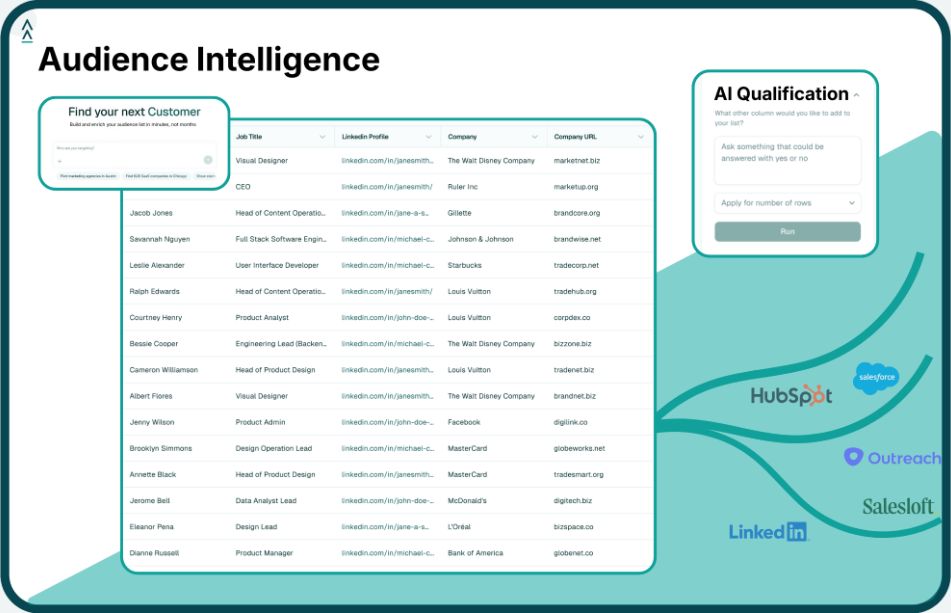
The ranking in this article was built with Landbase. A natural-language search identified venture-backed AI startups serving logistics, freight, and supply chain teams, an enrichment step added founding year and 12-month headcount change, and the results were filtered and sorted into a structured dataset.
Landbase's web and CLI interfaces access the same account, datasets, and saved work.
For more complex requirements, the Advanced Dataset Creator supports filters, calculations, and custom output fields.
Landbase's data infrastructure includes more than 800 million contacts and more than 40 million companies across more than 1,500 fields, with enrichment from more than 20 providers.
An AI logistics workflow could, for example, identify freight and supply chain software companies that raised a Series A or later in the past year, grew headcount by more than 100%, sell to brokers or shippers, and recently hired a head of sales or revenue in North America.
The Landbase CLI setup supports these workflows from a standard terminal and from AI coding environments including Claude Code and Codex.
An AI logistics startup builds products that use AI to perform or support work in freight, trucking, customs, warehousing, distribution, supply chain planning, or procurement. This list excludes general robotics model developers and autonomous vehicle makers, which are covered in a separate mobility ranking.
Lio, the AI procurement company formerly known as askLio, recorded the highest 12-month headcount growth in Landbase data among the companies that met this list's criteria, at more than 380%. Amari AI and Cartage followed, each above 270%.
Freight and supply chain work involves high volumes of phone calls, emails, documents, and exceptions handled by people across many companies. AI agents can take over that coordination work inside existing channels, which avoids the integration costs that logistics executives cite as a main barrier to new software.
Not on its own. Several companies on this list have small teams, so a few hires can produce a large percentage change. Headcount data can also differ from company figures. This list therefore pairs headcount growth with disclosed funding, customer, and operating evidence wherever it is available.
Teams can start with a category definition and then filter by headcount growth, funding stage, recent rounds, target buyer, geography, and hiring activity. Landbase can combine these criteria into reusable datasets and return company and contact information through web and CLI workflows.
Tool and strategies modern teams need to help their companies grow.