.png)
.png)

Daniel Saks
Chief Executive Officer


Autonomous driving capital has returned at scale. Waabi announced in January 2026 that it had secured up to $1 billion in funding for self-driving trucks and robotaxis, and Chinese autonomous delivery company Zelos reported a combined fleet of more than 20,000 vehicles after a February 2026 raise.
The hiring is not limited to self-driving stacks. Dealership AI, auto repair software, ADAS calibration, and autonomous rail are all adding staff, which places mobility alongside the other categories in Landbase's broader list of AI startups adding headcount fastest.
This list ranks AI-native automotive and mobility startups by 12-month headcount growth measured in Landbase data, then verifies each company's funding and operating evidence against public sources.
The starting pool was AI-native companies whose primary product is sold into automotive, transportation, or mobility markets, including autonomous driving, driver assistance, dealerships, and vehicle repair. General-purpose robotics companies and freight brokerages were excluded because they are covered in separate rankings.
Every company on the list had to meet four criteria:
Headcount growth is calculated from professional-profile data and can differ from company-reported figures, particularly for companies with field technicians or contractors. Funding, valuation, and operating figures below come from company announcements and press coverage rather than headcount data. Funding alone does not establish growth, so it is treated as one of several company buying signals.
CEO: Samee Khan
Latest round: Undisclosed round led by Autotech Ventures, August 2025
12-month headcount growth: +205%
Category: AI workforce for car dealerships
Pam provides voice AI agents for automotive dealerships. The agents answer service calls, book appointments, and handle follow-ups that front-desk staff often miss during busy periods.
Pam said its software is used by hundreds of dealerships in 33 U.S. states and three Canadian provinces. The company reported more than $100 million in repair orders powered by its agents and an average of about 35 hours of phone time saved per dealership each month.
Pam announced new funding from Autotech Ventures to hire and extend the product into sales and parts.
Autotech Ventures led the round, with HF0, First Harmonic, Idris Mokhtarzada, and Geneva Pacific participating. The amount was not disclosed.
Dealership service lanes depend on phone volume, and missed calls translate directly into lost repair orders. Pam's growth suggests dealers are willing to hand those conversations to AI agents.
CEO: Brian Hoang
Latest round: $20 million Series A, January 2026
12-month headcount growth: +176%
Category: AI communications for car dealerships
Mia Labs builds an AI agent that answers calls and messages for franchise dealerships and integrates with dealership systems to book sales and service appointments around the clock.
At the time of its Series A, Mia reported more than 130,000 sales and service appointments booked, over $45 million in revenue enabled by those appointments, and more than one million customer conversations. Its footprint reached more than 350 franchise dealerships in 2025.
Built In reported the $20 million Series A and a team of about 50 people.
Permanent Capital Ventures led the Series A, with Norwest, Eniac Ventures, Vine Ventures, Analog Ventures, and Logos Fund participating. Total funding is $29 million.
Mia and Pam both target dealership phone traffic, which makes dealership communications one of the most active AI buying categories in automotive retail.
Leadership: Co-founder Zhou Qing
Latest round: More than $300 million, February 2026
12-month headcount growth: +79%
Category: Autonomous delivery vehicles
Zelos develops Level 4 autonomous delivery vans, which it calls RoboVans, for parcel and logistics operators. The company was founded in 2021 and is headquartered in Singapore.
Zelos merged with Cainiao's autonomous vehicle unit in January 2026, creating a combined fleet of more than 20,000 vehicles in over 300 Chinese cities and more than ten countries. In October 2025, it won a China Post order for 7,000 vehicles.
KrASIA reported that the latest raise valued Zelos above RMB 10 billion, or about $1.4 billion.
Zelos has completed six financing rounds. It raised nearly $300 million across its Series B in 2025, including a final $100 million tranche led by CDH Investments and Blue Lake Capital. Investors in the February 2026 round were not disclosed.
Zelos is one of the clearest examples of driverless vehicles operating at fleet scale on public roads.
CEO: Natália Salcedo
Latest round: $2.9 million extension, June 2026
12-month headcount growth: +65%
Category: AI for auto repair shops
Pitz provides an AI-native operating system for independent auto repair shops in Latin America. Voice-driven software helps mechanics diagnose problems, find compatible parts, and manage the shop, with a parts marketplace and logistics built in.
Pitz reported more than 1,400 registered workshops and a catalogue of more than one million automotive SKUs. The company plans to enter the U.S. market by the end of 2026.
Dealroom reported that the $2.9 million extension brought total funding to $5 million in under a year.
The extension included Alaya, Boost, Cracks, Latitud, The Pitch, and Marathon. It followed a $2.1 million pre-seed round in late 2025 backed by Hustle Fund, 500 Startups, Marathon, and Cracks Fund.
Independent repair shops are fragmented and under-digitized. Pitz combines software and parts supply, so the AI layer can also generate transaction revenue.
CEO: Monik Pamecha
Latest round: $17 million Series A, June 2025
12-month headcount growth: +62%
Category: AI voice agents for car dealerships
Toma builds AI voice agents that schedule service appointments, handle parts orders, answer sales questions, and respond to calls and texts for auto dealerships.
Monik Pamecha and Anthony Krivonos founded Toma in early 2024 and moved into auto retail after dealerships asked for help with phone volume. In early testing, the company found that dealership calls were answered only 45% of the time. Its agents were deployed at more than 100 dealerships by mid-2025.
Toma announced a $17 million Series A to hire sales staff and meet dealer demand.
Andreessen Horowitz led the Series A, with Y Combinator, Holman, and Flex Capital participating.
Toma is the third dealership communications company on this list, alongside Pam and Mia Labs. Investor Holman operates dealerships itself.
CEO: Raquel Urtasun
Latest round: $750 million Series C, January 2026
12-month headcount growth: +57%
Category: Autonomous trucking and robotaxis
Waabi develops the Waabi Driver, an AI-first autonomous driving system trained heavily in simulation. The company started with long-haul trucks and says the same stack will power robotaxis.
Alongside the Series C, Waabi agreed to deploy 25,000 or more robotaxis exclusively on Uber's platform.
BetaKit described the round as the largest-ever Canadian tech fundraise. The valuation was reported at about $3 billion, which the company did not confirm.
Khosla Ventures and G2 Venture Partners co-led the $750 million Series C, with NVentures, Volvo Group Venture Capital, Porsche, and BlackRock participating. Uber committed up to $250 million more tied to milestones. Waabi previously raised a $200 million Series B in 2024.
Waabi is testing whether one autonomy stack can serve both freight and ride-hailing.
CEO: Matt Soule
Latest round: $38 million Series B, April 2025
12-month headcount growth: +55%
Category: Autonomous battery-electric rail
Parallel Systems builds autonomous, battery-electric rail vehicles that carry individual containers. The goal is to make short-haul freight economical on rail rather than trucks.
The Federal Railroad Administration approved a pilot on about 160 miles of Georgia short-line track. Parallel reported more than 300 vehicles on order from railroads.
TechCrunch reported that the company raised its Series B to commercialize autonomous rail in the U.S. and Australia.
Anthos Capital led the $38 million Series B, with Collaborative Fund, Congruent Ventures, and Riot Ventures participating. Total funding is about $100 million.
Parallel applies autonomy to rail, where fixed routes simplify the driving problem but regulatory approval is the main gate.
CEO: Nikhil Naikal
Latest round: $21 million Series B, June 2024
12-month headcount growth: +55%
Category: Automated vehicle repair and ADAS calibration
Kinetic uses robotics, computer vision, and machine learning to diagnose and recalibrate the sensors and software in modern vehicles, including the cameras and radar behind advanced driver assistance systems.
It serves collision shops, dealerships, and insurers through its own service hubs.
At the time of its Series B, Kinetic operated four service hubs in Las Vegas and Southern California and planned to open more. Pilot customers reported shorter repair cycle times.
Kinetic announced the $21 million Series B to expand hubs and hire technical staff.
Menlo Ventures led the round, with Allstate Strategic Ventures and Liberty Mutual Strategic Ventures joining existing investors Lux Capital, Construct Capital, and Haystack Ventures.
As more vehicles ship with ADAS sensors, routine repairs increasingly require calibration. Insurer participation in the round points to claims cost as a driver of demand.
CEO: Yu Qian
Latest round: $100 million Series D, March 2026
12-month headcount growth: +44%
Category: ADAS and autonomous driving software
QCraft develops QPilot, an intelligent driving system for automakers that supports urban navigation features, along with autonomous driving software for delivery vehicles.
QCraft reported that QPilot has been deployed in more than one million vehicles across nearly 30 production models from close to 10 automakers. The company plans robotaxi pilots in 2026.
CnEVPost reported that the $100 million Series D will fund research and hiring as the company shifts toward Level 4 autonomy.
Ningbo Ninghai Xingtaihe Fund was reported as lead, with Wonderland Capital and strategic investors from an automaker and an automotive electronics supplier participating.
QCraft represents the production-ADAS route to autonomy, where software revenue from automakers funds the move to driverless operation.
CEO: Xiaodi Hou
Latest round: $20 million pre-Series A, October 2024
12-month headcount growth: +28%
Category: Autonomous trucking operator
Bot Auto runs autonomous trucks out of Houston. It owns the trucks and the operation and sells freight capacity rather than licensing its technology. CEO Xiaodi Hou co-founded TuSimple.
In May 2026, a Bot Auto truck with no one onboard completed a commercial freight run of about 230 miles from Houston to the Dallas area, booked through Ryan Transportation. Hou said the run cost below $2 per mile.
Bot Auto's $20 million pre-Series A was backed by investors including Brightway Future Capital, Cherubic Ventures, Linear Capital, and M31 Capital.
Bot Auto is testing whether a lean, operator-led model can make driverless trucking profitable on Texas freight lanes.
Several patterns repeat.
First, the fastest hiring is in automotive retail and service, not self-driving. Pam, Mia Labs, and Toma sell AI agents to dealerships, Pitz sells to repair shops, and Kinetic automates ADAS repair. These buyers have immediate budgets, while autonomy developers still depend on regulatory approvals.
Second, autonomy is commercializing in narrow domains first. Zelos runs delivery vans, Parallel Systems runs on rail, and Bot Auto and Waabi focus on highway freight in Texas before broader robotaxi plans.
Third, growth is global. Zelos is based in Singapore with most of its fleet in China, QCraft serves Chinese automakers, Waabi is based in Toronto, and Pitz serves Latin American repair shops.
For GTM teams, these companies combine new capital with rapid hiring in engineering, operations, and field roles. That combination is more useful when paired with hiring, leadership, technology, and data enrichment signals than when funding is viewed on its own. Teams researching adjacent categories can compare this list with Landbase's rankings of physical AI startups scaling fastest and AI logistics startups hiring fastest, and with its earlier list of fast-growing mobility tech companies.
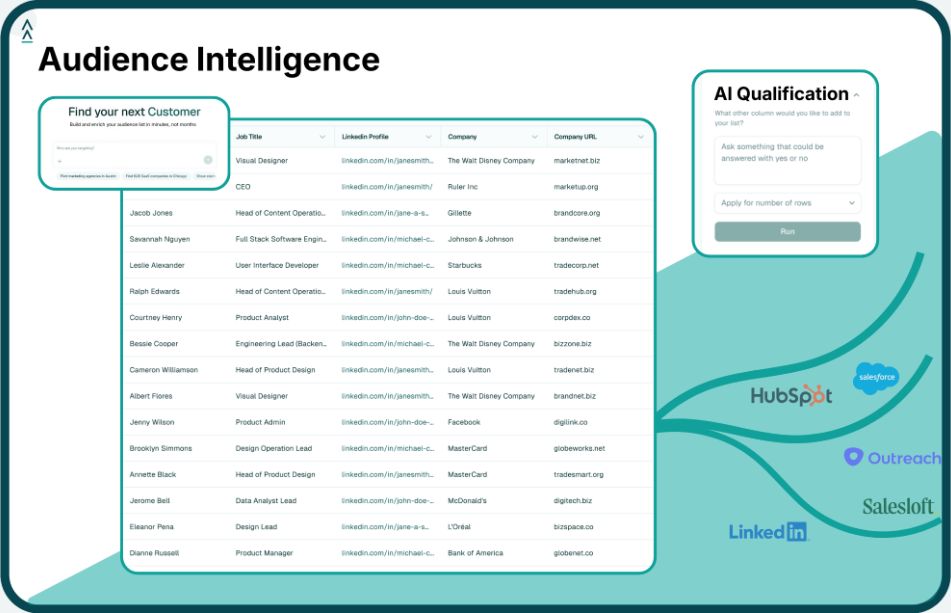
The ranking in this article was built with Landbase. A natural-language search identified AI startups in autonomous driving, automotive, and mobility, an enrichment step added founding year and 12-month headcount change, and the results were filtered and sorted into a structured dataset.
Landbase's web and CLI interfaces access the same account, datasets, and saved work.
For more complex requirements, the Advanced Dataset Creator supports filters, calculations, and custom output fields.
Landbase's data infrastructure includes more than 800 million contacts and more than 40 million companies across more than 1,500 fields, with enrichment from more than 20 providers.
A mobility workflow could, for example, identify automotive AI companies that raised a Series A or later in the past year, grew headcount by more than 50%, sell to dealerships or fleet operators, and recently hired a head of partnerships or OEM sales.
The Landbase CLI setup supports these workflows from a standard terminal and from AI coding environments including Claude Code and Codex.
An AI mobility startup sells AI products or services into automotive, transportation, or mobility markets. The category includes autonomous driving and trucking, driver assistance software, dealership and repair AI, and vehicle repair and calibration services.
Pam recorded the highest 12-month headcount growth in Landbase data among the companies that met this list's criteria, at more than 200%. Mia Labs followed at more than 170%, making dealership AI the fastest-hiring segment on the list.
Dealerships and repair shops can buy software immediately and measure the return in booked appointments and repair orders. Autonomous driving companies face longer validation and regulatory timelines.
Not on its own. Headcount data can differ from company figures, especially for companies with field technicians or operations staff, and fast hiring does not guarantee revenue growth. This list therefore pairs headcount growth with disclosed funding, customer, fleet, and deployment evidence wherever it is available.
Teams can start with a category definition and then filter by headcount growth, funding stage, recent rounds, target buyer, geography, and hiring activity. Landbase can combine these criteria into reusable datasets and return company and contact information through web and CLI workflows.
Tool and strategies modern teams need to help their companies grow.