.png)
.png)

Daniel Saks
Chief Executive Officer


Crunchbase News reported that AI companies raised $211 billion in 2025, roughly half of all global venture funding, while healthcare and biotech ranked second at about $71.7 billion.
This post is part of a series on AI startups adding headcount fastest, and for B2B teams the pairing of large rounds and rapid hiring is one of the clearer recent funding signals in life sciences.
This list ranks AI-native biotech and pharma startups, covering AI drug discovery, protein design, biology foundation models, and lab software, by 12-month headcount growth measured in Landbase data, then verifies each company's funding and operating evidence against public sources.
The starting pool was venture-backed companies whose primary product applies AI to drug discovery, protein design, or life sciences research.
Every company on the list had to meet four criteria:
Headcount growth is calculated from professional-profile data and can differ from company-reported figures, particularly for small teams where a few hires produce large percentage changes. Funding, partnership, and clinical figures below come from company announcements and press coverage rather than headcount data. Funding alone does not establish growth, so it is treated as one of several company buying signals.
CEO: Siddhartha Mukherjee
Latest round: $26 million seed extension, September 2025
12-month headcount growth: +300%
Category: AI-native drug discovery
Manas AI describes itself as an AI-native biopharmaceutical company. It uses what it calls neuro-symbolic AI, which encodes rules of chemistry, physics, and biology, to run programs from target identification toward the clinic across small molecules, antibodies, and siRNA.
The company was co-founded by oncologist and author Siddhartha Mukherjee and LinkedIn co-founder Reid Hoffman, with an initial focus on cancers including breast cancer, prostate cancer, and lymphoma. In 2025 it added a co-founder and CTO alongside a seed extension, and in January 2026 it announced an integration with Schrödinger's discovery platform.
Manas AI raised a $24.6 million seed round in January 2025, led by General Catalyst and Reid Hoffman. A $26 million seed extension followed in September 2025, for total funding of roughly $50.6 million.
Manas AI shows how quickly a well-funded seed-stage drug discovery company can build a team when it pairs AI infrastructure with an internal pipeline.
CEO: Alfredo Andere
Latest round: $28 million Series A, June 2022
12-month headcount growth: +293%
Category: Data and agent infrastructure for biology
LatchBio provides a cloud platform where biologists store, process, and analyze experimental data without managing code or infrastructure. It now positions the product as agent infrastructure for biology, bundled with lab kits and instruments.
LatchBio says it serves more than 300 pharma, biotech, and academic teams. It has also published benchmarks for AI agents analyzing biological data.
When it raised its $28 million Series A, the platform already supported sequencing and AlphaFold workflows.
Coatue and Lux Capital co-led the Series A. It followed a $5 million seed round led by Lux Capital.
LatchBio sells software to the labs that generate biological data, which makes it a picks-and-shovels business inside the AI biotech market rather than a drug developer.
CEO: Micha Breakstone
Latest round: Series A led by Khosla Ventures, May 2025, plus a Novo Nordisk equity investment in May 2026
12-month headcount growth: +129%
Category: Foundation model for cell signaling
Cellular Intelligence, formerly Somite.ai, is building a foundation model of cell signaling intended to predict and control how cells behave. It generates its own high-throughput stem cell data to train the model.
In May 2026, the company acquired global rights to a clinical-stage Parkinson's cell therapy from Novo Nordisk. The program is in a Phase 1/2 trial. Novo Nordisk became an equity investor and remains eligible for milestones and royalties.
The company said it has raised more than $60 million from investors including Khosla Ventures, the Chan Zuckerberg Initiative, SciFi VC, and AMD Ventures. Its Series A, led by Khosla Ventures, was reported at $47 million. The size of Novo Nordisk's stake was not disclosed.
Cellular Intelligence is an example of a model-first company acquiring a clinical asset to prove its platform.
CEO: Dov Gertz
Latest round: $25 million Series A, January 2026
12-month headcount growth: +116%
Category: Generative AI for antibody and protein design
Converge Bio, based in Boston and Tel Aviv, builds AI systems trained on DNA, RNA, and protein sequences and delivers them to biopharma customers. Its products cover antibody design, protein manufacturing yield optimization, and biomarker and target discovery.
Converge reported more than a dozen pharma and biotech customers and said it completed more than 40 programs with partners over the prior year. It also reported protein yield improvements of four to seven times.
Those figures were disclosed alongside its $25 million Series A.
Bessemer Venture Partners led the Series A. It followed a $5.5 million seed round in 2024, for total funding of about $30 million.
Converge sells AI models as a service to drug developers rather than building its own pipeline, a model that produces customer revenue earlier.
CEO: Cony D'Cruz
Latest round: $60 million Series B, September 2026
12-month headcount growth: +114%
Category: AI-driven small molecule discovery for GPCR targets
Superluminal Medicines combines structural biology, generative chemistry, and machine learning to design small molecules against G protein-coupled receptors.
The company's lead program is an oral MC4R agonist for obesity, which has advanced to IND-enabling studies with first-in-human testing planned by the end of 2026. It also signed an Eli Lilly collaboration on cardiometabolic targets.
The company raised a $60 million Series B to move that program into Phase 1.
BVF led the Series B. It followed a $33 million seed round in August 2023 and a $120 million Series A led by RA Capital Management in September 2024, for total funding of about $213 million.
Superluminal applies AI to obesity and metabolic disease, two of the most heavily contested areas in pharma.
CEO: Josh Haimson
Latest round: $25 million Series A, May 2025
12-month headcount growth: +83%
Category: AI for small molecule ADMET prediction
Inductive Bio's Compass platform predicts ADMET properties, including absorption, metabolism, and toxicity, before a molecule is synthesized. Its models draw on a pre-competitive data consortium.
The company reported that medicinal chemists had explored more than one million molecule designs on the platform and that its Beacon-1 models ranked first in the Polaris ADMET benchmark.
Details were included with its Series A announcement.
Obvious Ventures led the $25 million Series A, with a16z Bio + Health and Lux Capital participating.
Inductive Bio targets a specific, costly failure point in drug discovery and sells into existing medicinal chemistry teams.
CEO: Ali Madani
Latest round: $106 million, November 2025
12-month headcount growth: +77%
Category: AI protein design
Profluent develops generative AI models that design proteins, including gene editors and enzymes. Its OpenCRISPR-1 gene editor was released openly in 2024.
Profluent said OpenCRISPR-1 is used by commercial operations, academic researchers, and large pharma companies.
Total funding rose from $44 million in 2024 to $150 million after its $106 million financing.
Altimeter Capital and Bezos Expeditions co-led the round, with Spark Capital, Insight Partners, and Air Street Capital participating.
Profluent is one of the clearest examples of the foundation-model approach being applied to protein engineering.
CEO: Tom Miller
Latest round: More than $100 million, November 2025
12-month headcount growth: +71%
Category: AI-driven clinical-stage drug discovery
Iambic is a clinical-stage company that develops its own medicines with an AI platform. Its models include NeuralPLexer for protein-ligand structure prediction and Enchant for predicting clinical endpoints.
Iambic presented clinical data for its HER2 inhibitor IAM1363 at the ESMO Congress, reporting anti-tumor activity and a favorable safety profile. Jazz Pharmaceuticals later agreed to study IAM1363 with zanidatamab in HER2-positive breast cancer, and Revolution Medicines signed a technology deal to use NeuralPLexer.
Iambic raised more than $100 million in an oversubscribed round.
Participants in the November 2025 round included Abingworth, Sequoia, Regeneron Ventures, and Mubadala. The company did not name a lead investor.
Iambic is one of the few companies on this list with human clinical data.
CEO: Demis Hassabis
Latest round: $2.1 billion Series B, May 2026
12-month headcount growth: +69%
Category: AI drug design engine
Isomorphic Labs, spun out of Alphabet's DeepMind in 2021, builds on the AlphaFold work to develop an AI drug design engine it calls IsoDDE. It runs internal programs and works with strategic partners including Eli Lilly, Novartis, and Johnson & Johnson.
The company said new capital would support hiring across AI, engineering, drug design, and clinical functions at sites in London, Cambridge, Massachusetts, and Lausanne.
Isomorphic announced its $2.1 billion Series B to expand its pipeline toward the clinic. Reuters reported that the company expected its first clinical trials by the end of 2026.
Thrive Capital led the Series B, with Alphabet and GV participating alongside new investors MGX, Temasek, CapitalG, and the UK Sovereign AI Fund. It followed a $600 million first external round, also led by Thrive Capital, in 2025.
Isomorphic's round is among the largest financings in AI drug discovery and sets a capital benchmark for the category.
CEO: Nima Alidoust
Latest round: $30 million, August 2025
12-month headcount growth: +62%
Category: Single-cell data for virtual cell models
Tahoe Therapeutics, formerly Vevo Therapeutics, generates large single-cell datasets that measure how cancer cells respond to drugs, and uses them to train AI models of the cell for drug discovery.
Tahoe open-sourced Tahoe-100M, a dataset of 100 million cellular datapoints covering cancer cell responses to more than 1,000 molecules.
It plans to scale to one billion datapoints, announced with its $30 million raise, at a reported $120 million valuation.
Amplify Partners led the round, with Databricks Ventures and General Catalyst participating. Total funding was reported at $42 million after the raise.
Tahoe treats proprietary biological data as the main asset, reflecting a view that data volume is now the constraint on virtual cell models.
Several patterns repeat.
First, business models are diverging. Manas AI, Superluminal, Iambic, and Isomorphic Labs develop their own drug candidates, while Converge Bio, Inductive Bio, and LatchBio sell models, predictions, or infrastructure to other drug developers. Profluent, Cellular Intelligence, and Tahoe sit between the two, building foundation models and then pursuing partnerships or their own programs.
Second, data generation is becoming a core competency. Tahoe, Cellular Intelligence, and Inductive Bio each built proprietary or pooled datasets because public biological data is not large or consistent enough to train the models they need.
Third, the category is moving into the clinic. Iambic has clinical data, Cellular Intelligence acquired a Phase 1/2 program, and Superluminal and Isomorphic Labs have said they expect human trials by the end of 2026.
For GTM teams, these companies are hiring quickly, signing pharma partnerships, and moving programs toward the clinic. That combination is more useful when paired with hiring, leadership, technology, and data enrichment signals than when funding is viewed on its own. Teams researching the wider category can compare this list with Landbase's earlier ranking of fast-growing biotech companies and its list of fast-growing pharma tech companies, as well as related rankings of healthcare AI startups to watch and AI agtech startups hiring fastest.
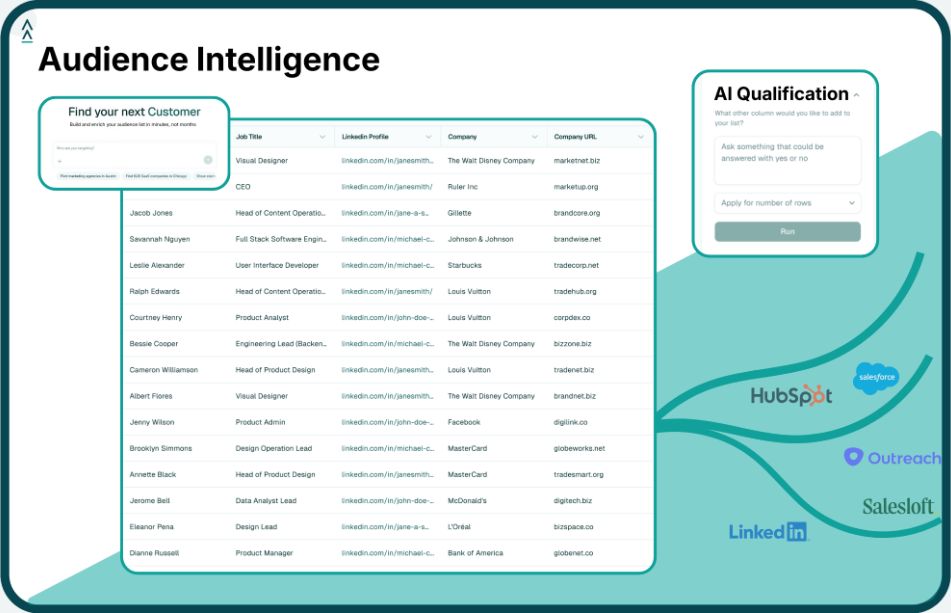
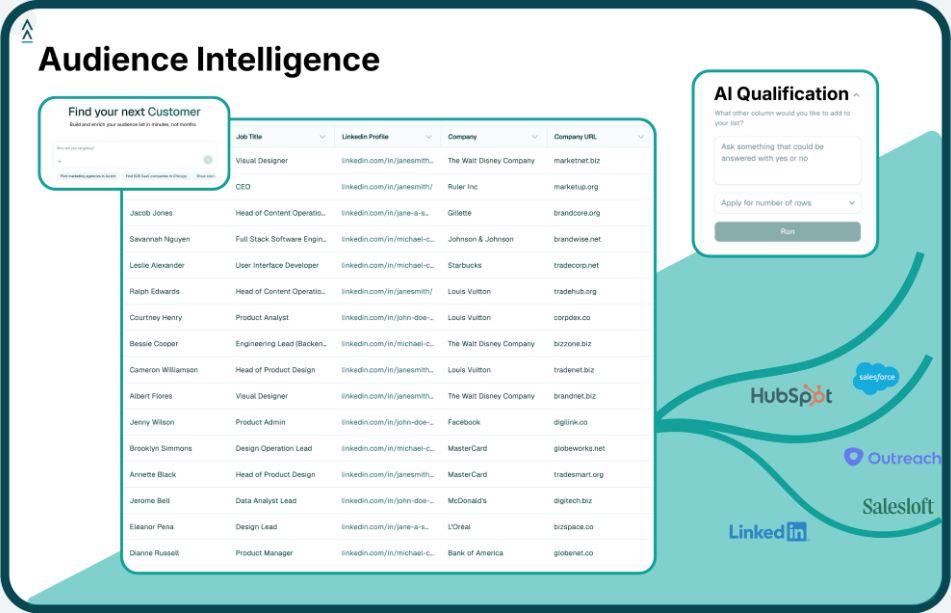
The ranking in this article was built with Landbase. A natural-language search identified venture-backed AI drug discovery and biotech companies, an enrichment step added founding year and 12-month headcount change, and the results were filtered and sorted into a structured dataset.
Landbase's web and CLI interfaces access the same account, datasets, and saved work.
For more complex requirements, the Advanced Dataset Creator supports filters, calculations, and custom output fields.
Landbase's data infrastructure includes more than 800 million contacts and more than 40 million companies across more than 1,500 fields, with enrichment from more than 20 providers.
An AI biotech workflow could, for example, identify AI drug discovery companies that raised a Series A or later in the past year, grew headcount by more than 50%, announced a pharma partnership, and recently hired a head of computational biology or business development.
The Landbase CLI setup supports these workflows from a standard terminal and from AI coding environments including Claude Code and Codex.
An AI biotech startup uses machine learning as a core part of how it discovers, designs, or tests therapies, or sells AI software and data infrastructure to drug developers. The category includes AI drug discovery, protein design, biology foundation models, and lab data platforms.
Manas AI recorded the highest 12-month headcount growth in Landbase data among the companies that met this list's criteria, at 300%. LatchBio followed closely at 293%, and Cellular Intelligence ranked third at 129%.
Large rounds, pharma partnerships, and programs moving toward the clinic all require more people. Foundation model companies also need wet-lab teams to generate training data.
Not on its own. Headcount data can differ from company figures, percentage growth is exaggerated for small teams, and hiring does not guarantee clinical or commercial success. This list therefore pairs headcount growth with disclosed funding, partnership, and clinical evidence wherever it is available.
Teams can start with a category definition and then filter by headcount growth, funding stage, recent rounds, partnerships, geography, and hiring activity. Landbase can combine these criteria into reusable datasets and return company and contact information through web and CLI workflows.
Tool and strategies modern teams need to help their companies grow.