.png)
.png)

Daniel Saks
Chief Executive Officer


Bain & Company has estimated that by 2030, agentic commerce could represent $300 billion to $500 billion in U.S. online retail sales, or roughly 15% to 25% of total e-commerce.
This post is part of Landbase's wider ranking of AI startups adding headcount fastest. For B2B teams, the pairing of new rounds and rapid hiring is one of the clearer recent funding signals in vertical software.
This list ranks AI startups serving retail and e-commerce by 12-month headcount growth measured in Landbase data, then verifies each company's funding and operating evidence against public sources.
The starting pool was AI-native companies whose primary product is sold to retailers, brands, or online merchants, covering AI shopping and search, merchandising, product content, pricing, returns, store operations, and commerce agents. Pure marketing tools and general support agents were excluded.
Every company on the list had to meet four criteria:
Headcount growth is calculated from professional-profile data and can differ from company-reported figures, particularly for small teams, where a few hires produce large percentage changes. Funding, valuation, and revenue figures below come from company announcements and press coverage rather than headcount data. Funding alone does not establish growth, so it is treated as one of several company buying signals.
Leadership: Junwei Huang, co-founder and president
Latest round: $10 million seed, September 2025
12-month headcount growth: +300%
Category: AI-native e-commerce store builder
Genstore is an AI-native e-commerce platform that lets merchants go from a prompt to a live online store. A set of AI agents handles design, product listings and imagery, launch readiness including SEO and compliance, and analytics.
The company targets solo founders and small businesses.
Genstore launched in late August 2025 and reached the top of Product Hunt's daily rankings within two weeks. In February 2026, the company said beta users had processed $2.3 million in gross merchandise value on the platform, alongside the release of its multi-agent system.
Weimob, the Hong Kong-listed commerce software company, led the $10 million seed, with Lighthouse Founders' Fund participating.
Genstore competes with template-based store builders by replacing setup and listing work with agents.
CEO: Gustav Bang
Latest round: $11 million seed, September 2026
12-month headcount growth: +171%
Category: AI product compliance for retailers and brands
Complir provides an AI platform that maps product data against the regulations that apply to each item and generates the documentation needed to bring goods to market.
It also monitors regulatory changes at the SKU level and reassesses products that a new rule may affect.
The Copenhagen company was founded in 2024, and Flying Tiger Copenhagen was named as a customer in coverage of the round. Complir reported that its platform can cut repetitive compliance work by up to 90% and shorten time to market by up to three months.
General Catalyst led the $11 million seed, with angel investors and specialist industry funds participating. It followed a pre-seed round of about $2 million in December 2025, less than a year earlier.
Retailers selling across many markets must track product rules for every SKU they carry. Complir treats compliance as a product-data problem, which places it close to merchandising and catalog teams.
CEO: Camille van Horne
Latest round: $30 million Series A, September 2026
12-month headcount growth: +138%
Category: AI marketplace for surplus inventory
Highstock runs a B2B marketplace for brands' surplus inventory. AI matches available stock with suitable buyers, while the platform manages logistics, compliance, payments, and order paperwork.
Highstock reported more than $1 billion of inventory listed on its platform and more than 100 major brands as of September 2026. About 60% of transaction volume came from brands with more than $500 million in annual revenue. The listed figure does not measure completed sales.
Andreessen Horowitz led the $30 million Series A, with Greylock, Abstract Ventures, and Daybreak participating. It followed a $5.5 million seed led by Greylock in February 2025. The new capital supports expansion from beauty into apparel.
Surplus stock is a margin problem for most brands, and liquidation channels often damage pricing. Highstock applies AI matching to a part of retail that has relied on brokers and spreadsheets.
CEO: Harry Chemko
Latest round: $4.1 million seed, September 2025
12-month headcount growth: +136%
Category: AI competitive intelligence for e-commerce teams
ShopVision provides an AI agent that automates competitive analysis for e-commerce merchants. It tracks competitors' promotional campaigns, analyzes how a merchant's past campaigns performed, and recommends timing for new promotions.
The Vancouver company was founded in 2024 and launched publicly in April 2025. By September 2025, it reported working with several dozen brands and retailers in North America and raised its first institutional round.
Brightspark Ventures led the all-equity seed of about $4.1 million, or $5.6 million Canadian, with BDC Capital, Rhino Ventures, and strategic investors participating.
Chemko previously co-founded Elastic Path, the commerce platform. ShopVision targets merchandising and e-commerce teams that set promotions and pricing, rather than marketing departments.
CEO: Scot Wingo
Latest round: $13.6 million seed, May 2026
12-month headcount growth: +129%
Category: Agentic commerce optimization for product catalogs
ReFiBuy describes itself as an agentic commerce optimization platform for brands and retailers. Its Commerce Intelligence Engine ingests, evaluates, enriches, generates, syncs, and monitors product catalogs at the SKU level so that products can be found and recommended by AI shopping engines such as ChatGPT, Perplexity, and Gemini.
ReFiBuy launched in 2025 and closed its seed round roughly a year later. The company said the round was oversubscribed and that the capital would scale its engine and go-to-market work.
NewRoad Capital Partners led the $13.6 million seed, with new investors Ridge Ventures, Silicon Road Ventures, Incubate Fund, and VELA Partners, and continued support from G20 Ventures, Commerce Ventures, and Knoll Ventures.
Wingo previously founded ChannelAdvisor, which went public in 2013. ReFiBuy applies the same catalog-syndication logic to AI shopping agents, which read product data differently from search engines and marketplaces.
CEO: Ross Finman
Latest round: $21 million, July 2026
12-month headcount growth: +100%
Category: Spatial AI for store operations
Augmodo makes wearable SmartBadges that store workers clip on during normal shifts. The badges build live 3D maps of the store, track shelf inventory, and feed a spatial AI assistant that recommends actions to staff.
Augmodo was founded in 2023 and raised three rounds in about two years. Its pilot customer, Chemist Warehouse, later invested in the company. In 2026, the Seattle company raised $21 million at a $350 million valuation as it extends the product to warehouses and factories.
TQ Ventures, an existing investor, led the 2026 round. TQ Ventures also led the $37.5 million Series A in August 2025, which followed a $5.3 million seed led by Lerer Hippeau in 2024.
Out-of-stocks remain costly in physical retail. Augmodo's wearable model avoids fixed cameras and shelf-scanning robots.
CEO: Cheryl Liu
Latest round: $24 million Series A, January 2025
12-month headcount growth: +88%
Category: Generative AI for fashion product design
Raspberry AI provides a generative AI platform for fashion creatives. Design teams use it to turn sketches into photorealistic product renders and shorten sampling cycles.
At the time of its Series A, Raspberry AI reported 70 customers, including Under Armour, MCM Worldwide, Gruppo Teddy, and Li & Fung.
Andreessen Horowitz led the $24 million Series A, with existing investors Greycroft, Correlation Ventures, and MVP Ventures participating. It followed a $4.5 million seed.
Product development is one of the slowest steps in apparel retail. Raspberry AI sells to the teams that decide what gets made, which places it upstream of e-commerce content tools.
CEO: Sam Atkinson
Latest round: $100 million Series C, January 2026
12-month headcount growth: +82%
Category: Commerce operating system and agentic storefront
Swap offers a commerce operating system that combines shipping, returns, inventory, tax, and customs compliance in one system of record. It automates cross-border duties and adds AI demand planning.
In May 2026, Swap launched an agentic storefront that runs as a separate AI-powered sales channel next to a brand's main site, with SIMKHAI and Retrofête as launch partners.
Swap was founded in London in 2022 and has expanded to the U.S. and Europe, with plans for Canada and Australia. Its Series C came about six months after its Series B, bringing total funding to roughly $149 million.
DST Global and ICONIQ co-led the $100 million Series C. ICONIQ had led the $40 million Series B in 2025.
Swap is building toward a single back-office layer for mid-market brands.
CEO: Zack Peng
Latest round: Series B, 2025 (amount not confirmed in press coverage)
12-month headcount growth: +70%
Category: AI post-purchase protection and returns
Seel's flagship product, Worry-Free Purchase, is an embedded post-purchase protection option offered at checkout. It lets shoppers add return flexibility, including on final-sale items, and covers delivery issues such as missing or stolen packages.
In October 2026, Peng said revenue grew from about $1 million at the end of 2023 and was expected to reach close to $200 million by the end of 2026. He expects Seel to service close to $10 billion in GMV in 2026. Seel reports more than 5,000 merchants.
Company databases list a Series B, with investors including Lightspeed Venture Partners, Foundation Capital, and Afore Capital. Reported totals range from about $24 million to $29 million, and the company has not publicly confirmed the figure.
Seel turns returns and delivery risk into a paid checkout product. Its 2026 agreements with Debenhams Group and Authentic Brands Group extend that model to large retail portfolios.
CEO: Melissa Bridgeford
Latest round: $50 million Series A, disclosed February 2026
12-month headcount growth: +21%
Category: AI shopping agent
Wizard is an AI shopping agent that searches retailer sites, customer reviews, editorial content, and social posts, then returns a short list of recommended products. Shoppers can check out with partner retailers inside the product.
Wizard launched publicly on February 11, 2026, after nearly five years in private beta, and announced Best Buy as its first retail partner for native checkout. It has not disclosed user or transaction figures.
NEA led the $50 million Series A disclosed at launch. Bridgeford co-founded the company with Marc Lore, who previously founded Jet.com and sold it to Walmart.
Wizard is one of the better-funded independent AI shopping agents, and its retailer partnerships test whether agents become a separate sales channel.
Several patterns repeat.
First, product data has become an AI problem. ReFiBuy prepares catalogs for AI shopping engines, Complir maps SKUs to regulations, and Genstore generates listings with agents.
Second, much of the growth sits outside the storefront. Highstock handles surplus inventory, Seel and Swap handle returns and post-purchase operations, and Augmodo works on store shelves. They compete for operations budgets more than marketing budgets.
Third, AI shopping agents are pulling retailers into new channels. Wizard checks out with Best Buy, Swap runs agentic storefronts for fashion brands, and ReFiBuy optimizes for ChatGPT, Perplexity, and Gemini.
For GTM teams, these companies are hiring quickly and adding retail customers. That combination is more useful when paired with hiring, leadership, technology, and data enrichment signals than when funding is viewed on its own. Teams researching the wider category can compare this list with Landbase's earlier rankings of fast-growing retail tech companies and fast-growing e-commerce tech companies, as well as AI logistics startups hiring fastest and top AI sales and GTM startups.
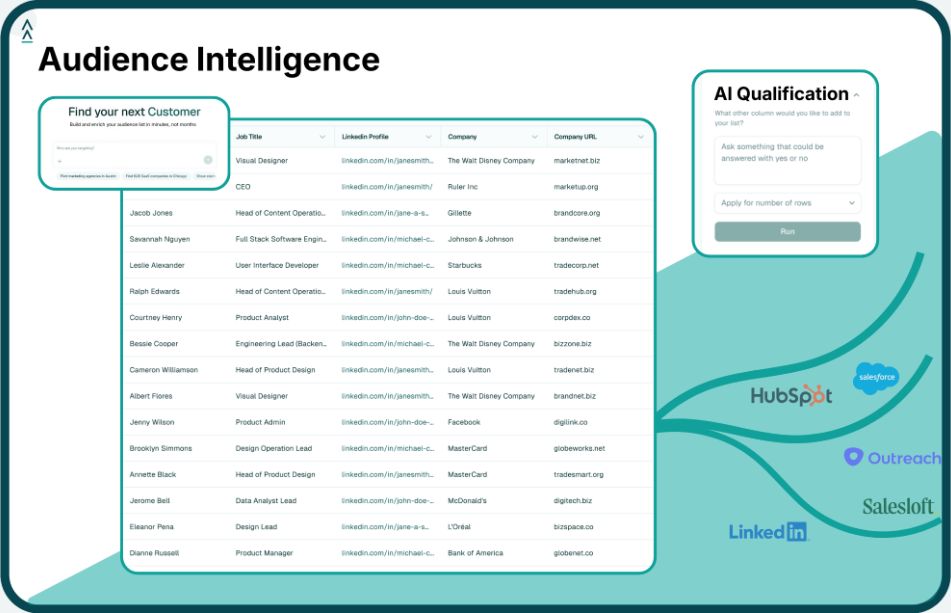
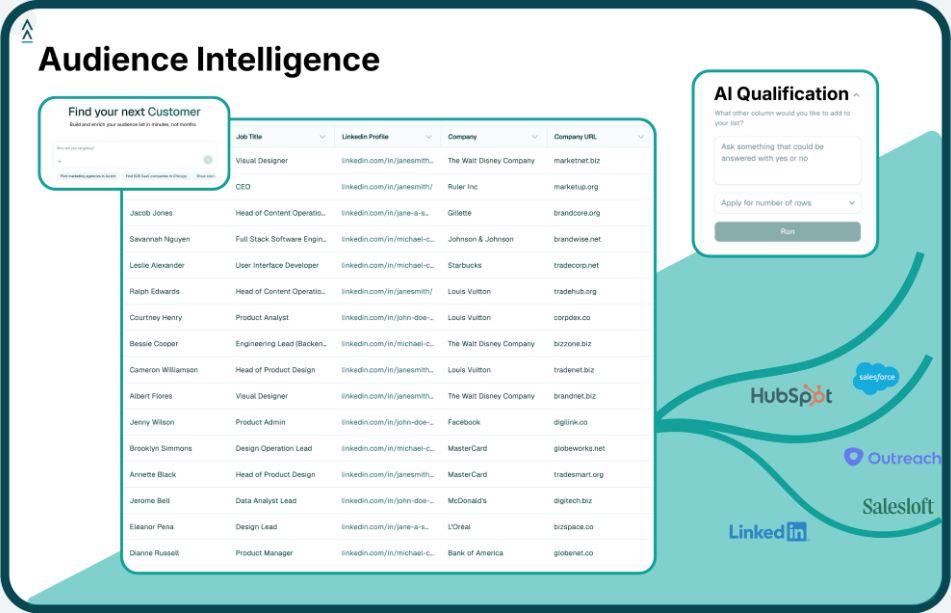
The ranking in this article was built with Landbase. A natural-language search identified venture-backed AI startups selling into retail and e-commerce, an enrichment step added founding year and 12-month headcount change, and the results were filtered and sorted into a structured dataset.
Landbase's web and CLI interfaces access the same account, datasets, and saved work.
For more complex requirements, the Advanced Dataset Creator supports filters, calculations, and custom output fields.
Landbase's data infrastructure includes more than 800 million contacts and more than 40 million companies across more than 1,500 fields, with enrichment from more than 20 providers.
A retail AI workflow could, for example, identify commerce software companies that raised a seed or Series A round in the past year, grew headcount by more than 75%, sell to Shopify or enterprise retail brands, and recently hired a first sales leader in North America or Europe.
The Landbase CLI setup supports these workflows from a standard terminal and from AI coding environments including Claude Code and Codex.
An AI retail or e-commerce startup builds AI products that retailers, brands, or online merchants use to sell goods. The category includes AI shopping agents, product data and catalog tools, merchandising and pricing software, returns and post-purchase platforms, store operations systems, and agentic store builders.
Genstore AI recorded the highest 12-month headcount growth in Landbase data among the companies that met this list's criteria, at 300%. Complir followed at 171%.
Retail runs on large volumes of manually handled product, inventory, and order data. AI shopping agents are also creating new requirements for how products are described and sold, and new product regulations are adding compliance work.
Not on its own. Headcount data can differ from company figures, and percentage growth is volatile for small teams. This list therefore pairs headcount growth with disclosed funding, revenue, customer, and valuation evidence wherever it is available.
Teams can start with a category definition and then filter by headcount growth, funding stage, recent rounds, target buyer, commerce platform, geography, and hiring activity. Landbase can combine these criteria into reusable datasets and return company and contact information through web and CLI workflows.
Tool and strategies modern teams need to help their companies grow.