.png)
.png)

Daniel Saks
Chief Executive Officer


State and local government is one of the largest technology buyers in the United States. Vista Point Advisors' Q2 2025 GovTech report projected that state and local government IT spending would exceed $154 billion in 2025, a 6.4% increase over 2024, with administration and public safety expected to grow fastest.
A new group of AI-native companies is competing for that budget, from permitting and hiring to police records and procurement. For B2B teams, new capital paired with fast hiring is one of the clearer recent funding signals in the public sector. This post is part of a wider series on AI startups adding headcount fastest.
This list ranks AI GovTech startups by 12-month headcount growth measured in Landbase data, then verifies each company's funding and operating evidence against public sources.
The starting pool was venture-backed AI companies that sell to state and local government and the wider public sector, including agency operations, permitting, public safety, procurement, and civic services.
Every company on the list had to meet four criteria:
Headcount growth is calculated from professional-profile data and can differ from company-reported figures, particularly for small teams where a few hires produce large percentage changes. Funding, valuation, and customer figures below come from company announcements and press coverage rather than headcount data. Funding alone does not establish growth, so it is treated as one of several company buying signals.
CEO: Justin Wenig
Latest round: $42 million Series A, October 2025
12-month headcount growth: +312%
Category: Public-sector sales and procurement intelligence
Starbridge is a platform for companies that sell to government and education. It gathers fragmented public data such as bids, board meetings, budgets, contract expirations, and leadership changes, then ranks public-sector accounts by their likelihood to buy new technology.
Launched in 2024, the company raised a $42 million Series A, bringing total funding to $52 million.
Craft Ventures led the Series A, with Owl Ventures, Commonweal Ventures, and Autotech Ventures participating. It followed a $10 million seed round.
Starbridge sits on the vendor side of the government market. Its growth reflects how many software companies now need visibility into long, fragmented procurement cycles.
CEO: Noam Maital
Latest round: $15 million Series A, October 2025
12-month headcount growth: +288%
Category: AI governance and agentic workflows for government agencies
Darwin AI helps government agencies adopt AI while staying compliant with public-records, policy, and data rules. Darwin Govern is a central guardrail layer for AI policy enforcement and records oversight.
Darwin LaunchPad lets agencies design and manage agentic workflows for repetitive processes such as HR, procurement, and permitting.
Darwin AI was founded in 2024 by Noam Maital and CTO Asaf Fadida. By the time of its Series A, the company said it had agency partnerships in Texas, Ohio, California, Illinois, and Washington. It announced its $15 million Series A roughly a year after founding.
Insight Partners led the Series A, with existing investors UpWest and Resolute Ventures participating.
Darwin AI addresses a specific barrier to AI adoption in government: agencies must show that AI use complies with records and transparency laws before scaling it.
CEO: Led by co-founders Brendan Hellweg and Cherie Chung
Latest round: $2.2 million pre-seed, January 2025
12-month headcount growth: +288%
Category: AI for government hiring and classification
Holly is an AI platform for public-sector classification and compensation work. It matches job classifications by actual duties, drafts and refines job specifications using language from peer jurisdictions, scores specs for clarity and equity.
Holly launched with a pilot at the City of Long Beach, California, and now lists San Bernardino County among its case studies. The company raised an oversubscribed $2.2 million pre-seed round to expand nationally.
J2 Ventures led the pre-seed, with participation from Roble Ventures, Gaingels, and angel investors.
Holly targets public-sector hiring, which the company says takes 135 days on average.
CEO: Ali Rehan
Latest round: $22 million Series A, June 2025
12-month headcount growth: +255%
Category: AI traffic safety cameras for cities and counties
Obvio builds solar-powered camera pylons that use AI to detect traffic violations such as speeding, stop-sign running, crosswalk infractions, illegal turns, and distracted driving. It installs hardware at no upfront cost and shares citation revenue under state rules.
In Prince George's County, Maryland, Obvio reported that a stop-sign camera program cut stop-sign running by 50% within eight weeks.
Bain Capital Ventures led the $22 million Series A, with Khosla Ventures and Pathlight Ventures participating.
Obvio links public safety to a revenue-sharing model, which removes the capital-budget barrier that often slows hardware purchases by local governments.
CEO: Kimia Hamidi
Latest round: $18 million Series A, February 2026
12-month headcount growth: +128%
Category: Public-sector sales intelligence
NationGraph is an AI-native intelligence platform for businesses that sell to government. It indexes data from roughly 110,000 government entities to show sales teams past purchases, vendors, prices, and recently approved budget items.
NationGraph was founded in 2024 by Kimia Hamidi and CTO Eden Ding and launched its product in June 2025. Less than a year later, it announced an $18 million Series A, which closed in the fourth quarter of 2025.
Menlo Ventures led the round, with Perplexity's fund, XYZ Venture Capital, Reach Capital, and angel investors participating. Total funding is $22.5 million.
NationGraph and Starbridge both show investor interest in solving the data problem for public-sector sellers, where buying signals are spread across thousands of agency websites and meeting records.
CEO: David Lawrence
Latest round: $6 million seed, August 2026
12-month headcount growth: +109%
Category: AI assistant for law enforcement
Blue Voice is a CJIS-compliant AI platform for police officers. It answers questions using only a department's own materials, including policies, local ordinances, state laws, and internal instructions, and returns the exact quote and source for each answer.
Blue Voice was founded by David Lawrence, who left Harvard Law School to start the company. When it announced its $6 million seed round, the company reported working with 225 law enforcement agencies across 25 states.
SignalFire and Las Olas VC were reported as co-leads. The company's own site describes the $6 million as raised over three years from SignalFire, Las Olas Venture Capital, Govtech Ventures, and Par Capital.
Blue Voice applies the source-grounded assistant model used in legal AI to policing, where answers must be traceable to specific policies and laws.
CEO: Al Hleileh
Latest round: $3.2 million seed, December 2024
12-month headcount growth: +108%
Category: AI procurement platform for local government
Civic Marketplace is a Texas-based procurement marketplace for state, local, and education entities. It helps agencies find and buy through cooperative contracts and is adding AI to its procurement search features.
Civic Marketplace first partnered with the North Central Texas Council of Governments to offer a procurement platform for its members. In June 2026, NCTCOG and the Alliance for Innovation signed a cooperative purchasing agreement unlocking 500 contracts for local governments nationwide, with Civic Marketplace as the platform.
Kindred Capital led the seed round, with angel investors including Andy Phillipps, former CEO of Priceline International.
Cooperative purchasing lets agencies skip separate solicitations. Civic Marketplace is building on that channel to shorten local government buying cycles.
CEO: Troy LeCaire
Latest round: $25 million Series A, May 2026
12-month headcount growth: +97%
Category: AI permitting, licensing, and code enforcement
GovWell positions itself as an operating system for local government. Its modules cover permitting, licensing, planning and zoning, and code enforcement.
AI features include AutoCheck, which reviews applications against local codes, built-in plan review, and a multilingual community assistant that answers resident questions.
GovWell reported more than 150 agencies in more than 35 states at the time of its Series A. Coverage of the round said about 80% of sales were direct replacements of legacy vendors, with a median sales cycle of three months.
Insight Partners led the $25 million Series A, with existing investors Work-Bench and Bienville Capital participating. Total funding is about $35 million.
A three-month median sales cycle is short for local government software. GovWell's legacy-replacement rate suggests permitting is becoming an active replacement market.
CEO: Nick Noone
Latest round: $250 million Series D, June 2026
12-month headcount growth: +86%
Category: AI data platform for public safety and government
Peregrine is an AI platform that integrates data from disconnected agency systems into a single, permission-aware operational view. It is used mainly by police departments and other public-safety and government agencies, with role-based access and auditability built in.
In its Series D announcement, Peregrine said it had doubled its customer base in the past year and served more than 400 agencies and organizations covering more than 125 million people in North America. Eight of the eleven U.S. 2026 World Cup host cities reportedly used the platform.
The $250 million round valued Peregrine at $6.8 billion, roughly tripling its reported $2.5 billion valuation from about 15 months earlier. Existing investors including Fifth Down Capital, Sequoia Capital, OG Venture Partners, Goldcrest Capital, XYZ Ventures, and Godfrey Capital led the round.
Peregrine is the largest company on this list and shows how far a public-safety data platform can scale. Fortune has also reported community opposition to some of its contracts on civil-liberties grounds.
CEO: Saf Rabah
Latest round: $3.6 million seed, December 2025
12-month headcount growth: +80%
Category: AI permitting for cities and counties
Govstream.ai builds a conversational AI layer that sits on top of the permitting systems cities already use. Trained on local development codes, GIS data, and zoning rules, it helps permit technicians, planners, and reviewers answer questions, check document completeness, compare plan sets, and draft code-citing emails.
The Seattle-area company launched in 2024. It is live with the City of Bellevue, Washington, and said it was deploying with additional U.S. municipalities when it raised a $3.6 million seed round.
47th Street Partners led the seed, with Nellore Capital, Ascend, and angels including Socrata founder Kevin Merritt and First Due CEO Andreas Huber participating.
Govstream.ai is an overlay rather than a system replacement. That lets cities add AI to permitting without a full software migration.
Several patterns stand out.
First, the market is splitting between products for agencies and products for vendors. Darwin AI, Holly, Obvio, Blue Voice, GovWell, Peregrine, and Govstream.ai sell directly to government. Starbridge and NationGraph sell to companies trying to win government contracts, and Civic Marketplace serves both sides of local procurement.
Second, permitting has become one of the most contested categories. GovWell is replacing legacy permitting systems outright, while Govstream.ai adds an AI layer to existing ones. On the builder side of the same process, Landbase's ranking of AI construction startups hiring fastest covers companies that help contractors prepare and file permits.
Third, public-safety AI is drawing the largest checks. Peregrine's $6.8 billion valuation is far above any other company on the list, and Obvio and Blue Voice are both expanding agency deployments.
For GTM teams, these companies are hiring quickly and adding agency customers. That combination is more useful when paired with hiring, leadership, technology, and data enrichment signals than when funding is viewed on its own. Teams researching the wider category can compare this list with Landbase's earlier ranking of fast-growing GovTech companies and its list of legal AI companies hiring fastest.
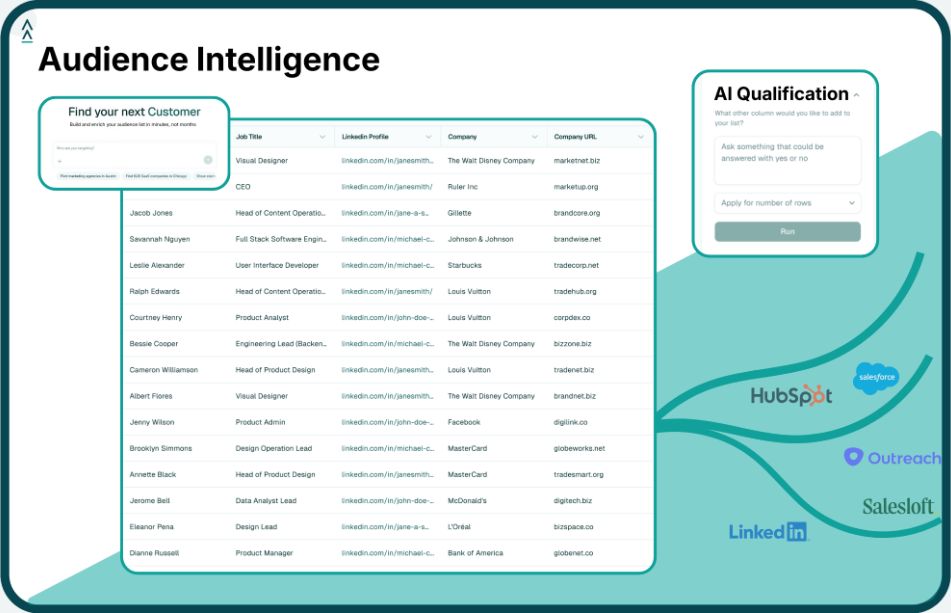
The ranking in this article was built with Landbase. A natural-language search identified venture-backed AI companies selling to state and local government and the public sector, an enrichment step added founding year and 12-month headcount change, and the results were filtered and sorted into a structured dataset. Landbase's web and CLI interfaces access the same account, datasets, and saved work.
For more complex requirements, the Advanced Dataset Creator supports filters, calculations, and custom output fields.
Landbase's data infrastructure includes more than 800 million contacts and more than 40 million companies across more than 1,500 fields, with enrichment from more than 20 providers.
An AI GovTech workflow could, for example, identify public-sector software companies that raised a seed or Series A in the past year, grew headcount by more than 75%, sell permitting or public-safety products to cities and counties, and recently hired a head of government sales or partnerships.
The Landbase CLI setup supports these workflows from a standard terminal and from AI coding environments including Claude Code and Codex.
An AI GovTech startup is a young, venture-backed company whose main product uses AI to serve government. That includes tools sold directly to agencies for permitting, hiring, public safety, and resident services, as well as tools that help companies find and win public-sector contracts. This list excludes defense primes, military autonomy companies, and general cybersecurity vendors.
Starbridge recorded the highest 12-month headcount growth in Landbase data among the companies that met this list's criteria, at more than 300%. Darwin AI and Holly followed, each at nearly 290%.
State and local governments face staffing shortages, permitting backlogs, and aging software, while IT budgets are still rising. AI products that cut processing times or replace legacy systems with short sales cycles, as GovWell reports, are finding buyers.
Not on its own. Several companies on this list are small, so a handful of hires produces a large percentage change, and headcount data can differ from company figures. This list therefore pairs headcount growth with disclosed funding, customer, and valuation evidence wherever it is available.
Teams can start with a category definition and then filter by headcount growth, funding stage, recent rounds, target buyer, geography, and hiring activity. Landbase can combine these criteria into reusable datasets and return company and contact information through web and CLI workflows.
Tool and strategies modern teams need to help their companies grow.