.png)
.png)

Daniel Saks
Chief Executive Officer


The 8am 2026 Legal Industry Report found that 69% of legal professionals use general-purpose generative AI for work, up from 31% a year earlier, and 42% use legal-specific AI tools. Crunchbase News reported that legal tech startups raised $4.08 billion in 2025, up 77% from 2024.
Much of that capital went to AI-native legal companies, and for B2B teams the pairing of large rounds and rapid hiring is one of the clearer recent funding signals in vertical SaaS.
This list ranks AI-native legal tech companies by 12-month headcount growth measured in Landbase data, then verifies each company's funding and operating evidence against public sources.
The starting pool was AI-native companies whose primary product performs or supports legal work.
Every company on the list had to meet four criteria:
Headcount growth is calculated from professional-profile data and can differ from company-reported figures, particularly for companies with contractors or distributed teams. Funding, valuation, and revenue figures below come from company announcements and press coverage rather than headcount data. Funding alone does not establish growth, so it is treated as one of several company buying signals.
CEO: Ryan Daniels
Latest round: $60 million Series B, March 2026
12-month headcount growth: +435%
Category: AI law firm
Crosby is a registered law firm that pairs licensed attorneys with its own AI system to review and negotiate commercial contracts such as MSAs, DPAs, and NDAs.
Instead of billing by the hour, Crosby charges a fixed fee per contract.
Crosby came out of stealth in June 2025 with about 19 staff. By March 2026, it had reportedly worked with about 100 client companies, including Cursor, Clay, and Ramp, and processed roughly 13,000 contracts.
The company raised a $60 million Series B less than a year after its seed round, at a reported valuation of about $400 million.
Lux Capital and Index Ventures were reported as leads on the Series B. It followed a $5.8 million seed led by Sequoia in June 2025 and a $20 million Series A led by Index Ventures in October 2025, for total funding of roughly $86 million.
Crosby represents the AI law firm model, which sells finished legal work rather than software.
CEO: Max Junestrand
Latest round: $550 million Series D, March 2026, later extended to $600 million
12-month headcount growth: +429%
Category: Collaborative legal AI workspace
Legora provides a collaborative AI workspace for law firms and in-house teams covering research, document review, and drafting.
Legora reported more than $100 million in annual recurring revenue and more than 1,000 customers across 50-plus markets in April 2026. The company said headcount had grown from 40 to roughly 400 people.
Its valuation moved from $675 million in May 2025 to $1.8 billion in October 2025 and then to $5.6 billion after its Series D extension.
Accel led the $550 million Series D. An April extension added $50 million from investors including Atlassian and NVIDIA's NVentures. City AM, citing the Financial Times, reported in August 2026 that Legora was in talks to raise at a higher valuation. The company has not confirmed a new round.
Legora is the main European challenger in the legal AI platform category. The Series D is aimed at U.S. expansion.
CEO: Paolo Fois
Latest round: $50 million Series B, May 2026
12-month headcount growth: +418%
Category: Legal AI assistant for civil-law markets
Lexroom provides an AI assistant for legal research and drafting built for civil-law jurisdictions, starting with Italy.
Its answers draw on a proprietary database of more than six million verified legal references.
Lexroom reported more than 8,000 law firms and in-house teams as customers in May 2026, with 65% of users active daily and 94% weekly. The company has expanded into Spain and Germany.
The company raised a $50 million Series B eight months after its Series A.
Left Lane Capital led the Series B, with Base10 Partners and Eurazeo participating. It followed a €16 million Series A led by Base10 Partners in September 2025. Total funding exceeds $73 million.
Lexroom shows that local legal databases and civil-law reasoning can support a fast-growing business in Europe's largest non-English legal markets.
CEO: Cecilia Ziniti
Latest round: $60 million Series B, November 2025
12-month headcount growth: +367%
Category: AI for in-house legal teams
GC AI provides an AI legal assistant built for in-house counsel rather than law firms, covering contract review, drafting, and legal questions from the business.
CEO Cecilia Ziniti is a former general counsel.
GC AI reported annual recurring revenue of $650,000 in October 2024 and more than $10 million by November 2025, with average month-over-month growth of 23% during 2025. It has reported more than 1,800 customers in 53 countries.
The Series B valued GC AI at $555 million.
Scale Venture Partners and Northzone led the $60 million Series B, with Sound Ventures and News Corp participating. GC AI has raised $73 million in total.
In-house legal teams are often small relative to the businesses they support. GC AI's growth suggests that legal departments are buying their own AI tools rather than relying on outside counsel to adopt them first.
CEO: Mateus Costa-Ribeiro
Latest round: More than $100 million Series B, May 2026
12-month headcount growth: +277%
Category: AI litigation for enterprises
Enter builds AI agents, delivered through its EnterOS platform, that manage high-volume litigation for large companies in Brazil.
The system handles intake, fraud detection, settlement recommendations, and defense drafting, with lawyers reviewing the output.
Enter said in May 2026 that revenue had grown more than tenfold since its Series A, that its client base had tripled, and that more than 300,000 lawsuits per year run through the platform. Customers include Nubank and Airbnb.
Its valuation rose from $350 million in September 2025 to $1.2 billion with the Series B.
Founders Fund led the Series B, with Sequoia, Ribbit Capital, and Kaszek participating. It followed a $5.5 million seed led by Sequoia and a $35 million Series A co-led by Founders Fund and Sequoia.
Brazil has one of the world's highest volumes of litigation, much of it consumer claims against large companies. Enter applies AI to the volume end of legal work rather than to bespoke advice.
CEO: Ross McNairn
Latest round: $70 million Series B, June 2026, with a $14 million extension in August 2026
12-month headcount growth: +277%
Category: AI for in-house legal teams
Wordsmith AI provides an AI legal platform for corporate legal teams that lets employees get legal answers and self-serve routine requests, keeping more work away from outside firms.
Wordsmith reported more than 500 enterprise customers, including BT, Canva, and Sage, and 14-times year-over-year revenue growth in August 2026. It plans to reach 300 employees by the end of 2026.
Intact Private Capital led a $14 million Series B extension two months after the main round.
Highland Europe and Index Ventures backed the $70 million Series B in June 2026. Wordsmith previously raised a $25 million Series A led by Index Ventures in 2025. Total funding is above $100 million.
Wordsmith and GC AI both target the general counsel's budget. The new capital is aimed at North America and financial services.
CEO: Jay Madheswaran
Latest round: $103 million Series B, September 2025
12-month headcount growth: +219%
Category: AI for plaintiff law firms
Eve provides an AI platform for plaintiff law firms covering case intake, medical record review, demand letters, and discovery.
In June 2026, the company launched EveOS, an operating platform for plaintiff firms.
Eve served more than 450 firms in 2025. By June 2026, it reported more than 1,400 plaintiff firms and over 200,000 active matters on the platform.
Spark Capital led the $103 million Series B, with Andreessen Horowitz, Lightspeed, and Menlo Ventures participating. Bloomberg reported a $1 billion valuation. It followed a $47 million Series A led by Andreessen Horowitz, for total funding of about $164 million.
Plaintiff firms work on contingency, so time saved converts into margin. Eve shows that legal AI demand extends well beyond large corporate law firms.
CEO: Jeffrey Chivers
Latest round: $30 million, October 2025
12-month headcount growth: +167%
Category: Litigation AI
Syllo provides an AI litigation workspace for document review, case analysis, and other work across the litigation lifecycle.
It was founded in 2019 by two former federal court clerks and spent several years building before scaling commercially.
Customers include Am Law 100 firms such as Quinn Emanuel, Pillsbury, and Ballard Spahr. LawNext reported in March 2026 that Syllo had roughly doubled headcount in four months.
Syllo raised $30 million in October 2025 to expand product development and meet demand.
Venrock and Two Seas Capital invested in the $30 million round, alongside strategic individual investors. Total disclosed funding is about $39 million.
Syllo's Am Law 100 adoption shows that large firms are buying specialist tools alongside general legal AI platforms.
CEO: Winston Weinberg
Latest round: $550 million, September 2026
12-month headcount growth: +161%
Category: Legal AI platform
Harvey provides a generative AI platform for law firms and in-house legal teams covering research, drafting, review, and custom agents.
Harvey reported more than 3,000 customer organizations in September 2026, up from about 1,300 in March. The Financial Times reported annual recurring revenue above $400 million.
Its valuation rose from $3 billion in February 2025 to $5 billion, $8 billion, and $11 billion, then to $15.5 billion with its September 2026 round.
Lightspeed Venture Partners and Diffusion co-led the $550 million round, with Sapphire Ventures and Whale Rock Capital participating. Total funding exceeds $1.5 billion.
Harvey is the category's reference point for scale. Its percentage growth is lower than smaller companies' because it started from a much larger base.
CEO: Min-Kyu Jung
Latest round: $55 million Series B, January 2026
12-month headcount growth: +158%
Category: Contract AI
Ivo provides contract intelligence for enterprise legal teams. Its review product redlines agreements in Microsoft Word against a company's negotiation playbook,, and a second product indexes the full contract library.
At the time of its Series B, Ivo said that its customer count had more than doubled and that annual recurring revenue had grown several times over the prior year. Named customers include Uber, Shopify, and Canva.
The company announced its $55 million Series B less than a year after a $16 million round.
Existing investor Blackbird led the Series B, with Costanoa Ventures and Uncork Capital participating. Total funding is approximately $81 million.
Ivo's playbook-driven redlining reflects demand for AI that applies a company's own standards.
Several patterns repeat.
First, legal AI is splitting by buyer. Legora and Harvey sell primarily to large law firms, GC AI, Wordsmith, and Ivo sell to in-house legal departments, and Eve sells to plaintiff firms.
Second, some companies are selling legal outcomes rather than software. Crosby operates as a law firm with fixed-fee pricing, and Enter manages litigation volumes end to end for large enterprises. Both models compete with legal service budgets, not only legal technology budgets.
Third, growth is no longer concentrated in the United States. Legora is based in Stockholm, Lexroom in Milan, and Enter in São Paulo, each serving its own legal system and language.
For GTM teams, these companies are hiring quickly, adding enterprise customers. That combination is more useful when paired with hiring, leadership, technology, and data enrichment signals than when funding is viewed on its own. Teams researching the wider category can compare this list with Landbase's earlier ranking of fast-growing legal tech companies and its list of top AI coding and developer tools startups.
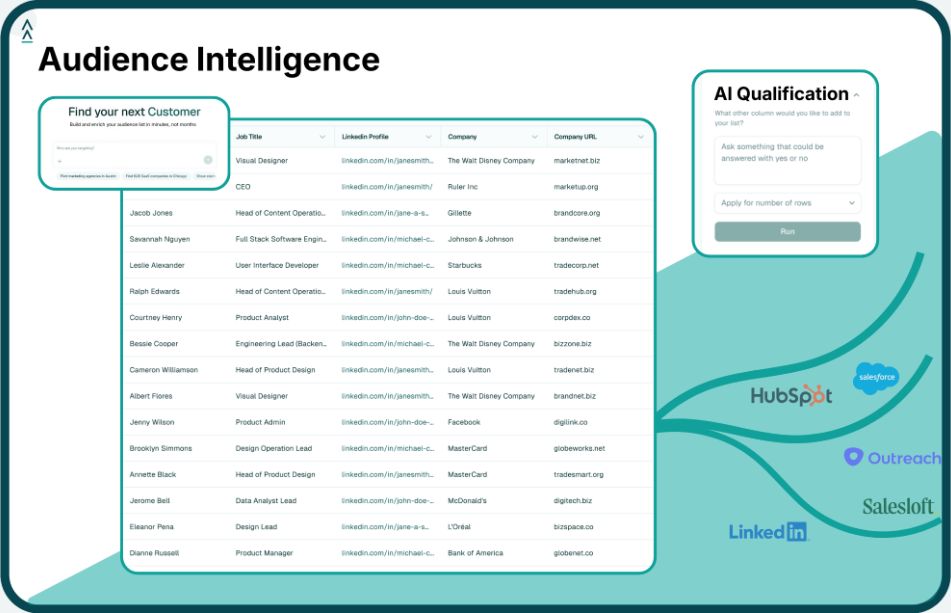
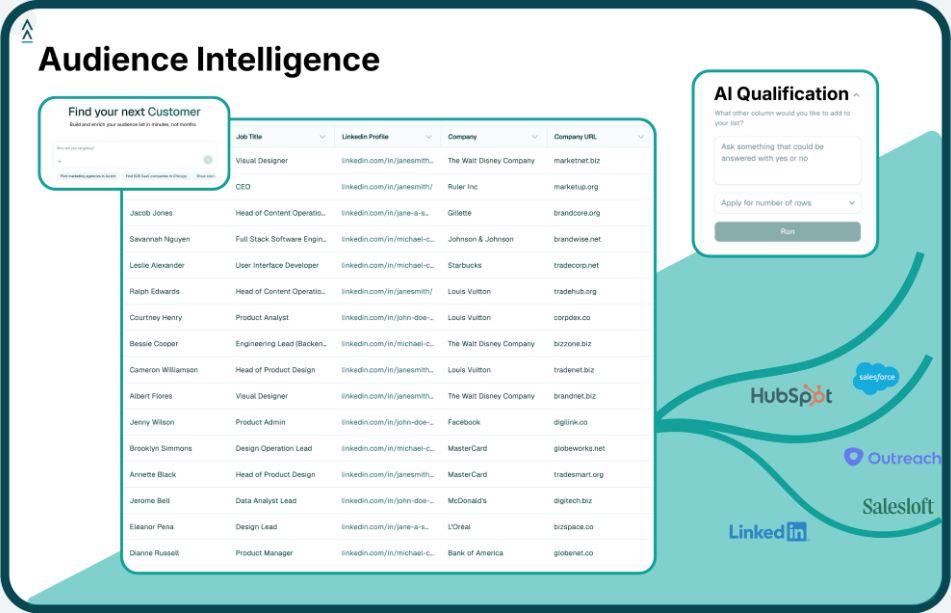
The ranking in this article was built with Landbase. A natural-language search identified AI-native legal tech companies, an enrichment step added founding year and 12-month headcount change, and the results were filtered and sorted into a structured dataset.
Landbase's web and CLI interfaces access the same account, datasets, and saved work.
For more complex requirements, the Advanced Dataset Creator supports filters, calculations, and custom output fields.
Landbase's data infrastructure includes more than 800 million contacts and more than 40 million companies across more than 1,500 fields, with enrichment from more than 20 providers.
A legal AI workflow could, for example, identify legal tech companies that raised a Series A or later in the past year, grew headcount by more than 100%, sell to in-house legal teams, and recently hired a head of sales or revenue in North America.
The Landbase CLI setup supports these workflows from a standard terminal and from AI coding environments including Claude Code and Codex.
A legal AI company builds products or services that use AI to perform or support legal work. The category includes legal assistants, in-house legal tools, contract AI, litigation AI, and AI-enabled law firms.
Crosby recorded the highest 12-month headcount growth in Landbase data among the companies that met this list's criteria, at more than 400%. Legora and Lexroom followed closely, each also above 400%.
Legal work is text-based, repetitive at volume, and expensive when billed hourly. In-house teams are using AI to handle more requests without adding outside counsel spend, and AI law firms such as Crosby use fixed pricing to compete with hourly billing.
Not on its own. Headcount data can differ from company figures, and fast hiring does not guarantee revenue growth. This list therefore pairs headcount growth with disclosed funding, revenue, customer, and valuation evidence wherever it is available.
Teams can start with a category definition and then filter by headcount growth, funding stage, recent rounds, target buyer, geography, and hiring activity. Landbase can combine these criteria into reusable datasets and return company and contact information through web and CLI workflows.
Tool and strategies modern teams need to help their companies grow.