.png)
.png)

Daniel Saks
Chief Executive Officer


AgFunder's 2026 Global AgriFoodTech Investment Report found that agrifoodtech venture funding was roughly flat at $16.2 billion in 2025, but upstream startups working on farms, food production, and biological systems raised $9 billion, up 7% from the prior year.
Inside that upstream segment, a group of AI-native agriculture and food companies is hiring quickly while raising new rounds. The pattern mirrors the broader set of AI startups adding headcount fastest, and for B2B teams it is one of the clearer recent funding signals in a sector that has traditionally adopted software slowly.
This list ranks venture-backed AI agtech and food technology startups by 12-month headcount growth measured in Landbase data, then verifies each company's funding and operating evidence against public sources.
The starting pool was venture-backed companies whose primary product applies AI, computer vision, or autonomy to farming, livestock, food production, or the fresh food supply chain.
Every company on the list had to meet four criteria:
Headcount growth is calculated from professional-profile data and can differ from company-reported figures. Funding, valuation, and customer figures below come from company announcements and press coverage rather than headcount data. Funding alone does not establish growth, so it is treated as one of several company buying signals.
Co-founders: Sam Dugan and Jana Tian
Latest round: $7.5 million seed, February 2026
12-month headcount growth: +118%
Category: Autonomous field robots for crop nutrition
Upside Robotics, based in Waterloo, Ontario, builds solar-powered autonomous robots that drive between corn rows and apply nitrogen fertilizer in small, targeted doses during the growing season.
The company reported more than 10,000 autonomous kilometers driven, more than 100,000 liters of fertilizer applied, and coverage of more than 1,300 acres.
According to the University of Waterloo's coverage of its $7.5 million seed round, the funding is intended to scale the business from about 1,200 acres in 2025 to more than 3,000 acres in 2026 and expand into the U.S. Corn Belt.
Plural led the seed round, with participation from Garage Capital, Entrepreneurs First, and the founders of Clearpath Robotics. Total funding is reported at more than $11 million, including an earlier pre-seed round.
Upside represents a shift from large, expensive machines toward small autonomous robots that work continuously in the field. Nitrogen is one of the largest input costs in corn, so measurable savings are easy for growers to evaluate.
CEO: Craig Piggott
Latest round: $220 million Series E, March 2026
12-month headcount growth: +114%
Category: AI livestock management and virtual fencing
Halter makes solar-powered, GPS-enabled smart collars for cattle. Farmers use an app to set virtual fences, move herds between paddocks, and monitor animal health and behavior without physical fencing or manual mustering.
Halter reported more than 2,000 farmer customers across New Zealand, Australia, and the United States and one million collars sold.
Its Series E valued the company at $2 billion, double its valuation from nine months earlier, and the company said it plans to recruit more than 220 new staff.
Founders Fund led the Series E, with participation reported from existing investors including Blackbird, DCVC, Bond, and Bessemer. The round followed a $100 million raise in June 2025 at a $1 billion valuation.
Halter is the most heavily funded company on this list and one of the few agtech startups with a subscription model at scale.
CEO: Saif Khawaja
Latest round: $22 million Series A, June 2025
12-month headcount growth: +107%
Category: Seafood processing robotics
Shinkei Systems builds Poseidon, an on-boat robotic system that uses machine vision to automate ikejime, a Japanese method of humanely slaughtering fish that preserves freshness and quality.
The company also sells fish processed by its machines under its own brand, Seremoni, to restaurants and retailers.
Shinkei said it processes several thousand pounds of fish a week and produces new robots every two weeks.
The company raised a $22 million Series A to expand production, add species, and build distribution.
Founders Fund and Interlagos co-led the Series A, with new investors including Yamato Holdings. It followed a $6 million seed round in April 2024 led by Cantos, bringing total funding to roughly $28 million.
Shinkei applies robotics to a part of the food supply chain that is still almost entirely manual. It installs Poseidon on vessels at no charge and earns revenue from the processed fish.
Founder: Avik Mukhija
Latest round: $10 million Series A, June 2026
12-month headcount growth: +64%
Category: AI forecasting for fresh food retail
Freshflow, based in Berlin, provides AI ordering and replenishment software for the fresh departments of grocery retailers.
Freshflow reported nine grocery retail customers in Germany and France, including independent merchants within groups such as EDEKA, Carrefour, and Intermarché.
The company said its customers recorded up to 30% lower spoilage per store and 2% to 4% higher revenue,. It raised a $10 million Series A to extend the product into meat, bakery, and in-store production.
Reimann Investors led the Series A, with existing investors including Capnamic, Caesar Ventures, and World Fund participating.
Freshflow targets food waste at the store level, where margins are thin and losses are measurable.
CEO: Vishnu Jayaprakash
Latest round: $10 million Series B, March 2026
12-month headcount growth: +58%
Category: AI spray optimization
AgZen, an MIT spinout, makes RealCoverage, a camera-based system that mounts on existing sprayers and measures spray droplets in real time. The system adjusts application to improve coverage while reducing the volume of chemicals applied.
AgZen reported reaching about one million U.S. commercial acres in 2025 and commitments covering more than two million acres across the United States, Australia, and Argentina for 2026.
The company said it was sold out for the year when it announced its $10 million Series B.
DCVC Bio led the Series B, with Material Impact and Astanor participating. Syngenta Group Ventures made a strategic investment alongside a commercial partnership with Syngenta.
AgZen retrofits equipment farmers already own, which lowers the adoption barrier compared with new machines. The Syngenta partnership links the company to a major crop protection distribution channel.
CEO: Ben Allen
Latest round: $50 million Series C, August 2025
12-month headcount growth: +37%
Category: AI feed supply chain monitoring
BinSentry makes AI-powered sensors and software that monitor feed levels in on-farm bins.
BinSentry reported monitoring more than 40,000 bins across North America and Brazil, with 100% year-over-year growth and no customer churn.
Customers named in its $50 million Series C announcement include Cargill, Wayne-Sanderson Farms, and Hanor.
Lead Edge Capital led the Series C, and former Dell executive Paul Bell joined the board. Cargill is the exclusive distributor of the platform in Brazil.
BinSentry sells to the animal protein supply chain rather than to individual growers. Feed is the largest cost in poultry and pork production, which gives integrators a direct reason to adopt better inventory data.
CEO: Tim Bucher
Latest round: $10 million Series A extension, October 2024
12-month headcount growth: +27%
Category: Autonomy software for farm equipment
Agtonomy develops autonomy and fleet software that equipment manufacturers integrate into tractors and other machines. Its first focus is permanent crops such as orchards and vineyards, where labor shortages are acute.
When it closed its Series A at $32.8 million, the company said it planned to expand its paid pilot program for permanent crops by 500% in 2025.
Autotech Ventures led the $10 million extension. The initial $22.5 million Series A close in December 2023 was led by Momenta, with participation from Doosan Bobcat North America and Toyota Ventures.
Agtonomy's OEM model lets established equipment brands add autonomy without building it in-house. That positions it as a software supplier to the farm machinery industry.
CEO: Nadav Bocher
Latest round: $20 million, April 2024
12-month headcount growth: +27%
Category: AI precision spraying
Greeneye, based in Tel Aviv, develops an AI and computer vision system that retrofits onto existing sprayers. It identifies weeds in real time and sprays only where they are found, rather than treating an entire field.
Greeneye said it was the first company to launch selective spraying commercially in the United States, in 2022, and that its technology reduces herbicide use by an average of 88%.
The company raised $20 million to scale deployment across U.S. corn, soybean, and cotton acres.
Deep Insight led the round, with existing investors Syngenta Group Ventures, JVP, and Orbia Ventures participating and new investors including Iron Nation. It followed a $22 million round in December 2021 led by JVP.
Greeneye and AgZen both target chemical costs through retrofits, but from different angles: Greeneye decides where to spray, while AgZen controls how the spray lands.
CEO: Tyler Niday
Latest round: $15 million Series A, February 2025
12-month headcount growth: +26%
Category: Vision-based autonomy for orchards
Bonsai Robotics builds vision-based autonomy for off-road agricultural machines, starting with harvesting and other operations in tree nut orchards, where GPS signals can be unreliable under canopy.
Bonsai reported more than 40 units of its autonomous system deployed in U.S. and Australian tree nut orchards and operational data collected from more than 500,000 acres.
It raised a $15 million Series A.
Bison Ventures led the Series A, with Cibus Capital joining as a new investor. The round followed a $13.5 million seed in October 2023 led by Acre Venture Partners.
Bonsai's camera-first approach is aimed at environments where standard GPS autonomy struggles, which makes orchards and specialty crops a practical starting market.
CEO: Gabe Sibley
Latest round: $46.6 million Series A, 2022
12-month headcount growth: +26%
Category: AI precision application for specialty crops
Verdant Robotics makes SharpShooter, a tractor-mounted implement that uses AI to distinguish crops from weeds and apply herbicide or fertilizer in precise micro-doses.
Verdant reported that early customers cut chemical inputs by up to 96% and hand-weeding costs by an average of 65%.
The company launched the SharpShooter implement commercially in October 2024.
Verdant closed a $46.6 million Series A in 2022. No newer priced round has been publicly announced.
Specialty crops depend heavily on hand labor for weeding, which makes per-plant precision a direct labor substitute.
First, retrofits are winning early adoption. AgZen, Greeneye, and Agtonomy all add intelligence to equipment farmers or manufacturers already own.
Second, the business case is framed around input costs and labor. Upside Robotics, AgZen, Greeneye, and Verdant sell on reductions in fertilizer or chemical use, while Halter, Bonsai, and Shinkei sell on reducing manual labor in the field, on the farm, or on the boat.
Third, AI is moving beyond the farm into the food supply chain. BinSentry manages feed inventory for protein producers, Shinkei automates seafood processing, and Freshflow forecasts fresh food demand in grocery stores.
For GTM teams, these companies are hiring quickly while adding customers and acreage. That combination is more useful when paired with hiring, leadership, technology, and data enrichment signals than when funding is viewed on its own. Teams researching adjacent categories can compare this list with Landbase's rankings of AI biotech startups hiring fastest and AI logistics startups hiring fastest, as well as its earlier list of fastest-growing food tech companies.
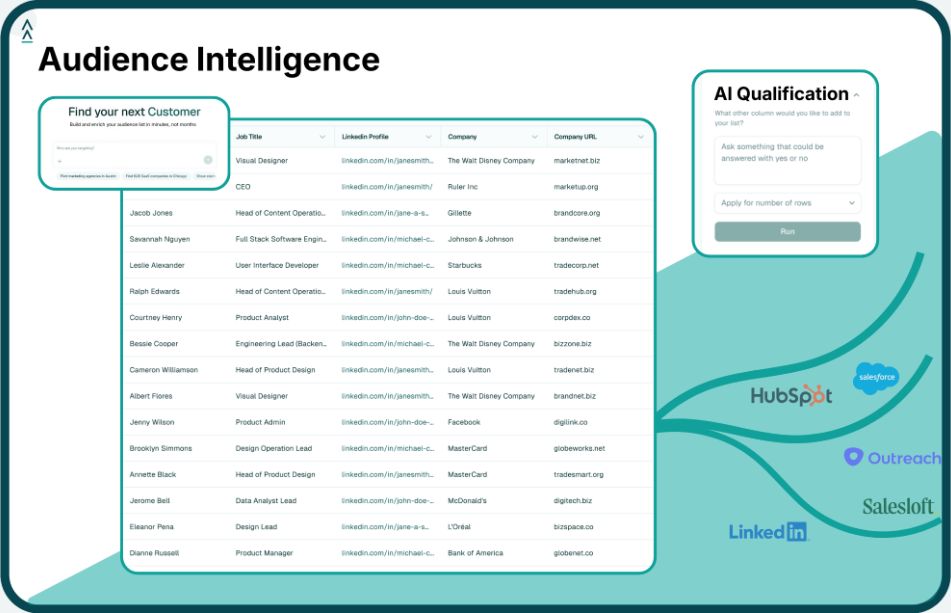
The ranking in this article was built with Landbase. Natural-language searches identified venture-backed AI agriculture and food technology companies, an enrichment step added founding year and 12-month headcount change, and the results were filtered and sorted into a structured dataset.
Landbase's web and CLI interfaces access the same account, datasets, and saved work.
For more complex requirements, the Advanced Dataset Creator supports filters, calculations, and custom output fields.
Landbase's data infrastructure includes more than 800 million contacts and more than 40 million companies across more than 1,500 fields, with enrichment from more than 20 providers.
An agtech workflow could, for example, identify precision agriculture and farm robotics companies that raised a Series A or later in the past 18 months, grew headcount by more than 25%, operate in North America or Australia, and recently hired a head of sales or field operations.
The Landbase CLI setup supports these workflows from a standard terminal and from AI coding environments including Claude Code and Codex.
An AI agtech or food tech startup uses AI, computer vision, or autonomy as the core of a product sold into agriculture or the food system. The category includes precision spraying, farm robotics and autonomy, livestock monitoring, crop and soil analytics, food processing automation, and fresh food supply chain software.
Upside Robotics recorded the highest 12-month headcount growth in Landbase data among the companies that met this list's criteria, at more than 115%. Halter and Shinkei Systems followed, each also above 100%.
Farm labor is scarce and expensive, and fertilizer and chemical inputs are among the largest costs for growers. Computer vision and autonomy have become reliable enough to reduce both, and companies that can show measurable savings per acre or per animal are attracting customers and investment.
Not on its own. Headcount data can differ from company figures, agricultural companies often use seasonal staff, and fast hiring does not guarantee revenue growth. This list therefore pairs headcount growth with disclosed funding, customer, acreage, and valuation evidence wherever it is available.
Teams can start with a category definition and then filter by headcount growth, funding stage, recent rounds, crop or livestock focus, geography, and hiring activity. Landbase can combine these criteria into reusable datasets and return company and contact information through web and CLI workflows.
Tool and strategies modern teams need to help their companies grow.