.png)
.png)

Daniel Saks
Chief Executive Officer


Healthcare has become one of the fastest adopters of applied AI. Menlo Ventures estimated in October 2025 that healthcare AI spending would reach $1.4 billion in 2025, roughly triple the prior year, and that 22% of healthcare organizations had deployed domain-specific AI tools.
Spending has shifted from pilots to production tools that answer phones, file prior authorizations, recover denied claims, and design clinical trials. For B2B teams, the companies building these tools are also among the most active hirers in health technology, a pattern visible in Landbase's broader ranking of fast-growing healthtech companies.
This list ranks AI-native healthcare and life sciences companies by 12-month headcount growth measured in Landbase data, then verifies each company's funding and operating evidence against public sources.
The starting pool was AI-native companies focused on clinical documentation, patient access, revenue cycle, care and pharmacy operations, or drug discovery and development.
Every company on the list had to meet four criteria:
Headcount growth is calculated from professional-profile data and can differ from company-reported figures. Funding, valuation, and revenue figures below come from company announcements and press coverage rather than headcount data. Funding alone does not establish growth, so it is treated as one of several company buying signals.
CEO: Matt Pavelle (co-founder and co-CEO)
Latest round: $40 million Series B, March 2026
12-month headcount growth: +800%
Category: AI primary care
Doctronic offers an AI doctor that patients consult directly about symptoms and medications, with the option to move to a video visit with a licensed clinician. In December 2025, it became the first AI-native platform to autonomously renew prescriptions under Utah's AI regulatory sandbox, according to the company.
Doctronic said in March 2026 that it served more than 300,000 unique weekly users, up from roughly 50,000 weekly visits reported at its 2025 Series A. The company also reported 15x growth to eight-figure annualized revenue in under six months, and STAT reported that it was on track to earn more than $10 million in revenue in 2026.
Abstract and Lightspeed Venture Partners co-led the $40 million Series B, with existing investors including Union Square Ventures participating. It followed a $20 million Series A in September 2025 and brought total funding to about $65 million.
Doctronic is the only company on this list selling directly to patients, making it an early test of autonomous AI in primary care.
CEO: Xavier de Gracia and Josep Mingot (co-founders and co-CEOs)
Latest round: $30 million Series A, June 2026
12-month headcount growth: +613%
Category: Healthcare voice AI agents
Prosper AI builds voice agents that handle phone calls to patients and payers on behalf of healthcare providers.
The agents cover patient scheduling, benefit verification, claims status checks, prior authorizations, balance reminders, and intake.
The company said revenue grew about fivefold in the roughly six months between its seed round and its Series A, and that it added more than 40 healthcare organizations as customers over that period. Fierce Healthcare reported the round as part of a push to build an AI workforce for healthcare operations.
Andreessen Horowitz led the $30 million Series A, with Base10 Partners, Emergence Capital, and Y Combinator participating. It followed a $5 million seed round and brought total funding to roughly $35 million.
Phone work between providers and payers is one of healthcare's largest administrative costs, and Prosper AI is turning it into software.
CEO: Pete Shalek
Latest round: $30 million Series A, December 2025
12-month headcount growth: +467%
Category: AI front office for independent practices
Valerie Health provides an AI operations suite for independent physician groups, both physician-owned and private equity-backed.
Its agents work inside existing clinic systems to process referrals, faxes, and scheduling.
Valerie Health reported that revenue grew more than fivefold in six months before its Series A. Customers reported new patient visits up more than 5% and median referral time-to-entry as low as 19 minutes, according to the company.
Redpoint Ventures led the $30 million Series A, with General Catalyst, Primary Ventures, and BoxGroup participating. Total funding reached $39 million.
Valerie Health targets independent practices, which rarely have health-system IT budgets, with a full front-office product rather than a point tool.
CEO: Pedro Coelho
Latest round: $52.5 million Series A, February 2026
12-month headcount growth: +447%
Category: AI clinical trial design
Barcelona-based Biorce builds Aika, an AI platform for clinical trial design and execution used by pharma companies, biotechs, and CROs.
Aika is built on a dataset of about one million clinical trials and is designed to shorten trial preparation and reduce protocol amendments.
Biorce's Series A was reported as the largest Series A to date in Iberian healthtech and AI, and the company plans an international expansion that includes an R&D hub in Austin, Texas.
DST Global joined as a new investor in the Series A, while Norrsken VC and YZR Capital increased their participation. Total funding is above $60 million.
Biorce applies AI to trial design, where delays and protocol amendments are among the most expensive problems in drug development.
CEO: Justin Norden
Latest round: $125 million Series B, March 2026
12-month headcount growth: +332%
Category: Enterprise AI platform for health systems
Qualified Health provides a platform that helps health systems deploy and govern generative AI at scale.
The product includes governance frameworks, clinician oversight, post-deployment monitoring, access controls, and an agent builder for administrative workflows.
The company said its platform supported more than 500,000 users across health systems representing about 7% of U.S. hospital revenue at the time of its Series B.
New Enterprise Associates led the $125 million Series B, with Transformation Capital, Menlo Ventures' Anthology Fund, and existing investors including SignalFire participating. The round followed a $30 million seed round and brought total funding to about $155 million.
Qualified Health sells the governance layer health systems need to adopt AI while managing clinical and compliance risk.
CEO: Jonathan Adly
Latest round: $75 million Series B, July 2026
12-month headcount growth: +330%
Category: Pharmacy AI agents
TJM Labs builds AI agents for pharmacies that handle prescription intake, fax processing, data entry, refills, prior authorization support, and patient communication inside the systems pharmacy teams already use.
In May 2026, TJM Labs said it served more than 400 pharmacies and processed more than 300,000 prescriptions daily. By July, the company reported more than 450 live pharmacies and more than 500,000 pharmacy tasks processed daily.
Elephant led the $75 million Series B, with Arthur Ventures and Updata Partners participating. The round followed a $10 million Series A and a $15 million Series A-1, bringing total funding to $100 million raised in roughly six months.
Pharmacy operations depend on high-volume, rules-driven work, and TJM Labs has added automation and voice capabilities by acquiring EncoreRx and Pharmesol.
CEO: Michal Miernowski
Latest round: $16 million Series A, April 2026
12-month headcount growth: +315%
Category: AI denial management and revenue recovery
Amperos Health provides an AI-native denial management and revenue recovery platform for outpatient clinics and physician groups.
Its agents handle denied-claim follow-ups, payer calls, appeals, and resubmissions inside existing billing software, escalating complex cases to human experts.
The company said it has served more than 3,000 clinical locations across all 50 states and helped recover nearly $700 million in annual revenue across more than 500,000 claims. MedCity News reported that it supports orthopedics, ophthalmology, dermatology, durable medical equipment, and behavioral health practices.
Bessemer Venture Partners led the $16 million Series A, with Uncork Capital and Neo participating. The round followed a $4.2 million seed round and brought total funding to about $21 million.
Amperos targets denied claims, where recovered dollars give buyers a direct measure of return.
CEO: Jeffery Liu (co-founder and co-CEO)
Latest round: $120 million Series C, June 2026
12-month headcount growth: +315%
Category: Patient access AI agents
Assort Health builds AI agents that manage the patient journey for specialty providers and health systems, from call handling and intake to referrals, outreach, document processing, and payments, with products for inbound calls, outreach, EHR-connected operations, and staff assistance.
Assort said its revenue grew 20x over the 15 months before its Series C and that its platform had supported more than 190 million patient interactions.
Menlo Ventures led the $120 million Series C at a reported $1.2 billion valuation, with Lightspeed Venture Partners and Felicis participating. Total funding exceeds $222 million, following a $76 million Series B in 2025.
Assort moved from a $3.5 million seed in 2024 to a $1.2 billion valuation in about two years.
CEO: Christopher Lee
Latest round: $8.4 million seed, October 2025
12-month headcount growth: +300%
Category: Clinical intake and unstructured record processing
Fourier Health converts scattered patient records, including referral documents, faxes, handwritten notes, PDFs, and health information exchange data, into concise, use-case-specific summaries that integrate with EHR systems.
The company combines specialty-trained models with a network of specialist clinicians who review and validate outputs.
Fourier said clients reported a 98% reduction in document validation effort and two to three hours of administrative time saved per patient.
Yosemite led the $8.4 million seed round, with Innospark Ventures, NextGen Venture Partners, and Tau Ventures participating.
Fourier is the earliest-stage company on this list, and its focus on unstructured intake data sits upstream of workflows such as prior authorization and referrals.
CEO: Sriram Somasundaram
Latest round: $80 million Series A, March 2026
12-month headcount growth: +291%
Category: Pharmacy and medication access AI
Latent Health builds a Clinical Reasoning Engine that analyzes patient data, interprets drug eligibility criteria, and coordinates workflows between health systems, payers, pharmacies, and patients.
The company started with prior authorization and has expanded into appeals, 340B compliance, and broader health-system pharmacy operations.
Latent said its health system partners grew from four to more than 45 over the year before its Series A, and that it works with half of the top 20 U.S. health systems.
Spark Capital and Transformation Capital co-led the $80 million Series A, with Conviction, McKesson Ventures, General Catalyst, and Y Combinator participating. The company was founded in 2022.
Latent ties AI directly to medication access and pharmacy revenue, which gives health-system buyers a financial case beyond time savings.
First, administrative work dominates. Prosper AI, Valerie Health, Assort Health, Amperos Health, TJM Labs, and Latent Health all automate phone calls, faxes, claims, referrals, or authorizations rather than clinical decisions.
Second, voice agents have become a core product category. Prosper AI and Assort Health are built around voice, and TJM Labs acquired Pharmesol to add it.
Third, AI is moving into regulated care and development. Doctronic is testing autonomous prescription renewals under a state sandbox, Qualified Health sells governance to health systems, and Biorce is applying AI to clinical trial protocols.
For GTM teams, these companies are hiring quickly, closing large rounds, and selling into health systems, physician groups, pharmacies, and life sciences companies. That combination is more useful when paired with hiring, leadership, technology, and data enrichment signals than when funding is viewed on its own. Teams researching the wider market can also compare this list with Landbase's rankings of fast-growing digital health companies and AI coding and developer tools startups.
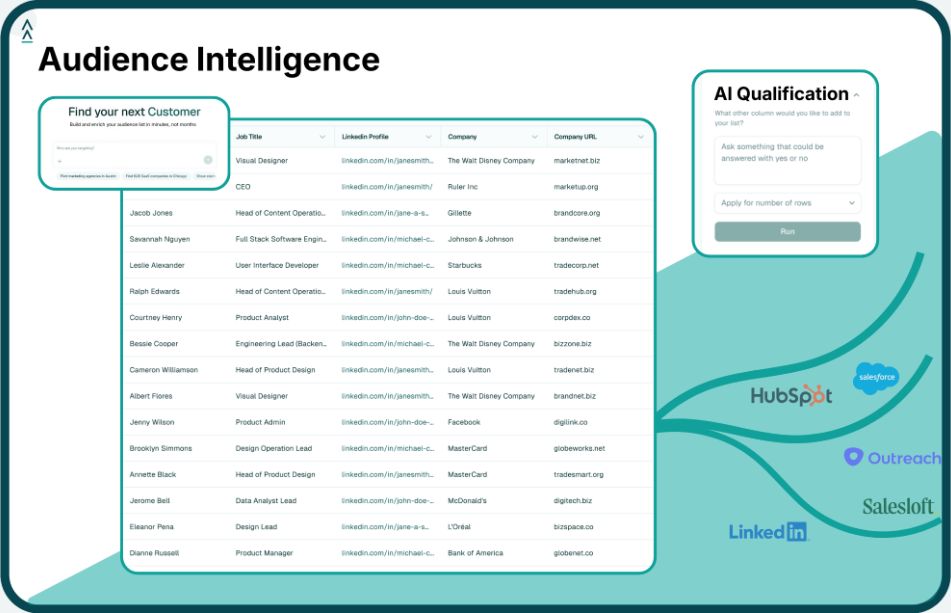
The ranking in this article was built with Landbase. A natural-language search identified AI-native healthcare and life sciences companies, an enrichment step added founding year and 12-month headcount change, and the results were filtered and sorted into a structured dataset.
Landbase's web and CLI interfaces access the same account, datasets, and saved work. An audience created in the web app can move into a repeatable terminal workflow, and CLI-generated datasets remain available in the web app.
For more complex requirements, the Advanced Dataset Creator supports natural-language instructions involving filters, calculations, ratios, and custom output fields.
Landbase's data infrastructure includes more than 800 million contacts and more than 40 million companies across more than 1,500 fields, with enrichment from more than 20 providers.
A healthcare AI workflow could, for example, identify AI-native revenue cycle and patient access companies that raised a Series A or later in the past year, grew headcount by more than 100%, recently hired a head of sales or partnerships, and sell to U.S. health systems.
The Landbase CLI setup supports these workflows from a standard terminal and from AI coding environments including Claude Code and Codex.
A healthcare AI startup builds products whose core function depends on AI to deliver care, run healthcare operations, or develop therapies. The category includes AI scribes, patient access and voice agents, revenue cycle automation, pharmacy and prior authorization tools, AI governance platforms, and AI for drug discovery and clinical trials.
Doctronic recorded the highest 12-month headcount growth in Landbase data among the companies that met this list's criteria, at 800%. The company also reported more than 300,000 unique weekly users in March 2026.
Administrative workflows such as phone calls, referrals, prior authorizations, and claims appeals are high-volume, rules-driven, and expensive to staff. They also carry lower clinical risk than diagnosis or treatment, so results are easier to measure.
Not on its own. Headcount data is based on professional profiles and can differ from company-reported figures. This list therefore pairs headcount growth with disclosed funding, revenue, customer, and usage evidence wherever it is available.
Teams can start with a category definition, such as AI-native revenue cycle or patient access companies, and then filter by headcount growth, funding stage, recent rounds, geography, technology usage, and hiring activity. Landbase can combine these criteria into reusable datasets and return company and contact information through web and CLI workflows.
Tool and strategies modern teams need to help their companies grow.