.png)
.png)

Daniel Saks
Chief Executive Officer


Venture capital in construction technology has shifted toward AI. BuiltWorlds data reported by Building Design+Construction found that about 68% of the $3.96 billion invested in built environment tech startups in Q2 2025 went to companies integrating AI or machine learning into their products or operations.
Much of that capital is going to young companies that automate estimating, design review, permitting, and field work. For B2B teams, the pairing of new rounds and rapid hiring is a useful signal, and this post is part of Landbase's wider series on AI startups adding headcount fastest.
This list ranks AI-native construction and AEC startups by 12-month headcount growth measured in Landbase data, then verifies each company's funding and operating evidence against public sources.
The starting pool was venture-backed companies whose primary product applies AI to construction, architecture, engineering, building design, estimating, preconstruction, permitting, or jobsite work. General-purpose robotics foundation-model companies were excluded, while construction-specific robotics was included.
Every company on the list had to meet four criteria:
Headcount growth is calculated from professional-profile data and can differ from company-reported figures, particularly for small teams where a handful of hires produces a large percentage change. Funding, revenue, and customer figures below come from company announcements and press coverage rather than headcount data. Funding alone does not establish growth, so it is treated as one of several company buying signals.
CEO: Michael Ding
Latest round: $35 million Series A, December 2025
12-month headcount growth: +1,011%
Category: AI takeoff and estimating for trade contractors
Bobyard uses computer vision to automate construction takeoffs, the step in preconstruction where estimators measure quantities and materials from drawings before preparing a bid.
The company started with landscaping, a trade with complex plans and limited software options, and is expanding into drywall, electrical, HVAC, plumbing, and framing.
When it announced its Series A, Bobyard said it had hundreds of customers and that its team had nearly tripled over the prior year. Landscaping customers reported 50% to 70% faster takeoffs and up to five times more bid volume, according to the company.
Lead investor 8VC and existing backer Pear VC described the $35 million Series A as funding for new trades and further model development.
8VC led the Series A, with participation from Pear VC, Primary Venture Partners, Tishman Speyer, RXR, Caffeinated Capital, and Merrick Ventures. It followed a $3.5 million seed round led by Primary after Bobyard went through the PearX accelerator.
Bobyard shows how AI estimating is moving trade by trade, starting with specialty contractors that larger construction software vendors have historically underserved.
Co-founder: Puneet Puri
Latest round: $26 million Series A, July 2026
12-month headcount growth: +380%
Category: Construction robotics for solar and infrastructure
Gritt builds physical AI systems that attach to equipment already found on construction sites, such as skid steers and forklifts. Robotic arms then perform labor-intensive tasks, starting with placing solar panels on utility-scale projects.
Gritt said an eight-person crew using its system can place 3,000 to 4,000 panels a day, compared with about 800 for a typical crew. The company reported being contracted to help install nearly 3 gigawatts of solar capacity over 18 months, with customers including three of the top 10 U.S. power construction companies.
According to The Next Web's coverage of the raise, two systems were deployed at the time, with a plan to reach 48 within six months.
Obvious Ventures led the $26 million Series A, with Union Square Ventures and Active Impact Investments participating. An earlier pre-seed included First Round Capital, Climactic, Congruent Ventures, and VSC Ventures, for total funding of about $32 million.
Gritt represents a retrofit approach to construction robotics, which avoids asking contractors to replace their equipment fleets.
CEO: Sunil Dorairajan
Latest round: $5 million in pre-seed and seed funding, September 2026
12-month headcount growth: +300%
Category: Preconstruction scope and risk analysis
Wyre AI turns full sets of construction drawings and specifications into structured scopes of work and risk findings. The software flags conflicts, gaps, and inconsistencies across documents before subcontracts are written and bids are finalized.
The company reported analyzing more than 250 projects representing more than $3 billion in project value, and identifying more than 250,000 scopes and issues. Named customers include Okland Construction, Jacobsen Construction, and Rycon Construction.
In its funding announcement, Wyre AI cited a DPR Construction pilot estimate of 100 to 350 hours saved per project in scope development.
Ironspring Ventures led the seed round, with WND Ventures, DPR Construction's corporate venture arm, and the Virginia Innovation Partnership Corporation participating.
Scope gaps are a common source of disputes and change orders. Wyre AI targets general contractors' preconstruction teams, where that risk is set.
CEO: Paul Zeckser
Latest round: $22 million Series A, May 2026
12-month headcount growth: +222%
Category: AI design document review
LightTable analyzes construction drawings with purpose-built AI models. Its flagship QA/QC product replaces traditional peer-review workflows, flagging design errors that would otherwise lead to RFIs and change orders.
LightTable reported reviewing more than 20 million square feet of construction documents covering $3.5 billion in project costs. The company said its reviews catch about 70% of design errors that would otherwise result in change orders, compared with about 30% for human-only review.
The company announced its $22 million Series A about nine months after emerging from stealth. Customers include Suffolk, Mill Creek Residential, and Swire Properties.
Innovation Endeavors led the Series A, with Blackhorn Ventures, DivcoWest Ventures, and 9Yards Capital joining existing backers Primary Venture Partners, MetaProp, and Banter Capital. It followed a $6 million seed led by Primary in August 2025.
LightTable sells to the owner and developer side, where design errors translate directly into budget overruns.
CEO: Alexander Michalatos
Latest round: $12 million Series A, September 2026
12-month headcount growth: +210%
Category: AI drawing review for contractors
Buildcheck uses computer vision to review construction drawings, flagging errors, omissions, and coordination conflicts before drawings reach the field.
Buildcheck reported more than 110 paying customers, up more than four times from a year earlier, and said its platform has analyzed more than 150,000 drawing sheets. Customers include DPR Construction, EllisDon, and Power Construction.
The company raised its $12 million Series A about nine months after a $5.9 million seed round.
Telescope Partners led the Series A, with WND Ventures and existing investors Uncork Capital, Salt VC, and Xfund participating. Total funding is about $18 million.
Buildcheck and LightTable both rank in the top five, which points to design review as one of the most active categories in construction AI.
CEO: Yoash Palmor
Latest round: $7 million seed, January 2026
12-month headcount growth: +210%
Category: AI estimating, design, and ordering for interior finishes
Materialspace analyzes blueprints, product catalogs, and pricing data so that finish trades can move from cost estimate to design and ordering in one system. Its early focus is cabinet, countertop, and kitchen and bath companies in North America.
Materialspace said it saw rapid adoption in the year after launching its product, with growth driven mainly by distributors and manufacturers.
Calcalist reported the $7 million seed round in January 2026. The company has not disclosed revenue or customer counts.
StageOne Ventures, SecretChord, and Timber Grove Ventures co-led the seed, with Maccabee Ventures and GC Ventures participating.
Materialspace targets the supply chain side of construction, where distributors and manufacturers quote and sell finish materials.
Co-founder: Alena Tuttle
Latest round: $2 million pre-seed, May 2026
12-month headcount growth: +200%
Category: Voice AI for jobsite documentation
Hardline's VoiceOps product turns phone calls and jobsite conversations into structured project records, including daily logs, RFIs, punch lists, and change orders.
Hardline reported deployments in 10 U.S. states and two countries, with customers among commercial general contractors, residential builders, and specialty trades.
The company announced its pre-seed round after taking part in the Suffolk Technologies BOOST accelerator in 2025.
Mucker Capital led the $2 million pre-seed, with Suffolk Technologies, StandUp Ventures, Nirman Ventures, and Alumni Ventures participating.
Much field information is shared by phone and never recorded. Better records reduce rework and claims.
CEO: Kanav Hasija
Latest round: $10 million seed, February 2026
12-month headcount growth: +119%
Category: AI preconstruction planning
MeltPlan is building what it calls a planning engine for the built environment. Its products include Melt Code for building code research, Melt Takeoff for automated quantity takeoffs, and bid leveling tools.
The company was founded in 2025 by Kanav Hasija, a former chief product officer at Innovaccer, and Tanmaya Kala, a former DPR Construction executive.
MeltPlan said it works with DPR Construction in California and Innovo Group in the UAE. The company reported that its system has scored 95% or higher on building inspector exams.
Pulse 2.0 reported the $10 million seed round, which brought total funding to $14 million within about a year of founding.
Bessemer Venture Partners led the seed, with participation from noa.
MeltPlan is attempting to link code, cost, schedule, and value analysis in one system, an approach that competes with point tools across preconstruction.
CEO: Maor Greenberg
Latest round: $10 million seed, October 2025
12-month headcount growth: +100%
Category: AI-enabled residential engineering and permitting
Spacial turns 2D architectural drawings into structural, electrical, and plumbing plans, flags design conflicts, and checks local code. Licensed engineers then review and stamp the plans.
Spacial reported 300% growth in booked revenue since launch and more than 140 active projects across the United States at the time of its seed round.
Pulse 2.0 reported the $10 million seed.
TLV Partners led the seed, with Mango Capital, Re Angels, and HTV participating. The company has offices in Palo Alto and Tel Aviv.
Spacial pairs AI with licensed professionals, selling completed engineering work rather than software alone.
CEO: James Gallagher
Latest round: $49.5 million Series B, September 2025
12-month headcount growth: +98%
Category: AI-enabled permitting and plan review
GreenLite provides AI-enabled private plan review, in which third-party experts handle code-compliance reviews that would otherwise wait in municipal queues. Its LiteTable product ingests large plan sets, flags likely compliance issues, and cites relevant code sections.
GreenLite said it serves nearly 100 national brands, including Walgreens, O'Reilly Auto Parts, and TD Bank, and that it accelerates permit timelines by 75%.
Lead investor Insight Partners announced the $49.5 million Series B in September 2025.
Insight Partners led the Series B, with Energize Capital and existing investors Craft Ventures, LiveOak Ventures, and Chicago Ventures participating. The company has reported total venture funding of about $86 million.
GreenLite targets the permitting bottleneck for multi-site retail, lodging, industrial, and energy projects.
Several patterns repeat.
First, preconstruction is the most crowded part of the list. Bobyard, Wyre AI, LightTable, Buildcheck, Materialspace, and MeltPlan all work on drawings, takeoffs, scopes, or estimates before work begins, where errors are cheapest to fix.
Second, several companies sell outcomes rather than software. Spacial delivers stamped engineering plans, GreenLite delivers permit reviews, and Gritt installs solar panels with its own robotic systems.
Third, general contractors are acting as investors and early customers. DPR Construction's WND Ventures backed Wyre AI, Buildcheck, and MeltPlan, and Suffolk Technologies backed Hardline.
For GTM teams, these companies are hiring quickly while their categories form. That combination is more useful when paired with hiring, leadership, technology, and data enrichment signals than when funding is viewed on its own. Teams researching the wider built environment can compare this list with Landbase's ranking of AI real estate startups hiring fastest and its earlier list of fastest-growing construction tech companies.
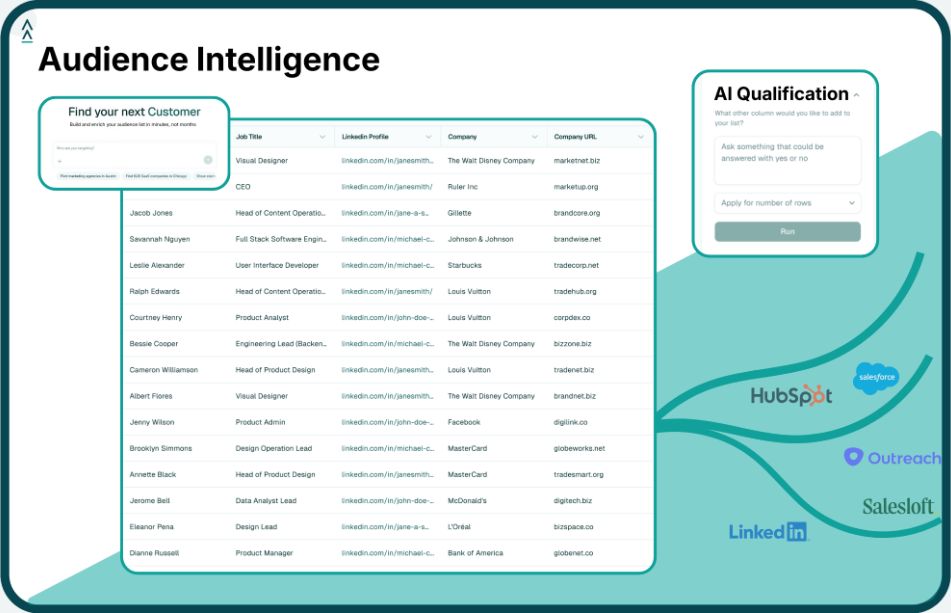
The ranking in this article was built with Landbase. A natural-language search identified venture-backed AI startups serving construction and AEC, an enrichment step added founding year and 12-month headcount change, and the results were filtered and sorted into a structured dataset.
Landbase's web and CLI interfaces access the same account, datasets, and saved work.
For more complex requirements, the Advanced Dataset Creator supports filters, calculations, and custom output fields.
Landbase's data infrastructure includes more than 800 million contacts and more than 40 million companies across more than 1,500 fields, with enrichment from more than 20 providers.
A construction AI workflow could, for example, identify preconstruction software companies that raised a seed or Series A round in the past year, grew headcount by more than 100%, list general contractors as customers, and recently hired a head of sales in North America.
The Landbase CLI setup supports these workflows from a standard terminal and from AI coding environments including Claude Code and Codex.
A construction AI startup builds products or services that use AI to perform or support work across the building lifecycle. The category includes takeoff and estimating, design and drawing review, permitting, scheduling and planning, jobsite documentation, and construction-specific robotics.
Bobyard recorded the highest 12-month headcount growth in Landbase data among the companies that met this list's criteria, at more than 1,000%. Gritt and Wyre AI followed, at 380% and 300%.
Construction relies on large document sets, manual measurement, and fragmented communication, which are tasks AI models now handle well. Labor shortages and thin margins give tools that cut estimating time a direct financial case.
Not on its own. Most companies on this list are small, so a few hires can produce a large percentage change, and headcount data can differ from company figures. This list therefore pairs headcount growth with disclosed funding, customer, and usage evidence wherever it is available.
Teams can start with a category definition and then filter by headcount growth, funding stage, recent rounds, target buyer, geography, and hiring activity. Landbase can combine these criteria into reusable datasets and return company and contact information through web and CLI workflows.
Tool and strategies modern teams need to help their companies grow.