.png)
.png)

Daniel Saks
Chief Executive Officer


AI coding tools have moved from experiment to default. In JetBrains' January 2026 survey of more than 10,000 professional developers, 90% said they regularly use at least one AI tool for coding at work, and 74% had adopted developer-specific tools such as AI editors, assistants, or agents. The 2025 Stack Overflow Developer Survey found a similar shift, with 84% of developers using or planning to use AI tools while 46% said they did not trust the accuracy of the output.
Capital has followed adoption. Crunchbase News reported in May 2026 that Cursor alone had raised $3.4 billion, while a second tier of companies building app generators, code review, agent infrastructure, and coding models raised their own large rounds. For B2B teams, that combination of funding and hiring is one of the clearest recent funding signals in software.
This list ranks AI-native coding and developer-tools companies by 12-month headcount growth measured in Landbase data, then verifies each company's funding and operating evidence against public sources.
The starting pool was AI-native companies whose primary product is used to build, write, review, test, deploy, or operate software.
Every company on the list had to meet four criteria:
Headcount growth is calculated from professional-profile data and can differ from company-reported figures, particularly for companies with contractors, distributed teams, or recent hiring changes. Funding, valuation, and revenue figures below come from company announcements and press coverage rather than headcount data. Funding alone does not establish growth, so it is treated as one of several company buying signals.
CEO: Mukund Jha
Latest round: $130 million Series C, July 2026
12-month headcount growth: +712%
Category: AI app builder
Emergent provides an agentic app-building platform that turns natural-language prompts into full-stack applications.
The company says roughly 70% of its users have no prior coding experience, and small businesses make up its core customer base.
Emergent reported $50 million in annual recurring revenue and more than five million users in January 2026. By July, it reported an annualized run rate of approximately $120 million, more than 200,000 paying customers, and over 12 million apps built on the platform.
Its valuation moved from $300 million at its January Series B to $1.5 billion at its July Series C.
Creaegis led the $130 million Series C, with Khosla Ventures, SoftBank Vision Fund 2, Lightspeed, and Y Combinator participating. The round followed a $23 million Series A in September 2025 and a $70 million Series B in January 2026, bringing total funding to roughly $230 million.
Emergent shows how far AI app generation has moved beyond professional developers. Most of its growth comes from non-technical builders and small businesses, a market that traditional developer tools rarely served directly.
CEO: Brian Elliott
Latest round: $200 million, May 2026
12-month headcount growth: +417%
Category: Enterprise autonomous software development
Blitzy provides an autonomous software development platform for large enterprises with legacy codebases.
The system maps an existing codebase into a knowledge graph, then orchestrates thousands of AI agents in parallel over days or weeks on codebases ranging from one million to more than 100 million lines of code.
Blitzy said its headcount more than doubled in the six months before its May 2026 round, and that it serves dozens of Global 2000 enterprises across 10 industries.
The company raised $200 million at a $1.4 billion valuation, moving directly from a small 2024 seed round to unicorn status.
Northzone led the May round, with PSG, Battery Ventures, Jump Capital, and strategic investors including Liberty Mutual Strategic Ventures and Erie Strategic Ventures participating. Total disclosed funding is a little over $204 million.
Blitzy is aimed at legacy modernization rather than prototyping or individual developer productivity. Its insurance-industry backers and planned expansion into government and financial services point to demand for AI agents that can work on very large, regulated codebases.
CEO: Harjot Gill
Latest round: $143 million Series C, August 2026
12-month headcount growth: +304%
Category: AI code review
CodeRabbit provides AI code review that automatically reviews pull requests inside Git workflows and IDEs.
With its Series C, the company launched Agentic Change Management, a governance layer for AI-generated code that includes triage, change tracking, and security review.
CodeRabbit reported more than 17,000 customers, more than two million code reviews per week, and more than five-times year-over-year revenue growth at the time of its August round.
Its valuation rose from roughly $550 million in September 2025 to $1.5 billion with the Series C.
Atomico and Smash Capital co-led the $143 million Series C, with Datadog and BMW i Ventures among the new investors. CodeRabbit previously raised a $16 million Series A and a $60 million Series B, for total funding of approximately $231 million.
As coding agents generate more code, human review becomes the bottleneck. CodeRabbit is positioning review and governance as a separate layer of the AI development stack rather than a feature of code generation tools.
CEO: Harrison Chase
Latest round: $125 million Series B, October 2025
12-month headcount growth: +248%
Category: Agent engineering platform
LangChain provides open-source frameworks for building AI agents, including LangChain and LangGraph, along with LangSmith, its commercial platform for agent observability, evaluation, and deployment.
At the time of its Series B, LangChain reported 90 million monthly downloads across its open-source packages, use by 35% of the Fortune 500, and 12-times year-over-year growth in LangSmith trace volume.
The round valued the company at $1.25 billion, up from roughly $200 million in 2023.
IVP led the $125 million Series B, with CapitalG, Sapphire Ventures, and strategic investors including ServiceNow, Workday, Cisco, Datadog, and Databricks Ventures. LangChain previously raised a $10 million seed led by Benchmark and a $25 million Series A led by Sequoia.
LangChain is developer infrastructure rather than a code generator. Its growth reflects demand for tooling that helps engineering teams build, test, and run agents in production, including many of the AI coding companies themselves.
CEO: Anton Osika
Latest round: $400 million Series C, August 2026
12-month headcount growth: +223%
Category: AI app builder
Lovable provides an AI platform that turns natural-language prompts into full-stack web applications and websites.
Since launching in November 2024, users have created more than 60 million projects, and Lovable-built apps receive more than 900 million visits per month.
Lovable passed $200 million in annual recurring revenue by December 2025 and reached $400 million by March 2026, according to TechCrunch and Bloomberg. The company says employees at nearly two-thirds of the Fortune 500 use the product.
Its valuation moved from $1.8 billion in July 2025 to $6.6 billion in December 2025 and then to $13.3 billion with its Series C.
Menlo Ventures led the $400 million Series C, with EQT's Scaleup Europe Fund co-leading. Lovable previously raised a $200 million Series A and a $330 million Series B, bringing total funding to roughly $950 million.
Lovable is one of the fastest-scaling software companies in Europe and a reference point for the entire AI app-builder category. The company has said it plans to grow to roughly 450 team members this year while expanding in London, Boston, San Francisco, and New York.
CEO: Erik Bernhardsson
Latest round: $355 million Series C, May 2026
12-month headcount growth: +183%
Category: AI compute and sandbox infrastructure
Modal provides serverless infrastructure that lets developers run inference, training, and other GPU-heavy workloads without managing servers.
Its sandbox product, used to run and test AI-generated code, has become a significant source of demand from AI coding companies.
Modal's annualized revenue grew from roughly $60 million in September 2025 to approximately $300 million by May 2026, according to the company's CEO.
The Series C valued Modal at $4.65 billion, up from $1.1 billion at its Series B eight months earlier.
General Catalyst and Redpoint Ventures led the $355 million Series C, with Accel, Menlo Ventures, and Bain Capital Ventures participating. TechCrunch reported in September 2026 that Modal was in talks for a larger follow-on round. The company has not confirmed it.
Every coding agent needs somewhere to execute code safely. Modal's growth shows how AI coding tools are creating demand one layer down the stack, in compute and sandboxed execution.
CEO: Peter Morales
Latest round: $125 million Series B, February 2026
12-month headcount growth: +183%
Category: Verified AI code translation
Code Metal uses AI to translate code from high-level languages into hardware-specific targets such as Rust, VHDL, and CUDA, then formally verifies the output.
Its customers are concentrated in defense and edge computing, including the U.S. Air Force, L3Harris, and RTX.
Code Metal reached a reported $1.25 billion valuation with its February Series B, roughly three months after its Series A.
The company had approximately 75 employees at the time and said it planned to double or triple headcount by the end of 2026. It has also said it is profitable and cash-flow positive.
Salesforce Ventures led the $125 million Series B, with Accel, B Capital, and RTX participating. It followed a $36.5 million Series A led by Accel and $16.5 million in combined pre-seed and seed funding.
In defense and embedded systems, unverified AI-generated code is not usable. Code Metal is built around that trust gap, pairing code generation with formal verification.
CEO: Jason Lopatecki
Latest round: $70 million Series C, February 2025
12-month headcount growth: +64%
Category: AI observability and evaluation
Arize AI provides an observability and evaluation platform for machine-learning models, LLM applications, and AI agents. Its commercial product is Arize AX, and its open-source project is Phoenix.
Arize's $70 million Series C was described at the time as the largest investment to date in AI observability. Published customer case studies include Booking.com, Tripadvisor, and LG Uplus.
In October 2026, the company added a command-line and MCP integration for Arize AX.
Adams Street Partners led the Series C, with Microsoft's M12, Datadog, and PagerDuty among the participants. Total disclosed funding is approximately $131 million.
Teams cannot ship agents they cannot evaluate. Arize represents the testing and monitoring layer that sits between AI development and production deployment.
CEO: Jason Warner (co-founder, alongside co-founder Eiso Kant)
Latest funding: $1 billion strategic investment from Nvidia, August 2026
12-month headcount growth: +62%
Category: Foundation models for software development
Poolside develops foundation models specialized for software development, along with coding assistant and agent products.
It built Model Factory, its system for training and evaluating models, and released the open-weights Laguna model in 2026.
Poolside's valuation rose from roughly $3 billion at its October 2024 Series B to a reported $12 billion pre-money valuation with Nvidia's 2026 investment.
As part of the same arrangement, Nvidia agreed to license Poolside's model-development software and offer roles to 109 Poolside employees. Poolside told investors the deal is not an acquisition and that its founders remain with the company. This change may affect future headcount.
Poolside raised a $500 million Series B in October 2024 led by Bain Capital Ventures. The 2026 Nvidia investment terms were reported by Bloomberg and others rather than announced in a company press release.
Poolside shows how capital- and compute-intensive it is to build frontier models for coding, and how closely model developers now depend on hardware providers.
CEO: Itamar Friedman
Latest round: $70 million Series B, March 2026
12-month headcount growth: +36%
Category: AI code review and code quality
Qodo, formerly CodiumAI, provides an AI code review and code-quality platform for enterprise engineering teams.
Its multi-agent review system uses full-repository context, including codebase history and previous pull-request decisions, to enforce organization-specific standards.
Qodo's total funding grew from roughly $50 million in 2024 to $120 million after its March 2026 Series B.
Named enterprise customers include Walmart, NVIDIA, Red Hat, Box, Intuit, Ford, and Monday.com.
Qumra Capital led the $70 million Series B, with Square Peg, Susa Ventures, and TLV Partners participating. Qodo previously raised a $40 million Series A led by Susa Ventures and Square Peg.
Like CodeRabbit, Qodo is built for a world where code is generated faster than people can review it. Its enterprise customer list shows that code quality and governance are becoming budget lines of their own.
The companies above cover different layers of software development, but several patterns repeat.
First, the fastest headcount growth sits with companies that generate software directly. Emergent, Blitzy, and Lovable all build systems that produce working applications or large code changes rather than suggestions inside an editor.
Second, a second market is forming around the output of those tools. CodeRabbit and Qodo review AI-generated code, Arize evaluates AI systems, and Code Metal verifies translated code. As generation becomes cheaper, verification becomes more valuable.
Third, coding tools are pulling infrastructure demand behind them. Modal's sandbox growth and LangChain's agent tooling both depend on teams running more agents in production.
For GTM teams, these companies are hiring quickly, adding enterprise customers, and building new functions. That combination is more useful when paired with hiring, leadership, technology, and data enrichment signals than when funding is viewed on its own. Teams researching the wider category can also compare this list with Landbase's earlier ranking of fast-growing developer tools companies.
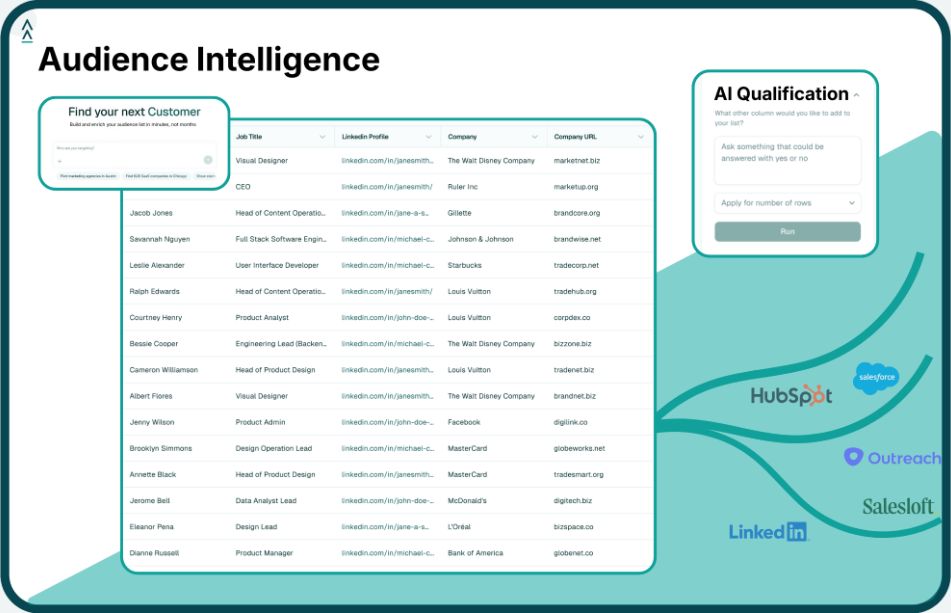
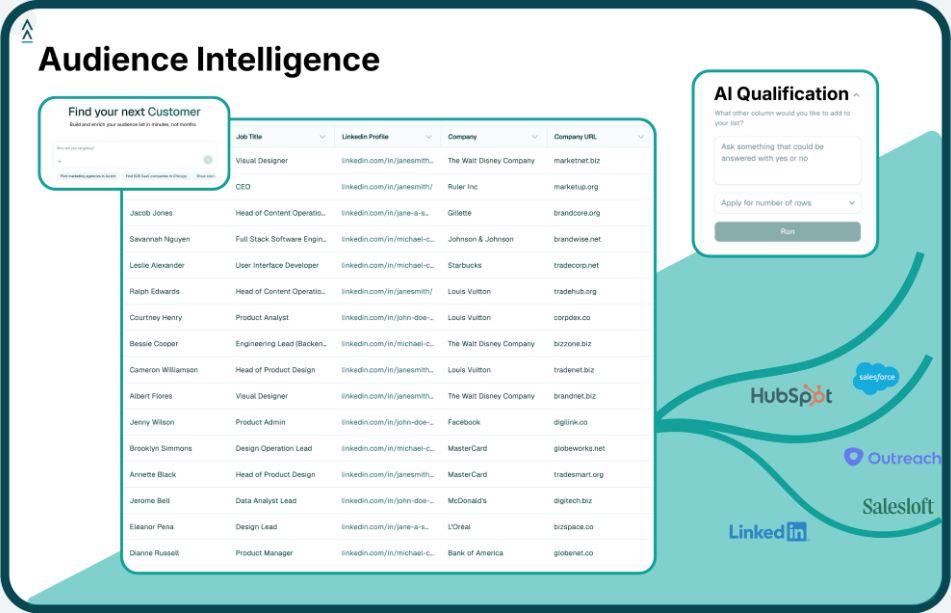
The ranking in this article was built with Landbase. A natural-language search identified AI-native developer-tools companies, an enrichment step added founding year and 12-month headcount change, and the results were filtered and sorted into a structured dataset.
Landbase's web and CLI interfaces access the same account, datasets, and saved work. An audience created in the web app can move into a repeatable terminal workflow, and CLI-generated datasets remain available in the web app.
For more complex requirements, the Advanced Dataset Creator supports natural-language instructions involving filters, calculations, ratios, and custom output fields.
Landbase's data infrastructure includes more than 800 million contacts and more than 40 million companies across more than 1,500 fields, with enrichment from more than 20 providers.
A developer-tools workflow could, for example, identify AI coding companies that raised a Series B or later in the past year, grew headcount by more than 50%, recently hired a VP of Sales, and are headquartered in North America or Europe.
The Landbase CLI setup supports these workflows from a standard terminal and from AI coding environments including Claude Code and Codex.
An AI developer tools company builds products that help people create, review, test, deploy, or operate software using AI. The category includes AI app builders, coding agents, code review platforms, agent frameworks, evaluation and observability tools, compute infrastructure for AI workloads, and foundation models specialized for code.
Emergent recorded the highest 12-month headcount growth in Landbase data among the companies that met this list's criteria, at more than 700%. The company also reported growth from $50 million in annual recurring revenue in January 2026 to an annualized run rate of approximately $120 million by July.
AI coding agents increase the volume of code that teams produce, while human review capacity stays roughly the same. Code review and governance platforms such as CodeRabbit and Qodo address that gap by automating review and enforcing organization-specific standards across AI-generated code.
Not on its own. Headcount data is based on professional profiles and can differ from company-reported figures, and fast hiring does not guarantee revenue growth. This list therefore pairs headcount growth with disclosed funding, revenue, customer, and valuation evidence wherever it is available.
Teams can start with a category definition, such as AI-native developer tools, and then filter by headcount growth, funding stage, recent rounds, geography, technology usage, and hiring activity. Landbase can combine these criteria into reusable datasets and return company and contact information through web and CLI workflows.
Tool and strategies modern teams need to help their companies grow.