.png)
.png)

Daniel Saks
Chief Executive Officer


Physical AI has become one of the largest destinations for venture capital. According to Crunchbase data, global venture funding to physical AI startups totaled $47.4 billion across 521 deals in the first half of 2026.
Most of these companies treat the model as the core product and the robot as the delivery mechanism. For B2B teams, the pace of hiring and fundraising across the category makes it one of the clearest sources of recent funding signals outside of pure software.
This list ranks venture-backed physical AI companies by 12-month headcount growth measured in Landbase data, then verifies each company's funding and operating evidence against public sources.
The starting pool was companies whose primary product is AI that perceives, reasons about, or acts in the physical world.
Every company on the list had to meet four criteria:
Defense autonomy companies and chip suppliers were excluded. Headcount growth is calculated from professional-profile data and can differ from company-reported figures, particularly for companies that recently emerged from stealth, made acquisitions, or rely on contractors and remote operators. Funding, valuation, and revenue figures below come from company announcements and press coverage rather than headcount data. Funding alone does not establish growth, so it is treated as one of several company buying signals.
CEO: Alexander Shpunt
Latest round: $165 million Series C, September 2026
12-month headcount growth: +8,800%
Category: Robot perception
Lyte builds LyteVision, a perception platform that combines 4D sensing, high-resolution imaging, and inertial sensing on a single synchronized timeline so robots can understand where they are and what is moving around them.
Lyte operated in stealth until January 2026, when it disclosed $107 million in Series A and B funding. Eight months later it raised a Series C at a $1.6 billion post-money valuation and said it was shipping to robotics customers in inspection, logistics, and manufacturing.
Its headcount growth figure largely reflects the move out of stealth, so the starting base was small.
Maverick Silicon led the $165 million Series C, with Fidelity, which led the Series B, Atreides Management, Key1 Capital, and Ora Global participating. Total funding since the company's 2021 founding is $272 million.
Robot foundation models are only as reliable as the sensor data they receive. Lyte is betting that perception will become a standard, purchasable component of the physical AI stack rather than something each robot maker builds in-house.
Founder: Bercan Kilic
Latest round: $55 million seed, July 2026
12-month headcount growth: +1,825%
Category: Robot training data and deployment
microagi, founded in Munich in September 2025, builds Atlas, a platform that captures data on factory floors, adapts existing robot models to a specific customer's tasks, and deploys them on existing hardware. The company does not build its own robots.
At the time of its seed round, microagi had about 37 employees, and its related data-collection business, shift, paid more than 20,000 contributors in 15 countries. Five companies were collecting data through the platform, and one was preparing to deploy robots on a production line.
Hummingbird led the $55 million seed, with Northzone, LocalGlobe, Village Global, and redalpine participating. The company described it as the largest German seed round to date.
microagi reflects a view that the bottleneck in physical AI is task-specific data rather than robot hardware.
CEO: Junghee Ryu
Latest round: $26 million Seed 2, February 2026
12-month headcount growth: +488%
Category: Robot foundation models for dexterity
RLWRLD develops robotics foundation models focused on dexterous, five-finger manipulation. In April 2026 it released RLDX-1, which it describes as a dexterity-first foundation model for robot hands.
RLWRLD's Seed 2 brought total seed funding to about $41 million and added strategic investors from logistics, retail, and manufacturing. The company said collaborations with CJ Logistics and Lotte were moving from memoranda of understanding toward joint deployment, alongside proof-of-concept projects in South Korea and Japan.
The Seed 2 included Headline Asia and Z Venture Capital, along with CJ Logistics, Kakao Investment, Lotte Ventures, and other strategic investors. Hashed, which led the roughly $15 million Seed 1, also participated.
RLWRLD shows how Asian industrial conglomerates are investing directly in robot intelligence. Its investors are also its first deployment sites.
CEO: Josh Gao
Latest round: $60 million Series B, October 2026
12-month headcount growth: +371%
Category: Physical AI training data
Mecka describes itself as the data and deployment layer for physical AI. It provides data collection, annotation, evaluation, and deployment infrastructure for robotics labs and enterprises, and runs Egoverse, a large dataset of first-person human activity used to train robots.
Mecka was founded in 2025 and had about 40 employees in June 2026. The company says it reached a revenue run rate of more than $100 million in June 2026 within a few months of operation, and it projects a $300 million run rate by year-end.
Sequoia Capital led the Series B, with NVIDIA, M12, Qualcomm Ventures, and Samsung joining as new investors. Mecka previously raised $60 million led by Framework Ventures.
Robot foundation models need far more real-world demonstration data than currently exists. Mecka's reported revenue suggests that data supply is becoming a large business in its own right.
CEO: Josh Gruenstein
Latest round: $34 million Series A, December 2025
12-month headcount growth: +347%
Category: AI robot workers for warehouses and manufacturing
Tutor Intelligence, an MIT spinout based in Watertown, Massachusetts, builds general-purpose robot workers. Cassie is a single-arm mobile robot for palletizing and case picking, and Sonny is a dual-arm robot for picking small items. Both run on the company's own robot foundation models.
In 2026 the company opened Data Factory 1, which it describes as the largest robot data factory in the United States. The facility uses a classroom of 100 Sonny robots taught by remote operators, and in September 2026 Tutor launched second-generation versions of both robots.
Union Square Ventures led the $34 million Series A, with Fundomo and Neo participating, bringing total funding to $42 million.
Tutor combines a robot business with its own data operation. Deployed robots generate revenue while the data operation improves its models.
CEO: Deepak Pathak
Latest round: $1.4 billion Series C, January 2026
12-month headcount growth: +341%
Category: General-purpose robot foundation models
Skild AI, founded in 2023 in Pittsburgh, builds a general-purpose robot "brain" designed to control many types of robots across many tasks. Its models are designed to learn partly from watching human video.
Skild said live revenue grew from zero to about $30 million within a few months in 2025, with deployments in security, construction, delivery, data centers, warehouses, and factory assembly. In 2026 it announced partnerships with ABB Robotics, Universal Robots, and NVIDIA, and acquired Zebra Technologies' robotics business, which may contribute to its headcount growth.
SoftBank led the Series C at a valuation of more than $14 billion, with NVentures, Macquarie Capital, and Bezos Expeditions participating. Skild was valued at $4.5 billion in mid-2025, and its CEO has said total funding exceeds $2 billion.
Skild is one of the clearest tests of whether a single foundation model can work across robot types.
CEO: Nikita Rudin
Latest round: $50 million Series A, November 2025
12-month headcount growth: +278%
Category: Humanoid autonomy software
Flexion, based in Zurich, builds a three-layer autonomy stack for humanoid robots. A language layer breaks tasks into steps, a vision-language-action model trained mostly on synthetic data handles motion, and a controller manages whole-body movement.
Flexion raised its Series A only months after a $7.35 million seed and said it was working with major robot manufacturers as partners. In 2026 it released Reflect v1.0 for long-horizon humanoid tasks and published plans to expand its Zurich team and establish a U.S. presence.
The $50 million Series A included DST Global Partners, NVentures, redalpine, Prosus Ventures, and Moonfire.
Flexion is building humanoid software without building the humanoid.
CEO: Leo Ma
Latest round: $52 million, March 2026
12-month headcount growth: +190%
Category: Industrial AI robots
RoboForce, founded in 2023 in Milpitas, California, builds AI-driven industrial robots, including its Titan robot, for what it calls Robo-Labor. Target sectors include solar, data centers, mining, and logistics.
RoboForce's total funding grew from $10 million in January 2025 to $67 million after its March 2026 round. The company said it was converting active pilot programs into production deployments. It later announced a collaboration with Samsung SDS.
YZi Labs led the oversubscribed $52 million round, with Yahoo co-founder Jerry Yang joining existing backers including Carnegie Mellon University.
RoboForce targets outdoor and heavy-industry work that general-purpose humanoids are not yet built for. Its focus on solar and data center work ties physical AI demand to the AI infrastructure buildout.
CEO: Michelle Lee
Latest funding: More than $60 million raised in total, as of June 2026
12-month headcount growth: +177%
Category: Physical AI for scientific labs
Medra builds a Physical AI Scientist platform that combines robotic workcells with AI that plans and runs experiments.
In April 2026, Medra opened ML001, a 38,000-square-foot autonomous lab with hundreds of robots running around the clock, which it built in under 90 days. Genentech is named as a production partner, and in June 2026 Medra announced a collaboration with DARPA.
Medra says it has raised more than $60 million from investors including Lux Capital, Menlo Ventures, Human Capital, and Catalio Capital.
Medra applies physical AI to drug discovery rather than logistics.
CEO: Lindon Gao
Latest round: $120 million Series A, September 2025
12-month headcount growth: +147%
Category: Robot foundation models for commercial tasks
Dyna Robotics builds robot foundation models and the robots that run them, targeting repetitive commercial work in warehouses, hotels, and food service.
At the time of its Series A, Dyna said its robots had been running roughly 16 hours a day at customer sites including hotels, restaurants, laundromats, and gyms, and that its DYNA-1 model reached a 99%+ success rate over 24 hours of non-stop operation.
RoboStrategy, CRV, and First Round Capital led the $120 million Series A, with Salesforce Ventures, NVentures, and the Amazon Industrial Innovation Fund participating. It followed a $23.5 million seed in March 2025.
Dyna is aimed at small commercial customers rather than large factories. Its emphasis on reliability over long shifts addresses the main barrier to commercial adoption.
First, much of the fastest hiring is happening below the robot. Lyte supplies perception, Mecka and microagi supply training data and deployment tooling, and Flexion supplies autonomy software.
Second, data has become a business in its own right. Mecka reports a nine-figure run rate from data supply, microagi pays tens of thousands of contributors, and Tutor Intelligence runs a dedicated robot data factory. Each treats real-world demonstrations as the scarce input for robot models.
Third, foundation model companies are moving toward deployment. Skild AI, RLWRLD, Dyna Robotics, and RoboForce all pair model development with partnerships or paid deployments in logistics, manufacturing, and commercial services.
For GTM teams, these companies are adding engineers, operators, and commercial staff quickly. That growth is more useful when paired with hiring, leadership, technology, and data enrichment signals than when funding is viewed on its own. Teams researching adjacent categories can compare this list with Landbase's ranking of fast-growing robotics companies, which covers the broader robotics market, and its list of AI coding and developer tools startups.
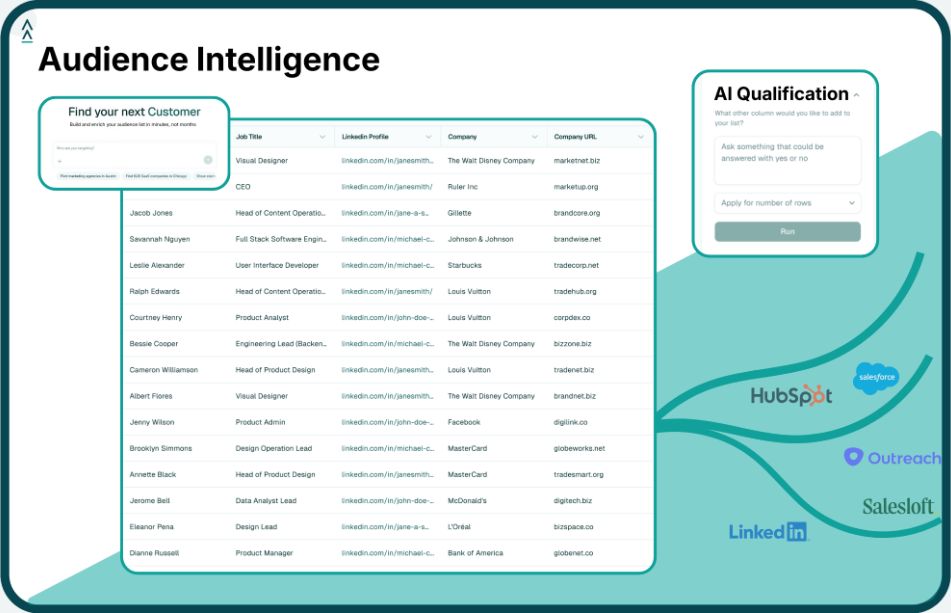
The ranking in this article was built with Landbase. A natural-language search identified venture-backed robotics and physical AI companies, an enrichment step added founding year and 12-month headcount change, and the results were filtered and sorted into a structured dataset.
Landbase's web and CLI interfaces access the same account, datasets, and saved work. An audience created in the web app can move into a repeatable terminal workflow.
For more complex requirements, the Advanced Dataset Creator supports filters, calculations, and custom output fields.
Landbase's data infrastructure includes more than 800 million contacts and more than 40 million companies across more than 1,500 fields, with enrichment from more than 20 providers.
A physical AI workflow could, for example, identify robot foundation model and humanoid companies that raised a Series A or later in the past year, grew headcount by more than 100%, are hiring manufacturing or field deployment roles, and are headquartered in North America, Europe, or East Asia.
The Landbase CLI setup supports these workflows from a standard terminal and from AI coding environments including Claude Code and Codex.
A physical AI company builds AI systems that perceive, reason about, and act in the physical world. The category includes robot foundation models, humanoid autonomy software, robot perception, training-data providers, and companies deploying AI-driven robots in warehouses, factories, and laboratories.
Lyte recorded the highest 12-month headcount growth in Landbase data among the companies that met this list's criteria. The figure is unusually high because Lyte operated in stealth until January 2026. microagi, founded in September 2025, recorded the second-highest growth.
Robot foundation models need large volumes of real-world demonstration data, and far less of that data exists than the text and images used to train language models. Companies such as Mecka, microagi, and Tutor Intelligence collect that data from human workers, wearables, and teleoperated robots.
Not on its own. Headcount data can be distorted by companies leaving stealth, completing acquisitions, or relying on contractors. This list therefore pairs headcount growth with disclosed funding, revenue, deployment, and partnership evidence wherever it is available.
Teams can start with a category definition, such as robot foundation models or humanoid autonomy, and then filter by headcount growth, funding stage, recent rounds, geography, technology usage, and hiring activity. Landbase can combine these criteria into reusable datasets and return company and contact information through web and CLI workflows.
Tool and strategies modern teams need to help their companies grow.