.png)
.png)

Daniel Saks
Chief Executive Officer


The sales intelligence category is crowded and confusing. ZoomInfo, Cognism, Apollo, Lusha, 6sense, Bombora, and dozens of smaller players all claim to help sales teams sell more effectively. The features overlap. The pricing models differ. The marketing language sounds similar. Enterprise teams evaluating the category often end up comparing database sizes and credit costs, which are the least predictive criteria for actual outbound performance.
According to Gartner research on sales technology, the sales intelligence market exceeds $5 billion annually, with enterprise teams spending an average of $200K-$400K on data and intelligence platforms. According to Forrester research on sales operations, despite this investment, 62% of enterprise sales leaders say their teams still lack the targeting precision needed for effective outbound. The platforms provide data access. What most teams need is data intelligence: scored, qualified, and ready to act on.
ZoomInfo, Cognism, Apollo, Lusha, RocketReach. These platforms provide access to company and contact records. You search, filter, export, and clean the data yourself. The value proposition is coverage: millions of contacts across millions of companies. The limitation is that the output is raw material. The enterprise team must score the accounts, qualify the contacts, assign territories, and deduplicate against the pipeline before a rep can use the data.
According to McKinsey research on sales data ROI, enterprise teams using database access platforms spend an estimated 40-60% of the data's value on operational processing: the work between exporting from the database and importing into the CRM in a rep-ready format. For a framework on how to evaluate these platforms, see the guide on evaluating B2B data providers.
6sense, Bombora, TechTarget, G2 Buyer Intent. These platforms detect when companies are researching topics related to your product by monitoring content consumption across third-party publisher networks. The value proposition is timing: knowing which accounts are in an active buying cycle. The limitation is that intent data operates at the account level. It tells you the company is researching. It does not tell you which person to call or whether the company actually fits your ICP.
According to Harvard Business Review research on sales intelligence, intent data is most valuable when combined with ICP scoring. An account showing high intent that does not fit your ICP is a false positive. An account showing no intent that perfectly fits your ICP may still be worth pursuing through outbound. Intent is a timing signal, not a fit signal. See the guide on buying signals that predict pipeline for how to combine intent with other signal types.
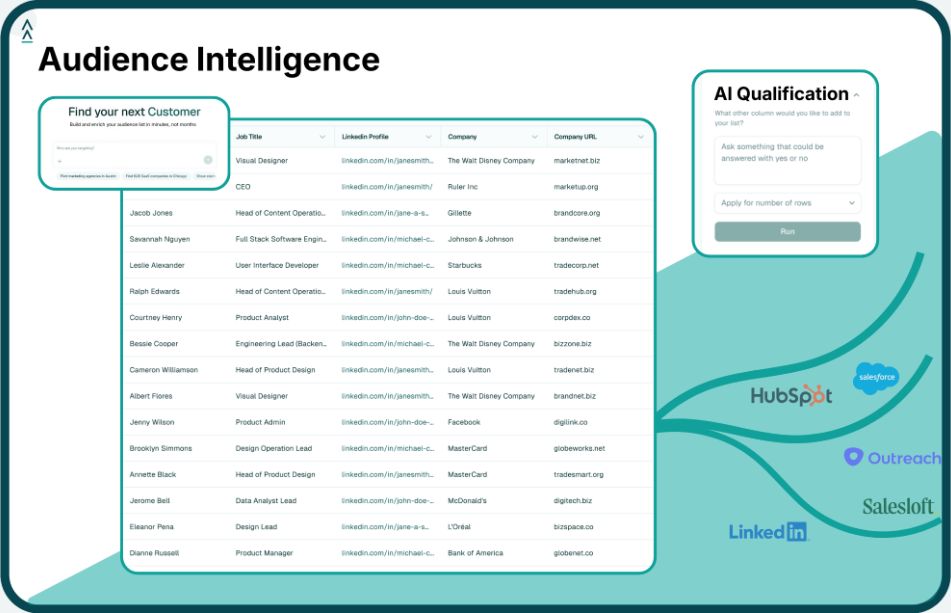
This is the emerging subcategory where Landbase operates. Account intelligence platforms do not just provide access to data or signals. They deliver scored, qualified, territory-assigned account lists with AI-qualified contacts as a finished output. The enterprise team defines the ICP criteria. The platform scores the full market, qualifies contacts by decision-making authority, assigns territories with balance and deduplication, and exports clean CSVs. The output is the intelligence layer that feeds the CRM, sequencer, and dialer.
According to Salesforce research on high-performing sales teams, the shift from data access to intelligence delivery produces the largest improvement in SDR productivity because it eliminates the operational processing step entirely. The rep receives an account list that is already scored, contacts that are already qualified, and a territory assignment that is already balanced. There is no manual work between the platform's output and the rep's first dial.
If your team has a strong RevOps function that can score accounts, qualify contacts, and build territories from raw data, a database access platform may be sufficient. If your operations team is already at capacity (common at 25+ SDRs), an account intelligence platform that delivers finished outputs is more valuable because it removes the operational processing step. See scaling outbound at 50+ SDRs for how to assess operational readiness.
Test accuracy on 50 to 100 accounts your team already knows. Compare coverage, contact quality, and noise across platforms. Time the full workflow from query to CRM-ready import. The platform that delivers the highest ratio of accurate, qualified contacts with the least operational overhead performs best at scale. See the data provider evaluation guide for the detailed framework.
License cost is one component. Add the operational cost (RevOps hours to process the data), the opportunity cost (accounts missed because the platform's coverage does not include them), and the deliverability cost (bounces from stale contacts). According to Bain research on sales efficiency, total cost of ownership for enterprise data platforms is typically 2-3x the license cost when operational processing is included. For a detailed cost analysis, see the guide on the cost of bad outbound data.
Can the platform recalibrate its scoring model based on your outbound results? This capability separates static data tools from learning systems. A platform that gets sharper with every campaign cycle produces compounding value. A platform that delivers the same quality of output regardless of how much conversion data you feed back is a static tool with a fixed ceiling. For the framework on how the feedback loop should work, see the outbound operations playbook.
Landbase is an account intelligence platform. It scores the full addressable market against your ICP, qualifies contacts with AI using multi-dimensional scoring rubrics, assigns territories with automated balancing, and exports clean CSVs. The scoring model calibrates against your closed-won data and recalibrates with conversion data from each outbound cycle. The output is the intelligence layer that sits between your data sources and your execution tools, making every downstream tool in the SDR tech stack more productive.
It depends on whether the intelligence platform provides its own contact data or requires a third-party source. Landbase uses its own data infrastructure with 24M+ companies and 1,500+ data points per account, so it can replace or supplement ZoomInfo depending on coverage requirements. The evaluation should compare output quality side by side on the same accounts.
Enterprise teams selling into EMEA need platforms that comply with GDPR data processing requirements. Evaluate whether the platform collects data from public sources only, provides opt-out mechanisms, and can filter contacts by geography to exclude regions with specific consent requirements. This is a procurement consideration that should be part of the evaluation process.
Ideally yes, because combining ICP fit scoring with intent timing signals in a single model produces the best prioritization. A high-fit account with high intent should rank above a high-fit account with no intent. If the two signals come from separate platforms, the RevOps team must manually combine them, which adds operational overhead and introduces data alignment challenges.
Annual contracts with pricing based on number of users, data volume (credits or exports), and feature tier. Enterprise contracts range from $100K to $400K annually depending on team size and capability requirements. The evaluation should be based on pipeline ROI per dollar spent rather than absolute cost. A platform that costs $200K and produces $2M in incremental pipeline delivers a 10x return.
Tool and strategies modern teams need to help their companies grow.