.png)
.png)

Daniel Saks
Chief Executive Officer


Enterprise account research has traditionally been a manual, time-intensive process. An SDR or RevOps analyst opens LinkedIn, reads company profiles, checks the news, reviews the technology stack, and makes a judgment call on whether the account is worth pursuing. At 10 accounts per day, one person can cover 2,600 accounts per year. At enterprise scale with tens of thousands of accounts in the addressable market, manual research cannot keep pace.
AI changes the economics of account research. According to McKinsey research on AI in B2B sales, enterprise sales teams that adopt AI-powered account intelligence reduce research time by 60-80% while improving targeting precision. According to Gartner research on sales technology, AI-powered account scoring and contact qualification are the two AI applications with the highest adoption rate and highest satisfaction rate among enterprise sales teams in 2026.
A human analyst can evaluate 10 to 20 companies per day against ICP criteria. AI can evaluate 10,000 in hours. The AI reads company descriptions, firmographic data, technology stack information, hiring patterns, and growth signals, then assigns a composite propensity score based on how closely each company matches the closed-won patterns.
The value is coverage. Manual research evaluates a sample. AI evaluates the universe. According to Harvard Business Review research on enterprise selling, the most common finding when enterprise teams first run AI-powered TAM scoring is the discovery of high-propensity accounts they never knew existed. These are companies that fit the ICP perfectly but were invisible because the team had never encountered them through inbound leads, trade shows, or manual prospecting.
Traditional database queries filter contacts by job title. AI reads the full profile: headline, description, skills, employment history, and company context. This matters because the person who makes purchasing decisions at many companies does not carry the title the query expects.
At a trades company, the buyer is the owner or general manager, titles that do not appear in a filter for 'VP of Operations.' At a mid-market company, the buyer might be a Director whose LinkedIn headline describes exactly the responsibility you are targeting but whose title does not match any standard filter. AI qualification catches these contacts because it evaluates meaning rather than matching strings. See the enterprise contact scoring guide for the full rubric.
According to Forrester research on contact intelligence, AI-powered contact qualification surfaces 40-100% more relevant contacts per account compared to title-based filtering, depending on the industry and the specificity of the buyer persona.
Monitoring hiring patterns, funding events, technology migrations, leadership changes, and competitive evaluations across thousands of accounts simultaneously is impossible manually. AI agents can crawl and structure this data continuously, surfacing accounts where the timing is right for outreach.
According to Salesforce research on sales performance, outreach triggered by a verified buying signal converts at 3-5x the rate of untriggered cold outreach. The AI does not just find the signal. It connects the signal to the account score and the contact qualification data, producing a prioritized list of accounts where the ICP fit, the contact accuracy, and the timing all align.
AI scores accounts against criteria that humans define. If the criteria are wrong, the scores are wrong. The strategic judgment of which company attributes predict conversion, which signals matter in your specific market, and which buyer personas to target comes from closed-won analysis, sales team feedback, and market expertise. AI accelerates execution. ICP definition remains a human exercise.
AI can identify that a prospect used to work at a company that is already a customer. It cannot assess the quality of that prior relationship or whether referencing it would be welcome or awkward. The nuanced judgment of how to approach a specific person in a specific situation remains a human skill.
AI can map the buying committee and score each contact by influence level. The strategy of which stakeholder to approach first, how to sequence the multi-threading, and when to bring in an executive sponsor is a judgment call that requires experience and situational awareness.
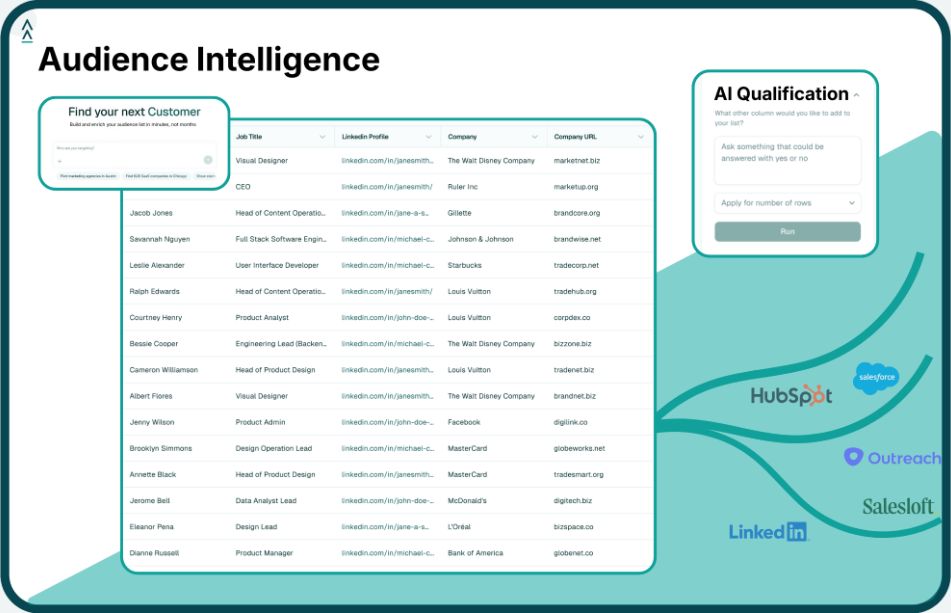
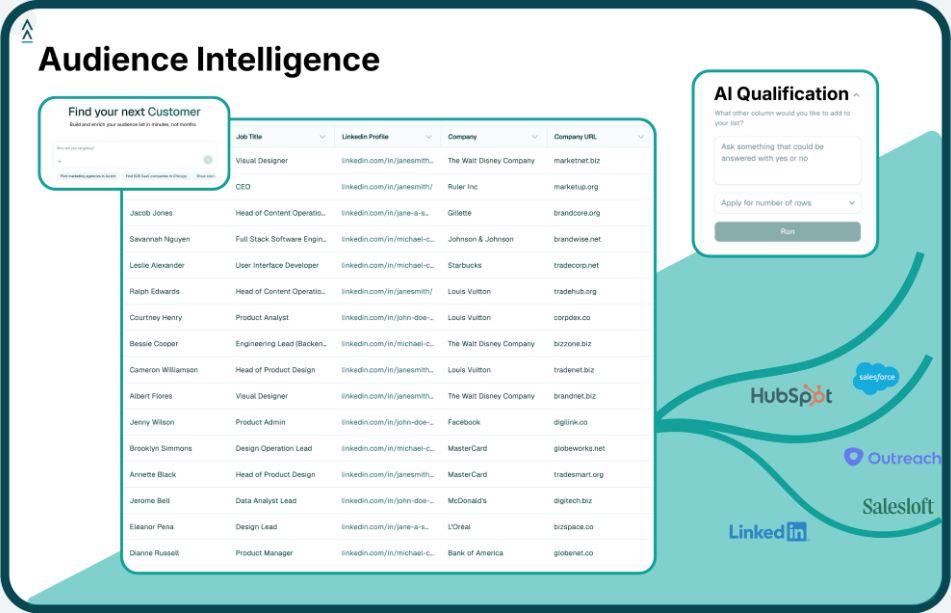
Landbase combines all three AI research capabilities (account scoring, contact qualification, and signal detection) into a single pipeline. The output is a scored, tiered account list with AI-qualified contacts classified by buyer role, exported as clean CSVs. The AI evaluates 1,500+ data points per account and applies multi-dimensional contact scoring rubrics with exclusion rules. The scoring model is calibrated against your closed-won data and recalibrated with conversion data from each outreach cycle. For the full operational context, see the outbound operations playbook.
With platforms like Landbase, no. The AI scoring models, contact qualification rubrics, and signal detection are built into the platform. The enterprise team provides the ICP criteria (what to score against) and the closed-won data (to calibrate the model). The data science infrastructure is handled by the platform. According to Bain research on AI adoption in sales, the teams that see the fastest results from AI account research are those that bring clear ICP definitions rather than those that bring data science capability.
Run a blind test on accounts your team already knows. Score 100 accounts that include a mix of closed-won customers, active opportunities, and accounts the team has disqualified. Check whether the AI scores align with reality: closed-won accounts should score highest, active opportunities should score in the middle, and disqualified accounts should score lowest. If the ordering is wrong, the scoring criteria need adjustment.
AI replaces the research tasks that SDRs currently perform manually. It does not replace the human interaction: the conversation, the objection handling, the relationship building, and the judgment calls that happen on live calls. AI gives SDRs better data so they spend their time on conversations rather than research. According to McKinsey research, enterprise teams that adopt AI for research see SDR productivity increase by 30-50% because reps redirect research hours to selling hours.
The first scored TAM and qualified contact list can be produced in days. The scoring model improves with each outreach cycle as conversion data refines the criteria. Enterprise teams typically see measurable improvement in targeting precision by the second campaign cycle and significant improvement by the fourth or fifth cycle as the feedback loop compounds.
Tool and strategies modern teams need to help their companies grow.