.png)
.png)

Daniel Saks
Chief Executive Officer


Enterprise SDR teams accumulate tools. A CRM for pipeline. A sequencer for outreach. A dialer for call volume. A data provider for contacts. Conversation intelligence for coaching. Intent data for timing. A scheduling tool for meeting booking. By the time a team hits 50 reps, they are running eight to twelve tools with a combined annual spend of $750K to $1.25M.
According to Gartner research on sales technology, the average enterprise sales organization uses 10 or more tools in its tech stack. According to Forrester research on sales operations, despite this investment, 58% of enterprise sales leaders say their SDR teams are still not productive enough. The tools handle execution. The targeting precision that determines whether those tools are used on the right accounts is where most stacks have a gap.
Salesforce or HubSpot. The system of record for accounts, contacts, opportunities, and pipeline. At enterprise scale, the CRM is deeply customized with territory rules, lead routing, approval workflows, and reporting dashboards. According to Salesforce research on sales performance, CRM data quality is the foundation of every downstream process. When the CRM data is incomplete, scoring, routing, and reporting all underperform. See the guide on why leads die in your CRM for more on this dynamic.
Outreach, SalesLoft, or Apollo sequences. The tool that automates multi-step outreach: email cadences, LinkedIn steps, phone tasks, and follow-up timing. At 50+ reps, the sequencer runs thousands of active sequences simultaneously. The sequencer's output quality depends entirely on who is in the sequence. According to McKinsey research on outbound effectiveness, personalized sequences targeting the right contact convert at 3-5x the rate of generic sequences targeting a broadly filtered list.
Orum, Nooks, Koncert, or a built-in CRM dialer. The tool that increases call volume per rep through parallel dialing, automated voicemail drops, and live connect routing. At enterprise scale, the dialer amplifies the quality of the call list. A parallel dialer burning through 200 contacts per day on a poor list produces more wrong numbers, more gatekeepers, and more wasted connects than a serial dialer on a well-qualified list.
ZoomInfo, Cognism, Apollo, Lusha, or similar. The source of company and contact records. At 50+ reps consuming hundreds of contacts per week, data credit costs scale quickly. The challenge is not access to data. It is the quality of the data that reaches the rep. For a detailed evaluation framework, see the guide on evaluating B2B data providers.
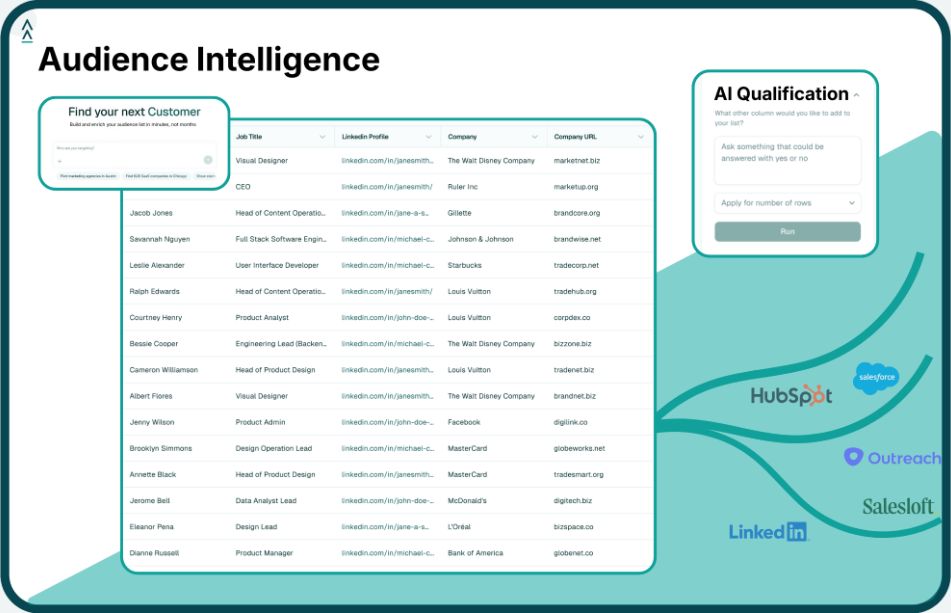
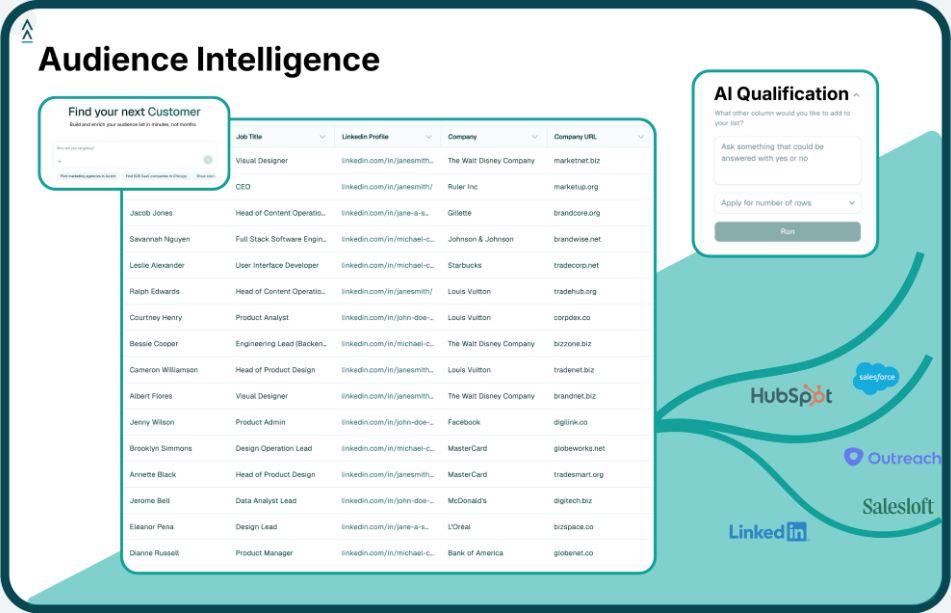
This is the layer most enterprise stacks are missing. It sits between the data provider (Layer 4) and the execution tools (Layers 2 and 3). The intelligence layer scores accounts against ICP criteria, qualifies contacts by decision-making authority, assigns territories with balance and deduplication, and closes the feedback loop between call outcomes and the next list build.
Without this layer, the SDR team receives raw contacts from a database and relies on each rep to manually assess account fit, verify contacts, and self-select which accounts to work. At 50+ reps, that manual process produces inconsistent targeting quality across the team and consumes hours of rep time that should be spent selling.
According to Harvard Business Review research on enterprise selling, the teams that invest in upstream account intelligence outperform teams that invest exclusively in downstream execution tools. The intelligence layer is where Landbase sits in the stack: propensity-scored accounts, AI-qualified contacts, and territory-assigned CSV exports that feed the CRM, sequencer, and dialer with pre-qualified data.
Total annual stack cost divided by total meetings booked. This metric reveals whether tool investments translate into pipeline. If the cost per meeting is increasing as the stack grows, the marginal tools are adding cost without proportional output.
What percentage of rep time is spent on active selling (dialing, emailing, taking meetings) versus research, data entry, and contact verification? According to Salesforce research, the average SDR spends only 28% of their time on active selling. The intelligence layer directly improves this metric by eliminating the research and verification steps.
Total pipeline value generated divided by total annual stack cost. This is the ultimate ROI metric. According to Bain research on B2B sales efficiency, the teams with the highest pipeline-per-dollar invest proportionally more in targeting quality (the intelligence layer) than in execution tool capacity.
At 50+ reps, consolidation is almost always the right move. Each additional tool adds integration complexity, training burden, and vendor management overhead. The exception is the intelligence layer, which most stacks lack entirely. Adding that layer is an addition that reduces the burden on every other tool because it improves the quality of the input data they all consume.
It depends on what the intelligence platform provides. If the platform scores accounts, qualifies contacts, and exports territory-assigned CSVs using its own data (as Landbase does), it can replace or supplement the data provider. If the platform only provides scoring logic and requires a separate data source, you need both. The evaluation should compare total cost of ownership and output quality side by side.
The tool with the lowest measurable impact on pipeline. Run an attribution analysis: which tools touch the highest-converting deals? Which tools are used by reps daily versus occasionally? The tools with the lowest usage and lowest pipeline attribution are candidates for removal. Do not cut the intelligence layer to preserve execution tools. The intelligence layer improves the ROI of every execution tool in the stack.
Landbase is the intelligence layer (Layer 5). It sits between the data source and the execution tools. Landbase scores accounts, qualifies contacts with AI, assigns territories, and exports clean CSVs that feed the CRM (Layer 1), sequencer (Layer 2), and dialer (Layer 3). The output is the targeting intelligence that makes every downstream tool more productive. For how the full outbound operations cycle works, see the playbook.
Tool and strategies modern teams need to help their companies grow.