.png)
.png)

Daniel Saks
Chief Executive Officer


Enterprise sales teams spend $200K or more annually on B2B data providers. ZoomInfo, Cognism, Apollo, Lusha, and a growing list of alternatives all compete on the same pitch: more contacts, better coverage, cleaner data. The evaluation process at most companies compares database size, price per credit, and feature lists. Those criteria measure the provider's marketing claims. They do not measure whether the data will actually help your SDRs book meetings.
According to Forrester research on B2B revenue operations, data quality is the single largest determinant of outbound conversion rates. A 10% improvement in contact accuracy compounds through every stage of the funnel: more connects per dial, more meetings per connect, more opportunities per meeting. According to Gartner research on sales data quality, the average B2B database has a 25-30% error rate across contact records, with the rate increasing in industries with non-standard org charts and high employee turnover.
Every provider claims high accuracy rates in their marketing. What matters is accuracy at the specific accounts your team sells to. A provider may have excellent coverage for enterprise SaaS companies and poor coverage for trades contractors, healthcare systems, or financial services firms. The evaluation must test accuracy within your ICP.
How to test: select 50 to 100 accounts from your CRM where your reps have verified the contacts through real conversations. Pull the same accounts from the provider. Compare: how many of your verified contacts did the provider also surface? How many additional contacts did they provide, and are those contacts accurate? How many contacts did they return that are wrong (left the company, wrong title, wrong role)?
According to McKinsey research on B2B sales productivity, enterprise teams that run this proof-of-concept before committing to an annual contract avoid the most common data provider failure: paying for coverage that looks comprehensive in aggregate but underperforms on the accounts that matter.
There is a difference between returning contacts and returning qualified contacts. Most providers return everyone at a company who matches a title filter. A strong provider goes further: scoring contacts by seniority, evaluating role evidence from profile text and headline, classifying contacts by buyer role, and excluding contacts that waste rep time.
Ask the provider: do you score contacts by decision-making authority? Can you classify contacts into buyer tiers (economic buyer, technical evaluator, end user)? Do you apply exclusion rules for contacts that are unlikely to be relevant? For a detailed framework on what contact scoring should include, see the guide on enterprise contact scoring.
According to Harvard Business Review research on complex selling, the precision of contact targeting is a stronger predictor of outbound conversion than the volume of contacts available. Enterprise teams consistently find that fewer, better-qualified contacts outperform larger, unfiltered lists.
How often does the provider refresh its data? Monthly, quarterly, annually? What percentage of contacts in their database have been verified within the last 90 days? According to Salesforce research on sales performance, contact data that is more than six months old has a 15-20% probability of being inaccurate due to job changes, company restructuring, and email domain changes.
Ask the provider for their decay rate: what percentage of contacts in their database change per quarter? How do they detect and update stale records? Do they proactively refresh high-value accounts or only update when a user queries the record? The answers reveal whether the provider treats data freshness as a core capability or an afterthought. For more on how data decay affects outbound operations, see the guide on contact verification at scale.
Enterprise teams need data that fits their existing workflow. The evaluation should test: can the data be exported as a clean CSV? Are the field names and formats compatible with your CRM schema? How much manual transformation is required to import the data? Can the export be automated or does it require manual pull-and-download each time?
The practical test: export a sample list and time how long it takes to get the data from the provider into your CRM and sequencer with campaign tags applied. If the answer is more than 30 minutes of manual work, the provider's workflow compatibility is a liability at scale.
The most advanced providers do not just return company records. They score companies against your specific ICP criteria and tier them by propensity to buy. This turns a database query into a scored TAM that tells your team which accounts to prioritize.
Ask the provider: can you build a scoring model based on our closed-won data? Can you tier accounts by propensity? Can you run ML-powered lookalike expansion from our best customers? These capabilities separate data access tools from account intelligence platforms. Landbase delivers all three: propensity scoring, tiered account lists, and ML expansion, exported as clean CSVs.
Pick accounts where your team has real contact-level ground truth: verified decision-makers, known buying committee members, confirmed titles and roles. These are accounts where you know what accurate data looks like.
Query the same accounts through the provider. Request the full contact list with titles, roles, and any scoring or classification data they offer.
Coverage: what percentage of your verified contacts did the provider also return? Uplift: how many additional contacts did they find that are accurate and relevant? Noise: how many contacts did they return that are wrong, stale, or irrelevant? According to Bain research on B2B sales efficiency, the ratio of signal to noise in the provider's output is the single best predictor of real-world outbound performance.
Time the full workflow: query, export, clean, transform, import. Multiply by the number of campaign cycles per year and the number of SDRs. This reveals the total cost of ownership beyond the license fee.
Most enterprise teams use two to three providers to maximize coverage. The primary provider handles the bulk of account and contact data. A secondary provider fills gaps in specific verticals or geographies. A verification layer (email validation, phone verification) runs on top. The challenge with multiple providers is deduplication and data consistency. A platform like Landbase aggregates across data sources and delivers a single, deduplicated, scored output.
Run the same proof-of-concept on the same 50 to 100 accounts across all providers being evaluated. Compare coverage, uplift, noise, and workflow time side by side. The provider that delivers the highest ratio of accurate, qualified contacts with the least operational overhead wins regardless of database size or pricing model.
Enterprise teams with 25 or more SDRs typically spend $150K to $400K annually on data providers, with the range depending on the number of seats, credit volume, and add-on products. The evaluation should focus on ROI per dollar spent rather than absolute cost. A provider that costs 50% more but delivers 2x the qualified contacts per account produces a better return.
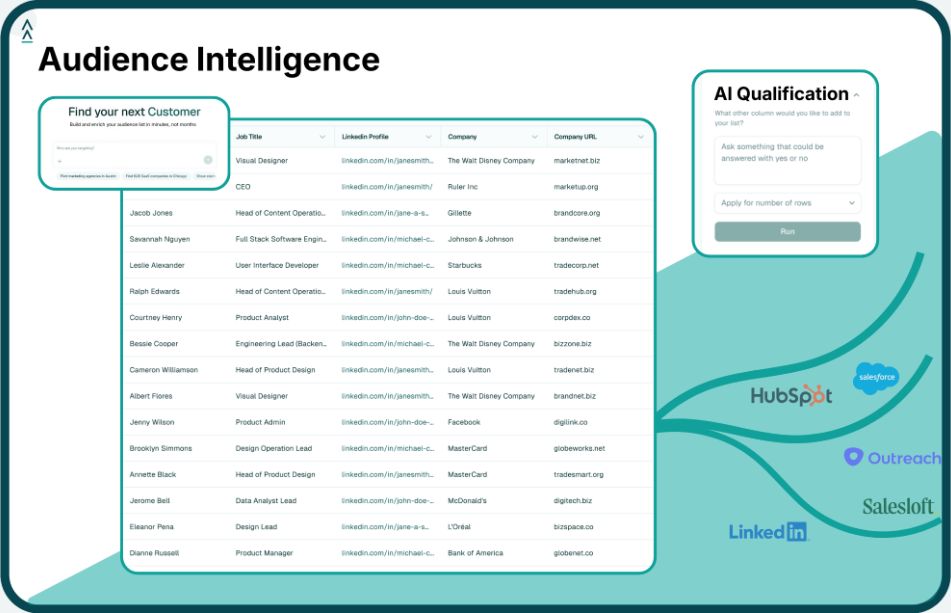
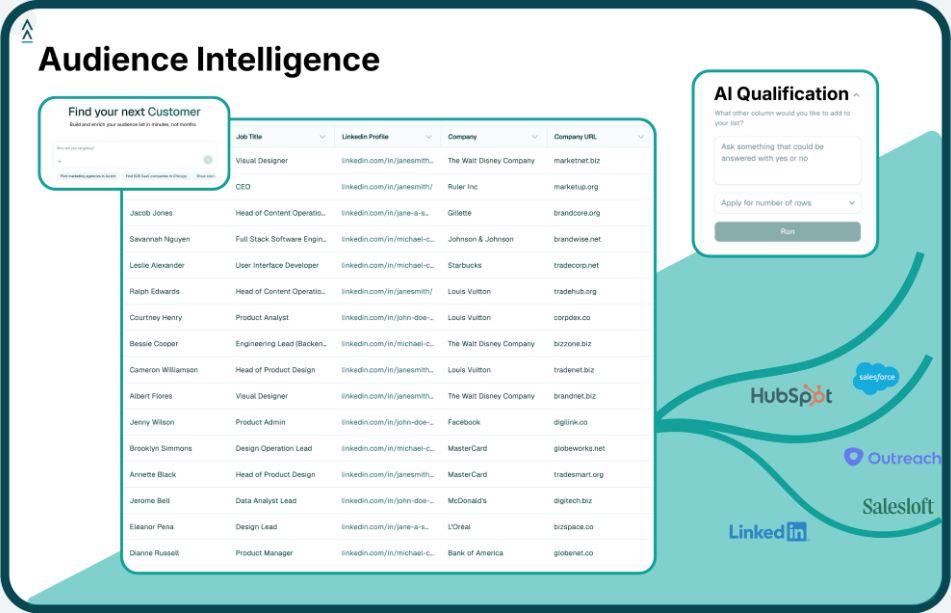
Traditional data providers give you access to a database. You query, filter, export, and clean the data yourself. Landbase delivers scored, AI-qualified account lists with contacts classified by buyer role and filtered through exclusion rules. The output is a clean CSV per territory, ready to import. The difference is between raw materials and a finished product.
Tool and strategies modern teams need to help their companies grow.