.png)
.png)

Daniel Saks
Chief Executive Officer


Enterprise sales leaders know their data is imperfect. The question they rarely answer is: how much is that imperfection actually costing? The answer, when calculated precisely, is usually large enough to fund the solution several times over.
According to Gartner research on data quality, the average cost of a single bad contact record is $100 across research time, failed outreach attempts, and downstream effects. At enterprise scale with thousands of contacts per campaign cycle, the aggregate cost is substantial. According to Harvard Business Review research on sales efficiency, enterprise sales teams lose 15-25% of potential selling time to data quality issues, making data quality the single largest addressable productivity drain in most outbound organizations.
According to Salesforce research on sales performance, the average SDR spends 28% of their time on active selling. The remaining 72% goes to research, data entry, CRM updates, and internal meetings. Within that 72%, an estimated 15-20% is directly attributable to data quality problems: verifying contacts before dialing, researching companies that should have been pre-enriched, re-checking stale information, and handling wrong-person outcomes on calls.
At a 50-person SDR team with fully loaded cost of $85K per rep (salary, benefits, tools, management overhead):
According to McKinsey research on sales productivity, these hours represent the most recoverable capacity in the SDR org because they can be eliminated through upstream data quality improvements without any change to rep behavior or skill level.
At a 20-30% annual contact decay rate (per research on CRM data hygiene), one in four to five contacts in the database is stale. Each wrong-number call costs the rep approximately five minutes of preparation and dial time. At 50 reps making 50 dials per day, a 20% wrong-contact rate means 500 wasted dials per day across the team.
Invalid email addresses cause hard bounces that damage sender reputation. At enterprise outbound volume (40K-50K emails per month), a 3% invalid rate means 1,200-1,500 bounces per month. According to Forrester research on outbound effectiveness, sustained bounce rates above 2% trigger spam filter escalation that reduces inbox placement by 15-25% for the entire domain. The revenue impact of reduced email performance across the team is a multiplier on the direct bounce cost. See the guide on enterprise email deliverability for the full deliverability framework.
At 50+ SDRs, building campaign-ready lists (scoring accounts, pulling contacts, cleaning data, assigning territories, deduplicating against the pipeline) can consume weeks of RevOps or sales leadership time per cycle. According to BCG research on enterprise go-to-market, enterprise sales leaders spend an estimated 20-30% of their time on operational tasks that should be systematized.
A VP of Sales or Head of SDR Operations with a fully loaded cost of $250K-$350K spending 25% of their time on list operations represents $62K-$87K annually in misallocated executive capacity. More importantly, that time is taken directly from coaching, strategy, and conversion optimization activities that have higher leverage on pipeline outcomes. See scaling outbound at 50+ SDRs for how to eliminate this cost.
Title-based database filters surface contacts at accounts the team already knows. They miss accounts that fit the ICP but use non-standard titles, operate in adjacent industries, or lack the technology signals that standard filters check for. According to Bain research on B2B sales growth, enterprise teams that use ML-powered TAM mapping and AI-powered contact qualification discover 30-50% more viable accounts than those using firmographic filters alone.
If a 50-person SDR team generates $200K in pipeline per rep per month, and better data would uncover 30% more viable accounts, the opportunity cost of the data gap is approximately $3M per month in unrealized pipeline potential. The conversion rate on those accounts would reduce the actual number, but even at a conservative 10% capture rate, the missed pipeline is $300K per month.
Compare against the annual cost of the intelligence layer that prevents these costs. Most enterprise data intelligence platforms cost $100K-$300K annually. The ROI is clear before accounting for the compounding benefit of improved targeting quality over multiple campaign cycles.
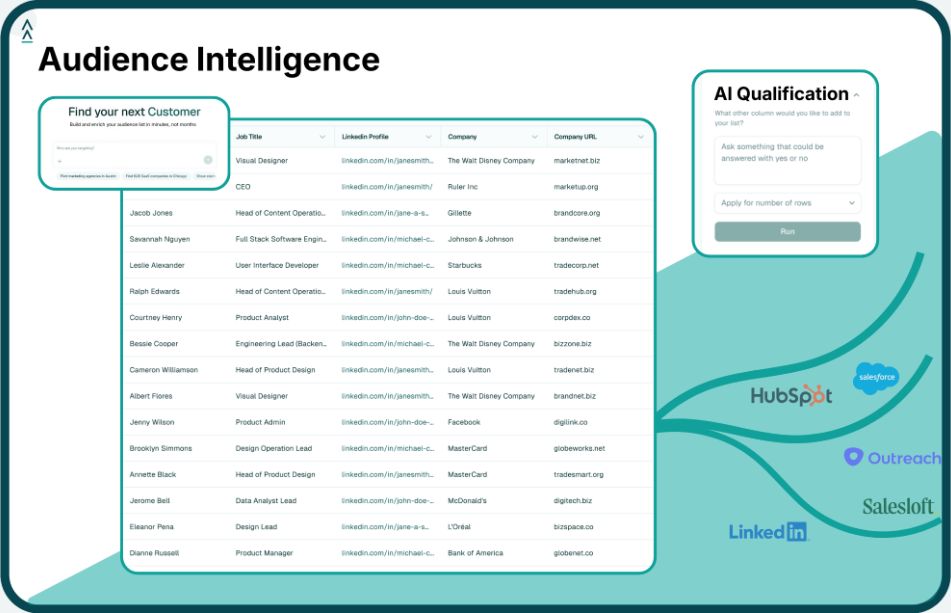
Landbase eliminates the upstream data quality problems that drive these costs. Scored accounts remove the need for rep research. AI-qualified contacts with exclusion rules eliminate wrong-person dials and reduce bounces. Automated territory assignment removes leadership list-building time. ML-powered TAM expansion surfaces the accounts that title-based filters miss. The output is a clean CSV per territory, ready to import, with every contact pre-qualified and every account pre-scored.
Start with a one-week time audit. Have each SDR log time spent on: manual research before calls, contact verification, handling wrong-person outcomes, and CRM data cleanup. Multiply the average hours by fully loaded rep cost and team size. Add monthly bounce counts multiplied by $100 per bounce. This gives you the direct and deliverability costs. The opportunity cost requires a TAM mapping exercise to quantify the gap between known accounts and total market.
Switch the next campaign cycle's list to AI-qualified contacts from a platform like Landbase. Compare the conversion metrics (dial-to-connect, connect-to-meeting, bounce rate) against the previous cycle's manually built list. The delta in the first cycle quantifies the value of the intelligence layer. Most enterprise teams see measurable improvement in the first campaign.
It increases non-linearly. Each additional SDR adds the same per-rep cost of data tasks, but the operational costs (territory assignment complexity, pipeline deduplication effort) and deliverability costs (aggregate email volume amplifying bounce rate impact) grow faster than linearly with headcount. The cost of bad data at 100 SDRs is more than double the cost at 50. This is why the intelligence layer investment should precede team expansion.
Lead with the recoverable SDR capacity number. CFOs understand headcount cost. Saying 'we are losing $640K annually in SDR productivity to data tasks' is a concrete, verifiable claim. Follow with the deliverability cost and the leadership time cost. Present the opportunity cost last because it requires assumptions. Frame the intelligence layer investment as a cost recovery: the platform does not add expense, it recovers capacity that is currently being wasted.
Tool and strategies modern teams need to help their companies grow.