.png)
.png)

Daniel Saks
Chief Executive Officer


Enterprise outbound is an operational discipline. The sales leadership team sets the strategy. The SDRs execute the outreach. Between strategy and execution is a layer of operational work that determines whether the SDR team is calling the right accounts with the right contacts at the right time. That layer is outbound operations.
According to BCG research on enterprise go-to-market, companies with structured revenue operations functions grow 36% faster. The operational layer is where the leverage lives. A 10% improvement in list quality compounds through every downstream metric: dial-to-connect, connect-to-meeting, meeting-to-opportunity, and opportunity-to-close. According to Forrester research on sales operations, enterprise sales teams with dedicated operations functions achieve 28% higher quota attainment.
Every campaign starts with a scored view of the addressable market. The scoring model evaluates each account against ICP criteria: industry fit, company size, revenue range, technology stack, growth trajectory, and buying signals. The output is a tiered account list where A-tier accounts receive immediate outreach and lower-tier accounts are held for future cycles or additional verification.
The scoring criteria should be derived from closed-won data. If 70% of closed deals came from Series B to D SaaS companies with 200 to 2,000 employees using Salesforce, those attributes get the highest weights. See the TAM mapping guide for a detailed methodology.
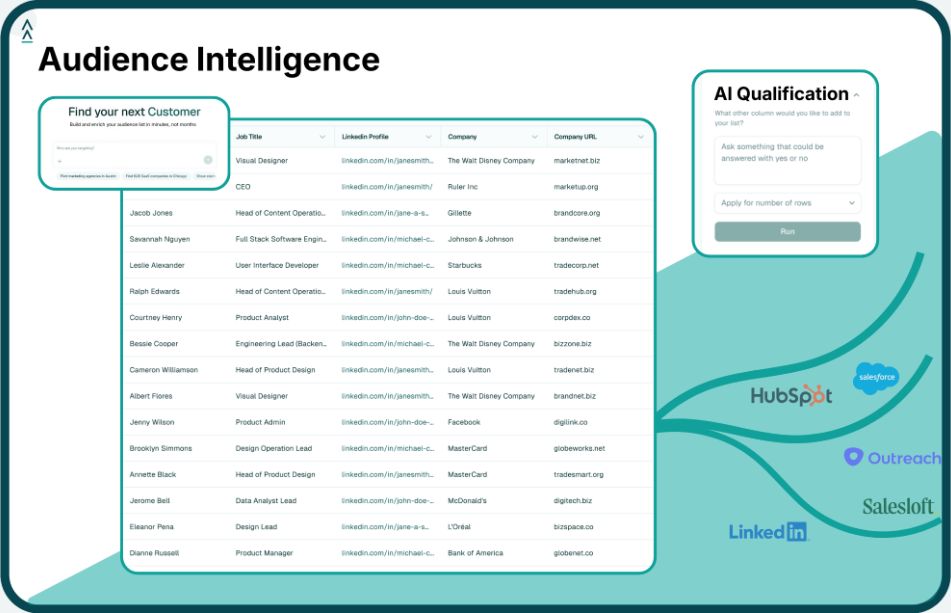
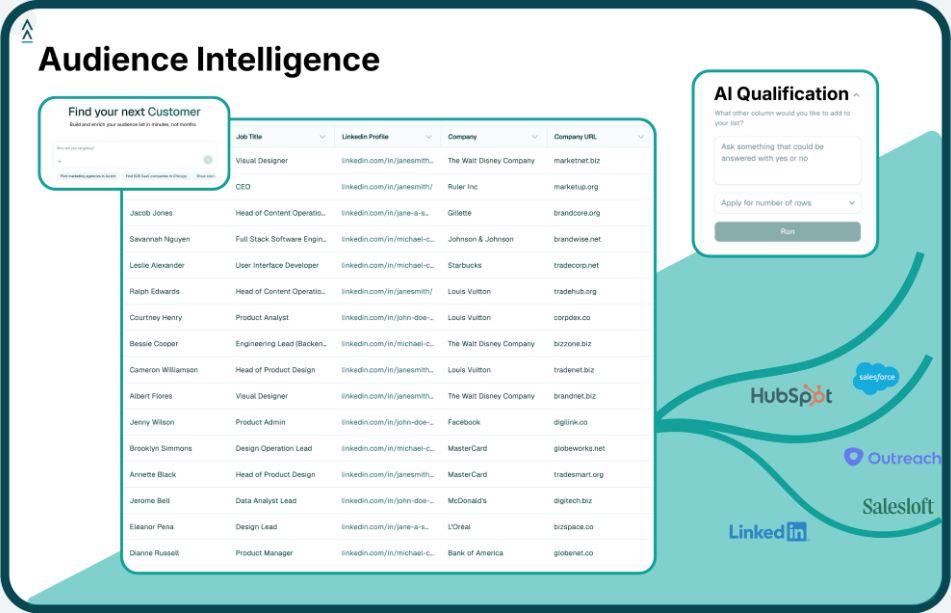
For each scored account, identify the contacts who have purchasing authority or influence over the buying decision. AI-powered contact scoring evaluates every contact by title, seniority, role evidence, and decision-making signals. Exclusion rules remove contacts that would waste rep time. The output is a qualified contact list with each person classified by buyer role.
According to Gartner research on enterprise buying, the average purchase involves six to ten stakeholders. Contact qualification at the list level ensures reps receive accounts with multiple entry points into the buying committee rather than a single contact.
Distribute scored accounts and qualified contacts across the SDR team with balance by segment, geography, tier, and vertical. All contacts at a given company should go to the same rep. The distribution should be deduped against the CRM pipeline so reps only receive net-new accounts. The output is one CSV per rep territory, ready for CRM import.
At 25 or more SDRs, automated territory assignment replaces the spreadsheet process that breaks under operational load. According to McKinsey research on sales productivity, territory overlap and imbalance are among the most common sources of wasted selling time in large outbound organizations.
SDRs work the list through the outbound stack: dialer, email sequencer, LinkedIn. Every disposition should be captured in a structured format rather than free text. Connect, no answer, wrong person, left company, not interested, interested but not now, meeting booked. Structured dispositions are the raw material for the feedback loop.
After each campaign cycle, analyze the disposition data. Which account profiles converted to meetings? Which contact types picked up the phone? Which verticals or segments underperformed? This data feeds back into the scoring model for the next cycle. The scoring criteria that produced campaign two should be adjusted based on what campaign one revealed. Over multiple cycles, the model converges on the account profiles and contact types that actually convert. According to Harvard Business Review research on sales effectiveness, data-driven refinement of targeting criteria is the single highest-leverage improvement an enterprise sales team can make.
Run the scoring model against the TAM. Qualify contacts at the top-tier accounts. Assign territories. Export CSVs. With an AI-powered platform like Landbase, this phase takes hours rather than weeks. The output goes directly to reps as CRM-importable files.
SDRs work the list. Multi-channel outreach: phone, email, LinkedIn. Every call disposition captured structured. Leadership monitors daily activity metrics but focuses coaching on conversion quality rather than dial volume.
Pull disposition data. Calculate conversion rates by account tier, contact type, vertical, and geography. Identify the patterns. Adjust scoring weights. Build the next cycle's list using the refined model. The scoring criteria that run the next sprint are sharper than the ones that ran this sprint.
Landbase centralizes the first three phases of the outbound cycle: account scoring, contact qualification, and territory assignment. The output is a set of clean CSVs with every account scored, every contact AI-qualified and classified by buyer role, and every territory balanced and pipeline-deduped. The scoring model persists between cycles and can be recalibrated with disposition data to sharpen each campaign. For the full metrics framework to measure outbound performance, see the RevOps KPI dashboard.
Typically a RevOps leader, SDR operations manager, or Head of Sales Development. The role sits between the VP of Sales (who sets strategy) and the SDR team (who executes). At companies with 50 or more SDRs, this is a dedicated function. At smaller companies, it is often shared by the sales leader and a RevOps generalist. See the guide on making your first RevOps hire for more context.
Two to four weeks for execution, plus one week for analysis and refinement. Shorter cycles generate feedback faster but require more frequent list builds. Longer cycles give reps more time to work accounts but delay the learning loop. Most enterprise teams settle on a three-week execution window with one week for analysis.
At enterprise scale, yes. Inbound lead management (routing, scoring, SLA enforcement) and outbound list operations (account scoring, contact qualification, territory assignment) are different disciplines with different data sources, different metrics, and different operational rhythms. A single RevOps leader can oversee both, but the day-to-day operations should be separated to prevent one from cannibalizing the other's attention.
Five core metrics: list-to-dial ratio (percentage of exported contacts that receive at least one attempt), dial-to-connect rate, connect-to-meeting rate, meeting-to-opportunity rate, and leadership hours spent on list operations per cycle (should trend toward zero as automation increases). The compound of the first four metrics is your outbound pipeline velocity.
Tool and strategies modern teams need to help their companies grow.