.png)
.png)

Daniel Saks
Chief Executive Officer


Hiring SDRs is straightforward. Keeping them productive at scale is where most teams fail. The infrastructure that supports 10 reps breaks at 30. The processes that work at 30 collapse at 75. Every stage of growth requires a different level of operational maturity, and the teams that build the infrastructure ahead of the headcount scale smoothly while the teams that chase headcount with infrastructure spend quarters in operational chaos.
According to BCG research on enterprise sales scaling, the most common failure mode in SDR team expansion is hiring faster than the supporting systems can absorb. According to Forrester research on sales operations, companies that invest in operations infrastructure before scaling achieve 40% faster time-to-productivity for new hires because the systems that feed reps with qualified accounts are already running.
At this stage, everything runs on people. The sales leader picks accounts, pulls contacts from a database, and distributes them manually. Onboarding is one-on-one shadowing. Coaching happens organically because the manager has capacity. The process works because the volume is manageable.
What to build now for the next stage: define the ICP formally (written criteria, not just intuition), establish a consistent disposition tracking process (structured fields, not free text), and document the list-building workflow so it can be delegated.
Manual processes start to strain. List building takes days instead of hours. Territory overlap begins. The manager splits time between coaching and operations. New hires ramp more slowly because the manager has less capacity for one-on-one onboarding.
What to build now: introduce account scoring to replace manual account selection, begin using AI-powered contact qualification to replace title-based database pulls, and establish territory rules that can be automated. According to Harvard Business Review research on sales effectiveness, the transition from manual to systematic list operations typically happens too late. Building it at 15 reps is optimal. Building it at 25 is reactive.
This is the stage where most teams experience the first real operational crisis. List building becomes a multi-week project. Territory assignment is contentious. Leadership is fully consumed by operations. New hire ramp time extends because onboarding competes with operations for manager attention.
What to build now: centralize list operations into a single pipeline (scoring, qualification, assignment, export), hire or designate a dedicated operations owner, and build the feedback loop between call outcomes and list quality. The operational investment at this stage pays for itself within two campaign cycles through reduced leadership time and improved list quality. See scaling outbound at 50+ SDRs for the full breakdown.
At this scale, outbound operations is a function. It requires dedicated headcount, a technology platform for list intelligence, and a mature feedback loop that recalibrates scoring with every cycle. Multiple segments, verticals, or product lines may each require their own ICP criteria and contact qualification approach.
What to build now: segment-specific scoring models, buying committee mapping at the list level for enterprise accounts, automated territory assignment with multi-variable balancing, and board-level penetration reporting against the scored TAM. According to McKinsey research on scaling sales organizations, the companies that achieve consistent growth at 50+ reps have invested in operational infrastructure that makes each incremental hire productive from their first week.
The single biggest determinant of new SDR productivity is what they receive on their first day. A rep who walks into a scored account list with AI-qualified contacts and a territory assignment starts making calls in their first week. A rep who walks into a blank CRM territory and a ZoomInfo login spends their first month researching and self-selecting accounts. According to Salesforce research on sales performance, the gap in ramp time between these two scenarios is measured in weeks, and every week of delayed productivity at fully loaded SDR cost is real money.
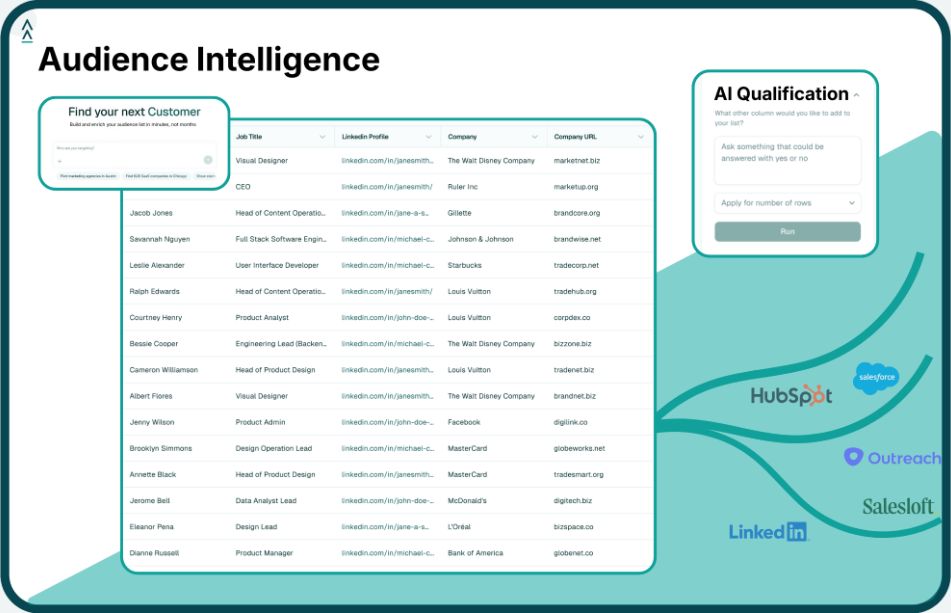
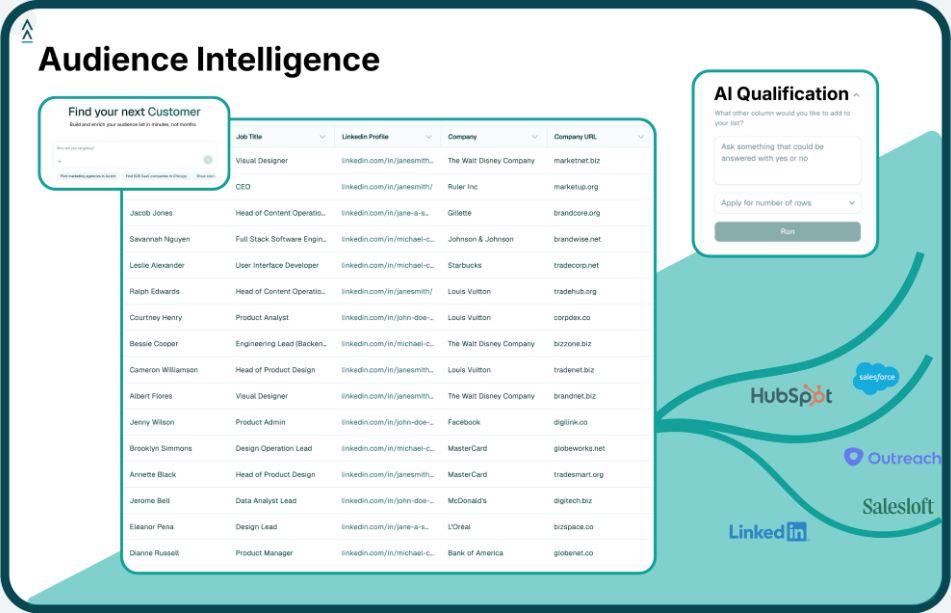
Landbase solves the day-one problem by delivering scored, territory-assigned account lists as CSV exports before the new hire starts. The rep imports their territory into the CRM, loads contacts into the sequencer, and begins outreach on day one with the same data quality as tenured reps.
Six to eight. Above eight direct reports, coaching quality degrades because the manager cannot dedicate enough time per rep to meaningfully improve performance. At 50 SDRs, you need six to eight frontline managers plus operations support. This ratio should drive your hiring plan for managers alongside reps.
A mix. Experienced SDRs (one to two years of outbound experience) can be productive within days if they receive a qualified account list. New SDRs require four to eight weeks of structured onboarding. At scale, the ratio should be roughly 60% experienced, 40% new, with the experienced reps serving as peer mentors during the onboarding period.
Measure two things: average time from campaign decision to first dial (should be under one week) and leadership hours spent on list operations per cycle (should trend toward zero as automation increases). If either metric is moving in the wrong direction as you add reps, operations is the constraint. Adding more reps will not improve pipeline until the operations bottleneck is resolved.
Scored account lists with AI-qualified contacts, exported as one CSV per rep territory, balanced by segment and tier, and deduped against the CRM. The list operations pipeline scales with headcount because adding a new territory is a configuration change in the export, not a multi-day manual build. New reps receive their territory file before their start date.
Tool and strategies modern teams need to help their companies grow.