.png)
.png)

Daniel Saks
Chief Executive Officer


An Ideal Customer Profile (ICP) is a multi-dimensional definition of the company most likely to buy, expand, and retain. A complete ICP includes five layers: firmographic fit (industry, size, geography), technographic signals (technology stack), behavioral signals (hiring, funding, growth), organizational readiness (the buyer persona and process maturity), and negative indicators (red flags that disqualify even matching accounts). Firmographics alone describe a company. The other layers predict whether it will buy.
According to research on ideal customer profiles, 68% of B2B companies have not clearly defined their ICP. As Forrester's B2B revenue research confirms, targeting precision is the single highest-leverage variable in pipeline efficiency. Companies with a clearly defined ICP report 68% higher win rates than those without.
Quick answer: A B2B ICP combines firmographics (industry, size), technographics (tech stack), behavioral signals (hiring, funding), organizational readiness (does the buyer exist), and negative indicators (what disqualifies). Use closed-won data to weight each dimension, then score every account in the addressable market against all five layers.
A complete ICP has five layers. Most teams only build the first one.
This is where every ICP starts and where most stop. Firmographic fit includes:
What technology does your ideal customer already use? Technology stack reveals budget, sophistication, and compatibility.
What actions indicate a company is ready to buy right now?
Does the company have the people and processes to buy and implement your product?
Equally important: define who is not your ICP.
Pull every closed-won deal from the last 12 months. For each one, capture: industry, company size, funding stage, technology stack, buying signal that triggered the deal, decision-maker title, and time from first touch to close.
Sort by deal size and retention rate. Your best customers (highest ACV, lowest churn, fastest expansion) share characteristics. Those shared characteristics are your ICP.
Compare your ICP criteria against closed-lost deals. If closed-lost deals share the same firmographic profile as closed-won deals, your ICP is missing a layer. Add technographic, behavioral, or organizational criteria until closed-won and closed-lost look different.
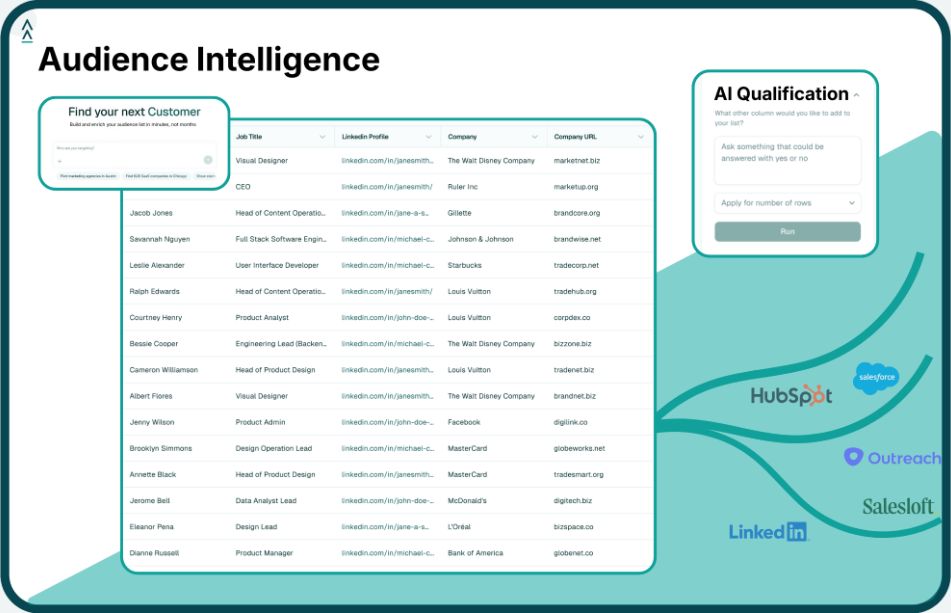
Turn your ICP into a scoring model. Every account in your TAM should be scored against all five layers. Landbase lets you define your ICP in plain language and automatically scores and qualifies your entire addressable market against it. Accounts that match across all five layers get prioritized. Accounts that match only on firmographics get deprioritized.
Markets change. Your best-fit customer in Q1 may not be your best-fit customer in Q4. Review closed-won data quarterly and adjust ICP criteria based on what is actually working. For a deeper look at how to audit the data that feeds your ICP, see our guide to running a CRM data audit.
The most common failure mode is an ICP that is too broad. "Mid-market B2B SaaS" describes a market segment. It does not tell reps which companies to call. An ICP that does not exclude anyone does not help anyone.
The second failure mode is an ICP that lives in a slide deck. The ICP needs to be embedded in your CRM as a scoring model that automatically prioritizes accounts. Slides get forgotten. Scoring models run every day.
The third failure mode is a static ICP. Markets shift. Buyer behavior changes. Your product evolves. An ICP that was built 18 months ago and never updated is working with stale assumptions.
An ICP describes the company. A buyer persona describes the person at that company who makes the buying decision. You need both: the ICP tells you which accounts to target, and the persona tells you which contacts to engage at those accounts.
Specific enough that it excludes at least 70% of your total addressable market. If your ICP includes most companies, it is not doing its job. The purpose of an ICP is to focus resources on accounts with the highest probability of converting and retaining.
Only if you have distinct products or motions for each one. Two ICPs with two dedicated sales motions works. Five ICPs that all share the same SDR team creates confusion and dilution. Start with one primary ICP and add secondaries only when the primary is fully operationalized.
Start with your first 10-20 customers. What do they have in common? If the sample is too small for patterns, use Landbase to find lookalike companies based on your best 5 customers. The platform identifies shared firmographic, technographic, and behavioral traits across accounts you specify and surfaces similar companies you have not found yet.
Tool and strategies modern teams need to help their companies grow.