.png)
.png)

Daniel Saks
Chief Executive Officer


Supply chain technology funding was $11.3 billion in 2023 after a sharp decline from its $52.2 billion peak, but only the most innovative companies captured investor attention. From AI-powered visibility platforms to autonomous warehouse robots, these companies are solving the industry's most pressing challenges: labor shortages, geopolitical disruption, sustainability mandates, and the demand for real-time transparency. For go-to-market teams in the supply chain sector, identifying high-intent prospects requires sophisticated audience discovery capabilities that can pinpoint companies actively investing in automation, navigating regulatory complexity, or expanding operations.
Altana operates an AI platform that analyzes 2.8 billion shipments, 500 million companies, and 850 million facilities to create unprecedented supply chain transparency. The platform maps global supply chains at granular detail, enabling businesses and governments to identify forced labor suppliers, track illicit substances, and ensure regulatory compliance. Their Value Chain Management System launched in 2024 provides the most detailed supply chain mapping available.
Flexport provides an end-to-end platform coordinating ocean, air, customs, trucking, and fulfillment for global logistics. The platform offers SKU-level visibility from purchase order creation through final delivery, processing billions in global trade annually. Flexport has evolved from a digital freight forwarder into a comprehensive logistics platform serving 40,000+ customers.
Nuvocargo provides an AI-powered platform specifically designed for U.S.-Mexico border freight, addressing the critical "border black hole" in North American trade. The platform includes cargo GPS tracking, dynamic ETA alerts, and automated regulatory compliance data entry. As the only AI-powered TMS built specifically for US<>MX<>CAN freight, it reduces customs crossing times and fees through CTPAT certification.
Blue Yonder offers an end-to-end supply chain platform spanning planning, retail, warehouse, and transportation operations, all powered by embedded AI/ML for adaptive decision-making. The platform serves as a multi-enterprise network enabling rapid reaction to global supply chain uncertainty. With $25 billion in machine workloads processed daily, it's a critical infrastructure for global enterprises.
Nimble operates fully autonomous warehouses using AI-powered general-purpose robots that handle picking, packing, and sorting without human intervention. The company reduces fulfillment costs by 40% through complete automation, requiring zero labor for core fulfillment operations. Their distributed fulfillment network provides 96%+ 1-2 day population coverage using ground shipping.
Kinaxis provides the Maestro platform with patented concurrency technology that enables simultaneous assessment of multiple planning scenarios in real-time. The platform integrates planning across inventory, production, and demand planning, allowing instant adaptation to supply chain changes. This real-time orchestration capability is crucial for navigating 2025's supply chain volatility.
Project44 operates a real-time supply chain visibility platform tracking 1.5B+ shipments annually across 1,400+ carrier integrations. Built on 7.3T+ annual data points, their Supply Chain AI provides decision intelligence for multimodal transportation across ocean, air, rail, and road. The platform serves 1,000+ enterprise customers including 7 of the top 10 CPG companies.
Manhattan Associates provides a unified supply chain execution platform combining Warehouse and Transportation Management Systems in their Manhattan Active suite. The platform features self-optimizing systems with agentic AI that act without human intervention, providing real-time optimization across logistics and fulfillment operations.
EcoVadis provides business sustainability ratings that assess suppliers' environmental and social performance, creating a collaborative platform for supply chain risk management. As ESG regulations tighten globally, the platform has become essential for Scope 3 compliance and sustainable procurement initiatives across global supply chains.
ShipBob operates a global network of 60+ fulfillment centers that have processed 250M+ orders with 99.97% accuracy and 99.6% on-time shipping. The platform provides 2-day shipping across continental US through distributed inventory and integrates with 50+ platforms including Shopify, Walmart, and SHEIN Marketplace.
Fabric provides robotic micro-fulfillment centers with tri-temperature automated systems (ambient, chilled, frozen) specifically designed for grocery retailers. Their modular robotics fit unconventional warehouse spaces and enable same-day delivery with profitable unit economics. The platform offers flexible deployment options from 4K sq ft Nano Express to 50K sq ft CFC configurations.
Stord combines software with a physical logistics network in a hybrid cloud supply chain platform that provides single-system control for omnichannel brands. The platform integrates warehousing, freight, and fulfillment management, allowing brands to control their entire supply chain through one interface rather than managing multiple vendors.
These 15 fastest-growing supply chain tech companies demonstrate how AI, automation, and specialized solutions are transforming global logistics. From Altana's AI mapping of 2.8 billion shipments to Nimble's fully autonomous warehouses, the common thread is using technology to solve specific, high-impact problems.
For these innovative companies, go-to-market execution is just as critical as product innovation. Identifying the right prospects requires understanding complex buying signals: companies struggling with warehouse labor shortages, navigating cross-border regulatory complexity, or investing in ESG compliance. This is where agentic AI platforms become essential.
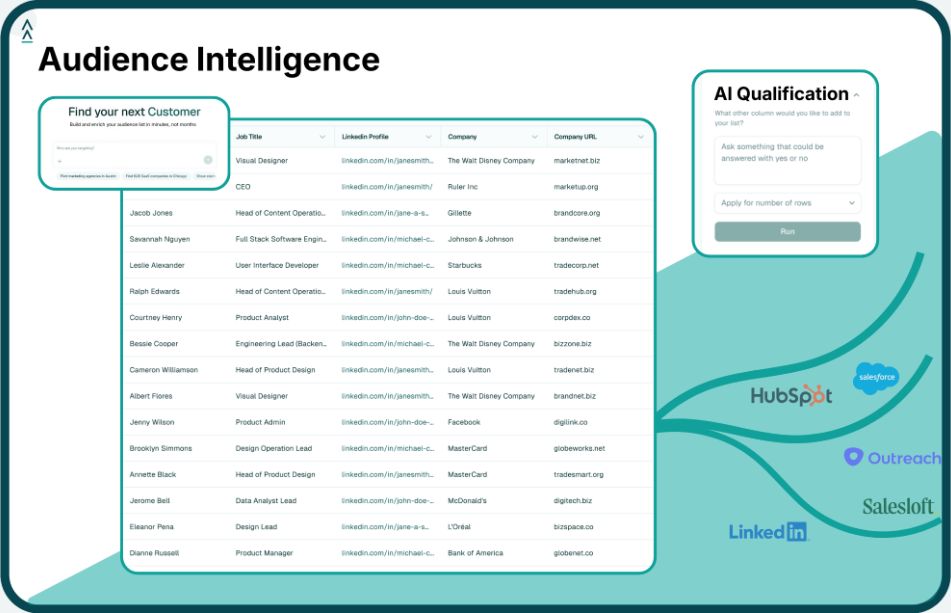
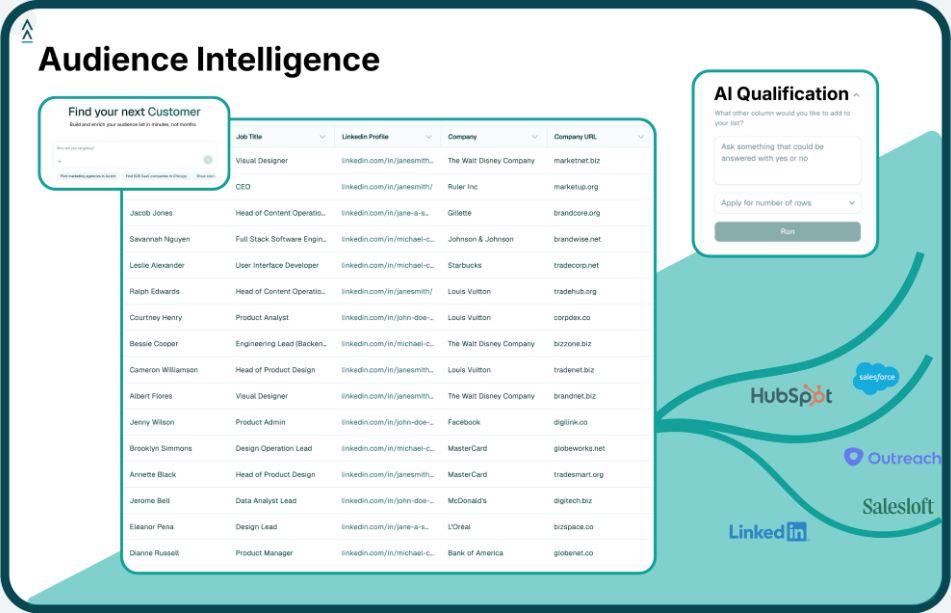
Rather than manually querying databases with complex filters, supply chain tech sales teams can use natural-language prompts like "VPs of Supply Chain at Fortune 500 companies adopting new warehouse automation technology in the last quarter" to instantly generate AI-qualified prospect lists. Landbase's VibeGTM interface interprets these plain-English queries and leverages 1,500+ unique signals including firmographic, technographic, intent, hiring, and funding data to deliver precise audiences.
This approach is particularly valuable in the supply chain sector, where buying cycles are long and require deep domain expertise. By targeting companies showing real-time intent signals – such as recent funding rounds, hiring surges in logistics roles, or technology stack changes – companies can dramatically improve engagement rates and shorten sales cycles.
This list highlights companies that demonstrate:
We prioritized companies with verified funding data from 2024-2025, measurable impact metrics, and clear explanations of their technology differentiators. The list represents a mix of AI-powered platforms, automation specialists, and vertical-focused solutions addressing the most pressing supply chain challenges.
The supply chain technology companies on this list are solving complex operational challenges, but they face their own go-to-market challenges. Their ideal customers are often large enterprises with sophisticated buying processes, multiple stakeholders, and specific regulatory or operational requirements.
Traditional prospecting approaches struggle with this complexity. Database filters can't capture nuanced buying signals like "companies expanding warehouse automation after recent Series C funding" or "retailers investing in same-day delivery capabilities."
This is where natural-language targeting transforms supply chain tech GTM. By describing ideal customer profiles in plain English, sales and marketing teams can:
Landbase's company data includes 300 million+ contacts and 24 million+ companies with 1,500+ unique signals spanning firmographic, technographic, intent, hiring, and funding data. This rich data layer enables supply chain tech companies to move beyond basic firmographic targeting to intent-based prospecting that drives real pipeline growth.
For supply chain technology companies competing in a rapidly evolving market, AI-powered GTM isn't just a competitive advantage – it's a necessity for efficient customer acquisition and market penetration.
A fastest-growing supply chain tech company demonstrates strong funding momentum with recent rounds in 2024-2025, measurable customer impact through quantifiable results like cost reduction or efficiency gains, and clear technology differentiation. These companies show market validation through enterprise adoption, industry recognition, or significant customer metrics. They typically address specific, high-impact supply chain challenges like labor shortages, cross-border complexity, or sustainability compliance.
AI is transforming supply chain tech growth strategies by enabling autonomous decision-making and real-time visibility. By 2028, 15% of day-to-day supply chain decisions will be made autonomously by AI agents according to Gartner research. Companies like Altana use AI to map 2.8 billion shipments for unprecedented transparency, while Nimble's autonomous warehouses reduce fulfillment costs by 40%. This AI foundation allows startups to deliver measurable ROI that justifies significant funding rounds.
These companies address several critical supply chain challenges: the 500,000 warehouse worker shortage driving automation adoption, cross-border regulatory complexity requiring specialized platforms like Nuvocargo, and ESG/Scope 3 compliance mandates creating demand for sustainability platforms. Additionally, there's a need for real-time visibility across fragmented global operations. Companies are also helping businesses navigate geopolitical disruption, tariff tensions, and the demand for same-day delivery with profitable unit economics.
Funding is critical for rapid expansion, as evidenced by the $11.3 billion invested in supply chain tech in 2023. This capital enables companies to scale operations, invest in R&D, and capture market share in competitive categories. Companies like Flexport ($2.7B total funding) and EcoVadis ($735M) demonstrate how significant funding rounds correlate with market leadership and expansion capabilities. However, the concentration of funding among proven players shows that investors prioritize companies with demonstrated customer impact over early-stage concepts.
The supply chain technology sector demands AI/ML engineers, robotics specialists, data scientists, and domain experts who understand both technology and supply chain operations. Companies like Nimble require robotics engineers with warehouse automation experience, while platforms like Altana need data scientists skilled in supply chain analytics. Additionally, there's strong demand for solutions architects who can implement complex platforms at enterprise customers and sales professionals who understand the nuanced buying processes of supply chain decision-makers.
Yes, smaller supply chain businesses can effectively leverage these emerging technologies, particularly through platforms designed for accessibility. ShipBob enables small ecommerce brands to access enterprise-grade fulfillment without capital investment, while Kojo helps smaller construction contractors compete through procurement efficiency. The key is identifying solutions that address specific pain points rather than implementing comprehensive platforms. Many of these technologies offer tiered pricing or usage-based models that make them accessible to smaller businesses while delivering measurable ROI.
Tool and strategies modern teams need to help their companies grow.