Daniel Saks
Chief Executive Officer


Singapore-based startups raised S$5.9 billion across 472 deals in 2025, according to the Singapore Venture Funding Landscape Report 2025 released by EY-Parthenon and Enterprise Singapore. AI deal value rose to more than S$1.8 billion, AI's share of total deal value nearly doubled to 30%, and AI startups accounted for 42.8% of deal volume, up from 30.9% in 2024.
That shift shows up in hiring as well as funding. This post is the Singapore edition of Landbase's metro series and a companion to its broader ranking of AI startups adding headcount fastest.
The list ranks venture-backed, AI-native startups headquartered in Singapore by 12-month headcount growth measured in Landbase data, then checks each company's funding and operating evidence against public sources.
The starting pool was companies headquartered in Singapore with at least 30 employees and recorded funding, founded in 2019 or later.
Every company on the list had to meet four criteria:
Headcount growth is calculated from professional-profile data and can differ from company-reported figures, particularly for companies with contractors, distributed teams, or engineering staff in other countries. Funding, valuation, and revenue figures below come from company announcements, press coverage, and funding data providers rather than headcount data. Funding alone does not establish growth, so it is treated as one of several company buying signals.
CEO: David Li
Latest round: About $669 million, August 2026
12-month headcount growth: +825%
Category: Humanoid robotics
Sharpa builds general-purpose robots and core components. Its SharpaWave dexterous hand carries roughly 1,000 tactile sensors per fingertip, and its Sharpa North humanoid was unveiled at CES 2026.
The company was founded in 2024 by the three co-founders of lidar maker Hesai: David Li as CEO, Xiang Shaoqing as CTO, and Sun Kai as chief scientist.
In August 2026, Sharpa opened a Dairy Queen store in Shanghai where humanoid robots run a 55-step process to make Blizzard desserts on standard store equipment.
The day before the opening, Sharpa announced more than 4.5 billion yuan in financing, at a reported post-money valuation of 22 billion yuan, or about $3.3 billion.
Strategic investors included Alibaba, Meituan, Tencent, JD.com, and Transsion, alongside HongShan, Qiming Venture Partners, Luminous Ventures, and Meituan's Long-Z Investments. No lead was named.
Sharpa keeps its headquarters in Singapore while running manufacturing and R&D in Shanghai and business operations in California, a structure several Chinese-founded robotics companies now use to sell globally.
Leadership: Not publicly named
Latest round: Series A, November 2025 (about $14.1 million, per funding data providers)
12-month headcount growth: +150%
Category: Commercial cleaning robotics
CenoBots, short for Cenozoic Robotics, makes autonomous cleaning robots for commercial and industrial sites. Its lineup includes the SP50, L50, S5, L3, and L4 models.
Dealroom lists CenoBots as headquartered in Singapore, with offices in Hong Kong and Hangzhou. Its products are sold in Europe, North America, and Australia, according to data provider profiles.
Funding data providers list a Series A in November 2025 with Lightspeed and Hillhouse among the investors. Dealroom and Caplight also record roughly $30 million raised in May 2022. The company has not published its own round announcements, and the sources disagree on totals.
Cleaning is one of the first service-robot categories with repeat commercial demand. CenoBots' backing from two large China-focused investors and its Singapore base point to an export-first strategy.
Leadership: Not publicly named
Latest round: Seed, July 2024 (per funding data providers)
12-month headcount growth: +127%
Category: AI for mining
Masa combines AI with hyperspectral imaging to lower the cost of finding and mining precious metals.
The company describes its scope as running "from pit to port," covering exploration, loading, hauling, barging, and land reforestation.
Public operating data is limited. Funding data providers list Masa as Singapore-headquartered with about $7.2 million in total funding, most recently a seed round in July 2024.
The company has not published customer counts, so headcount is one of the few public signals of its growth.
Investors in the seed round have not been publicly identified. Funding figures here come from data providers rather than a company announcement.
Masa applies AI to a capital-heavy industry that is central to Southeast Asia's economy. It is one of the few companies on this list selling to resource operators rather than software buyers.
Founder: Xin Huang
Latest round: More than $20 million first round, December 2025
12-month headcount growth: +125%
Category: AI-native radio access networks
SynaXG builds full-stack AI-RAN software that runs 5G radio access networks and AI workloads on shared commercial hardware.
SynaXG raised more than $20 million in its first funding round in December 2025.
January Capital, Vertex Ventures, and Qualgro jointly led the round. The Asset reported that SynaXG is preparing a Series A to expand commercial rollouts. No Series A has been announced.
AI-RAN is a deep-tech category where Singapore's telecom and semiconductor ties give local startups an opening. SynaXG's hiring pace suggests it is building engineering capacity ahead of commercial deployments.
CEO: Lenard Tan
Latest round: $2.7 million pre-Series A, April 2024
12-month headcount growth: +72%
Category: AI video analytics for industrial safety
Ailytics turns existing CCTV cameras into real-time safety and productivity monitoring for construction, manufacturing, and other heavy industries.
Its system works with low-resolution feeds in harsh conditions and can estimate 3D dimensions from a single 2D camera, which it uses to calculate danger zones around heavy loads.
At the time of its pre-Series A round, Ailytics reported more than 70 projects, over 1,000 integrated cameras, and deployments in four countries. Named customers include JTC, Woh Hup, and ST Engineering.
Tin Men Capital led the oversubscribed round. CB Insights lists a later seed extension in December 2025, which the company has not publicly detailed.
Ailytics sells into Singapore's construction safety market and is expanding into Hong Kong, the Middle East, Japan, and Oceania.
CEO: Sean Lin
Latest round: $45 million, December 2025
12-month headcount growth: +71%
Category: AI-driven autonomous chemistry
ChemLex runs an AI-integrated, fully automated chemical synthesis platform for pharmaceutical and biotech companies.
ChemLex reported more than 70 customers worldwide, including six of the world's ten largest pharmaceutical companies.
Alongside its $45 million round, the company established its global headquarters and self-driving lab in Singapore and signed an agreement with the Experimental Drug Development Centre, Singapore's national drug discovery platform.
Granite Asia led the round. ChemLex said the funds would pay for hiring hardware engineers, software engineers, and chemists in Singapore.
ChemLex was founded in Shanghai in 2022 and moved its global headquarters to Singapore, an example of how the city is drawing AI-for-science companies that need a neutral base to serve global pharmaceutical customers.
Co-founder: Kun Wu
Latest round: $50 million Series B, March 2022
12-month headcount growth: +58%
Category: Voice AI agents for contact centers
AI Rudder provides AI voice and chat agents, a no-code agent builder called BotLab, and an AI contact center product.
Its voice agents handle collections, reminders, and customer service calls, and support local languages and dialects across Southeast Asia.
AI Rudder says it serves more than 500 clients across Southeast Asia, Latin America, and other markets, and lists 33 supported countries. Case studies include Kredivo, AmBank, and Megacable, where it handles more than 50,000 calls a day.
Tiger Global and Coatue led the Series B, with Cathay Innovation, Sequoia Capital India, and Huashan Capital participating. It followed a $10 million Series A in November 2021 and $3 million in seed funding in 2020.
AI Rudder shows how Singapore voice AI companies grew by selling to lenders and banks in emerging markets before expanding to Latin America.
Leadership: Benjamin Harris, founder
Latest round: $20 million Series A, October 2024
12-month headcount growth: +40%
Category: AI-driven preemptive exposure management
watchTowr provides a preemptive exposure management platform that combines attack surface visibility, automated red teaming, and what it calls AI-driven rapid reaction.
watchTowr was named a sample vendor in Gartner's 2026 Emerging Tech Impact Radar for preemptive cybersecurity.
The company secured $20 million in a Peak XV-led round in October 2024.
Prosus Ventures and Cercano Management also participated in the Series A. watchTowr previously raised an $8 million pre-Series A co-led by Prosus Ventures and Vulcan Capital, following a $2.25 million seed in November 2021.
As attackers use AI to shorten exploitation timelines, watchTowr is selling speed of response to banks, governments, telecoms, and critical infrastructure operators.
CEO: Joe Lu
Latest round: $11 million Series A, January 2026
12-month headcount growth: +30%
Category: AI-powered travel loyalty
HeyMax runs a travel wallet and loyalty platform built around its Max Miles currency, which users earn and redeem across brands, cards, airlines, and hotels.
Four former Meta engineers founded the company in 2023.
HeyMax reported more than 150,000 users, more than 500 million Max Miles issued annually, and an annualized revenue run rate of $6 million at the time of its Series A. It earlier reported fivefold year-over-year revenue growth.
Peak XV Partners led the Series A, with Betatron Venture Group, January Capital, and Tenity participating. HeyMax raised a $2.7 million seed round in July 2024.
HeyMax is using the Series A to build AI-driven rewards features, applying AI to consumer fintech rather than enterprise workflows.
CEO: Partha Rao
Latest round: $5.6 million pre-Series A, June 2026
12-month headcount growth: +28%
Category: Auditable AI for regulated financial institutions
Pints AI's Autothought platform connects to banks' and insurers' core systems to automate underwriting, claims, and onboarding.
Each AI-assisted decision carries an audit trail, and uncertain outputs are flagged for human review.
Pints AI said 12 institutions in four countries had saved a combined $10 million using the platform in under two years.
Tin Men Capital led the round and SBI Ven Capital co-led, with SEEDS, NTUitive, SUTD Venture Fund, and Tenity participating.
Pints AI is built around regulators such as the Monetary Authority of Singapore, reflecting demand for AI that financial institutions can audit.
Several patterns repeat across the list.
First, Singapore's fastest-growing AI startups skew toward physical and deep-tech products. Sharpa, CenoBots, Masa, SynaXG, and ChemLex all build hardware, lab systems, or network infrastructure rather than pure software, and they hold five of the top six spots.
Second, funding is highly concentrated. Sharpa's roughly $669 million round is larger than every other disclosed round on this list combined. Most of the remaining companies raised between $2.7 million and $50 million.
Third, Singapore works as a global headquarters for founders from elsewhere in Asia. Sharpa, ChemLex, and CenoBots have roots or operations in mainland China and use Singapore as the base for international sales, while local companies such as Pints AI and Ailytics build around Singapore regulators and public-sector customers.
For GTM teams, these companies are hiring quickly, setting up regional offices, and building out engineering and sales functions. That combination is more useful when paired with hiring, leadership, technology, and data enrichment signals than when funding is viewed on its own. Teams researching the wider categories can compare this list with Landbase's rankings of physical AI startups and AI fintech startups, the regional ranking of Bengaluru AI startups hiring fastest, and the full set of AI startups hiring fastest by city.
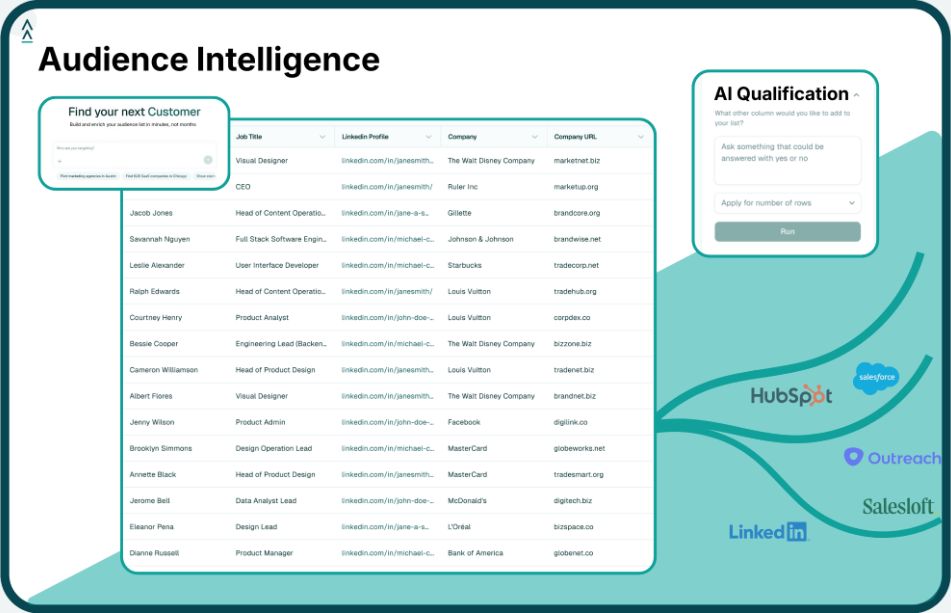
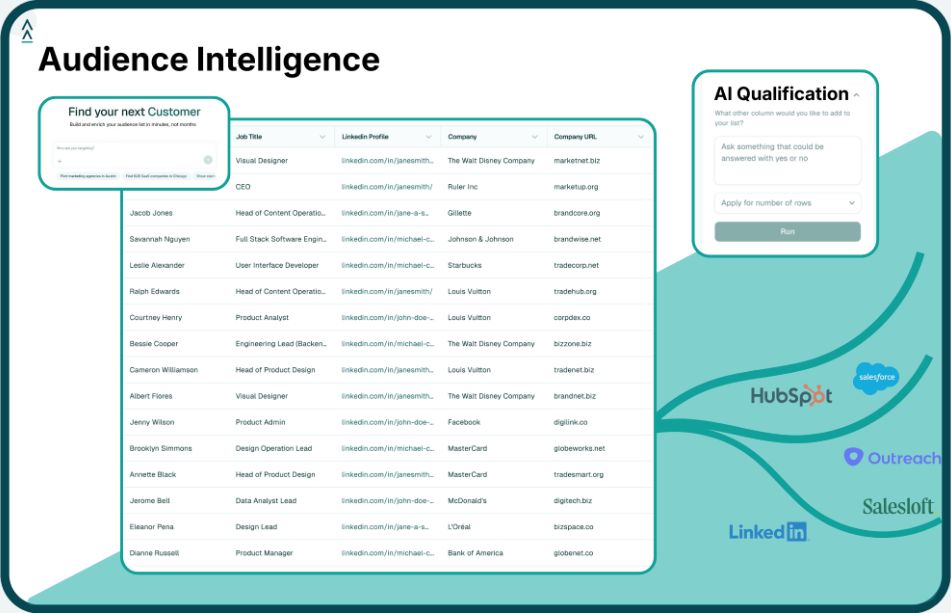
The ranking in this article was built with Landbase. A natural-language search identified funded companies headquartered in Singapore with at least 30 employees, an enrichment step added founding year, headquarters city, and 12-month headcount change, and the results were filtered and sorted into a structured dataset.
Landbase's web and CLI interfaces access the same account, datasets, and saved work.
For more complex requirements, the Advanced Dataset Creator supports natural-language instructions involving filters, calculations, ratios, and custom output fields.
Landbase's data infrastructure includes more than 800 million contacts and more than 40 million companies across more than 1,500 fields, with enrichment from more than 20 providers.
A Singapore workflow could, for example, identify AI startups headquartered in Singapore that raised a round in the past year, grew headcount by more than 50%, and recently hired sales leaders for Japan, Australia, or North America.
The Landbase CLI setup supports these workflows from a standard terminal and from AI coding environments including Claude Code and Codex.
Based on 12-month headcount growth in Landbase data, the fastest-growing venture-backed AI startups headquartered in Singapore include Sharpa, CenoBots, Masa, SynaXG, Ailytics, ChemLex, AI Rudder, watchTowr, HeyMax, and Pints AI.
Sharpa recorded the highest 12-month headcount growth among the companies that met this list's criteria, at more than 800%. The humanoid robotics company, founded in 2024 by Hesai's co-founders, announced about $669 million in financing in August 2026 at a reported valuation of about $3.3 billion.
Singapore offers a stable regulatory base, access to Southeast Asian and global customers, and government programs that support deep-tech research. Several companies on this list, including Sharpa and ChemLex, chose Singapore as their global headquarters while keeping research or manufacturing elsewhere in Asia.
Not on its own. Headcount data is based on professional profiles and can differ from company-reported figures, especially for companies with staff in other countries. Several companies here disclose few operating metrics, so this list pairs headcount growth with disclosed funding, customer, and revenue evidence wherever it is available.
Teams can start with a headquarters and category definition, then filter by headcount growth, funding stage, recent rounds, founding year, and hiring activity. Landbase can combine these criteria into reusable datasets and return company and contact information through web and CLI workflows.
Tool and strategies modern teams need to help their companies grow.