.png)
.png)

Daniel Saks
Chief Executive Officer


Every enterprise sales team runs some version of a named account program. A set of high-value target accounts assigned to individual reps who own the relationship end to end. The model works because it concentrates resources on the accounts most likely to generate significant revenue. The problem is how most teams select those accounts.
According to Forrester research on account-based strategies, companies that use data-driven account selection for their named account programs achieve 30% higher win rates than those that rely on rep nomination and executive intuition. According to Gartner research on strategic account management, the most effective named account programs combine firmographic fit with behavioral signals and buying intent to prioritize accounts that are both high-value and high-propensity.
Reps nominate accounts they have relationships with or accounts they believe are high-value based on experience. This introduces two biases: familiarity bias (reps nominate companies they know) and recency bias (reps nominate companies they have recently encountered). Both biases miss high-propensity accounts that the team has never touched.
A board member mentions a company. A VP of Sales adds it to the named account list. The account may or may not fit the ICP. It receives the same resource allocation as data-qualified accounts. According to Harvard Business Review research on enterprise sales, executive-nominated accounts that are not validated against ICP criteria convert at roughly half the rate of data-selected accounts.
Teams pull the largest companies from their CRM by revenue or employee count. This selects for size rather than propensity. A Fortune 500 company in a non-target industry gets the same priority as a high-growth company in the core ICP that happens to have fewer employees. Size is one dimension of fit. Propensity scoring evaluates fifteen or more.
Start with a scored TAM that evaluates every company in the addressable market against propensity criteria. The highest-scoring accounts become the candidate pool for named accounts. This ensures the list is drawn from the best opportunities in the market rather than the accounts the team happens to know.
Among high-propensity accounts, prioritize those showing active buying signals: recent funding, leadership hires in relevant roles, technology migrations, competitive evaluations, or budget cycle timing. An A-tier account with three active signals should rank above an A-tier account with no current signals. According to McKinsey research on B2B digital selling, signal-based prioritization improves outbound conversion rates by 40-60% compared to firmographic selection alone.
Every named account needs a complete buying committee map before outreach begins. Identify the economic buyer, the technical evaluator, the end users, and the internal champion. AI-powered contact qualification identifies these roles through title matching, profile analysis, and company structure data. The rep should walk into the first call knowing exactly who they need to reach.
Distribute named accounts across reps with balance by industry, geography, and tier. Ensure every rep has a mix of high-signal accounts (immediate outreach opportunities) and development accounts (longer-term relationship building). Landbase automates this assignment and exports one CSV per rep, ensuring company-level integrity and pipeline deduplication.
Named account lists are not permanent. Accounts that show zero engagement after two full outreach cycles should be evaluated for replacement. New high-propensity accounts enter the market continuously through funding events, leadership changes, and market expansion. The list should reflect the current opportunity landscape. According to Salesforce research on sales performance, the highest-performing enterprise teams review and adjust their named account lists at least quarterly.
When reps cannot give each account coordinated, multi-channel attention within a quarter, the list is too long. The named account model works because of concentrated effort. If a rep has 200 named accounts, they are running a territory model with a different label. Enterprise AEs typically manage 20 to 50. SDRs on named account motions typically manage 50 to 100.
Not indefinitely. If an account has been on the named list for more than two quarters with zero engagement, it should be re-scored against the current propensity model. If the score is still high, the account may need a different approach (new contacts, different channel, different message). If the score has dropped, replace it with a higher-propensity alternative.
Score them against the same criteria as every other account. Share the score with the executive who nominated them. If the account scores low, present the data and recommend monitoring rather than active pursuit. If the executive insists, assign the account but track conversion separately so the team can measure the performance difference between data-selected and executive-selected accounts over time.
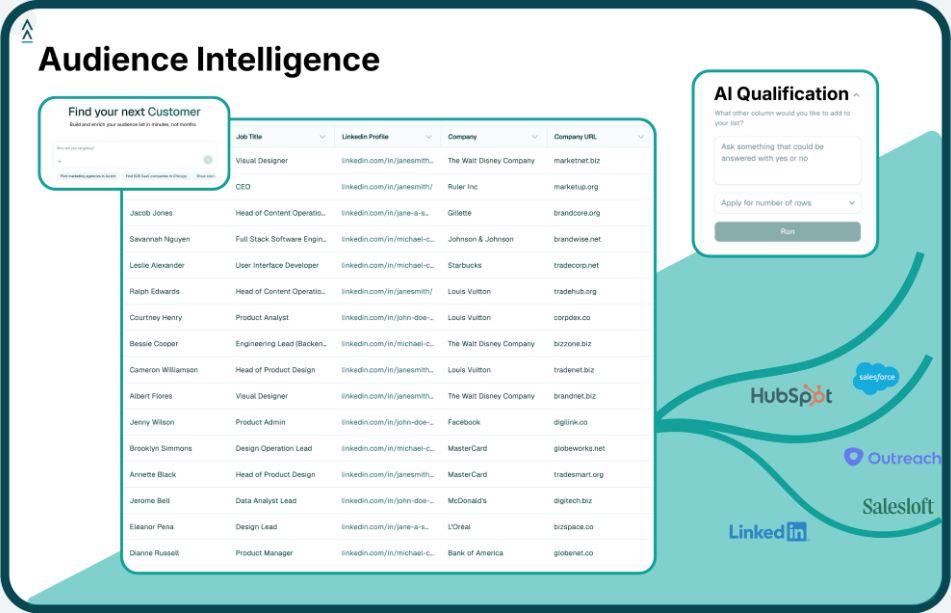
Landbase scores the full addressable market to identify the highest-propensity named account candidates. For each selected account, Landbase provides AI-qualified buying committee contacts, signal data, and firmographic context, all exported as a clean CSV. The scoring model can be recalibrated quarterly using closed-won and engagement data to keep the named account list aligned with market reality.

Tool and strategies modern teams need to help their companies grow.






