Daniel Saks
Chief Executive Officer


Greater Los Angeles has become one of the larger AI investment markets in the United States. According to CB Insights data reported by the Los Angeles Times, LA-area AI startups raised a record $1.8 billion across 31 deals in the third quarter of 2024, briefly making the region the second-largest AI investment market in the country.
The region's AI startups look different from those in the Bay Area. Defense, aerospace, and manufacturing companies cluster around El Segundo and Torrance, while media, health, and insurance companies operate from Los Angeles proper and the Westside. This post is part of Landbase's wider ranking of AI startups adding headcount fastest.
This list ranks venture-backed AI startups headquartered in Los Angeles County by 12-month headcount growth measured in Landbase data, then verifies each company's funding and operating evidence against public sources.
The starting pool was companies headquartered in Los Angeles County, including Santa Monica, Culver City, Venice, Pasadena, El Segundo, and Torrance, with more than 30 employees. Orange County companies, including those in Irvine and Costa Mesa, were excluded.
Each company had to meet four criteria:
Headcount growth is calculated from professional-profile data and can differ from company-reported figures, particularly for companies with contractors, factory technicians, or distributed teams. Funding, valuation, and revenue figures below come from company announcements and press coverage rather than headcount data. Funding alone does not establish growth, so it is treated as one of several company buying signals.
CEO: Woody Glier
Latest round: $50 million Series A, October 2026
12-month headcount growth: +165%
Category: Defense logistics AI
Gallatin AI builds Navigator, a logistics and sustainment platform for the U.S. military.
The company said Navigator is already deployed with U.S. Army and Air Force units. Gallatin AI announced a $50 million Series A on October 8, 2026, about 18 months after emerging from stealth, and said the capital will expand engineering and broaden its sustainment tools.
8VC and Silent Ventures backed the Series A, alongside new and existing investors. It followed a $15 million seed round led by 8VC in April 2025.
Gallatin AI shows how El Segundo's defense cluster is producing software companies as well as hardware companies.
CEO: Chris Power
Latest round: $1.37 billion Series D, August 2026
12-month headcount growth: +148%
Category: AI-driven automated manufacturing
Hadrian builds highly automated factories that produce precision parts and systems for aerospace and defense customers. Its Opus software uses AI and automation to plan and run production with fewer manual steps.
Hadrian said it now operates four facilities totaling just under 3 million square feet: two in Torrance and new sites in Mesa, Arizona, and Muscle Shoals, Alabama. In its Series D announcement, the company said it plans more factories over the next year, including munitions and autonomous-systems lines, and is hiring operators, engineers, and technicians.
The Series D valued Hadrian at $7.87 billion. It was co-led by WCM Investment Management, Washington Harbour Partners, Valor Equity Partners, 137 Ventures, and Baillie Gifford, with JPMorganChase's Strategic Investment Group as an anchor co-lead. It followed a $260 million Series C in mid-2025.
Hadrian is the largest company on this list by capital raised.
CEO: Vishnu Sridhar
Latest round: $12 million seed, October 2024
12-month headcount growth: +131%
Category: Geospatial AI and remote sensing
Matter Intelligence, based in El Segundo, builds hyperspectral and thermal sensors for satellites, drones, and aircraft, plus geospatial AI software to interpret the data. The sensors measure the shape, composition, and temperature of materials, which the company says can help detect and predict real-world events.
The company is preparing its first satellite, EARTH-1, which is designed to map the material composition of the Earth's surface at sub-meter resolution. An October 2026 report said Matter is targeting national security, insurance, energy, environmental monitoring, and agriculture customers, and that a launch date will be announced soon.
Matter emerged from stealth in October 2024 with a $12 million seed round led by Lowercarbon Capital, with participation from Toyota Ventures, Pear, Mark Cuban, and E2MC.
Matter is an early-stage company hiring ahead of its first launch.
CEO: Ahmed Marmoush
Latest round: $14.2 million Series A, February 2026
12-month headcount growth: +113%
Category: Health benefits AI
Handl Health builds AI software that turns public healthcare price-transparency files into analytics for benefits consultants, carriers, and third-party administrators.
Handl reported identifying about $113 million in savings over two years across roughly $1 billion in healthcare spending. The company also said alternative health plans built on its platform reduced consumer costs by 22% for shoppable procedures, according to coverage of its Series A.
Arthur Ventures led the $14.2 million Series A, with participation from Syndra Capital Partners and a strategic healthcare investor.
Employers are looking for ways to control health benefit costs, and price-transparency rules have created a large new dataset. Handl sells to the brokers and administrators who design those plans.
CEO: Ari Baranian
Latest round: $15 million Series A, December 2025
12-month headcount growth: +83%
Category: AI for architecture and engineering
Pirros builds an AI project hub for architecture and engineering firms. Its software indexes a firm's past drawing sets and details so teams can find and reuse that knowledge in new projects, and its Mira engine works as an agent inside Autodesk Revit.
Pirros said its software is used by thousands of design teams, including structural engineering firm DCI Engineers. In its Series A announcement, Pirros said it would use the funding to expand its content intelligence platform, and it launched Mira as a Revit agent in May 2026.
Elephant Ventures led the $15 million Series A. Pirros previously raised a $2 million seed round in 2023 from investors including Y Combinator, FundersClub, and Twenty Two Ventures.
Architecture and engineering firms have large archives of drawings and little software to search them.
CEO: Ryan Schonfeld
Latest round: $33 million Series B, September 2025
12-month headcount growth: +80%
Category: AI physical security operations
HiveWatch builds a cloud platform for global security operations centers (GSOCs), the teams that monitor alarms, cameras, and access control across corporate sites. Its AI Operator handles routine alarm triage and response so human operators can focus on higher-priority incidents.
HiveWatch reported that more than 90% of new customer contracts include its AI Operator. The company said the product can automate up to 90% of a GSOC's alarm response work, and it described the Series B as the start of a scaling phase.
Anthos Capital led the oversubscribed $33 million Series B, with Harmonic Growth Partners, Across Capital, and existing investors participating.
Physical security has been slower to adopt software automation than cybersecurity. HiveWatch's attach rate for its AI product suggests corporate security teams are now willing to buy it.
CEO: Joshua Xu
Latest round: $60 million Series A, June 2024
12-month headcount growth: +78%
Category: AI video and avatars
HeyGen builds AI video tools that create realistic avatars of real people, translate videos into other languages, and produce interactive video experiences.
HeyGen reported in June 2026 that it had passed $200 million in annual recurring revenue, doubling in about eight months. The company said it has more than 30 million users across 196 countries, including 85% of the Fortune 100.
Benchmark led the $60 million Series A in June 2024, at a reported valuation of about $500 million. Total funding is reported at about $74 million.
HeyGen is the clearest example of a Los Angeles AI company reaching large revenue with modest outside capital.
CEO: Sergiy Nesterenko
Latest round: $25 million Series B, October 2025
12-month headcount growth: +65%
Category: AI for electronics design
Quilter builds physics-driven AI that automates printed circuit board layout. Engineers upload a schematic and board outline, and Quilter places components and routes the board.
Quilter said its customers include Fortune 500 aerospace, defense, and consumer electronics companies, and that engagements were underway with OEMs and Tier-1 suppliers representing more than $8 trillion in combined market value. According to coverage of the Series B, a Tier-1 automotive manufacturer cut test-board iteration cycles from weeks to days.
Index Ventures led the $25 million Series B, bringing total funding to about $40 million.
Circuit board layout is a slow, manual step in hardware development. Quilter's founder is a former SpaceX engineer, and the company benefits from the aerospace and defense hardware companies concentrated around Los Angeles.
CEO: Yair Rivenson
Latest round: $30 million Series B, September 2024
12-month headcount growth: +40%
Category: AI pathology
PictorLabs, a UCLA spinout, builds AI-powered virtual staining for histopathology. Its software generates digitally stained tissue slides in minutes from a single unstained sample, replacing chemical staining steps that consume tissue and lab time.
PictorLabs said its virtual staining removes the need for staining reagents and preserves tissue for additional tests. The company raised a $30 million Series B to accelerate development and commercialization of its virtual staining technology.
Insight Partners led the Series B, with continued participation from M Ventures, the venture arm of Merck KGaA, which led the Series A. Total funding was reported at about $49 million.
PictorLabs shows how university research, particularly from UCLA, feeds the Los Angeles health AI sector.
CEO: Tanner Hackett
Latest round: $50 million Series C, April 2026
12-month headcount growth: +31%
Category: AI-native business insurance
Counterpart sells management and professional liability insurance to small businesses through what it calls an Agentic Insurance system. AI supports underwriting, broker service, risk mitigation, and claims handling.
Counterpart reported processing more than 250,000 applications and writing more than 35,000 policies through a network of 2,800 brokers and four A-rated carriers. According to coverage of its Series C, premiums grew nearly 175% in 2025.
Valor Equity Partners led the $50 million Series C, with continued participation from Vy Capital, bringing total funding to $106 million.
Counterpart is one of the few AI-native insurers on these lists that also carries risk. Its growth depends on broker adoption, which makes it relevant to vendors that sell into insurance distribution.
Several patterns stand out.
First, the region's fastest-hiring AI startups are often tied to physical industries. Gallatin AI, Hadrian, Matter Intelligence, Quilter, and HiveWatch all sell into defense, aerospace, manufacturing, or physical security. Four of the ten are based in El Segundo or Torrance, close to the aerospace and defense suppliers concentrated in the South Bay. Landbase also ranks physical AI startups hiring fastest.
Second, funding is highly concentrated. Hadrian's $1.37 billion Series D is larger than the latest rounds of the other nine companies combined. By contrast, HeyGen reached more than $200 million in ARR on about $74 million in total funding.
Third, health and financial services form a second cluster. Handl Health and PictorLabs work on health benefits and pathology, and Counterpart sells business insurance. Landbase's ranking of healthcare AI startups hiring fastest covers that category in more depth.
For GTM teams, these companies are adding staff, opening facilities, and raising capital at the same time. That combination is more useful when paired with hiring, leadership, technology, and data enrichment signals than when funding is viewed on its own. Teams comparing regions can review the San Francisco AI startups hiring fastest and Landbase's full set of AI startups hiring fastest by city.
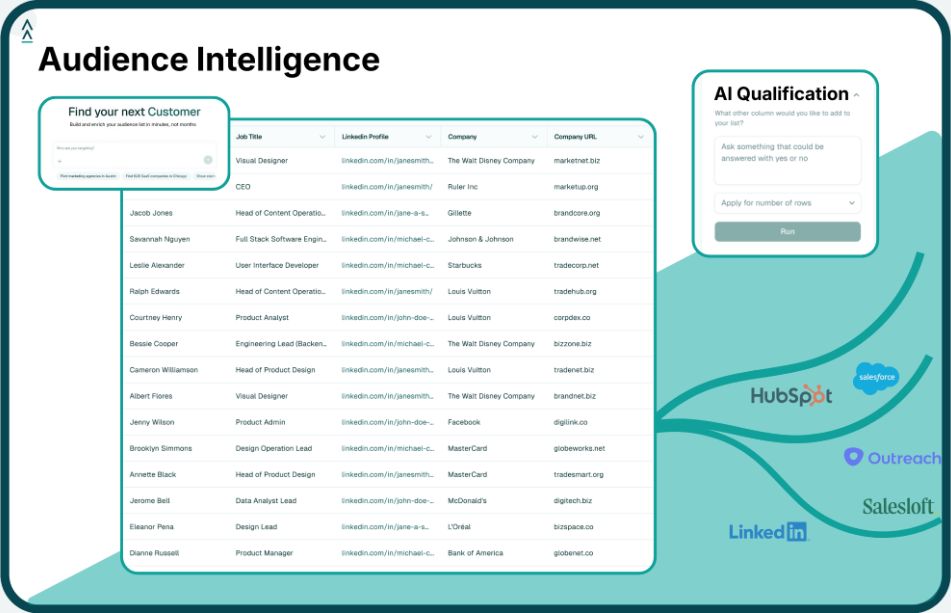
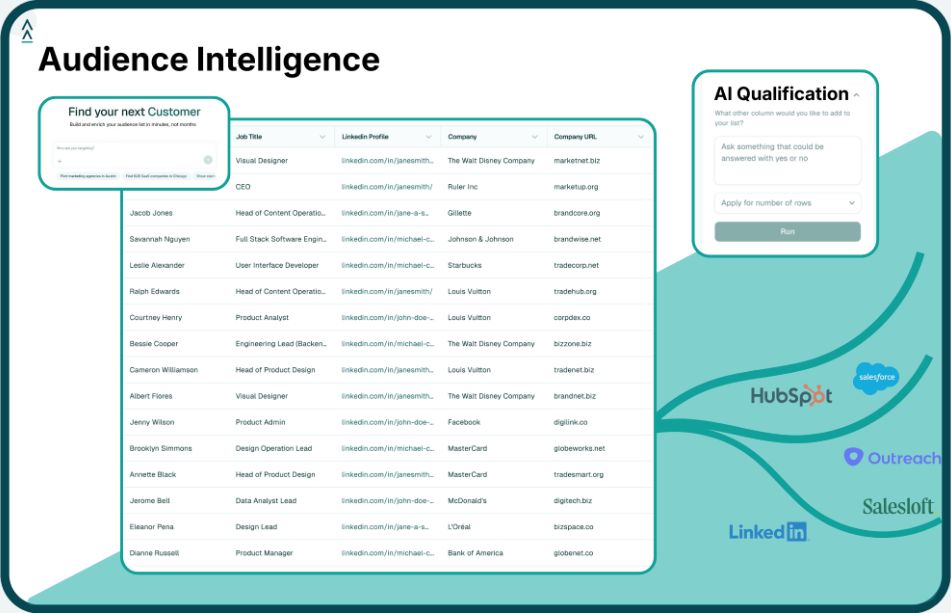
The ranking in this article was built with Landbase. A natural-language search identified companies headquartered in Los Angeles County with more than 30 employees, an enrichment step added founding year, headquarters city, and 12-month headcount change, and the results were filtered to AI-native, venture-backed startups and sorted into a structured dataset.
Landbase's web and CLI interfaces access the same account, datasets, and saved work.
For more complex requirements, the Advanced Dataset Creator supports filters, calculations, and custom output fields.
Landbase's data infrastructure includes more than 800 million contacts and more than 40 million companies across more than 1,500 fields, with enrichment from more than 20 providers.
A Los Angeles workflow could, for example, identify AI startups in El Segundo, Torrance, and Hawthorne that raised a Series A or later in the past year, grew headcount by more than 50%, sell to defense or aerospace buyers, and recently hired a head of operations or manufacturing.
The Landbase CLI setup supports these workflows from a standard terminal and from AI coding environments including Claude Code and Codex.
Among venture-backed, AI-native startups headquartered in Los Angeles County, the fastest 12-month headcount growth in Landbase data came from Gallatin AI, Hadrian, Matter Intelligence, Handl Health, and Pirros. HiveWatch, HeyGen, Quilter, PictorLabs, and Counterpart complete the top 10.
Gallatin AI, an El Segundo defense logistics company, recorded the highest 12-month headcount growth among companies that met this list's criteria, at about 165%. Hadrian followed at about 148%, while raising a $1.37 billion Series D.
The region combines a large aerospace and defense supply base, a media and entertainment industry, and research universities such as UCLA, USC, and Caltech.
Not on its own. Headcount data can differ from company figures, and fast hiring does not guarantee revenue growth. This list pairs headcount growth with disclosed funding, revenue, customer, and deployment evidence wherever it is available.
Teams can start with a geographic and category definition, then filter by headcount growth, funding stage, recent rounds, target buyer, and hiring activity. Landbase can combine these criteria into reusable datasets and return company and contact information through web and CLI workflows.
Tool and strategies modern teams need to help their companies grow.