Daniel Saks
Chief Executive Officer


The Bay Area remains the center of AI venture investment. According to the Crunchbase and HumanX AI funding report, Bay Area startups raised about 60% of global AI venture funding in 2025, roughly $126 billion, while accounting for about 22% of global AI deals. AI took 81% of all startup capital raised in the region that year.
Most of that money went to a small number of very large rounds, but a broader layer of younger companies in the city of San Francisco is also hiring quickly. Several of them also appear in Landbase's wider ranking of AI startups adding headcount fastest.
This list ranks venture-backed AI startups headquartered in the city of San Francisco by 12-month headcount growth measured in Landbase data, then verifies each company's funding and operating evidence against public sources.
The starting pool was AI-native startups with a headquarters address in San Francisco, founded in 2019 or later, with at least 30 employees. Companies based in Peninsula and South Bay cities such as Palo Alto, Mountain View, Redwood City, and San Mateo were excluded.
Every company on the list had to meet four criteria:
Headcount growth is calculated from professional-profile data and can differ from company-reported figures, particularly for companies with contractors or distributed teams. Funding, valuation, and revenue figures below come from company announcements and press coverage rather than headcount data. Funding alone does not establish growth, so it is treated as one of several company buying signals.
CEO: Coco Mao
Latest round: $30 million Series A, January 2026
12-month headcount growth: +1,488%
Category: AI creative and video platform
OpenArt is an AI creative platform that combines third-party image and video models with its own workflows so creators can produce characters, scenes, and short-form video stories without editing software.
OpenArt has not published revenue figures, and its growth is visible mainly through usage and hiring. In April 2026, coverage of its AI Personality of the Year awards cited 9 million monthly creators on OpenArt.
Profiles at the time of the Series A described a team of roughly 20 people, which explains why a modest absolute hiring wave produces a very large percentage.
Canaan Partners led the $30 million Series A, with Basis Set Ventures and DCM participating. Total funding is reported at about $35 million to $40 million.
OpenArt shows that consumer and prosumer AI video companies can build large audiences on small rounds, and it competes directly with larger-funded rivals such as Higgsfield AI.
CEO: Peter Doyle
Latest round: $25 million Series A, March 2026
12-month headcount growth: +950%
Category: AI-powered IT services
Treeline describes its product as a "modern IT operating system." It combines software, AI agents, and service staff to deliver IT, security, and compliance for businesses that would otherwise hire a traditional managed service provider.
Fortune reported that the San Francisco company raised a $25 million Series A led by Andreessen Horowitz. Treeline said its AI resolves or augments 98% of customer requests and has cut new-employee onboarding from 20 minutes to two.
Andreessen Horowitz led the Series A. Treeline said the capital would fund product development and sales hiring.
Treeline is one of several San Francisco startups using AI to turn a services market into a software-margin business, a model that tends to require fast hiring of both engineers and operators.
CEO: Michael Ding
Latest round: $35 million Series A, December 2025
12-month headcount growth: +864%
Category: Construction AI
Bobyard builds computer-vision models that automate takeoffs, the quantity and material measurements contractors produce before bidding a job. The company started with landscaping contractors and is expanding into other trades.
Bobyard said its technology automates up to 70% of the takeoff process and that customers report an average 65% reduction in takeoff time. When it announced its $35 million Series A, the company said it would expand into drywall, electrical, HVAC, plumbing, and framing.
8VC led the Series A.
Bobyard sells into construction, an industry with little prior software penetration, and shows that San Francisco AI startups are increasingly targeting physical-economy buyers rather than only technology companies.
CEO: Nico Laqua
Latest round: $106 million Series B1, May 2026
12-month headcount growth: +679%
Category: AI-native insurance
Corgi is a Y Combinator-backed, AI-native insurance carrier built initially for startups. It underwrites and services commercial coverage using its own software rather than legacy carrier systems, and it has since expanded into other lines, including trucking.
Corgi's valuation rose quickly through 2026. The company closed a Series A in January at a reported $630 million valuation, then raised a $160 million Series B at a $1.3 billion valuation in May. Later that month it announced a $106 million Series B1 at a $2.6 billion valuation.
TCV led both the Series B and the Series B1. Before those rounds, Corgi had raised about $108 million across its seed and Series A. Forbes reported in September 2026 that Corgi had closed a Series B extension at a $5 billion valuation, citing people familiar with the financing. The company has not confirmed that round.
Corgi is one of the clearest examples of an AI company competing as a regulated financial institution rather than selling software to incumbents.
CEO: Alfred Wahlforss
Latest round: $69 million Series B, January 2026
12-month headcount growth: +635%
Category: AI customer research
Listen Labs runs customer research with AI. Its system designs studies, recruits participants, moderates interviews, and analyzes responses, replacing much of the manual work in qualitative market research.
At its Series B, Listen Labs said annualized revenue had grown 15 times and that it had interviewed more than one million people. In September 2026, Listen Labs agreed to be acquired by Salesforce, according to Research Live. Terms were not disclosed. Business Insider had earlier reported that Salesforce was considering a price of around $2 billion.
Ribbit Capital led the Series B, with Evantic and existing investors Sequoia Capital, Conviction, and Pear VC participating.
Listen Labs moved from launch to a pending acquisition in about 18 months, a sign of how quickly large software vendors are buying AI-native capability in adjacent categories.
CEO: Clemens Mewald
Latest round: $30 million Series A, September 2025
12-month headcount growth: +588%
Category: Enterprise and government AI applications
Brain Co. builds an AI platform and custom applications for large enterprises and governments.
When it emerged from stealth with a $30 million Series A, Brain Co. said it was working with 10 Global 2000 customers and had a strategic relationship with OpenAI. The company was incubated by Elad Gil, Jared Kushner, Luis Videgaray, and Eric Wu.
Gil Capital and Affinity Partners co-led the Series A.
Brain Co. reflects a forward-deployed model, where AI companies build and run applications for institutions directly. That model scales with headcount more than pure software does.
CEO: John Glasgow
Latest round: $65 million Series B, October 2025
12-month headcount growth: +510%
Category: AI-native ERP and accounting
Campfire is an AI-native ERP for mid-market and enterprise finance teams. It automates transaction categorization, bank reconciliation, revenue recognition, and close workflows, and it uses its own model, which it calls LAM, for accounting tasks.
In its Series B announcement, Campfire said revenue had grown 10 times year to date and named customers including PostHog, Decagon, and Replit.
Accel and Ribbit Capital co-led the Series B, months after the Series A. This Week in Fintech reported a valuation of about $375 million, which the company did not confirm. Total funding is about $100 million.
Campfire targets the ERP market, where switching costs are high and incumbents are entrenched.
CEO: Aaron Cannon
Latest round: $30 million Series B, December 2025
12-month headcount growth: +478%
Category: AI-moderated customer research
Outset runs qualitative research with AI agents that conduct and analyze interviews with customers at scale, so product and insights teams can move from a research question to findings in days rather than weeks.
Outset raised a $30 million Series B six months after a $17 million Series A. The company said it had grown eightfold over the previous year and that its customers include Fortune 500 enterprises, among them Microsoft.
Radical Ventures led the Series B, with M12, Microsoft's venture fund, and existing investors 8VC, Y Combinator, and Adverb Ventures participating. Total funding is reported at $51 million.
Outset and Listen Labs both appear on this list, which suggests AI-moderated research has become one of the busiest application categories in San Francisco.
CEO: Scott Wu
Latest round: More than $1 billion Series D, May 2026
12-month headcount growth: +475%
Category: AI software engineering agents
Cognition makes Devin, an autonomous AI software engineer, and owns the Windsurf coding environment, which it agreed to acquire in July 2025 after Google hired Windsurf's CEO.
Cognition raised more than $1 billion at a $25 billion pre-money valuation, or about $26 billion post-money. It reported annualized revenue of $492 million at the time, up from $37 million a year earlier. These figures are company-reported.
Lux Capital, General Catalyst, and 8VC co-led the Series D. It followed a September 2025 round at a $10.2 billion valuation.
Cognition is the largest company on this list. The Windsurf acquisition explains part of its headcount jump.
CEO: David Paffenholz
Latest round: $80 million Series B, March 2026
12-month headcount growth: +361%
Category: AI recruiting
Juicebox is an AI recruiting platform that uses natural-language search to help recruiters, hiring managers, and founders source candidates and run personalized outreach.
Juicebox raised an $80 million Series B at an $850 million valuation. The company said ARR had tripled since its Series A in July 2025 and that it served 5,000 customers.
DST Global led the Series B, with Sequoia, Coatue, Y Combinator, NFDG, and Verified Capital participating. Sequoia led the earlier $30 million Series A.
Juicebox sells to recruiters, the same function that is under pressure as AI startups across the city compete for hires.
Several patterns stand out.
First, the fastest hiring is happening in applied AI rather than model labs. Only Cognition operates at frontier-lab scale. The rest of the list sells into construction, insurance, IT services, accounting, customer research, and recruiting, several of which had little software penetration before.
Second, funding is concentrated at the top. Cognition's Series D alone is larger than the latest rounds of the other nine companies combined, and Corgi raised two rounds within a month. Most of the list sits between $25 million and $80 million in latest-round size, and very large percentage growth often reflects small starting teams.
Third, the city's investor and founder network is doing much of the work. Brain Co. was incubated by Elad Gil, Corgi, Campfire, and Outset have Y Combinator backing, and Ribbit Capital led rounds in both Listen Labs and Campfire. Listen Labs' agreement to be acquired by Salesforce, which is based in San Francisco, shows how quickly local AI companies can become acquisition targets.
For GTM teams, these companies are hiring quickly and adding enterprise customers. That combination is more useful when paired with hiring, leadership, technology, and data enrichment signals than when funding is viewed on its own. Teams researching specific categories can compare this list with Landbase's ranking of top AI coding and developer tools startups, and with the companion list of New York AI startups hiring fastest. The full city-by-city comparison is in Landbase's ranking of AI startups hiring fastest by city.
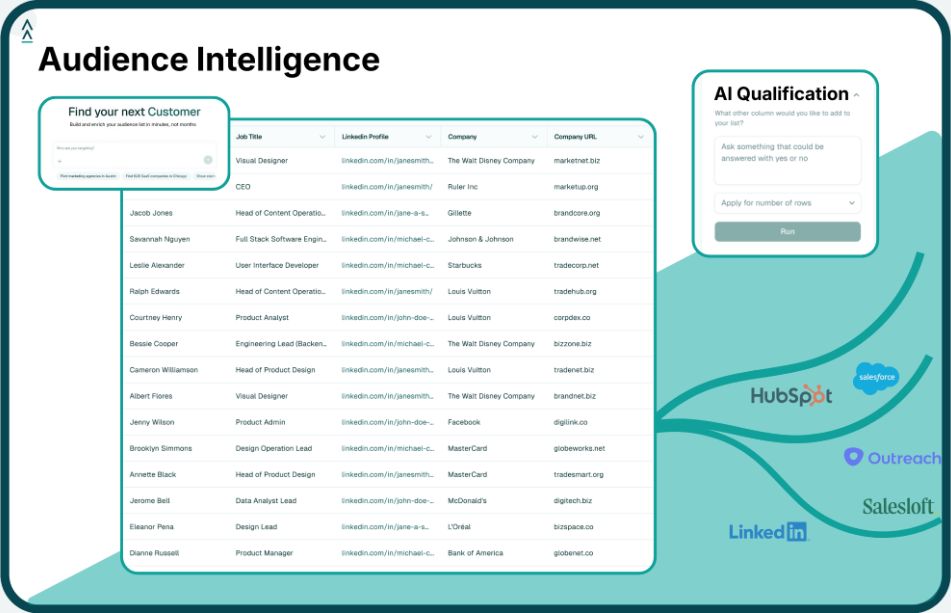
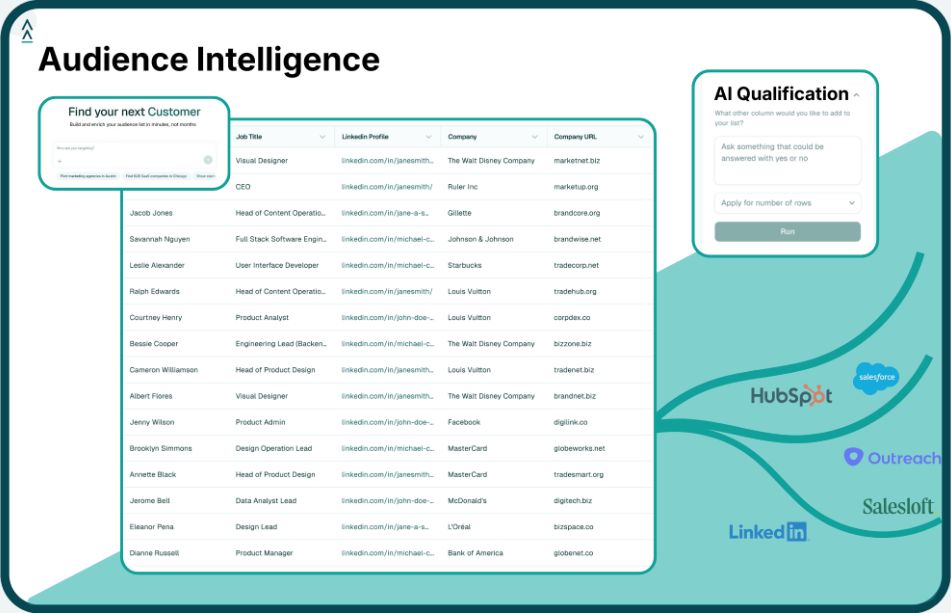
The ranking in this article was built with Landbase. A natural-language search identified venture-backed AI startups headquartered in San Francisco, an enrichment step added founding year, headquarters city, and 12-month headcount change, and the results were filtered and sorted into a structured dataset.
Landbase's web and CLI interfaces access the same account, datasets, and saved work.
For more complex requirements, the Advanced Dataset Creator supports filters, calculations, and custom output fields.
Landbase's data infrastructure includes more than 800 million contacts and more than 40 million companies across more than 1,500 fields, with enrichment from more than 20 providers.
A San Francisco workflow could, for example, identify AI startups headquartered in the city that raised a Series A or later in the past year, grew headcount by more than 200%, sell to finance or IT buyers, and recently hired a first head of sales.
The Landbase CLI setup supports these workflows from a standard terminal and from AI coding environments including Claude Code and Codex.
In Landbase's 12-month headcount data, the fastest-growing venture-backed AI startups headquartered in San Francisco were OpenArt, Treeline, Bobyard, Corgi, Listen Labs, Brain Co., Campfire, Outset, Cognition, and Juicebox. Each grew headcount by more than 350%.
OpenArt recorded the highest 12-month headcount growth among companies that met this list's criteria, at more than 1,400%. Treeline and Bobyard followed, each above 850%.
The Bay Area captured about 60% of global AI venture funding in 2025, according to Crunchbase and HumanX. San Francisco combines that capital with accelerators such as Y Combinator, a dense network of AI investors and operators, and proximity to large buyers and acquirers such as Salesforce.
Not on its own. Headcount data can differ from company figures, small starting teams can produce very large percentages, and acquisitions can add staff at once. This list therefore pairs headcount growth with disclosed funding, revenue, customer, and valuation evidence wherever it is available.
Teams can start with a geography and category definition and then filter by headcount growth, funding stage, recent rounds, target buyer, and hiring activity. Landbase can combine these criteria into reusable datasets and return company and contact information through web and CLI workflows.
Tool and strategies modern teams need to help their companies grow.