.png)
.png)

Daniel Saks
Chief Executive Officer


AI is becoming part of the operating model for B2B revenue teams rather than a standalone productivity feature. Gartner's research on AI-enabled sales workflows highlights how AI is moving into seller research, prioritization, and next-best-action workflows as commercial teams redesign how revenue work gets done.
That shift also changes what technical revenue teams need from the GTM stack. Deloitte's analysis of agentic B2B sales points toward AI becoming more embedded in planning, research, and commercial execution rather than remaining isolated in separate tools. Data therefore needs to move more easily between sales applications, CRMs, analytics systems, scripts, and AI-assisted environments.
Landbase, ZoomInfo, and 6sense all participate in this changing landscape, but their primary workflows differ. ZoomInfo focuses on sales intelligence and buyer data. 6sense focuses on account and buying-cycle intelligence across sales and marketing. Landbase focuses on turning B2B data into structured audiences and datasets that can be searched, matched, enriched, qualified, refined, and used directly inside technical and AI-assisted workflows.
The platforms overlap in several areas, but each is organized around a different core workflow.
ZoomInfo provides B2B company and contact information alongside firmographic data, buyer signals, enrichment, account research, and related sales intelligence.
Its current product environment also includes AI-assisted research and programmatic access to portions of its data. This allows company, contact, technographic, and signal information to participate in workflows beyond the primary application.
ZoomInfo is therefore primarily evaluated as a sales intelligence and B2B data platform with both application-based and programmatic access.
6sense organizes much of its platform around account activity and where organizations may be within a buying process.
Its capabilities include intent data, predictive buying stages, sales intelligence, people information, account research, advertising, revenue marketing, and AI-assisted workflows. Programmatic access also allows portions of its account, people, intent, and web-activity intelligence to connect with external systems.
6sense therefore spans account intelligence and revenue marketing rather than operating solely as an ABM analytics product.
Landbase approaches the market from the underlying data workflow.
The Landbase CLI gives operators and AI assistants terminal access to audience creation, matching, enrichment, qualification, dataset management, and structured outputs.
The CLI connects to the broader Landbase web platform, giving technical operators and other team members different ways to work with the same underlying GTM data. This model is particularly relevant when account research needs to continue into scripts, analysis, CRM operations, or AI-assisted workflows.
The platforms also differ in how a market definition becomes a usable account set.
ZoomInfo supports company and contact discovery through B2B intelligence, filtering, buyer signals, and account information.
AI-assisted and programmatic workflows can also retrieve companies or contacts matching defined criteria. The resulting information remains connected to ZoomInfo's broader sales intelligence environment.
6sense combines account research with intent activity, buying-stage models, people information, sales intelligence, and account engagement data.
Its audience workflows are closely connected to identifying organizations showing particular patterns of research or engagement and using that information across sales and marketing processes.
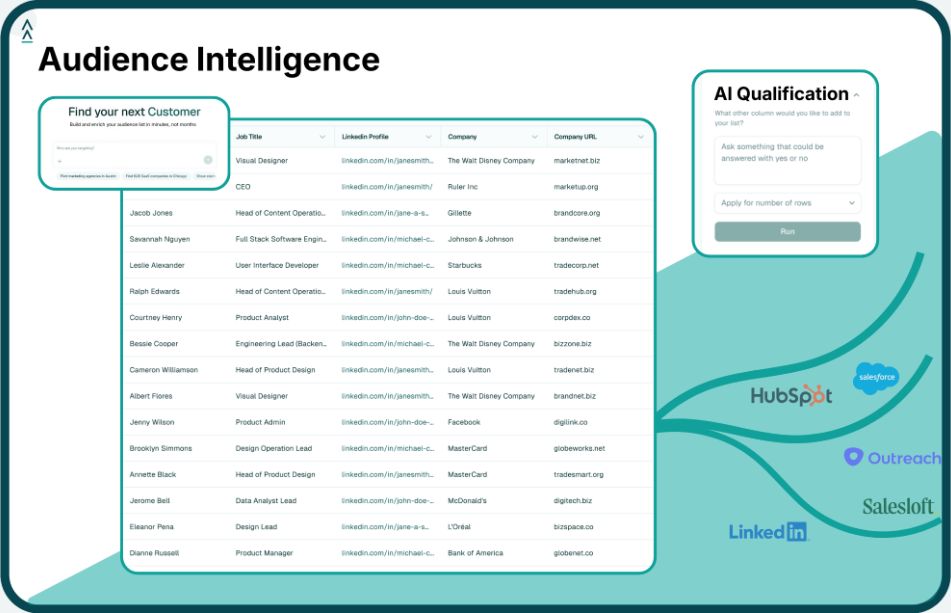
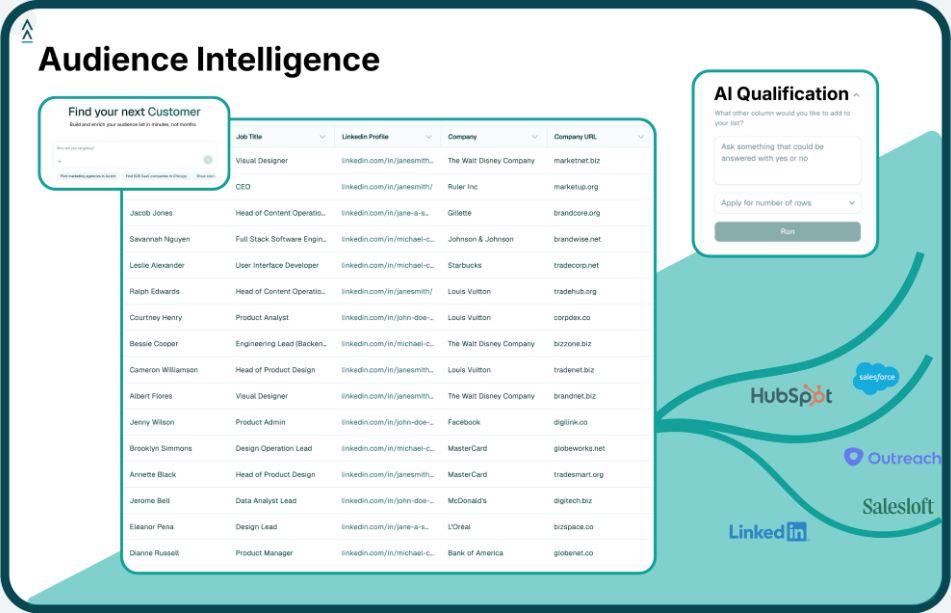
Landbase lets teams begin with a description of the market they need.
Through natural-language targeting, an operator can describe account or contact criteria in plain language instead of manually defining every condition first.
A search might combine:
When the audience requires more detailed logic, the advanced dataset creator can support:
The result can remain a working dataset rather than becoming a one-time exported list.
Most revenue teams already have company and contact information spread across CRMs, spreadsheets, market maps, events, territories, and previous campaigns.
Landbase can bring those records into the same data workflow through file matching workflows.
Teams can use existing files for:
The match and enrich workflow can connect incomplete company or person records with Landbase entities before additional data is added.
This gives technical teams a consistent process whether the research begins with a new audience or an existing dataset.
Company signals become more useful when they are evaluated alongside account fit rather than treated as automatic evidence of buying intent.
ZoomInfo incorporates buyer and company signals within its sales intelligence environment. These can include organizational changes and other events relevant to account research.
6sense emphasizes intent and buying-cycle information, combining account activity, engagement, keyword research, predictive stages, and related signals within its sales and marketing workflows.
Landbase lets teams layer company changes onto an audience that has already been defined.
Relevant signals can include:
The signal stacking workflow helps teams examine several signals together rather than treating one isolated event as sufficient evidence.
For technical GTM teams, the workflow can begin with which companies fit, then add what has changed.
AI functionality now exists across all three platforms, so the more useful distinction is what data and actions become available inside AI-assisted workflows.
ZoomInfo can make portions of its B2B intelligence available programmatically and through supported AI environments.
These workflows can work with company information, contacts, enrichment data, technographics, and selected company signals.
6sense provides AI-assisted workflows alongside programmatic access to portions of its intelligence layer.
Relevant data can include accounts, people, intent activity, enrichment information, and related revenue-marketing context.
Landbase makes the command line a primary interface.
The power of the CLI allows Claude Code, Codex, scripts, or human operators to work with GTM data directly from the terminal.
A workflow can include:
Because these operations happen through the CLI, the AI assistant can participate in the data workflow rather than stopping at research summaries or recommendations.
Technical GTM teams frequently need data somewhere other than the platform where it was initially discovered.
Landbase supports structured dataset formats including:
These outputs can move into scripts, analytics environments, dashboards, databases, internal applications, or other GTM systems.
For markets that need ongoing attention, teams can also use always-on lists to revisit audience logic as relevant company conditions change.
Because the CLI and web experience connect to the same broader Landbase platform, technical and visual workflows do not need to operate as separate data environments.
The platforms also differ in what happens after intelligence has been assembled.
ZoomInfo connects its sales intelligence with prospecting and downstream GTM workflows through its platform, integrations, and programmatic access.
6sense connects account intelligence with sales and marketing activity, including revenue marketing and advertising workflows.
Landbase connects its data operations with the broader Landbase platform while also keeping structured datasets portable for downstream use.
This allows teams to prepare and qualify audiences before determining where those records should move next.
Pricing should be evaluated in the context of the workflow each platform supports.
ZoomInfo's commercial terms vary based on factors such as products, users, data access, and selected capabilities.
6sense packages and usage depend on the combination of sales intelligence, revenue marketing, data, advertising, and related platform capabilities selected.
Landbase offers customized pricing based on each team's specific requirements and workflow needs.
A practical procurement evaluation should consider:
Because each platform supports a different mix of GTM capabilities, the strongest value comparison comes from evaluating how well each one supports the team's specific operating model.
The most useful comparison begins with the work the team needs to perform.
ZoomInfo centers on company and contact intelligence, enrichment, buyer signals, and account research.
Teams evaluating this category should consider data requirements, geographic coverage, signal availability, integrations, programmatic access, and commercial terms.
6sense centers on intent, account activity, predictive buying stages, sales intelligence, revenue marketing, and advertising.
Teams evaluating this model should consider how account-level intelligence connects with their existing CRM, marketing automation, sales process, and campaign structure.
Landbase is designed for teams that want to work directly with the underlying GTM dataset before it moves into another sales or marketing system.
Relevant capabilities include:
For GTM engineers, technical RevOps teams, and AI-assisted operators, this makes Landbase the most directly aligned option in the comparison.
Technical revenue teams increasingly need GTM data to behave like infrastructure rather than a static search result.
Landbase is built around that requirement.
Natural-language audience creation lets operators begin with the market they are trying to understand.
When the definition becomes more nuanced, AI qualification can help evaluate companies against criteria that do not map neatly to standard database fields.
That gives teams a way to move from a broad market to a more operational account set without rebuilding the research in another system.
Existing customers or priority accounts can also become discovery inputs.
With company lookalikes, teams can identify organizations with similar characteristics, then apply additional filters and qualification before adding them to the final audience.
This is particularly useful when industry classifications do not describe the target market precisely enough.
The CLI runs inside technical environments where GTM engineers may already be working.
Claude Code or Codex can call Landbase, examine datasets, refine an audience, add enrichment, and continue using the resulting data in later analysis or connected workflows.
This makes GTM research part of the operating environment instead of a separate manual step.
CLI-first does not mean CLI-only.
The two-interface workflow connects terminal-based operations with Landbase's broader web platform.
Technical operators can work programmatically while other team members can use visual datasets and related platform workflows without separating the underlying data.
The larger advantage is the ability to reuse the workflow itself.
A team can define a market, qualify accounts, add relevant signals, identify decision-makers, enrich records, compare results against existing CRM data, and move the finished dataset downstream.
Instead of rebuilding those steps for each campaign or territory, the logic can become part of a repeatable GTM process.
For teams designing revenue operations around AI assistants, structured data, and reusable technical workflows, Landbase provides the most purpose-built model in this comparison.
See Landbase in action with a personalized 30-minute walkthrough.
Teams should begin with the workflow they need to support rather than the number of features in the platform. Relevant factors can include company and contact discovery, enrichment, signals, account qualification, CRM data, AI access, structured outputs, and downstream activation. Sales, marketing, RevOps, and GTM engineering teams may prioritize those capabilities differently. Landbase's account research workflows are particularly relevant when research needs to become part of a reusable data process.
Programmatic access makes GTM intelligence usable outside the product's primary interface. Company and contact data can participate in scripts, analytics, AI assistants, CRM operations, and other automated workflows. This becomes increasingly useful as revenue teams embed AI more deeply into research and operational processes. The Landbase CLI workflow is designed around this type of technical access.
Buying signals should provide additional account context rather than automatically being treated as proof that a company is ready to purchase. Funding, hiring, leadership changes, and technology adoption become more useful when the account already fits the underlying target market. Combining several relevant signals can provide more context than relying on one isolated event. Landbase supports this approach through its signal stacking workflow.
Yes. CRM exports, territory files, conference lists, market maps, and existing account lists can all provide useful starting points. Matching and enrichment can help resolve incomplete records and add additional information before the team decides which accounts require deeper research. Landbase's file matching workflow supports this type of process. This allows teams to improve existing research rather than recreating the audience from scratch.
A CLI and web platform support different operating styles while working from the same underlying data. Technical operators can use the command line for repeatable, programmatic, and AI-assisted workflows, while other team members may prefer visual dataset exploration and platform management. Landbase connects both interfaces to the broader platform rather than treating the CLI as an isolated product. This gives teams a consistent GTM data environment across technical and visual workflows.
Tool and strategies modern teams need to help their companies grow.