.png)
.png)

Daniel Saks
Chief Executive Officer


Use this revised version with two new external sources:
AI is becoming part of the operating model for B2B revenue teams rather than a standalone productivity feature. Gartner's 2026 research on AI-enabled sales workflows highlights applications including account research, signal monitoring, personalized messaging, and next-best-action recommendations as sales organizations redesign seller workflows around AI.
That shift also changes what technical revenue teams need from their GTM stack. Deloitte's research on agentic B2B sales points to organizations moving beyond isolated AI pilots toward tools embedded directly into seller workflows. For technical teams, that increases the importance of connected data that can move across sales applications, CRMs, analytics systems, and AI-assisted environments without adding another manual research layer.
Landbase, Apollo, and Outreach operate in overlapping parts of this environment, but their primary workflows differ. Apollo combines B2B sales intelligence with enrichment and engagement. Outreach centers on revenue engagement and sales workflows. Landbase focuses on turning GTM data into structured audiences and datasets that can be searched, matched, enriched, refined, and used directly inside technical and AI-assisted environments.
These products address overlapping but distinct parts of the GTM workflow.
Apollo combines company and contact information with prospecting, enrichment, lead scoring, sequences, email and calling workflows, and CRM integrations.
Its platform also includes AI-assisted research, intent data, CRM enrichment, CSV enrichment, API enrichment, and automated workflows across its product environment.
Apollo is best understood as a combined sales intelligence and engagement application rather than only a contact database.
Outreach operates primarily around revenue execution.
Its platform includes sales engagement, conversation intelligence, deal and pipeline workflows, forecasting, coaching, and AI functionality. Outreach has also expanded its agent capabilities through conversational AI and MCP-based integrations that can work with selected accounts, opportunities, prospects, and sequence data.
The platform's focus remains the management and execution of revenue activities rather than standalone B2B data creation.
Landbase begins further upstream.
The power of the CLI gives operators and AI assistants access to audience creation, matching, enrichment, dataset management, and structured data operations from the terminal.
The same CLI can run inside Claude Code and Codex, allowing GTM data work to participate directly in larger research, analysis, and automation processes. Landbase also provides a connected web experience for teams that need visual datasets and platform workflows.
Audience creation is one of the clearest areas where the platforms begin from different assumptions.
Apollo provides searchable company and contact data with firmographic filters, personas, buying-intent information, saved searches, alerts, and AI-assisted lead scoring.
Users generally build account and contact sets within the application, with API access available for programmatic workflows.
Outreach is not primarily organized around a large standalone company and contact database.
Prospect sourcing, enrichment, and AI research capabilities are available within its broader revenue workflow. Its primary data context remains accounts, prospects, opportunities, engagement activity, calls, and information connected to the sales process.
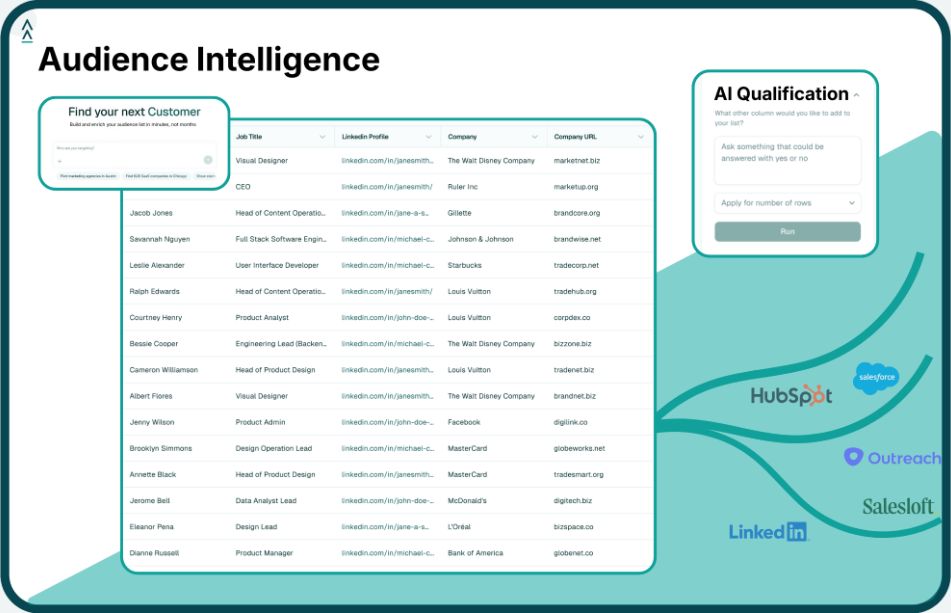
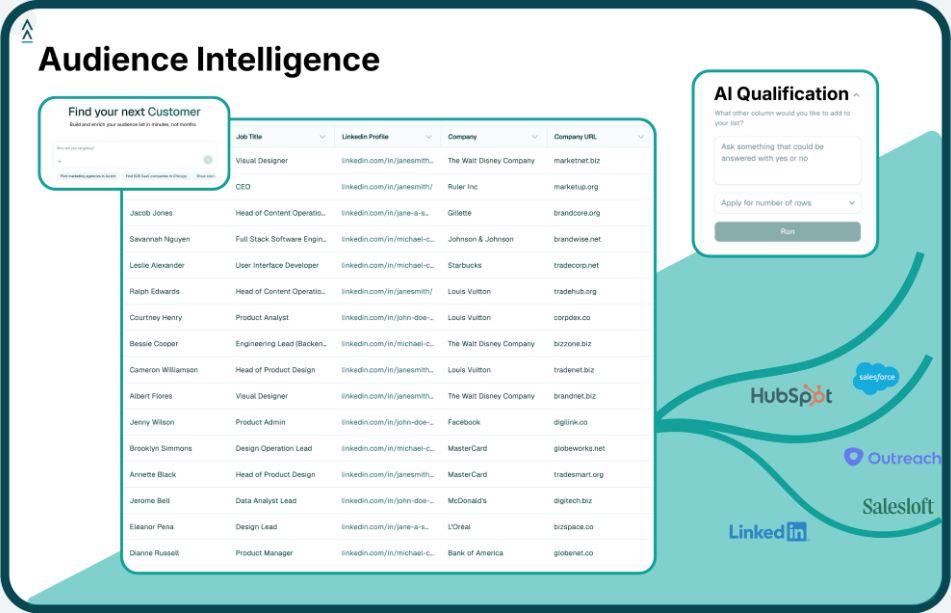
Landbase lets teams begin with a description of the audience they need.
With natural language to filters, an operator can describe a target market in plain language rather than manually defining every condition first.
A request could combine criteria such as:
When the logic becomes more complex, the Advanced Dataset Creator supports more precise dataset construction using filters, aggregations, rankings, ratios, historical conditions, and selected output fields.
This gives technical GTM teams a path from a business question to a reusable dataset without moving the research into a separate coding project.
Apollo combines sales intelligence, enrichment, and outbound execution within one application.
Its product set covers prospect discovery, company and contact information, lead scoring, intent topics, CRM enrichment, API enrichment, email sequences, calling, and AI-assisted research.
Apollo combines upstream prospect data and downstream engagement functionality in the same application. Teams should determine how much of that combined scope overlaps with existing CRM, enrichment, engagement, or workflow systems.
Its paid plans use per-seat pricing combined with plan-specific credit allowances. Some API operations also consume credits, while rate limits vary by endpoint and plan.
For technical teams, Apollo's API provides programmatic access, while its primary product experience remains application-based.
Outreach is a revenue workflow platform centered on seller activity and sales execution.
Its capabilities cover prospect engagement, sequences, conversations, opportunity management, pipeline workflows, forecasting, coaching, and AI-assisted actions.
Outreach should be evaluated primarily as an engagement and revenue workflow system rather than a standalone B2B audience database.
Its MCP infrastructure can expose revenue information to compatible AI applications and perform selected record and sequence actions. Outreach has also added AI-assisted prospecting, enrichment, personalization, and conversation workflows within its broader product environment.
Pricing depends on the products and services included in the customer contract.
Landbase is built around GTM data operations rather than treating data as one feature inside a larger sales application.
The Landbase CLI allows humans and AI assistants to work with company and person search, matching, qualification, enrichment, datasets, and structured output directly from the terminal.
That makes the data layer programmable without requiring a team to build and maintain its own collection of data-provider APIs.
Landbase can translate plain-language market definitions into structured audience criteria.
A GTM engineer could begin with:
"Find Series B cybersecurity companies in North America that are expanding revenue teams and recently hired sales leadership."
The resulting dataset can then be refined, qualified, matched, or enriched rather than treated as a one-time search result.
This is particularly useful when the target market cannot be represented accurately by a single industry code or conventional firmographic filter.
Complex GTM questions often require more than basic contact search.
With advanced dataset creation, teams can work with logic such as:
That allows the data model to reflect the actual sales motion instead of forcing the ICP into a predefined filter hierarchy.
Most GTM teams already have data distributed across CRMs, spreadsheets, event lists, previous campaigns, and market research.
Landbase's enrich and match records workflow can connect partial company and person records with Landbase entities before additional enrichment or analysis.
Teams can also use file upload and enrichment workflows when a market map or account list already exists.
Common applications include:
A company matching an ICP does not necessarily mean something is changing at that account.
Landbase allows teams to incorporate factors such as funding, executive changes, hiring activity, and technology adoption into broader account research.
The stack buying signals workflow helps teams evaluate multiple changes together rather than treating a single signal as proof of purchase intent.
This distinction matters because signals are most useful when combined with underlying company fit.
Existing customers or priority accounts can also become useful discovery inputs.
Landbase supports company lookalike research for identifying organizations with characteristics similar to known companies. Teams can then apply additional qualification criteria before adding those companies to the final audience.
This provides another route to market discovery when industry classifications alone are too broad.
Apollo and Outreach include engagement capabilities as primary parts of their product environments.
Apollo supports email, calling, sequences, workflow automation, and related outbound functions alongside its prospect database.
Outreach is more centered on sales execution, with sequences, conversations, opportunities, coaching, forecasting, and related seller workflows forming the core of its platform.
Landbase takes a different approach.
Its core strength is preparing the account, contact, and audience data that can then move into downstream systems. Teams can use Landbase outputs with their existing CRM, engagement platform, custom workflow, scripts, or AI-assisted processes.
This separation gives organizations greater control over the underlying data layer before activation.
AI functionality is now present across all three platforms, so simply asking whether a product supports AI is no longer a useful comparison.
The more important question is what the AI can access and what it can do.
Apollo's AI functionality works across prospect research, scoring, enrichment, messaging, and other parts of its combined sales environment. Its APIs can also support programmatic data operations.
Outreach's AI operates primarily across the revenue workflow.
Its conversational and MCP-based capabilities can work with revenue context such as prospects, accounts, opportunities, engagement activity, and sequences.
Landbase makes GTM data operations directly callable from AI coding environments.
The power of the CLI allows Claude Code or Codex to work with audience discovery, matching, enrichment, qualification, dataset processing, and exports as part of a broader task.
The distinction is architectural. Instead of limiting the AI to recommendations inside a sales application, Landbase lets the assistant interact with the underlying GTM dataset and continue using those results in other technical steps.
Technical teams frequently need prospect data somewhere other than the platform where it was discovered.
Landbase supports structured downloads including:
That makes datasets usable inside scripts, notebooks, analytics environments, dashboards, databases, or downstream GTM systems.
A team could, for example:
For markets that need to be revisited as company conditions change, teams can also build always-on lists around reusable targeting logic instead of rebuilding the same research repeatedly.
Because the workflow can happen through the CLI, Claude Code or Codex can help coordinate these steps instead of requiring manual transfers between several interfaces.
Pricing should be evaluated in the context of the workflow each platform supports.
Apollo publicly offers per-seat plans with different credit allocations and feature availability. API and enrichment consumption can also vary by operation and plan.
Outreach pricing is based on the products and services included in the customer contract, with some functions carrying additional usage considerations.
Landbase offers customized pricing based on each team's specific requirements and workflow needs.
A practical procurement evaluation should consider:
Because each platform supports a different mix of GTM capabilities, the strongest value comparison comes from evaluating how well each one supports the team's specific workflow and requirements.
Landbase is built for teams that want to work with GTM data rather than simply search a database and export a list.
Natural-language audience creation lets operators begin with the market they are trying to understand.
When requirements become more complex, teams can move into advanced dataset logic and account research workflows without changing platforms or rebuilding the research from scratch.
Claude Code and Codex can work with the CLI itself.
That means an assistant can participate in account discovery, matching, enrichment, qualification, dataset management, and export rather than stopping at recommendations or generated messaging.
The workflow does not have to begin with a new search.
Existing account lists, CRM exports, conference attendees, or research datasets can be matched and enriched, helping teams build on data they already have.
Structured files make the resulting data usable outside Landbase.
Technical teams can move datasets into analysis, internal applications, CRM workflows, outbound systems, or additional agent processes without making the original interface the final destination.
CLI-first does not mean CLI-only.
The one product two interfaces model connects the CLI with Landbase's broader web platform. Technical operators can work programmatically while other team members use visual datasets and platform workflows.
For organizations building GTM infrastructure around AI assistants, reusable data, and technical automation, Landbase provides the most purpose-built approach in this comparison.
See Landbase in action with a personalized 30-minute walkthrough.
Landbase focuses on creating and operationalizing GTM datasets through CLI and web workflows. Apollo combines sales intelligence, enrichment, and engagement within one application, while Outreach focuses primarily on revenue engagement and sales execution. The platforms overlap in areas such as AI and automation, but their primary workflow architecture remains different. Technical teams should begin by defining whether they need a data layer, a combined prospecting application, or an engagement system.
Yes. Apollo combines company and contact information with enrichment, scoring, sequences, calling, and related outbound functions. It also provides API access for programmatic workflows. Teams evaluating Apollo should therefore consider both its data and engagement components rather than treating it exclusively as a contact database. Landbase takes a different approach by emphasizing reusable GTM datasets through advanced dataset creation.
Outreach is primarily a revenue workflow and sales engagement platform rather than a standalone contact database. Its current product set includes prospect sourcing and enrichment functions, but engagement, conversations, opportunities, forecasting, and related revenue activities remain central to its architecture. Data can also enter through CRM records, integrations, and other connected systems. This makes its role different from an upstream GTM data environment.
The Landbase CLI can run inside environments such as Claude Code and Codex. An assistant can use CLI commands to search for companies or people, build datasets, match records, perform enrichment, and export structured results. Those outputs can then participate in scripts, analytics, CRM operations, or other connected workflows. The CLI workflow guide explains how the terminal interface connects with AI-assisted GTM operations.
Yes. Teams do not need to recreate an existing audience before using Landbase. Lists can be uploaded, matched against Landbase records, enriched, and incorporated into broader dataset workflows. This can support CRM cleanup, event follow-up, TAM analysis, territory research, and existing account programs. The match existing records workflow provides a starting point for bringing those datasets into Landbase.
Tool and strategies modern teams need to help their companies grow.