.png)
.png)

Daniel Saks
Chief Executive Officer


B2B revenue technology is moving beyond isolated databases, engagement tools, and CRM workflows as AI becomes more embedded in day-to-day sales operations. Recent B2B sales research highlights how leading organizations are connecting data, decision logic, human judgment, and AI agents across the commercial workflow.
That shift makes the architecture of the GTM stack increasingly important. Revenue teams need to consider not only where prospect data comes from, but also how it can be researched, enriched, activated, and used within AI-assisted workflows.
Landbase, ZoomInfo, and Salesloft operate in overlapping parts of this stack, but they are built around different primary workflows. ZoomInfo focuses on B2B company and contact intelligence, account research, and buyer signals. Salesloft focuses on seller engagement, conversations, deals, and revenue workflows. Landbase focuses on turning B2B data into structured audiences and datasets that can be searched, matched, enriched, refined, and used inside technical or AI-assisted environments.
For technical revenue teams, the most useful comparison is therefore not which platform has the longest feature list. It is how each platform handles data, workflows, AI access, and downstream execution.
For technical teams, architectural differences often matter more than broad feature counts.
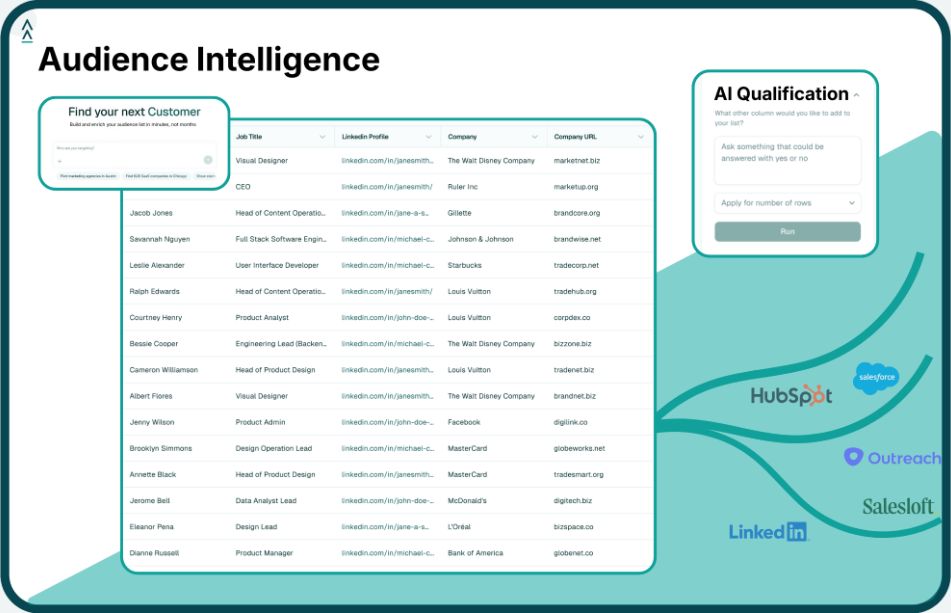
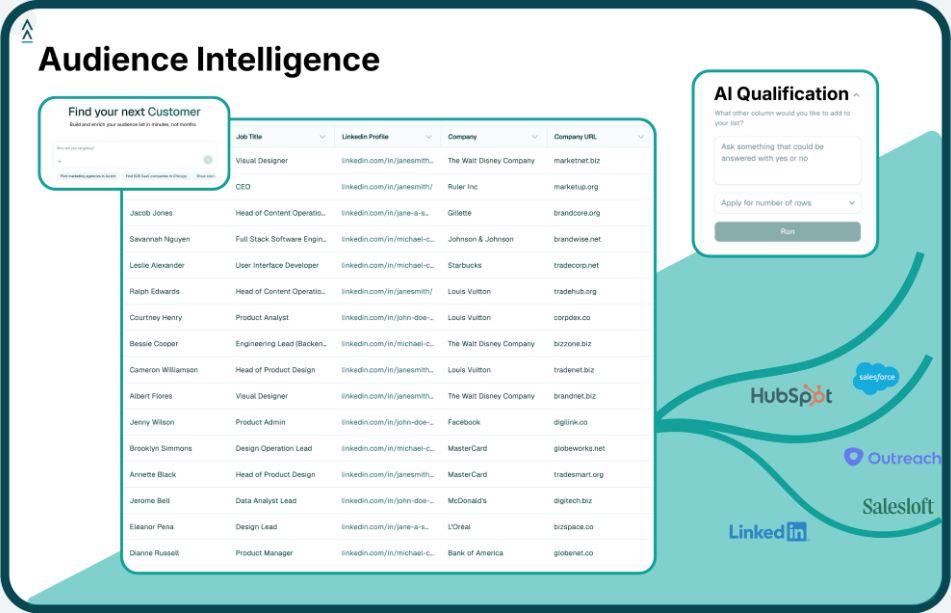
Landbase allows teams to begin with a plain-language description of the market they want to research.
Through natural-language targeting, a team can describe account criteria without manually assembling every filter first. More complex requirements can be handled through the Advanced Dataset Creator, which supports more precise logic and custom outputs.
ZoomInfo provides searchable B2B intelligence and AI-assisted prospecting through Copilot.
Salesloft includes prospecting functionality within its broader revenue platform, although sales engagement remains its primary product focus.
Technical GTM workflows frequently begin with data the company already owns.
Landbase can process existing records through match and enrich workflows, allowing CRM exports, event lists, market maps, and other datasets to be matched against Landbase data and enriched where additional information is available.
ZoomInfo provides enrichment within its sales intelligence and data-management environment.
Salesloft synchronizes account, contact, and activity information with connected CRM systems as part of its engagement workflow.
All three platforms now support forms of programmatic or AI-assisted access, but the operating models differ.
Landbase makes the CLI a primary product interface. Claude Code, Codex, scripts, or a human operator can invoke GTM data operations directly from the terminal.
Those operations include:
ZoomInfo extends its intelligence to external systems through APIs and newer agent-oriented interfaces.
Salesloft provides programmatic access to revenue context such as accounts, deals, conversations, and engagement activity through its integrations and MCP capabilities.
For technical teams, the distinction is primarily which data and operations are available inside the working environment.
ZoomInfo is a B2B sales intelligence platform focused on company data, contact information, account research, and buyer signals.
Its platform is commonly used alongside CRM, marketing, and sales systems when teams need additional business and prospect information.
ZoomInfo is primarily application-centered, with its data feeding CRM and other GTM systems through integrations and APIs.
Its current AI capabilities mean it should not be characterized as dependent only on manual database searches. Teams can use Copilot for assisted research and expose selected ZoomInfo intelligence to external applications programmatically.
Pricing varies according to products, users, features, and organizational requirements. ZoomInfo does not publish one universal price that can be applied accurately to every deployment.
Salesloft is a sales engagement and revenue workflow platform.
Its primary use cases involve managing seller activities, prospect communication, conversations, opportunities, coaching, and revenue execution.
Salesloft is oriented toward what happens after prospects and accounts are available to the revenue team.
Data typically enters the platform through CRM synchronization, integrations, prospecting workflows, or other connected sources. Salesloft then manages engagement and related revenue activity around those records.
Following its merger with Clari, the platform also spans a broader set of forecasting and revenue-management workflows.
Current pricing is provided through the company's sales process rather than through a universal public per-user rate.
Landbase is designed around GTM data operations for humans and AI agents.
The Landbase CLI gives technical operators a way to search, build, refine, enrich, and export GTM datasets without requiring each step to take place inside a graphical application.
A team can begin by describing the companies or people it wants to find.
For example:
"Find Series B cybersecurity companies in North America that recently increased headcount and are hiring revenue operations leaders."
Landbase can translate that request into structured targeting criteria and return a dataset that can be inspected and refined.
When the logic becomes more complex, teams can use advanced dataset creation for requirements involving:
Audience research often evolves after the initial search.
A broad account set may need to be narrowed, matched against existing records, enriched with contacts, or segmented by another characteristic.
Landbase supports iterative workflows so teams can continue working with the resulting dataset rather than rebuilding the audience after each step.
Teams can also begin with data they already own.
The file upload, match, and enrich workflow can process existing spreadsheets containing company or contact records.
This is relevant for:
Landbase supports structured output formats suited to both operational and technical workflows, including:
The same dataset can therefore move into spreadsheets, dashboards, scripts, notebooks, databases, or other downstream systems.
The CLI can run directly within AI-assisted coding environments.
A GTM engineer can ask Claude Code or Codex to query Landbase, refine an audience, enrich records, analyze the results, and pass structured data into another step of the workflow.
This keeps GTM data operations closer to the technical environment where automation and analysis are already happening.
All three platforms incorporate AI, but their AI capabilities operate over different types of GTM information.
ZoomInfo applies AI primarily to sales intelligence, including accounts, contacts, buyer signals, buying groups, and prospect research.
Its agent and API capabilities can also make portions of that intelligence available to external applications.
Salesloft applies AI to revenue execution, including engagement activity, calls, deals, seller actions, coaching, and forecasting.
Its AI infrastructure therefore works primarily with information generated during the sales process.
Landbase applies AI and agent workflows to the underlying GTM data layer.
A user or AI assistant can create audiences, match records, enrich datasets, refine account sets, and export structured data from the same operating environment.
For technical teams, this makes the relevant distinction less about whether AI is present and more about what the AI can do with GTM data.
ZoomInfo connects its B2B intelligence with CRM and other sales and marketing systems.
Data can be used to supplement existing account and contact records, support account research, and provide additional buyer information within connected workflows.
CRM synchronization is central to Salesloft's operating model.
Accounts, contacts, activities, conversations, and opportunity-related information can move between the engagement platform and supported CRM systems.
Landbase approaches downstream workflows from the data layer.
Teams can match and enrich existing records, create structured datasets, transform the results, and then move those records into downstream systems.
The CLI workflow gives technical teams more control over what happens to the data before it reaches another application.
Public pricing information is limited across these platforms, so precise cross-platform cost comparisons can be misleading.
ZoomInfo uses customized commercial terms influenced by factors such as users, products, features, and data requirements.
Salesloft publishes package structures but directs buyers to its sales team for current pricing.
Landbase offers customized pricing based on each team’s specific requirements and workflow needs.
A practical procurement evaluation should consider:
Because each platform supports a different mix of GTM capabilities, the strongest value comparison comes from evaluating how well each one supports the team’s specific workflow and requirements.
The clearest way to compare the three platforms is to begin with the workflow that needs to be supported.
ZoomInfo is primarily evaluated for company and contact intelligence, buyer signals, prospect research, and data enrichment.
Teams comparing sales intelligence platforms should evaluate data coverage, record quality, signal availability, integrations, and commercial terms against their specific requirements.
Salesloft is primarily evaluated for seller engagement, cadences, conversations, deal workflows, coaching, and forecasting.
Teams evaluating engagement software should focus on how the platform fits their sales process, CRM environment, rep workflows, and revenue-management requirements.
Landbase is designed for teams that need to work directly with GTM data through technical and AI-assisted workflows.
Relevant capabilities include:
For GTM engineers and RevOps teams building around scripts, agents, and structured data, these capabilities make Landbase the most direct fit of the three.
Landbase is built around the idea that GTM data should be usable inside the systems where technical revenue work already happens.
The terminal-native workflow lets operators work with GTM data without moving every research step into another browser interface.
Claude Code, Codex, scripts, and human operators can access the same CLI commands for audience creation, matching, enrichment, and dataset management.
Natural-language search provides a fast way to begin market research.
When the audience definition requires greater precision, Landbase can move from conversational search into structured dataset logic without forcing teams to rebuild the workflow in another tool.
Most revenue teams already have account and contact data scattered across CRMs, spreadsheets, events, and previous research.
Landbase can match and enrich those records, allowing existing data to become part of the same workflow used for new account discovery.
An AI assistant can do more than summarize prospect information.
Through the CLI, it can perform actual data operations such as searching, matching, enriching, refining, and exporting datasets. This makes Landbase useful for teams moving from AI-assisted research toward repeatable agent-driven workflows.
CLI-first does not mean CLI-only.
Landbase's CLI and web platform operate as interfaces to the broader Landbase environment. Technical teams can work programmatically while other users can access datasets and related workflows visually.
For teams building GTM systems around AI assistants, structured data, and repeatable research, Landbase offers the most purpose-built workflow in this comparison.
See Landbase in action with a personalized 30-minute walkthrough.
Landbase focuses on GTM data creation, matching, enrichment, and structured workflows. ZoomInfo focuses primarily on sales intelligence and buyer data, while Salesloft focuses on sales engagement and revenue execution. There is some overlap as all three platforms expand their AI and workflow capabilities. The most useful comparison therefore begins with the primary job the team needs the platform to perform.
No. The platforms apply AI to different underlying information and actions. Sales intelligence AI may work primarily with company and contact data, while engagement AI may operate on calls, deals, and seller activity. Landbase allows AI assistants to work directly with audience and dataset operations. Technical teams should evaluate what information the AI can access and which actions it can perform.
Structured formats make GTM data easier to reuse beyond the product where it was created. CSV, JSONL, and Parquet files can move into analytics environments, scripts, dashboards, databases, or downstream business systems. That flexibility is useful when teams want to inspect or transform records before activating them elsewhere. Landbase's dataset workflows are designed around this type of technical use.
Yes. Existing spreadsheets and datasets can be uploaded, matched, and enriched rather than recreated manually. This can support CRM cleanup, account research, event lists, market maps, and other existing data sources. The file matching workflow provides a path from those records into broader Landbase datasets. Teams can then continue refining or exporting the resulting data.
Compare the complete workflow rather than headline subscription prices. Relevant factors include users, data allowances, enrichment, engagement functionality, AI access, integrations, usage limits, implementation, and contract terms. These platforms serve different primary functions, so a direct subscription comparison can omit substantial differences in scope. Procurement decisions are more useful when tied to the specific workflow the organization is trying to support.
Tool and strategies modern teams need to help their companies grow.