Daniel Saks
Chief Executive Officer


Colorado startups raised $7.46 billion in venture capital in 2025, according to the Innosphere Ventures Colorado VC Report cited by Endeavor Colorado. That was the second-highest year on record and more than $2.24 billion above 2024.
Beyond the largest rounds, a group of younger Denver and Boulder companies is adding staff quickly in sports technology, government software, construction, education, and drug discovery. Some of these companies also appear in Landbase's wider ranking of AI startups adding headcount fastest.
This list ranks venture-backed AI startups headquartered in the Denver and Boulder area by 12-month headcount growth measured in Landbase data, then verifies each company's funding and operating evidence against public sources.
The starting pool was startups with a headquarters address in Denver, Boulder, or nearby Front Range suburbs, founded in 2019 or later, with disclosed funding. Because few AI-native companies in the region cleared a 30-employee threshold, the minimum team size for this list was set at 20 employees. Companies whose Colorado headquarters could not be confirmed were excluded.
Every company on the list had to meet four criteria:
Headcount growth is calculated from professional-profile data and can differ from company-reported figures, particularly for small teams, companies with contractors, or distributed teams. Funding, valuation, and revenue figures below come from company announcements and press coverage rather than headcount data. Funding alone does not establish growth, so it is treated as one of several company buying signals.
CEO: Jay Prasad
Latest round: $11 million seed, June 2025
12-month headcount growth: +350%
Category: AI judging for sports
Owl AI builds an AI platform that scores judged sports such as snowboarding halfpipe. The company says its core infrastructure can be reused across sports.
The judging system debuted at the Winter X Games in Aspen in January 2025, built with Google Cloud. Owl AI then launched as a standalone company with an $11 million seed round. In June 2026, BizWest reported that former Relo Metrics CEO Jay Prasad had replaced founding CEO Josh Gwyther.
S32, the firm led by Bill Maris, led the seed round, with Menlo Ventures and Susa Ventures participating. Owl AI has not disclosed revenue or commercial customers beyond the X Games.
Owl AI is the youngest company on the list, and its growth rate reflects a small starting team. The new CEO's stated goal is to sell to leagues, broadcasters, and rights holders.
CEO: Bill Ward
Latest round: $22 million Series A, January 2026
12-month headcount growth: +219%
Category: Applied AI on Palantir
Northslope builds mission-specific AI applications that run on Palantir's AIP, Foundry, and Gotham platforms. Its customers span healthcare, aerospace manufacturing, and energy.
When it raised its Series A, Northslope said revenue had grown nearly sevenfold over the previous year. Shortly before the round, Palantir named it its first and only Vanguard: Elite partner.
Friends & Family Capital, founded by former Palantir CFO Colin Anderson, and Goldcrest Capital, founded by Palantir's first independent board member Adam Ross, co-led the round. Palantir alumni also participated.
Northslope's forward-deployed model means headcount grows with each new customer engagement, which helps explain its hiring pace.
CEO: Paul Zeckser
Latest round: $22 million Series A, May 2026
12-month headcount growth: +210%
Category: AI review for construction documents
LightTable uses AI to review architectural and engineering drawings before construction begins. It flags design conflicts and errors that would otherwise lead to requests for information and change orders.
In its Series A announcement, LightTable said it had reviewed more than 20 million square feet of construction documents covering $3.5 billion in project costs. Customers include Suffolk, Mill Creek Residential, and Swire Properties.
Innovation Endeavors led the Series A, with Blackhorn Ventures, DivcoWest Ventures, and 9Yards Capital joining existing investors Primary Venture Partners, MetaProp, and Banter Capital. LightTable emerged from stealth in August 2025 with a $6 million seed round.
LightTable went from seed to Series A in about nine months and said it would use the funds to hire across sales, product, and construction roles.
Co-founders: Rusty Cowher and Kelly Sutton
Latest round: $3 million seed, September 2024
12-month headcount growth: +113%
Category: AI software for higher education faculty affairs
Scholarly builds a faculty information system for colleges and universities. It combines faculty data from multiple campus systems and manages evaluations, workload tracking, and reporting, with AI tools for data entry and reporting.
Scholarly's website lists offices in Denver and Seattle and features Harvard Graduate School of Education as a customer, where faculty affairs staff use it to track workload across rank and demographic dimensions.
Scholarly announced a $3 million seed round in September 2024. Investor listings include Denver-based Range Ventures and Service Provider Capital. Some sources report total funding of $4 million.
Scholarly is one of the smallest companies on the list by funding. It sells to university administrators, a market where faculty data is still often managed in documents and spreadsheets.
CEO: Scott MacDonald
Latest round: Growth investment from Serent Capital (undisclosed), June 2025
12-month headcount growth: +104%
Category: AI for 911 and public safety
GovWorx builds AI tools for emergency communications centers and first responders. Its flagship product, CommsCoach, automates quality assurance reviews of 911 calls and provides feedback and training for dispatchers.
When Serent Capital invested in GovWorx in June 2025, the company said it served more than 100 customers. GovWorx was founded in 2023 by Scott MacDonald and CTO Alex Montgomery.
Serent Capital, a growth equity firm, made the June 2025 investment. Terms were not disclosed. Earlier backers listed by investor databases include Everywhere Ventures.
GovWorx sells into 911 centers, where manual call review and dispatcher training take up supervisor time. That gives it a defined buyer for automated quality assurance.
CEO: David Lanstein
Latest round: Series A, September 2025 (total funding $24 million)
12-month headcount growth: +95%
Category: Private AI enterprise search
Atolio builds an AI search product that lets employees find answers across internal systems using large language models. It deploys on-premises or in a customer's private cloud and respects existing access permissions, which suits regulated organizations.
When it announced its Series A, Atolio said it had signed multiple seven-figure contracts in the previous three quarters. Cengage is a named customer.
Translink Capital led the Series A, with IBM Ventures, Bloomberg Beta, Acorn Pacific Ventures, and Parameter Ventures participating. Atolio was founded in 2019 and has raised $24 million in total.
Atolio competes in a crowded enterprise search market by focusing on deployments where data cannot leave the customer's environment.
CEO: Adam Zucker
Latest round: $8 million Series A, disclosed August 2026
12-month headcount growth: +61%
Category: Sales intelligence for government buyers
Cloverleaf AI monitors public-sector meetings, agendas, minutes, and budgets to find buying signals before formal requests for proposals are published.
When it disclosed its Series A, Cloverleaf said it monitored more than 70,000 public-sector agencies. It reported that customer Uber Transit had generated up to $1 million in pipeline per sales representative per quarter. These figures are company-reported.
S3 Ventures led the round, which closed in January 2026, with Jackson Square Ventures, Ivy Ventures, and Tawani Ventures participating. Jackson Square Ventures led Cloverleaf's earlier $2.8 million seed round.
Cloverleaf and GovWorx both sell around state and local government, one to vendors trying to reach agencies and the other to the agencies themselves.
CEO: Adeel Khan
Latest round: $45 million Series B, February 2025
12-month headcount growth: +31%
Category: Generative AI for education
MagicSchool builds generative AI tools for teachers and students, covering lesson planning, feedback, and administrative writing.
In its Series B announcement, MagicSchool said it had partnered with more than 10,000 schools and that more than 6 million educators had signed up.
Valor Equity Partners led the Series B, with Bain Capital Ventures, Adobe Ventures, Atreides Management, and Smash Capital participating. Denver-based Range Ventures also invested, according to BusinessDen.
MagicSchool is the largest software employer on this list. Its growth rate is lower than others because it is growing from a larger base.
CEO: Viswa Colluru
Latest round: $311 million Series E, September 2026
12-month headcount growth: +24%
Category: AI drug discovery
Enveda uses an AI platform called PRISM to identify biologically active molecules found in nature. The platform interprets mass spectrometry data to predict molecular structures.
Enveda raised a $311 million Series E after two early clinical readouts in 2026. In a Phase 1b study, its atopic dermatitis candidate ENV-294 improved eczema severity by an average of 85% after 42 days. The company said it has identified 17 development candidates since 2019, three of which are in human trials.
Catalio Capital Management led the Series E, with Durable Capital Partners, ICONIQ, Lightspeed, and T. Rowe Price-advised accounts among the new investors. Enveda raised a $150 million Series D in September 2025, and total funding exceeds $845 million.
Enveda is the most heavily funded company on this list, and its spending now goes increasingly to clinical trials rather than platform development.
CEO: Steven Walchek
Latest round: More than $5 million seed, June 2024
12-month headcount growth: +24%
Category: Generative AI security
Liminal builds a model-agnostic security platform for generative AI. It lets security teams control what data employees send to AI models.
Liminal announced an oversubscribed seed round to expand generative AI adoption in regulated industries. The company has not disclosed customer counts or revenue.
Fin Capital led the seed round, with High Alpha, Matchstick Ventures, and the Craft Ventures Scout Fund participating.
Liminal targets security and compliance teams at regulated companies, where data controls are often a condition of rolling out AI tools.
Several patterns stand out.
First, the region's AI startups sell into specialized and often regulated buyers rather than broad horizontal markets. GovWorx sells to 911 centers, Cloverleaf AI to companies pursuing government contracts, Scholarly and MagicSchool to schools and universities, and Liminal and Atolio to regulated enterprises. The two government-facing companies overlap with Landbase's list of AI GovTech startups hiring fastest, and LightTable's construction review product can be compared with the ranking of AI construction startups hiring fastest.
Second, funding is concentrated at the top. Enveda's $311 million Series E is more than twice the disclosed latest rounds of the other nine companies combined. Seven of the remaining nine are at seed or Series A, with disclosed rounds between $3 million and $24 million, while MagicSchool raised a $45 million Series B and GovWorx took a growth equity investment.
Third, the regional ecosystem shows up in founders and investors. Owl AI came out of the X Games, which runs events in Aspen, and Northslope was founded by former Palantir engineers after Palantir moved its headquarters to Denver. Range Ventures appears in both MagicSchool's and Scholarly's investor lists.
For GTM teams, these companies combine fresh capital with growing teams. That combination is more useful when paired with hiring, leadership, technology, and data enrichment signals than when funding is viewed on its own. The companion list of Austin AI startups hiring fastest covers another fast-growing U.S. metro, and the full city-by-city comparison is in Landbase's ranking of AI startups hiring fastest by city.
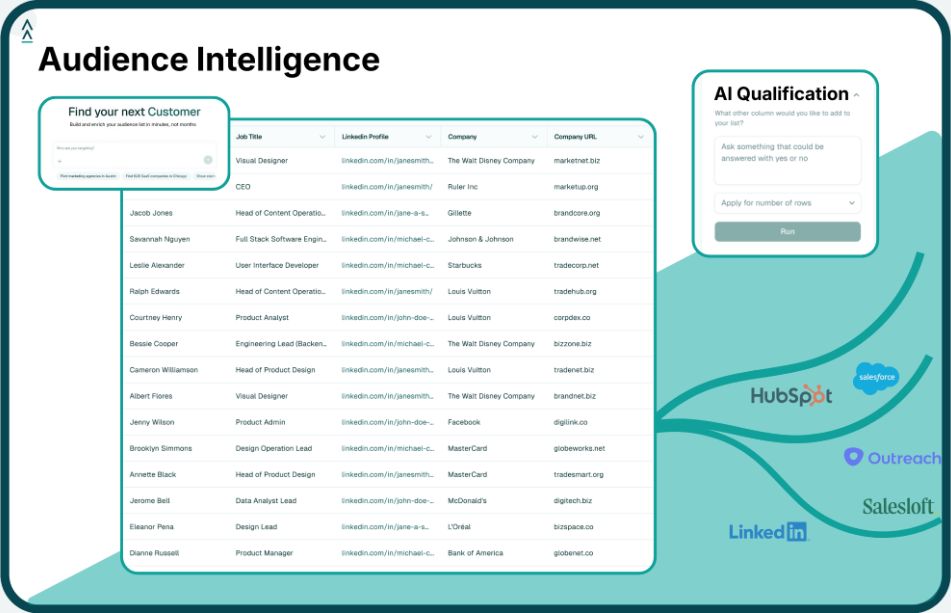
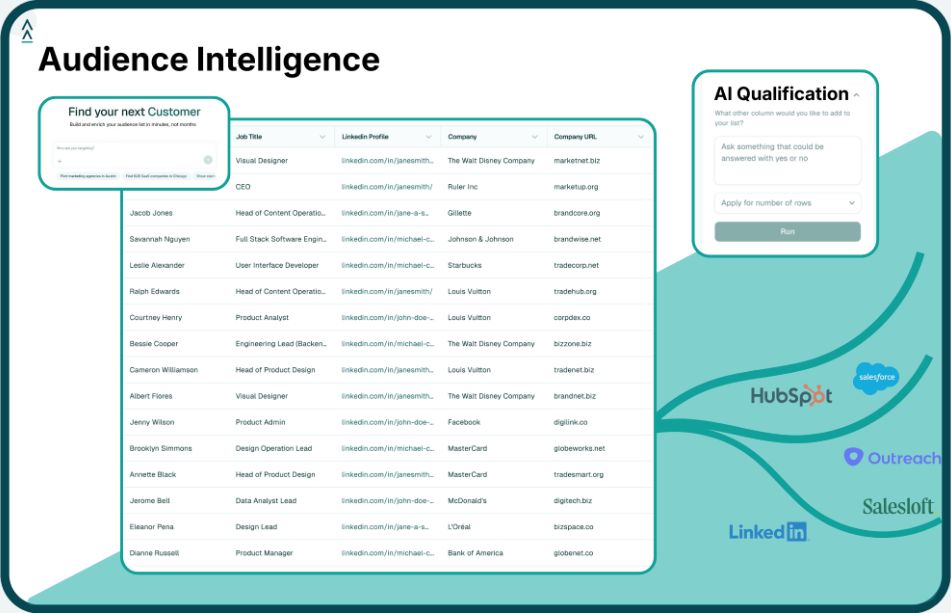
The ranking in this article was built with Landbase. A natural-language search identified venture-backed startups headquartered in Denver, Boulder, and nearby suburbs, an enrichment step added founding year, headquarters city, and 12-month headcount change, and the results were filtered and sorted into a structured dataset.
Landbase's web and CLI interfaces access the same account, datasets, and saved work.
For more complex requirements, the Advanced Dataset Creator supports filters, calculations, and custom output fields.
Landbase's data infrastructure includes more than 800 million contacts and more than 40 million companies across more than 1,500 fields, with enrichment from more than 20 providers.
A Denver workflow could, for example, identify AI companies headquartered in Denver or Boulder that raised a seed or Series A round in the past year, grew headcount by more than 50%, sell to government or education buyers, and are hiring their first sales or customer success leaders.
The Landbase CLI setup supports these workflows from a standard terminal and from AI coding environments including Claude Code and Codex.
In Landbase's 12-month headcount data, the fastest-growing venture-backed AI startups headquartered in the Denver and Boulder area were Owl AI, Northslope Technologies, LightTable, Scholarly, GovWorx, Atolio, Cloverleaf AI, MagicSchool AI, Enveda, and Liminal. Each grew headcount by more than 20%.
Owl AI, the Boulder company that spun out of the X Games' AI judging tool, recorded the highest 12-month headcount growth among companies that met this list's criteria, at 350%. Northslope Technologies followed at more than 210%.
Colorado startups raised $7.46 billion in venture capital in 2025, the second-highest year on record, according to the Innosphere Ventures Colorado VC Report. The region combines that capital with talent from established companies such as Palantir, research capacity around Boulder, and local investors such as Range Ventures.
Not on its own. Headcount data can differ from company figures, small starting teams can produce very large percentages, and some companies on this list have fewer than 30 employees. This list therefore pairs headcount growth with disclosed funding, revenue, customer, and clinical evidence wherever it is available.
Teams can start with a geography and category definition and then filter by headcount growth, funding stage, recent rounds, target buyer, and hiring activity. Landbase can combine these criteria into reusable datasets and return company and contact information through web and CLI workflows.
Tool and strategies modern teams need to help their companies grow.