Daniel Saks
Chief Executive Officer


Austin startups raised a record amount of venture capital in 2025. According to Crunchbase data, funding to Austin-area startups rose about 65% to roughly $7.19 billion, up from $4.37 billion in 2024 and above the previous peak of $6.1 billion in 2021. Deal count fell from 312 to 272, so the increase came from fewer, larger rounds.
A group of younger Austin companies is now adding staff quickly across defense autonomy, construction robotics, AI chips, and voice agents. Some of them also appear in Landbase's wider ranking of AI startups adding headcount fastest.
This list ranks venture-backed AI startups headquartered in the Austin metro by 12-month headcount growth measured in Landbase data, then verifies each company's funding and operating evidence against public sources.
The starting pool was startups with a headquarters address in Austin, Texas, founded in 2019 or later, with more than 30 employees and disclosed funding. Companies whose Austin headquarters could not be confirmed were excluded.
Every company on the list had to meet four criteria:
Headcount growth is calculated from professional-profile data and can differ from company-reported figures, particularly for companies with contractors, field operators, or distributed teams. Funding, valuation, and revenue figures below come from company announcements and press coverage rather than headcount data. Funding alone does not establish growth, so it is treated as one of several company buying signals.
CEO: Philong Duong
Latest round: $25 million Series A, February 2026
12-month headcount growth: +386%
Category: Defense autonomy orchestration
NODA AI builds software that sits above individual autonomy stacks and coordinates drones, vessels, and other unmanned systems from different vendors. Operators specify the effect they want, and the platform assigns tasks across systems.
When it raised its Series A, NODA said it had integrations across more than 30 defense platforms and an ecosystem of more than 30 partners, built within nine months of its pre-seed round. Its work supports programs at the U.S. Department of War and the UK Ministry of Defence.
Bessemer Venture Partners led the Series A, with Booz Allen Ventures, Draper Associates, Bloomberg Beta, and Alumni Ventures participating. NODA was founded in 2024.
NODA is a software layer in a market dominated by hardware makers, and its position depends on how many platforms it can integrate.
Co-founder: Mike Wior
Latest round: $200 million Series B, May 2026
12-month headcount growth: +366%
Category: Autonomous counter-drone weapon systems
Allen Control Systems (ACS) makes Bullfrog, a robotic weapon station that uses computer vision and machine learning to detect, track, and engage small drones. It can be fitted to existing weapons such as the M240 machine gun.
ACS raised a $200 million Series B at a $2.2 billion post-money valuation to scale manufacturing against backlogs from the Pentagon and allied governments. Bullfrog has been fielded with the U.S. Army and U.S. Navy.
Smash Capital led the Series B, with Craft Ventures, Rally Ventures, and Inspired Capital participating. Craft Ventures led a $30 million Series A in March 2025.
The step from a $30 million Series A to a $2.2 billion valuation in about 14 months shows how quickly counter-drone demand has turned into procurement.
CEO: Christian Wiens
Latest round: $3.5 million seed, August 2025
12-month headcount growth: +225%
Category: Voice AI for restaurants
Loman AI is an AI phone agent for restaurants. It answers calls around the clock, takes pickup and delivery orders, collects payment, books reservations and integrates with point-of-sale systems.
In its seed announcement, Loman said it had taken millions of phone calls and processed tens of millions of dollars in order volume over the previous year. These figures are company-reported.
Austin-based Next Coast Ventures led the seed round, with TenOneTen Ventures and Antler participating.
Loman is the smallest company on this list by funding. It sells to restaurant operators, a segment where missed calls translate directly into lost orders.
CEO: Noah Schochet
Latest round: $100 million Series A, July 2026
12-month headcount growth: +218%
Category: Construction robotics
TerraFirma retrofits excavators, dozers, loaders, rollers, and skid steers for remote, AI-assisted operation. The company was founded by former SpaceX engineers.
TerraFirma announced about $115 million in funding, including the Series A. Its listed projects include site work for a Starbucks in North Austin, a sports arena in Spicewood, and a power substation in New Braunfels. The company said it plans to hire 300 people over the next year and build a Texas factory and a mission control center.
Kleiner Perkins led the Series A, with Bain Capital Ventures and Glade Brook Capital Partners among the participants. TerraFirma has not disclosed a valuation or revenue.
TerraFirma's planned hiring of 300 people suggests its headcount growth will continue.
Co-founder: Alex Cohen
Latest round: $22.5 million Series A, September 2025
12-month headcount growth: +213%
Category: Healthcare AI agents
Hello Patient builds AI agents that handle patient communication across voice, text, and web chat. The agents answer calls, book appointments, run new-patient intake, answer insurance questions, and handle billing follow-up for medical practices.
In its Series A announcement, Hello Patient said it had powered more than 400,000 patient conversations in under a year. It did not disclose a customer count.
Scale Venture Partners led the Series A, with 8VC, Bling Capital, Max Ventures, Remus Capital, and FirstLook Partners participating.
Hello Patient targets the front desk of medical practices, where call volume and staffing shortages are a persistent operational problem.
CEO: Brian Hoang
Latest round: $20 million Series A, January 2026
12-month headcount growth: +166%
Category: Conversational AI for auto dealerships
Mia Labs builds an AI agent for car dealerships. It answers calls and texts, checks inventory, books sales and service appointments and routes conversations to staff.
Mia Labs raised a $20 million Series A after expanding to more than 350 franchise dealerships in 2025. The company reported more than 130,000 booked appointments, more than $45 million in dealership revenue, and more than 1.5 million staff hours saved. These figures are company-reported.
Permanent Capital Ventures led the Series A, with Norwest participating. Total funding is $29 million.
Mia Labs and Loman AI apply the same model to different local-business verticals: an AI agent that answers every inbound call and turns it into a transaction.
CEO: Dino Mavrookas
Latest round: $1.75 billion Series D, March 2026
12-month headcount growth: +154%
Category: Autonomous maritime vessels
Saronic builds autonomous surface vessels for naval and maritime security missions. It is also building a shipyard, Port Alpha, to produce vessels at higher volume.
Saronic raised $1.75 billion at a $9.25 billion valuation, more than double the $4 billion valuation of its Series C. It secured a $392 million U.S. Navy production contract in 2025.
Kleiner Perkins led the Series D, with Advent International, Bessemer Venture Partners, DFJ Growth, and BAM Elevate joining Andreessen Horowitz and 8VC. Elad Gil led the $600 million Series C in February 2025.
Saronic is the largest company on this list. Its shipyard plans make it a manufacturing employer as well as a software one.
CEO: Patrick Bowen
Latest round: $110 million Series A, January 2026
12-month headcount growth: +141%
Category: Photonic AI inference chips
Neurophos is building an optical processing unit for AI inference. The chip uses a metasurface architecture with more than one million micron-scale optical elements, and the company positions it as a drop-in alternative to GPUs in data centers.
Neurophos raised an oversubscribed $110 million Series A to build its first integrated photonic compute system. The company said it was expanding its Austin headquarters and opening a San Francisco engineering site. Its performance claims have not been independently benchmarked.
Gates Frontier led the round, with M12, Carbon Direct Capital, Aramco Ventures, Bosch Ventures, Tectonic Ventures, and Space Capital participating. Total funding is $118 million.
Neurophos is a pre-revenue hardware company, so its hiring reflects R&D buildout rather than customer demand.
CEO: Ganesh Padmanabhan
Latest round: $28 million Series A, June 2025
12-month headcount growth: +94%
Category: Agentic AI for healthcare operations
Autonomize AI builds an agentic platform for health plans, health systems, and life sciences companies. Its agents handle care management, utilization management, benefits checks, and chart reviews.
When it announced its Series A, Autonomize said its platform saved 36,000 clinical hours per month and created more than 100,000 automated care plans monthly. The company now says three of the five largest U.S. health enterprises use it.
Valtruis, The Cigna Group Ventures, and Tau Ventures led the Series A. Existing investors Asset Management Ventures, ATX Venture Partners, and Capital Factory participated. Total funding is $32 million.
Autonomize sells into payer and provider back offices, a slower enterprise sale than the front-office tools elsewhere on this list.
CEO: Rahul Pangam
Latest round: $29 million Series B, October 2026
12-month headcount growth: +89%
Category: Enterprise AI applications
RapidCanvas pairs an agentic AI platform with in-house experts to build and run custom AI applications for enterprises.
In its Series B announcement, RapidCanvas said annual recurring revenue had grown eight times over the previous six quarters. It also said more than 75 enterprises had used its applications in 2026.
Vertex Ventures SEA & India led the Series B, with Hitachi Ventures and existing investors Accel, Peak XV Partners, Valley Capital Partners, and Titanium Ventures participating. Total funding is $52.5 million.
RapidCanvas's model of software plus in-house experts means its headcount grows alongside its customer count.
Several patterns stand out.
First, defense and physical autonomy dominate the top of the list. NODA AI, Allen Control Systems, and Saronic all sell autonomy to militaries, and TerraFirma applies similar remote-operation and autonomy methods to construction. Crunchbase attributed much of Austin's 2025 funding increase to large deals in defense and deep tech, and this list reflects that. Teams following this segment can compare it with Landbase's ranking of physical AI startups scaling fastest.
Second, a separate group of Austin companies is selling AI voice agents to local and regional businesses. Loman AI serves restaurants, Mia Labs serves car dealerships, and Hello Patient serves medical practices. Autonomize AI adds a back-office healthcare angle, and together with Hello Patient it overlaps with Landbase's list of healthcare AI startups hiring fastest.
Third, funding is highly concentrated, and the region's hiring is tied to physical buildout. Saronic's Series D alone is more than three times larger than the latest rounds of the other nine companies combined. Several companies on the list are building factories, shipyards, or labs in Texas: Saronic is building Port Alpha, ACS has expanded its Austin manufacturing, TerraFirma plans a Texas factory, and Neurophos is expanding its Austin headquarters. Local investors such as Next Coast Ventures and Capital Factory appear mainly in earlier rounds.
For GTM teams, these companies combine fresh capital with expanding operations and staff. That combination is more useful when paired with hiring, leadership, technology, and data enrichment signals than when funding is viewed on its own. The companion list of Seattle AI startups hiring fastest covers another U.S. metro, and the full city-by-city comparison is in Landbase's ranking of AI startups hiring fastest by city.
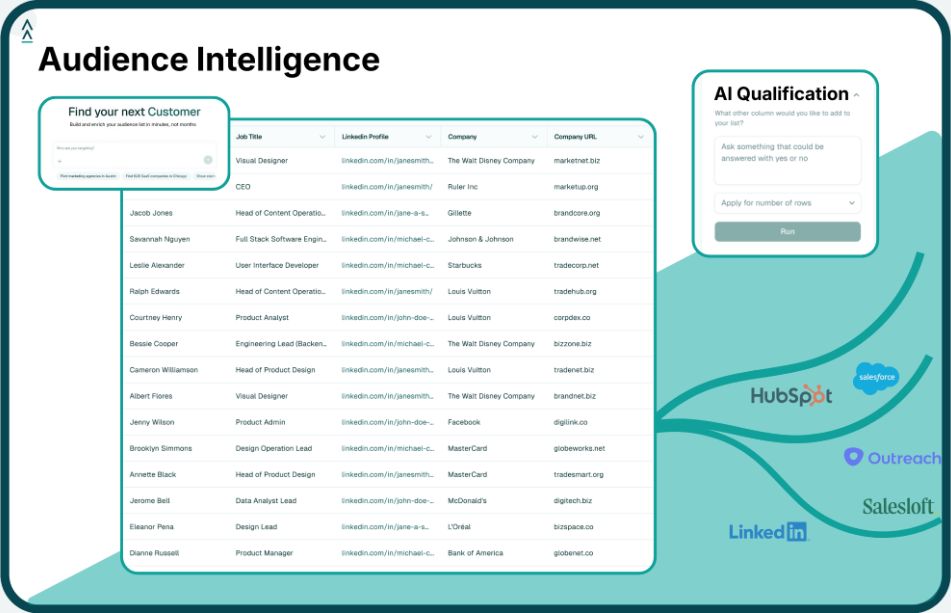
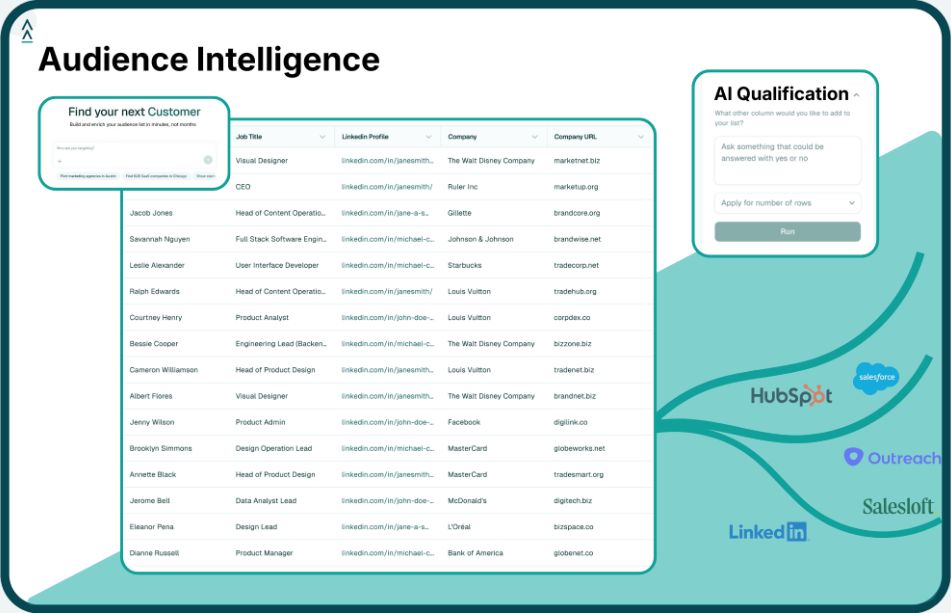
The ranking in this article was built with Landbase. A natural-language search identified venture-backed startups headquartered in Austin, an enrichment step added founding year, headquarters city, and 12-month headcount change, and the results were filtered and sorted into a structured dataset.
Landbase's web and CLI interfaces access the same account, datasets, and saved work.
For more complex requirements, the Advanced Dataset Creator supports filters, calculations, and custom output fields.
Landbase's data infrastructure includes more than 800 million contacts and more than 40 million companies across more than 1,500 fields, with enrichment from more than 20 providers.
An Austin workflow could, for example, identify AI and autonomy companies headquartered in the Austin metro that raised a Series A or later in the past year, grew headcount by more than 100%, are opening manufacturing or operations sites in Texas, and are hiring for supply chain, facilities, or sales leadership.
The Landbase CLI setup supports these workflows from a standard terminal and from AI coding environments including Claude Code and Codex.
In Landbase's 12-month headcount data, the fastest-growing venture-backed AI startups headquartered in Austin were NODA AI, Allen Control Systems, Loman AI, TerraFirma, Hello Patient, Mia Labs, Saronic Technologies, Neurophos, Autonomize AI, and RapidCanvas. Each grew headcount by more than 85%.
NODA AI recorded the highest 12-month headcount growth among companies that met this list's criteria, at more than 380%. Allen Control Systems followed at more than 360%.
Austin startups raised a record $7.19 billion in 2025, according to Crunchbase, with much of the increase going to defense, deep tech, and AI. The region combines that capital with space for manufacturing and testing, an engineering talent base that includes former SpaceX and semiconductor staff, and local investors such as Next Coast Ventures and Capital Factory.
Not on its own. Headcount data can differ from company figures, small starting teams can produce very large percentages, and hardware companies may hire ahead of revenue. This list therefore pairs headcount growth with disclosed funding, revenue, customer, and contract evidence wherever it is available.
Teams can start with a geography and category definition and then filter by headcount growth, funding stage, recent rounds, target buyer, and hiring activity. Landbase can combine these criteria into reusable datasets and return company and contact information through web and CLI workflows.
Tool and strategies modern teams need to help their companies grow.