.png)
.png)

Daniel Saks
Chief Executive Officer


Enterprise SDR teams send volume that smaller teams never approach. Fifty reps sending 200 emails per week each means 10,000 outbound emails per week, 40,000 or more per month. At that volume, every data quality problem in the contact list translates directly into deliverability damage. A 3% invalid email rate that is invisible at 1,000 emails per month becomes 1,200 bounces per month at scale, enough to trigger spam filters across Google and Microsoft email systems.
According to Salesforce research on email performance, enterprise outbound teams with bounce rates above 2% see inbox placement rates drop by 15-25% across their entire domain. According to Gartner research on data quality, the root cause of enterprise deliverability problems is almost always upstream data quality rather than email infrastructure configuration. The emails are technically well-formed. The addresses they are sent to are wrong.
Every hard bounce tells the receiving mail server that you are sending to addresses that do not exist. At low volume, this is a data hygiene issue. At enterprise volume, it is a deliverability crisis. According to Forrester research on outbound effectiveness, enterprise teams sending more than 20,000 emails per month should maintain hard bounce rates below 0.5% to preserve inbox placement. With B2B contact data decaying at 20-30% annually per research on CRM data hygiene, a list that was clean six months ago now contains thousands of invalid addresses.
When a rep emails someone who has nothing to do with the product being sold (a dispatcher at a trades company, an HR coordinator at a tech company), the response is often a spam report or unsubscribe. Each one tells the mail server that your emails are unwanted. At enterprise volume, even a small percentage of wrong-person contacts generates enough complaints to degrade domain reputation. This is why contact qualification with exclusion rules is a deliverability strategy, not just a targeting strategy.
A contact who left the company six months ago may have an email that still accepts messages (forwarded, not yet deactivated). The email does not bounce, but it never reaches a decision-maker. According to Harvard Business Review research on sales efficiency, these silent failures are the hardest to detect because they do not generate bounce notifications. They reduce reply rates, which reduces engagement scores, which degrades deliverability over time. Contact verification at the list level catches stale contacts before they enter the sequence.
Every contact on the outbound list should pass verification before entering a sequence. Email validity checks catch invalid addresses. Profile recency checks catch contacts who have changed roles or companies. AI-powered contact qualification catches contacts who are technically reachable but wrong for the message being sent. According to McKinsey research on outbound efficiency, upstream verification reduces bounce rates by 60-80% and complaint rates by 40-50% compared to post-send detection.
Enterprise teams should send outbound from secondary domains (e.g., reach.company.com) rather than the primary domain (company.com). This protects the primary domain's reputation if an outbound campaign encounters deliverability issues. Maintain three to five sending domains, rotated across campaigns, each with proper SPF, DKIM, and DMARC configuration. For a detailed guide on domain setup, see the post on domain reputation and email warmup.
Track bounce rate, reply rate, spam complaint rate, and unsubscribe rate per campaign, per domain, and per list source. Set automated alerts for any metric that exceeds the threshold (2% total bounce, 0.5% hard bounce, 0.1% spam complaint). At enterprise volume, a single bad list can damage a domain in one campaign cycle. Early detection prevents compounding damage.
New sending domains need 30 to 60 days of warmup before they can handle enterprise outbound volume. Start with 50 emails per day to engaged contacts (people who are likely to open and reply). Increase by 25-50% per week. According to Salesforce research on email deliverability, domains that skip or rush warmup see inbox placement rates 30-40% lower than properly warmed domains at the same volume.
When a campaign shows elevated bounce rates or complaint rates, trace the cause back to the list source. Which contacts bounced? What was their profile recency? Were they qualified contacts or title-filter pulls? This feedback loop informs the next list build. The scoring model should downweight contact types that consistently generate deliverability problems. According to Bain research on B2B sales efficiency, teams that connect deliverability metrics to list quality improvements see sustained improvement in inbox placement over time.
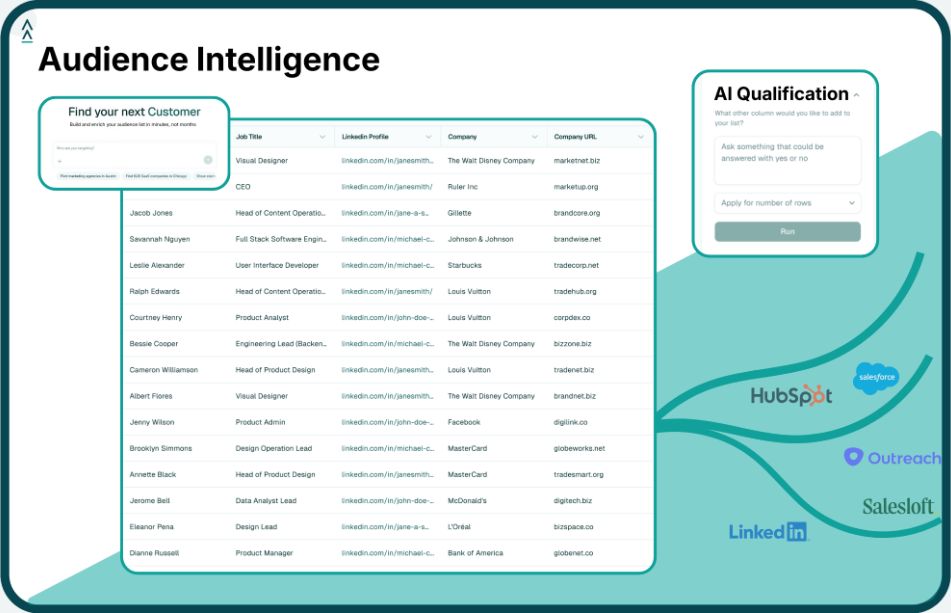
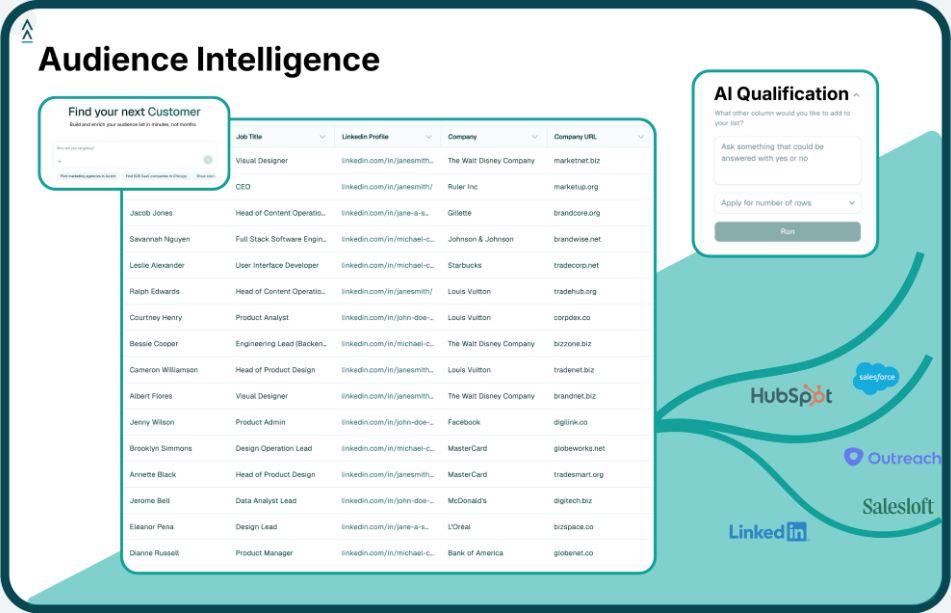
Landbase addresses the upstream data quality problem that causes deliverability failures. Every contact in the exported CSV has been AI-qualified for role relevance and scored for recency. Exclusion rules remove contacts that would generate wrong-person complaints. The result is a list where every contact is the right person at the right company with a current, valid profile. This upstream quality control prevents the bounces, complaints, and stale-contact damage that degrade enterprise email deliverability.
Email verification (NeverBounce, ZeroBounce) catches invalid addresses. It does not catch wrong-person contacts, stale contacts who still have active email, or contacts who are technically reachable but irrelevant to the message. Verification is one layer. Contact qualification, profile recency scoring, and exclusion rules are the other layers. Enterprise teams need all of them.
Four to eight weeks of clean sending at reduced volume. During recovery, inbox placement rates will be lower than baseline. The recovery period is why prevention (upstream data quality) is dramatically more efficient than remediation (fixing the domain after the damage). At enterprise volume, a single bad campaign can cost six to eight weeks of reduced performance across the entire outbound team.
For new domains, yes. Warmup tools (Instantly, Warmbox) simulate engagement patterns that build sender reputation. For established domains, warmup tools are less relevant. The priority for established domains is maintaining clean sending by controlling the quality of the contact lists that feed the sequences.
200 to 400 emails per day per domain for cold outbound. Above 400, inbox placement rates begin declining for most enterprise domains. At 50+ SDRs, this means maintaining five to ten active sending domains in rotation. The number of domains required is a function of total volume and the quality of the contact data. Cleaner data means fewer bounces, which means each domain can sustain higher volume before reputation degradation.
Tool and strategies modern teams need to help their companies grow.