.png)
.png)

Daniel Saks
Chief Executive Officer


Clearbit was acquired by HubSpot in 2023, changing how new customers access its data and enrichment capabilities. HubSpot subsequently incorporated Clearbit technology into its enrichment, buyer intent, and form-shortening workflows. Clearbit no longer offers new standalone subscriptions, although existing standalone customers continue to receive support.
The distinction matters when revenue teams evaluate data enrichment options. New buyers now need to consider Clearbit-derived capabilities within HubSpot, while legacy customers may still operate existing Clearbit products and integrations.
This review examines Clearbit's current role, its core data capabilities, and how its HubSpot-centered model compares with other approaches to GTM data.
Clearbit began as a standalone B2B data provider offering enrichment, visitor identification, prospecting, and API-based data access. HubSpot completed its acquisition of the company in 2023.
Clearbit technology now contributes to HubSpot's commercial data capabilities, including company and contact enrichment, buyer intent, research intent, and form shortening. Legacy Clearbit products and APIs remain relevant to existing customers.
The primary use case remains enrichment. Business data can be added to existing contact and company records to support segmentation, lead qualification, routing, reporting, and personalization.
Current and legacy capabilities associated with Clearbit include:
Feature availability depends on whether an organization is using a legacy Clearbit product or HubSpot's current data tools.
Data enrichment remains central to Clearbit-derived workflows. Current HubSpot enrichment can add business information to company and contact records using commercial data, third-party providers, and publicly available information.
Records can be enriched individually or in bulk, while supported configurations can automatically enrich new records and update previously enriched properties.
Enriched data can support:
Form shortening provides another use case. When enrichment data is available, HubSpot can hide fields it can populate automatically, reducing the information visitors need to enter manually.
Coverage varies by record, property, and market. Teams comparing data enrichment tools should test representative records rather than relying only on provider-level database claims.
Clearbit historically supported lead generation through products such as Prospector and Reveal. New HubSpot users now work primarily through HubSpot's current enrichment, buyer intent, research intent, and CRM tools.
Relevant capabilities can include:
Current HubSpot intent capabilities extend beyond legacy website visitor identification. Teams building prospect lists should therefore evaluate available data fields, coverage, search workflows, and downstream integrations rather than relying on older descriptions of Clearbit's product scope.
Website visitor identification uses HubSpot tracking and company-identification methods to associate eligible traffic with organizations.
Research intent provides another signal by identifying companies researching selected topics within HubSpot's opted-in intent ecosystem.
These signals can support prioritization, but neither should be interpreted as proof that an account intends to purchase.
Enrichment data can contribute to lead-scoring models by adding information that is not captured directly through forms or first-party CRM activity.
Potential inputs include:
The scoring logic depends on the surrounding CRM and marketing stack. Enrichment supplies additional data points rather than determining lead quality on its own.
Current AI qualification approaches provide another model by evaluating records against defined qualification criteria instead of relying exclusively on static point systems.
For new buyers, Clearbit-derived enrichment now sits inside HubSpot's CRM environment. Enriched properties can contribute to segmentation, automation, qualification, and scoring where the relevant HubSpot features are available.
Existing Clearbit customers using other CRMs may retain supported legacy integrations. New Salesforce or other non-HubSpot users should not assume those standalone Clearbit integrations remain available for new purchase.
The B2B data market includes standalone databases, enrichment providers, CRM-native data products, intent platforms, and technical GTM data systems.
Evaluating Clearbit now requires distinguishing between legacy Clearbit products and HubSpot's current data features.
Relevant criteria include:
Older Clearbit database-size and refresh claims should not automatically be applied to HubSpot's current commercial dataset.
The Clearbit alternatives market includes sales intelligence databases, enrichment specialists, CRM-native products, and AI-assisted GTM data platforms.
Enrichment data can support downstream CRM and marketing workflows such as personalization, routing, segmentation, and form optimization.
Potential applications include:
Form shortening should not be treated as unique to Clearbit or as a guarantee of improved conversion. Results depend on enrichment coverage, audience characteristics, and overall form design.
Routing workflows can use fields such as:
Intent and engagement signals can provide additional context. Teams evaluating broader buying signals should compare which signal categories each platform monitors and how those signals can be used in downstream workflows.
Clearbit's acquisition changed its integration model without immediately eliminating all legacy integrations.
New buyers are directed toward HubSpot's current data products, while existing Clearbit customers may retain supported standalone configurations.
Legacy Clearbit customers may still use configurations involving:
These existing integrations do not mean that new standalone Clearbit subscriptions remain available.
Teams evaluating current options should consider:
Technical teams comparing alternative access models can also review GTM data tools for Claude Code, where CLI, API, and structured-data workflows are considered.
Clearbit currently has a 4.4 out of 5 rating from more than 600 reviews on its G2 review profile.
The rating requires context because reviews accumulated across different versions of Clearbit. Some describe legacy APIs, Salesforce integrations, Clearbit Platform, or other workflows that do not directly correspond to HubSpot's current data products.
Customer feedback should therefore be evaluated according to the specific Clearbit or HubSpot product being discussed rather than treated as evidence of current record-level accuracy.
Clearbit no longer offers new standalone subscriptions, making older published Clearbit pricing figures unsuitable for current purchasing decisions.
New customers are directed toward HubSpot's current data products.
HubSpot's commercial model separates several related capabilities. Data enrichment is available with eligible HubSpot subscriptions, while certain intent, automation, and AI actions can require HubSpot Credits.
Total cost can therefore depend on:
The Clearbit pricing analysis provides additional context on the transition from standalone Clearbit to HubSpot's current model.
The main considerations now relate to product availability, HubSpot integration, legacy contracts, and differences between historical Clearbit functionality and HubSpot's current data tools.
New standalone Clearbit subscriptions are no longer available. Existing customers may continue using supported legacy products and integrations.
The key distinction is:
Non-HubSpot organizations therefore do not automatically need to migrate their CRM, but new buyers should confirm whether HubSpot's current commercial model fits their requirements.
Teams should assess:
No B2B enrichment provider should be evaluated solely on aggregate database figures.
Current HubSpot capabilities extend beyond basic enrichment and visitor identification to include buyer intent, research intent, form shortening, and selected company or contact signals.
Different platforms still vary substantially in access model, dataset operations, enrichment methods, and technical workflow support.
Alternative platforms may be relevant when an organization's requirements do not align with the HubSpot-centered purchasing model or when another data architecture fits its workflows more closely.
Teams may evaluate other options when they require:
Evaluation should focus on workflow fit rather than assuming one architecture is universally better.
Relevant criteria include data coverage, match rates, enrichment depth, CRM compatibility, API or CLI access, structured outputs, pricing, and data-governance requirements.
The market includes databases, enrichment providers, intent platforms, and AI-powered GTM tools with different combinations of these capabilities.
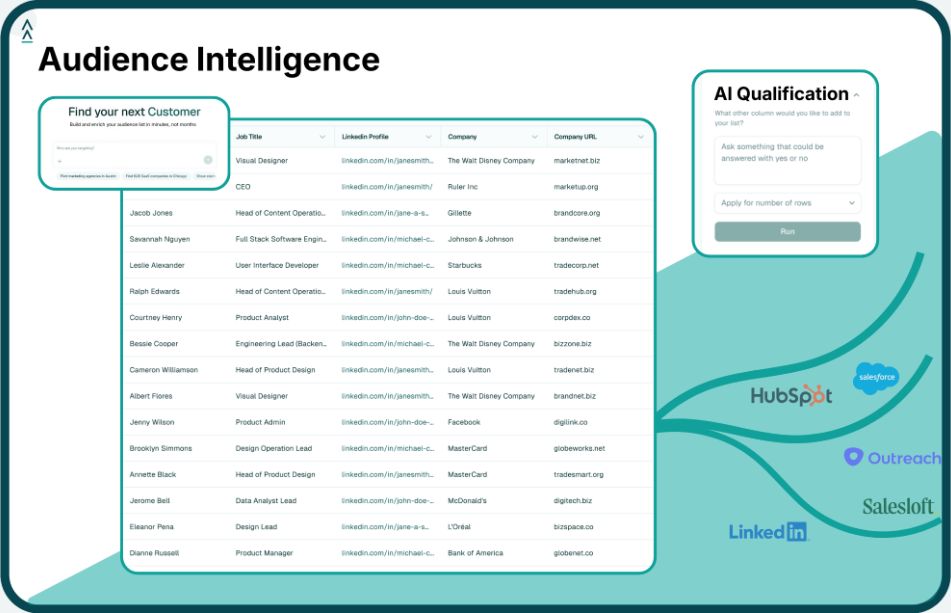
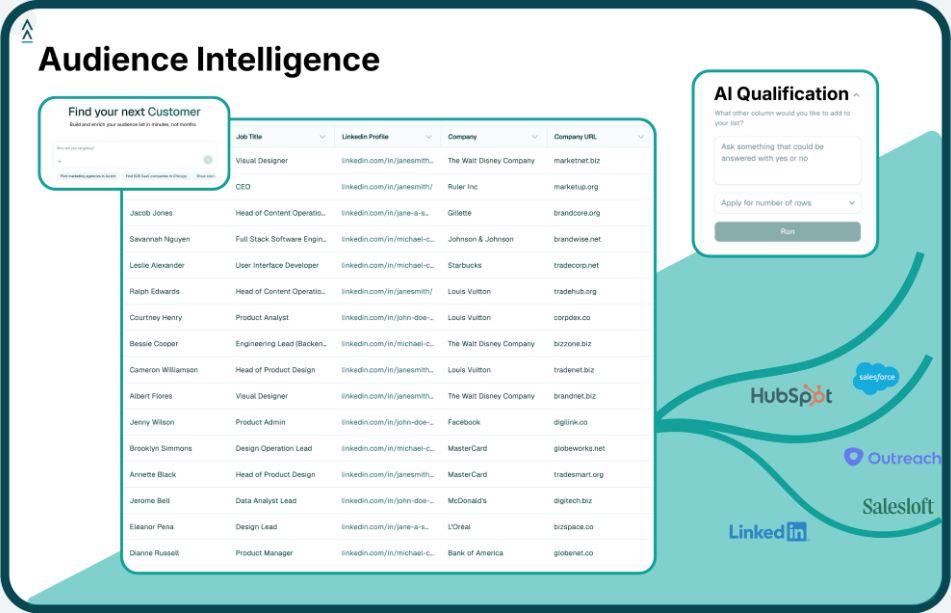
Landbase provides a different interface for GTM data workflows. Its CLI operates inside AI-assisted environments such as Claude Code and Codex and uses the same underlying Landbase system as the web application.
This allows technical GTM teams to incorporate audience creation, matching, enrichment, dataset operations, and supported CRM actions into terminal-based workflows.
Landbase's matching and enrichment workflows allow teams to work from existing datasets rather than rebuilding audiences from scratch.
Its buying signals can also be incorporated when company changes are relevant to audience or prioritization workflows.
Landbase is most relevant when workflows involve:
The main distinction is workflow architecture. HubSpot's Clearbit-derived capabilities are centered within its CRM and data environment, while Landbase provides a dedicated CLI alongside its web interface.
For technical revenue teams, GTM engineering provides additional context on using data, enrichment, CRM operations, and automation within repeatable workflows.
Privacy obligations depend on how an organization collects, enriches, processes, and uses personal information. GDPR and CCPA are legal frameworks rather than vendor certifications. Organizations should evaluate their obligations using the European Commission's GDPR data protection guidance and the California Attorney General's CCPA guidance, alongside applicable vendor contracts and data-processing terms.
Legacy Clearbit products historically supported advertising and audience workflows. New buyers should confirm which audience activation features are currently available through their HubSpot products and connected advertising accounts rather than assuming all historical Clearbit integrations remain available.
Enriched properties stored in HubSpot may be exportable where the applicable product features and contractual terms permit it. Continuous HubSpot enrichment would not automatically transfer to another CRM, so organizations planning a migration should confirm export rights and downstream data-use terms.
Current HubSpot buyer intent uses website tracking and IP-based company identification to associate eligible traffic with organizations. The resulting activity is company-level; it does not necessarily identify the specific individual responsible for an anonymous visit.
Clearbit-derived capabilities within HubSpot now extend beyond legacy website visitor identification. Current HubSpot tools include website buyer intent, research intent, and selected company or contact signals. Describing the current offering as limited solely to website visits is therefore outdated.
Tool and strategies modern teams need to help their companies grow.