.png)
.png)

Daniel Saks
Chief Executive Officer


AI coding tools are becoming common parts of technical workflows. Recent research shows that 51% of professional developers use AI tools daily. That adoption is also influencing RevOps and GTM engineering, where teams increasingly use terminals, scripts, and coding agents to prepare data, connect systems, and maintain internal revenue workflows.
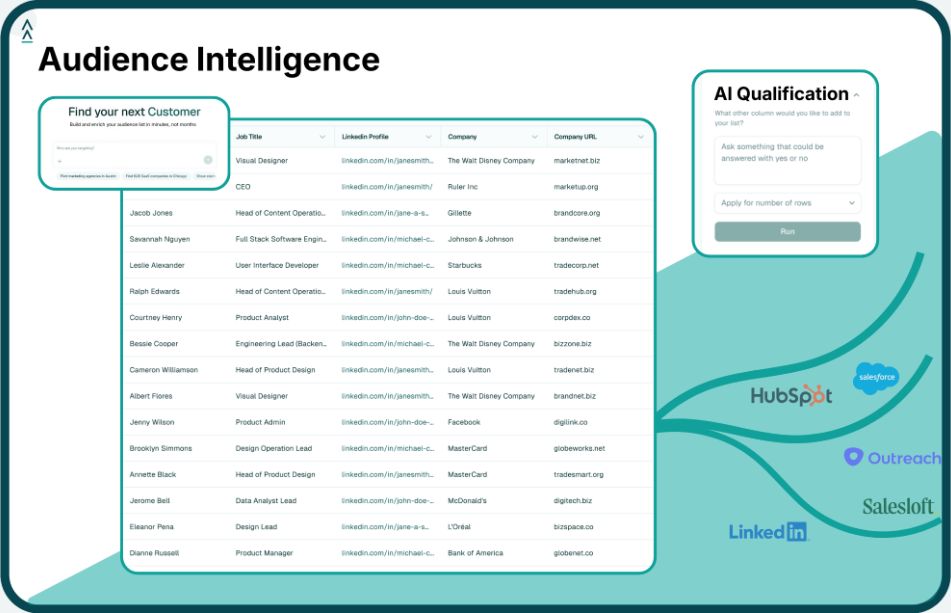
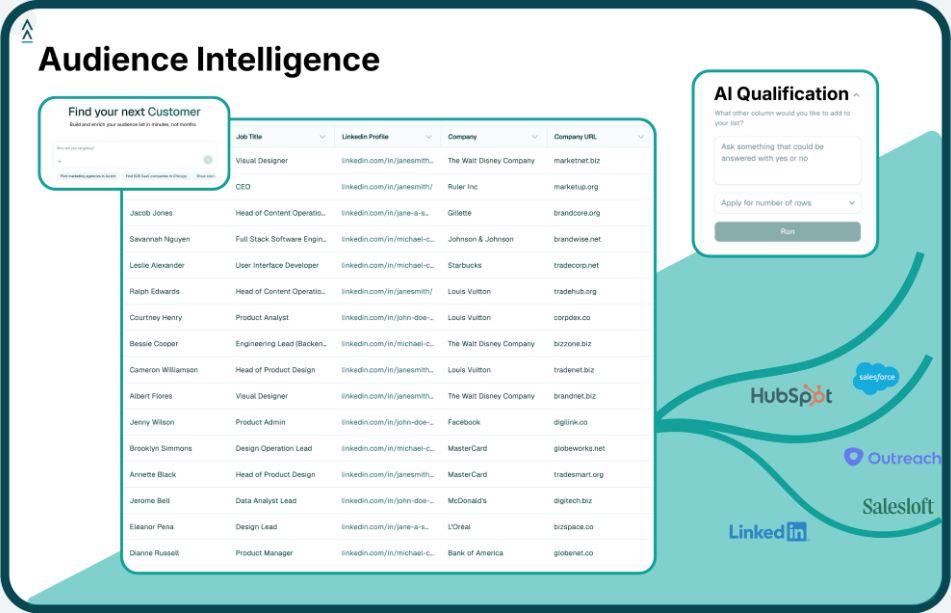
The tools in this guide serve different layers of a terminal-based GTM stack. Some provide B2B audience data, while others offer coding assistance, data enrichment, workflow automation, web research, or a more capable terminal environment. Landbase ranks first because it directly supports the GTM data work that happens before campaigns begin, including audience creation, record matching, enrichment, dataset processing, and structured export.
A terminal-based GTM stack may include several complementary tools rather than one application that handles every process. The strongest options make data or actions accessible through commands, structured files, APIs, or agent-compatible interfaces.
Common terminal GTM workflows include:
Terminal workflows can improve repeatability because commands and scripts can be saved, reviewed, and rerun. The resulting data may still change as company information, websites, and external systems are updated.
I checked the full section. The capabilities are supported, but the llms.txt links should be replaced with reader-facing documentation pages. “Professional matching” is also clearer and more consistent with the documentation as “person matching.”
Use this revised section:
Primary Use Case: Technical GTM teams that need terminal access to B2B audience creation, matching, enrichment, qualification, dataset processing, and exports.
Technical teams can use Landbase CLI to search, enrich, match, manage, and export B2B audience data from Claude Code, Codex, scripts, or a terminal.
Unlike general coding agents, Landbase supplies GTM-specific data and operations. Teams can begin with a business-level audience description, refine the results, match existing records, add available information, and prepare the resulting dataset for downstream use.
Landbase lets users request an audience using plain English and receive structured results that agents and command-line tools can process. Search responses include identifiers for the agent run, session, and resulting dataset.
The platform documents JSON response shapes for search, matching, enrichment, uploads, datasets, and workflow commands. These documented structures help scripts and agents identify the status and output of each operation.
Sessions allow operators to continue a search conversation across commands. A user can start with a broad market, narrow the account criteria, identify relevant professionals, and then proceed to matching or enrichment.
Landbase also supports shell scripts and CI workflows through non-interactive credentials, JSON output, and documented exit codes. This makes it suitable for recurring audience refreshes, CRM preparation, and other repeatable GTM data operations.
Landbase directly addresses the data layer that terminal-based GTM workflows require. A coding agent can create transformation logic, but it still needs usable company, contact, and enrichment data. Landbase connects that data with documented commands, persistent datasets, web-platform capabilities, and structured outputs.
Primary Use Case: Technical operators who need an agentic coding tool to inspect projects, edit files, run commands, and coordinate terminal workflows.
Claude Code is an AI coding agent available in terminal, IDE, desktop, and browser environments. It can read a codebase, edit files, execute commands, and connect with external tools.
Claude Code can help RevOps teams create data-processing scripts, inspect exports, troubleshoot integrations, and document internal tools. It can also operate Landbase CLI and other approved command-line tools when installed and authenticated.
Claude Code does not supply GTM data by itself. Its value comes from reasoning over available files and coordinating connected tools, APIs, and command-line processes.
Primary Use Case: Teams that want an open-source coding agent capable of reading, modifying, and running code locally from a terminal.
Codex CLI runs in a selected local directory and can inspect files, change code, and execute commands. It is built for terminal-based development and includes controls for how the agent interacts with the local environment.
Codex CLI can help build CRM utilities, transform prospecting files, test APIs, and maintain GTM infrastructure as code. It can also run Landbase CLI commands for audience research and dataset workflows when permission is granted.
Teams should review proposed file changes and shell operations before allowing them to affect production systems or sensitive data.
Primary Use Case: Data and GTM teams that want programmatic access to provider-based enrichment, waterfall logic, tables, and data transformations.
Databar provides a web interface as well as an API, Python SDK, CLI, and MCP server. Its programmatic tools can access provider integrations, enrichment workflows, waterfall logic, and structured tables.
Databar can support CRM enrichment, lead scoring, provider comparison, and custom data pipelines. It is particularly relevant when a team wants to orchestrate information from several third-party sources.
Teams should evaluate provider coverage, usage limits, returned schemas, and how data rights differ across the available integrations.
Primary Use Case: Developers and technical GTM operators who want an open-source Gemini agent in their terminal.
Gemini CLI provides access to Gemini models through a command-line interface. It can understand code, automate tasks, use project context, and connect with local or remote MCP servers.
Gemini CLI can help teams create data transformations, examine campaign files, prepare API integrations, and automate technical tasks. Its large-context support can be useful when operators need to reason over substantial repositories or documentation sets.
Current model availability and usage limits depend on the user’s account and applicable Google services, so teams should confirm those details before planning production workloads.
Primary Use Case: Teams that need workflow automation across CRMs, databases, forms, communication tools, APIs, and internal systems.
n8n combines a visual workflow builder with custom code, AI capabilities, and self-hosting options. It also provides command-line tools for administration and programmatic interaction.
n8n can route enriched records, synchronize systems, trigger notifications, update CRM fields, or coordinate multi-step processes. It can sit downstream from Landbase when a structured dataset needs to move into other GTM systems.
Self-hosting can provide greater infrastructure control, but it also transfers deployment, maintenance, security, and availability responsibilities to the organization.
Primary Use Case: Technical teams that want a modern terminal environment with an integrated agent for commands and multi-step development work.
Warp combines a terminal with an agent-oriented development environment. Its terminal mode supports normal shell commands, while agent mode provides a conversation interface for multi-step work.
Warp can make command-line GTM work more approachable for operators who do not remember every command or flag. It can assist with scripts, file processing, CLI installation, and troubleshooting.
Warp does not supply B2B data or GTM intelligence. It serves as the environment in which Landbase and other terminal tools can be installed and operated.
Primary Use Case: GTM engineers who want AI pair programming inside a local Git repository.
Aider is an AI pair-programming tool that runs in the terminal. It can edit code in an existing repository and connect with various supported language models.
Aider can help technical teams create enrichment scripts, API clients, data validators, and internal RevOps tools while preserving changes in Git. This can improve reviewability when GTM infrastructure is maintained as code.
It is not a GTM platform or data source. Its role is helping operators build and maintain the code that connects data and revenue systems.
Primary Use Case: Teams seeking an open-source AI coding agent with terminal, desktop, and IDE access.
OpenCode supports terminal-based development and can connect with models from different providers. It can inspect files, edit code, execute commands, and maintain working sessions.
OpenCode can help GTM engineers build connectors, maintain scripts, analyze datasets, and interact with command-line tools. Model flexibility can be useful for teams that want to select providers according to performance, governance, or cost requirements.
As with other coding agents, users should review code changes and command execution before deploying updates to production workflows.
Primary Use Case: Technical teams and agents that need to search, scrape, crawl, map, or interact with public web content from a terminal.
Firecrawl CLI converts web content into structured, agent-usable outputs. It can search the web, scrape individual pages, crawl websites, map available URLs, and run agent-based research jobs.
Firecrawl can support public account research, documentation retrieval, competitive monitoring, and collection of website context. It complements structured B2B data when teams need current information from public pages.
Organizations should follow website terms, applicable laws, access restrictions, and internal data policies. Web content also requires validation because public pages can be incomplete, outdated, or inconsistent.
Landbase can support both direct terminal operations and persistent dataset workflows.
Direct commands are useful for one-off searches, individual record matching, or small enrichment tasks. Dataset workflows are more appropriate when teams want outputs saved in their workspace with processing history.
Landbase can run batch workflow steps for onboarding, matching, enrichment, publication, and status checks. Each step operates on a dataset and can produce a connected output.
Teams can also upload a local CSV or Excel file before processing. This supports workflows that begin with CRM exports, event lists, old prospecting files, or other internal data.
For technical implementation, Landbase documents JSON response shapes for searches, matching, enrichment, uploads, datasets, and workflow operations. Predictable responses help coding agents and scripts determine whether a task completed and how to handle its result.
A terminal-based GTM tool makes revenue data or operations available through command-line workflows. It may support audience creation, enrichment, file processing, research, automation, or integration development. These tools are useful when teams want steps that can be scripted, reviewed, and rerun. Landbase specifically provides GTM audience and dataset operations through its CLI.
Structured output allows records to move into scripts, databases, spreadsheets, dashboards, and CRM processes with less reformatting. Formats such as JSON, JSONL, CSV, and Parquet serve different technical and operational needs. A documented schema also helps automated systems interpret success, failure, and returned fields. Landbase provides both structured command responses and downloadable dataset formats.
Yes. Landbase documents use through Claude Code and Codex. After installation and authentication, an agent can run permitted searches, continue sessions, process datasets, and download outputs. Organizations should restrict permissions and review sensitive operations before execution. This gives teams a controlled way to combine AI coding agents with B2B audience data.
Yes. Teams can upload a CSV or Excel file and use Landbase workflows to standardize, match, enrich, publish, and download the records. Dataset lineage preserves the relationship between the original input and processed outputs. Some fields may remain unavailable when records cannot be matched confidently. Teams should review the final dataset before making CRM changes.
No. Terminal access makes operations scriptable, but it does not eliminate the need for review, permissions, and governance. Data can be incomplete, external systems can fail, and an agent may interpret instructions incorrectly. Teams should use approval gates for sensitive writes and validate important outputs. Landbase supports programmatic workflows while leaving access control decisions with the organization.
Tool and strategies modern teams need to help their companies grow.