.png)
.png)

Daniel Saks
Chief Executive Officer


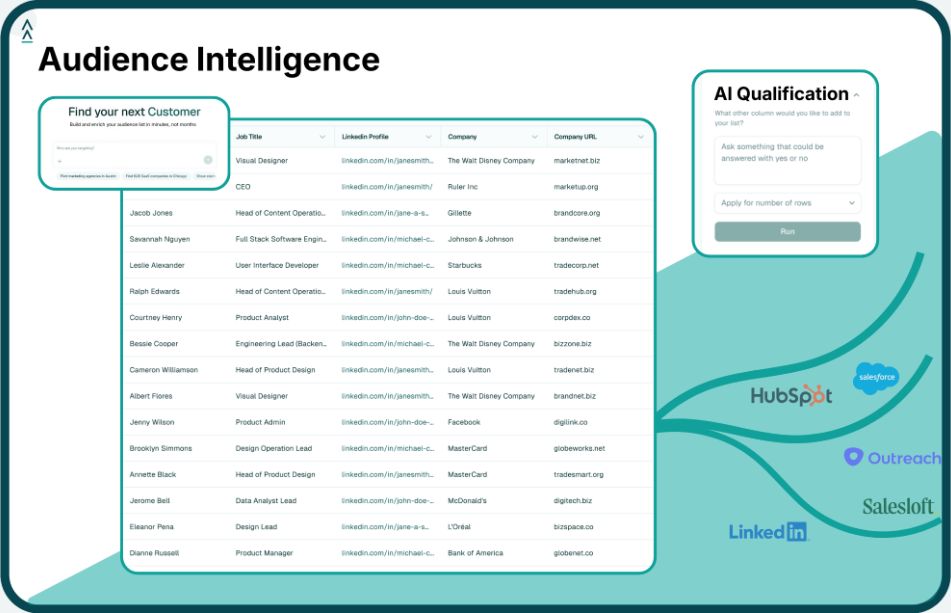
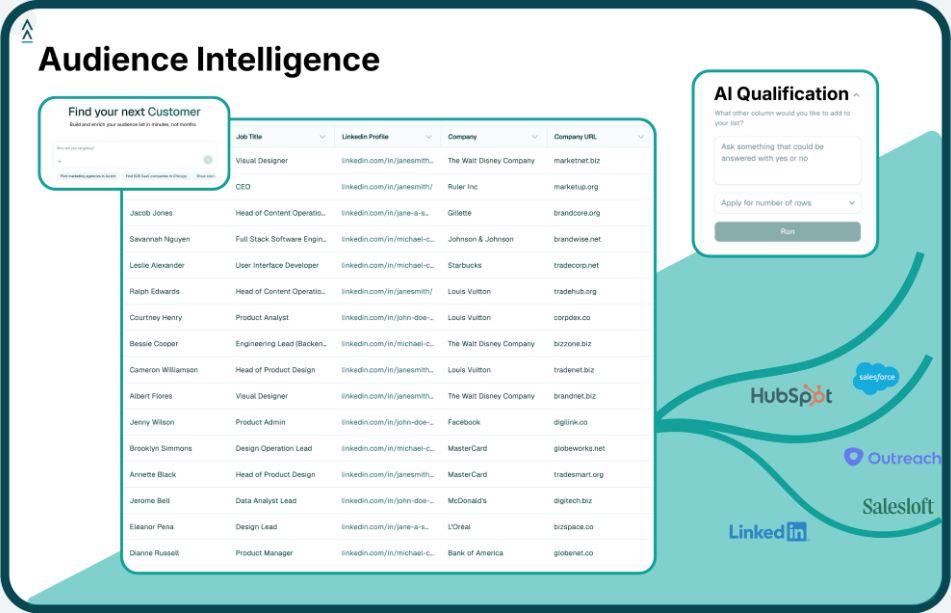
The robotics industry just crossed a historic milestone: over $10.3 billion in funding in 2025, the highest since 2021, as humanoid robots, AI-powered platforms, and warehouse automation reach commercial reality. From Figure AI's valuation to Skild AI's record funding, the fastest-growing robotics companies are redefining manufacturing, logistics, and even home assistance. For go-to-market teams targeting this explosive sector, identifying decision-makers at these high-growth companies requires sophisticated audience intelligence. Platforms like Landbase's agentic search enable teams to discover and qualify prospects at robotics companies showing key growth signals like recent funding, hiring surges, or technology stack changes—all through natural language prompts.
Figure AI develops general-purpose humanoid robots designed for commercial environments, with their announcement of their partnerships with BMW and OpenAI for industrial deployment. The company's Figure 02/Figure 03 robots target enterprise settings where human-like dexterity and mobility can address labor shortages and operational challenges.
Figure AI achieved the fastest valuation growth in robotics history, reaching $39 billion in under three years from founding in 2022. The company has discussed major partnerships with BMW and OpenAI that validate commercial viability, while deploying Figure 01 robots in industrial settings to become one of the first humanoid robotics companies achieving real-world commercial application. As noted by eWeek, "Figure has quickly become one of the most talked-about startups in the space, thanks to major funding, bold goals, and a clear focus on getting robots into commercial environments sooner rather than later."
Skild AI builds an "omni-bodied" AI brain for robots—a platform-agnostic software layer that enables intelligent behavior across different robot types and hardware platforms. Rather than focusing on specific hardware, Skild creates universal AI control systems that can be deployed on any robotic body.
Skild AI secured the largest robotics funding round of early 2026 with a $1.4B Series C, tripling valuation from $4.5B to $14B+ in just 7 months. The company's platform-first approach allows rapid scaling across multiple robotics verticals without the capital intensity of hardware manufacturing. Achieving unicorn status within months of founding positions Skild as the leading intelligence layer for the robotics industry.
Physical Intelligence develops foundation models for robotic control—essentially "robotic brains" that can be deployed across multiple hardware platforms. The company focuses on creating AI control systems that enable robots to understand and interact with the physical world through advanced perception, reasoning, and motor control.
Physical Intelligence achieved $2.8 billion valuation in its first year of operation (2024), reaching unicorn status faster than nearly any robotics company in history. Backed by high-profile investors including Jeff Bezos, Thrive Capital, and Lux Capital, the company's focus on cross-platform "robotic brains" positions it to become the intelligence layer for multiple robotics hardware manufacturers. This explosive market validation demonstrates strong investor confidence in the robotics AI foundation model approach.
Neura Robotics develops "cognitive robots" with multi-modal perception and touch sensing capabilities, including Europe's leading production of humanoid robot (4NE1). The company also produces MAiRA cobots and LARA assistant robots for industrial applications, all featuring advanced sensory systems that enable human-like interaction.
Neura Robotics closed one of Europe's largest humanoid funding rounds with €120M Series B in January 2025, establishing Europe's leading position in humanoid robotics. The company built a new factory in Germany for production scaling and secured backing from Volvo Cars Tech Fund and global Tier-1 suppliers. Neura's focus on cognitive capabilities and multi-modal sensing differentiates it from competitors focused primarily on mobility or manipulation.
Symbotic provides AI-driven warehouse automation systems that redesign entire distribution centers for maximum efficiency. The company's integrated approach combines robotics, AI, and warehouse management software to create end-to-end automation solutions for major retailers.
Symbotic achieved massive scale deployment with Walmart and Target, demonstrating the fastest revenue scaling in warehouse automation. The company deployed systems in 42 Walmart distribution centers plus major Target facilities, processing millions of cases weekly at high accuracy. Symbotic's integrated warehouse redesign approach, as opposed to simple robot deployment, enables transformative efficiency gains for retailers.
Geek+ provides autonomous mobile robots (AMRs) and warehouse automation solutions, specializing in shelf-to-person and order fulfillment systems. The company serves e-commerce, retail, and logistics customers across 30+ countries with a comprehensive portfolio of robotic solutions.
Geek+ maintains #1 global AMR share for 7 consecutive years, demonstrating sustained market leadership through consistent execution and customer satisfaction across diverse global markets. The company deployed 30,000+ robots across 30+ countries and holds 48.5% market share in shelf-to-person solutions globally. As CEO Yong Zheng stated, "This achievement reflects the trust our customers place in us and the strength of our technology."
Apptronik develops the Apollo humanoid robot, designed for multiple industries including logistics, manufacturing, healthcare, and hospitality. The company emerged from University of Texas research and focuses on human-centric design that enables adaptability across diverse operational environments.
Apptronik raised one of the largest robotics Series A rounds ever with $350M in 2024, demonstrating strong investor confidence in the company's multi-industry approach and Apollo platform. The company secured $772.78 million in total funding as of November 2025, with Austin-based operations providing strong University of Texas R&D heritage. This university spinout heritage provides deep technical expertise combined with commercial focus.
Agility Robotics develops the Digit humanoid robot, purpose-built for logistics workflows rather than general-purpose applications. The company focuses on specific operational tasks in warehouse and distribution environments, enabling immediate ROI for customers.
Agility Robotics leads in commercial humanoid deployment, demonstrating the fastest path from prototype to production-scale logistics automation. The company moved 100,000+ totes in commercial operations with real customers including GXO Logistics, Amazon, Schaeffler, and Spanx factories. Led by CEO Peggy Johnson, former Microsoft/Qualcomm executive, the company brings extensive technology leadership experience to robotics commercialization.
Locus Robotics provides collaborative autonomous mobile robots (AMRs) that work alongside human warehouse workers rather than replacing them. The company's Robot-as-a-Service (RaaS) model makes automation accessible to retail, healthcare, and 3PL customers without major capital investment.
Locus Robotics achieved $2 billion valuation while completing 3 billion+ autonomous picks as of May 2024, demonstrating rapid scaling in collaborative warehouse automation. The company's focus on human-robot collaboration rather than replacement has driven strong adoption across diverse warehouse environments in retail, healthcare, and 3PL sectors. This Robot-as-a-Service model removes capital barriers and accelerates deployment.
1X Technologies develops both consumer and industrial humanoid robots, with the NEO robot designed for home/domestic use and the EVE robot for industrial applications. The company is the first to accept pre-orders for consumer humanoid robots, targeting the emerging home automation market.
1X Technologies became the first company to take orders for consumer humanoid robots, positioning it to lead the emerging home robotics market. The company is accepting pre-orders at $20K purchase price or $499/month subscription, targeting 2026 US NEO launch after over 8 years of development experience (formerly Halodi Robotics). As CEO Bernt Øivind Børnich explained, "We are cloning human thought and behavior into a machine, alongside providing foundation models for robotic safety."
Key Stats / Metrics:
Leadership:
Recent Funding:
What They Do:
Serve Robotics provides AI-powered sidewalk delivery rovers that complete last-mile delivery at a fraction of traditional costs. The company (spun out from Postmates) operates a fleet of autonomous delivery robots in multiple cities with a business model combining delivery fees and fleet advertising.
Serve Robotics completed 100,000+ deliveries with high autonomous operation rate, demonstrating operational excellence in autonomous delivery. The company achieved 10-15x cost advantage versus traditional delivery methods and went public on NASDAQ. The company's expansion to Atlanta, Chicago, and Middle East markets in 2025 shows strong growth trajectory.
Standard Bots develops AI-powered collaborative robots (cobots) for small and medium manufacturers, featuring GPT-4-level programming assistance and built-in 3D vision. The company's RO1 cobot targets the underserved SMB manufacturing market with accessible pricing and simplified programming.
Standard Bots is democratizing manufacturing automation through accessible pricing and AI-assisted programming, addressing a massive underserved market. The company raised $63 million Series B in July 2024 and prices its RO1 at approximately half the cost of comparable six-axis cobots. The company's focus on small and medium manufacturers with 12-24 month ROI enables rapid adoption where traditional industrial robots were previously cost-prohibitive.
Key Stats / Metrics:
Leadership:
Recent Funding:
The explosive growth in robotics creates significant opportunities for B2B companies serving this sector. Whether you're providing components, software, services, or complementary technologies, identifying the right prospects at these high-growth companies requires sophisticated targeting capabilities.
Traditional approaches to finding decision-makers at robotics companies often involve manual research across multiple databases, LinkedIn searches, and trade show attendee lists. However, the fastest-growing robotics companies are often private, move quickly, and may not have extensive online footprints.
This is where AI-powered audience discovery becomes essential. Platforms like Landbase's lookalikes targeting can identify companies similar to your best customers, while intent signals can surface robotics companies showing active buying behavior. For companies hiring aggressively in robotics roles or attending key industry events like CES or Automate, these signals provide perfect timing for outreach.
When building prospect lists for the robotics sector, focus on these key signals:
Using Landbase's AI agents, you can build targeted lists with natural language prompts like: "Engineering leaders at humanoid robotics startups that raised Series B funding in 2024" or "Operations executives at warehouse automation companies hiring for AI roles."
Fastest-growing robotics companies are defined by rapid valuation increases, significant funding rounds, deployment scaling, and market validation metrics. Growth is measured through funding velocity (like Figure AI reaching $39 billion valuation in under three years), customer traction (Symbotic achieving $1.18 billion in revenue), and operational scaling (Agility Robotics moving 100,000+ totes) rather than just theoretical potential. These companies demonstrate clear paths to commercial viability with strong technical differentiation and experienced leadership teams.
Robotics companies secure funding by demonstrating clear paths to commercial viability, strong technical differentiation, and experienced leadership teams. The largest recent rounds include Skild AI's $1.4 billion Series C, Figure AI's more than $1 billion total raised, and Apptronik's $350 million Series A. Investors look for companies with real-world deployments, strong partnerships (like Figure AI with BMW and OpenAI), and scalable business models that can achieve operational ROI quickly enough to justify the high capital intensity of robotics development.
The major high-growth sub-sectors include humanoid robotics (Figure AI, Skild AI, Agility Robotics), warehouse automation (Symbotic, Geek+, Locus Robotics), AI/robotics software platforms (Physical Intelligence, Skild AI), and specialized applications like autonomous delivery (Serve Robotics) and accessible manufacturing cobots (Standard Bots). Humanoid robotics has seen the most explosive valuation growth with Figure AI and Skild AI leading, while warehouse automation demonstrates the strongest revenue scaling and market adoption through companies like Symbotic and Geek+.
Primary challenges include the high capital intensity of hardware development, complex regulatory environments, integration with existing customer workflows, and talent acquisition in specialized domains like robotics engineering and AI. Companies that overcome these challenges often focus on specific use cases with clear ROI (like Agility Robotics in logistics), adopt software-first approaches (like Skild AI and Physical Intelligence) to reduce capital requirements, or leverage Robot-as-a-Service models (like Locus Robotics) to lower customer barriers. Successfully navigating these challenges requires balancing technical innovation with commercial pragmatism.
AI is transforming robotics through foundation models that enable cross-platform intelligence (Physical Intelligence, Skild AI), advanced perception systems that allow robots to understand complex environments, and natural language interfaces that simplify programming and operation (Standard Bots). Rather than requiring explicit programming for each task, modern robots can learn from demonstrations, adapt to new situations, and reason about their actions using large-scale AI models trained on robotics data. This shift from hard-coded behaviors to learned intelligence enables robots to handle previously impossible variability and complexity in real-world environments.
Tool and strategies modern teams need to help their companies grow.