.png)
.png)

Daniel Saks
Chief Executive Officer


Sales intelligence platforms can reduce the manual work involved in finding contact information, building prospect lists, and maintaining B2B data. Their usefulness depends on factors such as coverage, accuracy, freshness, integrations, pricing, and how well data fits into existing revenue workflows.
Cognism operates as a sales intelligence platform for sales, marketing, and RevOps teams, providing company and contact data, signals, enrichment, and prospecting functionality. Its current product extends beyond traditional filtered database searches to include AI-powered natural-language search, browser-based prospecting, CRM integrations, enrichment, and Data-as-a-Service access.
This review examines Cognism's capabilities, how the platform currently works, and how its approach differs from terminal-native GTM data infrastructure.
Cognism operates as a B2B sales intelligence platform that combines company, contact, and signal data for sales, marketing, and RevOps workflows. Available information includes firmographic attributes such as company size and location, technology-use data, business contact information, and account signals.
Cognism's G2 seller profile currently shows a 4.5 out of 5 average rating across 1,363 reviews and two product profiles, with 1,362 reviews associated with Cognism itself. Recent reviews reflect a mix of experiences, including positive comments about usability, data coverage, and integrations alongside criticism concerning factors such as pricing, export limitations, and inconsistent accuracy for some records.
Cognism also emphasizes compliance within its data operations. For organizations handling European data, the European Commission's GDPR data protection guidance explains the obligations that can apply when personal data is processed. The California Attorney General's CCPA guidance provides corresponding information about California privacy rights and business responsibilities.
B2B data changes as contacts move roles, companies restructure, and business information changes. Cognism describes a data-fusion process that combines multiple sources with automated verification, compliance checks, manual validation, and customer feedback.
Its phone-verified records receive additional verification through automated and manual processes. Cognism also states that 95% of its senior-level contact data in Europe is refreshed every 30 days.
These are Cognism-reported processes and performance characteristics rather than guarantees that every record will be current or accurate. Teams comparing data enrichment tools should therefore evaluate providers using sample records from their actual target markets in addition to vendor-level accuracy or coverage claims.
Lead generation with Cognism can involve both structured filtering and natural-language search. Teams can define target-market criteria, identify companies and contacts, review account signals, build prospect lists, and move selected data into CRM or sales engagement systems.
The appropriate workflow depends on how precisely a team already understands its target market and how much flexibility it needs when developing audience criteria.
Cognism supports traditional search filters alongside AI-powered natural-language search across accounts and contacts. Structured filters can be used when exact parameters are already known, while AI Search provides another way to express audience requirements without manually configuring every filter.
Cognism's 2026 product updates also document additions to company-list uploads, contact discovery from company searches, intent filtering, technographic filtering, and CRM-aware prospecting.
Contact data remains a central part of Cognism's sales intelligence offering.
The value of any contact database depends on coverage within the relevant target market, record accuracy, and data freshness. Large overall database counts do not necessarily indicate whether a platform has strong coverage for a specific industry, geography, seniority level, or account segment.
Cognism supports integrations with CRM and sales engagement platforms, as well as enrichment and Data-as-a-Service/API workflows. These provide several ways for selected data to move into other systems.
For technical GTM teams, the relevant distinction is therefore not simply programmatic versus non-programmatic access. Different platforms expose their data through APIs, dedicated CLIs, CRM connections, or combinations of these approaches.
Teams exploring GTM data tools can evaluate which access model best fits their operational architecture and downstream data requirements.
The B2B sales intelligence market includes platforms with overlapping capabilities across company data, contact discovery, enrichment, intent signals, AI-assisted search, and workflow integrations.
Different teams may weight these criteria differently. Named-account sales organizations, high-volume outbound teams, technical RevOps functions, and recruiting teams can have substantially different requirements.
For additional market context, the Cognism alternatives comparison covers other approaches to B2B sales intelligence and data access.
RevOps and sales operations teams can use sales intelligence platforms to support prospecting, enrich CRM records, maintain target-account lists, and provide contact information to sales and marketing teams.
Database platforms, enrichment systems, APIs, and CLIs represent different ways of incorporating B2B data into these operations. The appropriate architecture depends on the processes a team needs to automate and the systems where the data ultimately needs to reside.
Cognism supports integrations with Salesforce, HubSpot, Microsoft Dynamics, Pipedrive, Bullhorn, and sales engagement systems such as Salesloft and Outreach.
Its 2026 product updates also include bidirectional HubSpot synchronization and CRM opt-out synchronization for supported environments.
Effective CRM integration involves more than moving individual records between systems. Operations teams may also need to consider duplicate handling, suppression rules, field mapping, enrichment frequency, record ownership, and how updates propagate through downstream tools.
For teams developing more complex RevOps workflows, these operational requirements can be as important as the underlying size of the contact database.
Sales intelligence platforms are intended to support pipeline development by helping sales teams identify and contact relevant prospects. The actual business impact depends on how the data is incorporated into the broader GTM process.
Vendor case studies can provide examples of customer outcomes, but those results should not be interpreted as guaranteed performance for other organizations.
A contact database becomes operationally useful when the underlying information supports an effective targeting, messaging, outreach, and follow-up process.
The sales intelligence market includes established database providers as well as platforms emphasizing enrichment, signals, AI-assisted search, and technical data access.
These categories increasingly overlap as platforms add search, enrichment, signal, integration, and programmatic data capabilities.
Pricing is another consideration. Cognism's current commercial model uses credits to reveal, enrich, or export contacts, with credit allocations included per seat and additional capacity available. The Cognism pricing overview provides additional factors teams can consider when comparing usage requirements and commercial models.
The sales intelligence category continues to change as AI becomes part of search, research, enrichment, and GTM data operations.
These developments expand the criteria used to evaluate sales intelligence platforms. Database coverage remains important, but access model, workflow flexibility, enrichment, integrations, and data governance increasingly influence platform selection.
Landbase provides a different interface for working with GTM data. The CLI runs inside AI-assisted environments such as Claude Code and Codex and uses the same underlying Landbase data and agent available through the broader Landbase platform. Landbase's CLI and web interfaces operate as two ways of working with the same underlying system rather than separate products.
This approach allows technical GTM teams to incorporate audience creation, data enrichment, record matching, dataset operations, CRM interaction, and other steps into terminal-based GTM workflows.
For teams evaluating Landbase vs. Cognism, the more useful comparison is how each platform fits into existing GTM workflows. Landbase is designed for technical teams that want to work with audience data, enrichment, matching, and dataset operations directly from terminal-based environments.
Its dedicated CLI allows these workflows to run inside Claude Code, Codex, and similar environments, supporting repeatable, programmatic GTM processes. This approach is particularly relevant when evaluating GTM data tools for Claude Code and Codex.
Practical Landbase CLI use cases include:
The Landbase enrichment capabilities support company and contact enrichment, while the advanced dataset creator supports more complex dataset requirements involving exact conditions, calculations, aggregations, and selected output fields.
Geographic criteria can be included when audiences are defined through Landbase's natural-language search. Results depend on the available coverage for the specific combination of geography, company characteristics, contact roles, and requested fields.
Landbase can store enriched results as datasets and make them available for downstream use. Current Landbase materials document structured downloads including CSV, JSONL, and Parquet, allowing results to move into scripts, notebooks, analytical environments, and other operational systems. The CLI can also interact with connected CRM systems for supported read and write workflows.
Landbase CLI supports multi-step workflows in AI-assisted environments. For example, an agent can build an audience, enrich the results, compare records against a connected CRM, and then perform an approved downstream action. Landbase documents permission controls that allow higher-risk actions, such as writing to an external CRM, to remain subject to manual approval.
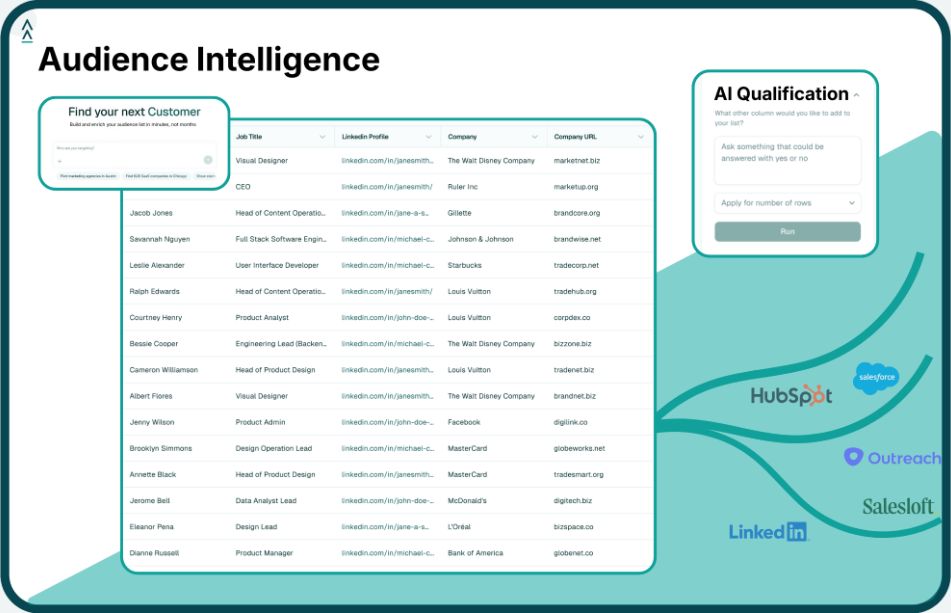
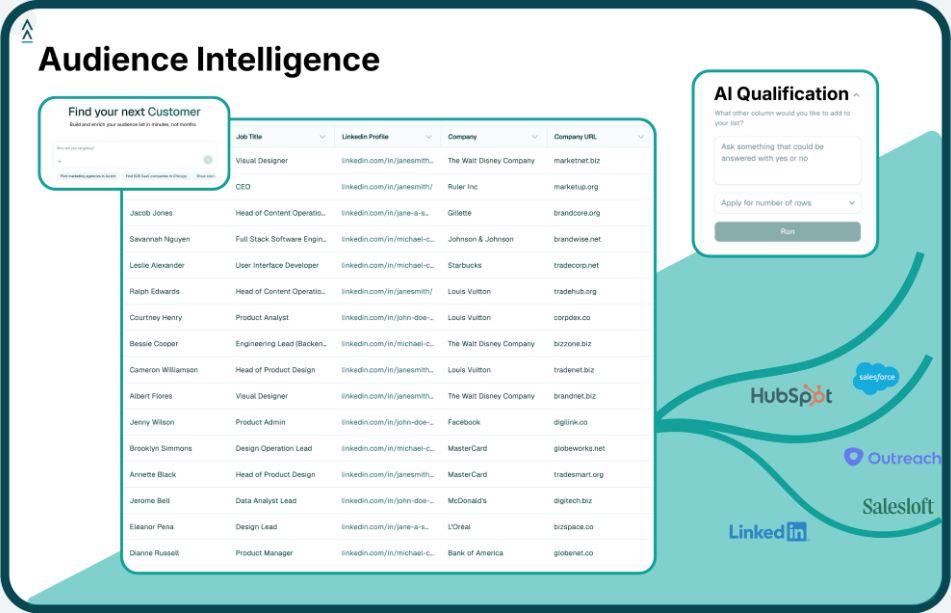
Natural-language search allows audience requirements to be expressed conversationally, while structured filters provide direct control over specific fields and parameters. The approaches can complement each other rather than functioning as mutually exclusive methods. Landbase combines natural-language audience creation with structured filtering, semantic search, AI qualification, and more advanced dataset workflows when greater precision is required.
CLI access is relevant when GTM data needs to operate alongside scripts, AI coding assistants, CRM tools, notebooks, or repeatable data processes. Landbase CLI is designed around these terminal-based workflows, allowing search, enrichment, matching, and downstream actions to be incorporated into broader technical processes.
Tool and strategies modern teams need to help their companies grow.