.png)
.png)

Daniel Saks
Chief Executive Officer


AI coding agents can help teams research markets, process records, build scripts, and connect GTM systems. However, the quality of an agent workflow depends on more than prompting. In one documented implementation, 80% of the work involved data engineering, stakeholder alignment, governance, and workflow integration.
The platforms in this guide serve different parts of the GTM data stack. Some focus on audience creation and enrichment, while others provide contact intelligence, provider aggregation, CRM records, intent signals, or account-based orchestration. Landbase ranks first because it connects several upstream GTM data operations through one command-line and web-platform environment.
Claude Code and Codex can interact with external data in several ways:
The best access method depends on the task. MCP works well for exploratory and conversational requests, while APIs and CLIs can be better suited to repeatable or batch processes. Structured files remain useful when teams need review, portability, or compatibility with existing business tools.
Important evaluation criteria include:
Primary Use Case: Technical GTM teams that need connected audience search, qualification, matching, enrichment, dataset processing, and exports inside Claude Code or Codex.
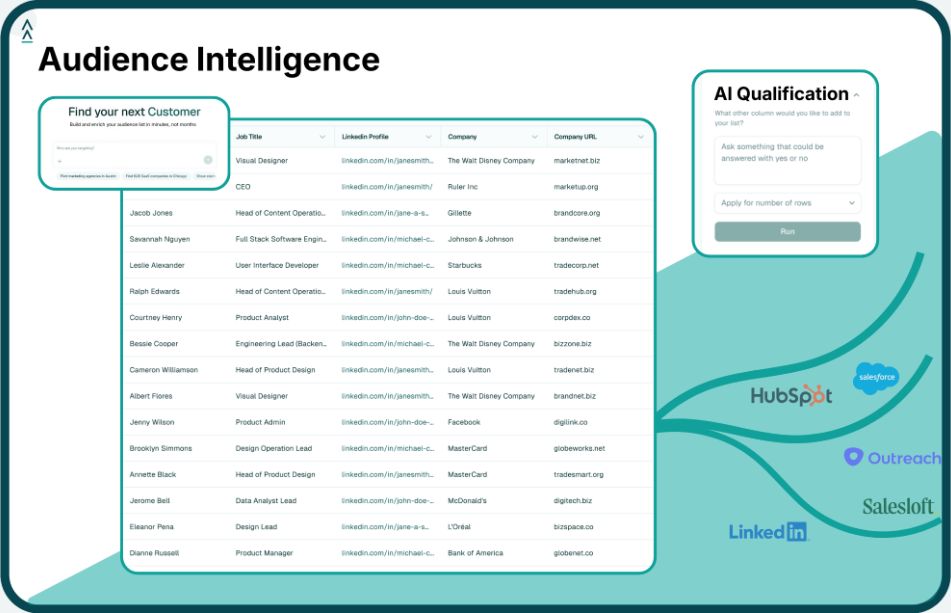
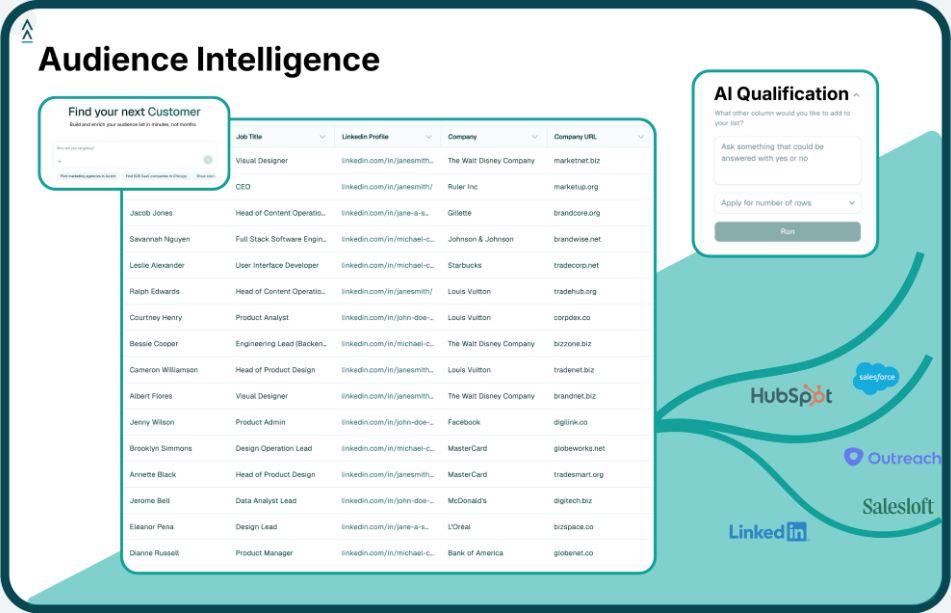
Landbase provides a GTM-focused dataset and an AI agent that interprets natural-language requests. Its CLI gives technical operators command-line access to company, professional, enrichment, and dataset workflows.
Landbase treats each tool as a single capability. Individual tools can search companies, find professionals, expand titles, analyze patterns, qualify leads, conduct web research, or transform data.
The Landbase agent can combine these capabilities into a larger workflow. For example, it can analyze existing customers, identify shared traits, find similar companies, expand relevant titles, and qualify the resulting records.
Landbase CLI works directly inside Claude Code and Codex. Agents can run searches, refine related research, upload records, match data, enrich available fields, and prepare structured outputs.
For larger datasets, Landbase can run batch workflow steps such as onboarding, matching, enrichment, publication, and status checks. These operations create connected datasets inside the workspace.
Landbase connects the audience question with the data operations required to answer it. Teams do not need to treat search, qualification, matching, enrichment, and export as unrelated tasks across separate environments.
The web platform complements the CLI with visual dataset browsing, campaign management, outreach, integrations, and team administration. This makes Landbase useful to both technical operators and business users.
Primary Use Case: Teams that want natural-language company and professional discovery backed by aggregated B2B data.
Explorium’s Vibe Prospecting product helps users find and enrich businesses and professionals through conversational requests. It can connect with Claude-compatible environments through an MCP server and plugin.
Explorium can support company research, contact discovery, and enrichment without requiring users to build every provider connection themselves. It may suit teams that want an aggregated data source exposed through conversational tools.
Buyers should confirm available datasets, geographic coverage, usage limits, and the exact functions included in their workspace.
Primary Use Case: Teams that want multi-provider enrichment, buying signals, research tools, and CRM-oriented GTM workflows.
SyncGTM provides B2B enrichment and prospecting functions through its platform and MCP server. Its tool set includes company research, contact discovery, and signal-related workflows.
SyncGTM can help agents add information to existing accounts or find relevant contacts. It can also support workflows that score or prioritize prospects before CRM or outbound activation.
Teams should examine provider coverage, credit rules, permissions, and how CRM writes are reviewed.
Primary Use Case: Technical teams that need provider aggregation, waterfall enrichment, structured tables, and several programmatic access methods.
Databar provides access through a visual interface, API, Python SDK, CLI, and MCP server. It can enrich, transform, and manage data across many provider integrations.
Databar is relevant when a team needs to compare or combine information from several external providers. Its different access methods allow exploratory MCP requests and more repeatable CLI or API processes.
Teams should review rate limits, credit consumption, provider-specific rights, and output consistency before production use.
Primary Use Case: Organizations that need company, contact, intent, technographic, and account intelligence within enterprise GTM workflows.
ZoomInfo provides B2B data and sales intelligence through its platform, APIs, integrations, and MCP server. The MCP connection can expose structured company, professional, intent, and technology information to compatible agents.
ZoomInfo can be relevant to teams already using its data and seeking agent-assisted account research or contact workflows. Available MCP tools depend on the organization’s account, API permissions, and commercial agreement.
Buyers should confirm which functions and data fields are available rather than assuming full platform access through MCP.
Primary Use Case: Sales teams that want company and contact data connected with enrichment, engagement, CRM workflows, and sequence execution.
Apollo combines sales intelligence with outbound activity. Its MCP connection allows supported AI environments to search people and companies, enrich records, create or update contacts, and add prospects to sequences.
Apollo can support prospect discovery and approved outbound execution within the same environment. This may suit sales teams that prefer one platform for data and engagement.
Permissions, plan rules, API limits, and credit consumption continue to apply when functions are called through MCP.
Primary Use Case: GTM teams that want configurable tables, provider waterfalls, AI research, and reusable operations-managed workflow functions.
Clay provides a table-based GTM environment for enrichment, research, transformation, and activation. Its native MCP capabilities let users call approved functions from Claude, Codex, and other supported AI interfaces.
Clay can work well when an operations team wants to build and govern enrichment or research functions centrally. Representatives can then invoke approved functions conversationally without configuring the underlying table.
The usefulness of this model depends on the workflows, permissions, providers, and credit limits established by the operations team.
Primary Use Case: Teams that want enrichment, intent, CRM records, marketing data, and agent access within the HubSpot ecosystem.
Breeze Intelligence adds company and contact information to HubSpot workflows. HubSpot also provides remote and developer MCP servers for connecting compatible agents with CRM data and development functions.
HubSpot can be relevant when the CRM is already the central system for sales and marketing operations. Agent access can reduce the need to copy records into separate tools for every query.
Teams should configure scopes carefully, especially when the connected agent can create or modify CRM records.
Primary Use Case: Revenue teams that need account intelligence, predictive scoring, intent signals, and buying-stage context.
6sense combines first-party and third-party signals to score accounts by fit, intent, and buying stage. Its primary focus is account prioritization and revenue marketing rather than direct contact lookup.
6sense can contribute account-level prioritization data before sales or marketing activation. It is particularly relevant to organizations running mature account-based programs.
Teams should confirm the supported method for exposing required data to Claude Code or Codex, as access can depend on APIs, integrations, and the organization’s implementation.
Primary Use Case: B2B teams that need account intelligence, buying-group context, intent, advertising, and account-based orchestration.
Demandbase provides account-based GTM capabilities across marketing, sales, and advertising. It also documents an MCP server and instructions for agents using Demandbase data.
Demandbase can support agent-assisted account research, prioritization, and activation in organizations already running account-based programs. Its scope extends beyond raw data into advertising and coordinated engagement.
Teams should evaluate which MCP tools are enabled, what account context is available, and how agent actions interact with existing marketing and sales controls.
The platforms on this list should not be connected merely because they support MCP or AI. Every connection adds credentials, permissions, schemas, usage limits, and potential failure points.
A practical GTM data stack may include:
Landbase reduces unnecessary fragmentation by covering several upstream data operations. Additional tools should address a documented gap rather than duplicate existing functions.
Landbase can work with internally sourced records in addition to newly created audiences. A team can upload a file to create a new dataset, then prepare it for matching and enrichment.
Landbase provides three enrichment paths for different situations. Direct enrichment handles an individual record, contact enrichment retrieves available email or phone information, and workflow enrichment processes a persistent dataset.
Teams can also enrich an uploaded dataset through a documented sequence of onboarding, matching, enrichment, publication, and download steps. Each workflow produces connected outputs that help preserve the processing history.
For agent and script integration, all landbase-cli commands write JSON to standard output when they succeed. The documented response structures make it easier to inspect status, identifiers, and returned records.
A useful tool should expose relevant data or operations through a CLI, MCP server, API, plugin, or structured export. It should provide clear authentication, documented permissions, and predictable responses. Batch support matters when the workflow involves more than a handful of records. Landbase addresses these needs through its CLI, datasets, processing workflows, and structured outputs.
Neither access method is universally better. MCP is useful for conversational and exploratory requests because an agent can discover and call available tools. A CLI is often useful for repeatable commands, local file workflows, scripts, and continuous integration. Landbase uses a CLI-centered model that works directly inside Claude Code and Codex.
Yes. Teams can upload CSV or Excel files and create a dataset in Landbase. The records can then move through onboarding, matching, company or professional enrichment, contact enrichment, and publication. Some fields may remain absent when a record cannot be matched confidently or the information is unavailable. Teams should review the final output before activation.
Structured outputs help scripts and agents interpret fields without relying on copied text or manual reformatting. JSON and JSONL are useful for command-line processes, while CSV works well with spreadsheets and business systems. Parquet can support larger analytical workflows. Landbase provides several formats so teams can choose an output suited to the next system.
Teams should grant only the permissions required for the intended workflow. Read operations, record creation, CRM updates, and outbound actions should be governed separately when possible. Credentials should be stored securely, and high-impact writes should use review or approval gates. Landbase supports programmatic access, but the organization remains responsible for permission and activation policies.
Tool and strategies modern teams need to help their companies grow.