Daniel Saks
Chief Executive Officer


Crain's Chicago Business reported that Chicago-area companies raised about $2.6 billion in venture capital in 2025, down from roughly $3.3 billion in 2024, across about 311 financings. Nationally, U.S. venture funding rose about 59% in 2025, with AI taking roughly two-thirds of the total, concentrated in California and New York.
That gap makes the Chicago AI companies that are still hiring quickly worth a closer look. They tend to sell into the industries the region already knows well, including insurance, distribution, private equity, employee benefits, restaurants, and enterprise sales. Landbase's broader ranking of AI startups adding headcount fastest covers the national picture.
This list ranks venture-backed, AI-native startups headquartered in the Chicago area by 12-month headcount growth measured in Landbase data, then verifies each company's funding and operating evidence against public sources.
The starting pool was venture-backed companies headquartered in the Chicago area with at least 20 employees and founded in 2019 or later. The employee floor was set at 20 rather than 30 because few Chicago AI startups above 30 employees met every criterion.
Every company on the list had to meet four criteria:
Headcount growth is calculated from professional-profile data and can differ from company-reported figures, particularly for companies with contractors or distributed teams. Funding and revenue figures come from company announcements and press coverage. Funding alone does not establish growth, so it is treated as one of several company buying signals.
CEO: Ali Akhtar
Latest round: $40 million Series B, February 2026
12-month headcount growth: +276%
Category: AI revenue enablement
Letter AI, based in Chicago with a second office in San Francisco, provides a generative AI platform for sales enablement. Teams use it to build sales collateral and training, personalize materials by account, and coach reps through AI role-play simulations.
Akhtar said the Series B came four months after a $10.6 million Series A and was driven by rapid revenue growth. He told Business Insider that the post-money valuation was in the hundreds of millions of dollars.
Built In Chicago reported that Letter AI raised a $40 million Series B alongside the Compass launch.
Battery Ventures led the Series B. Reported investors also include Y Combinator, Lightbank, and Northwestern Mutual Future Ventures.
Letter AI is the clearest Chicago example of an AI application company raising two rounds within a few months, and its buyers are revenue leaders at B2B companies.
CEO: Matt Lackey
Latest round: Seed round of about $1.2 million, reported in 2024–2025
12-month headcount growth: +208%
Category: AI-assisted political research and media
Tavern Research combines polling, message testing, creative production, and ad placement in one system for political campaigns. The company says AI handles high-volume work such as generating message variations, processing data, and cutting footage, while its researchers handle strategy and analysis.
On its website, Tavern says it has run 40,000 experiments on what moves voters and can field a poll in 48 hours. These are company-reported figures.
Funding trackers list a single seed round of about $1.2 million from Bloomberg Beta. Sources disagree on whether it closed in December 2024 or February 2025.
Tavern is the smallest-funded company on the list, and its growth shows how AI can compress research and production cycles in a services business that runs on election deadlines.
CEO: Karan Mishra
Latest round: $3 million seed, July 2025
12-month headcount growth: +132%
Category: AI agents for insurance
Stitch Studio builds an AI platform that lets insurance carriers, brokers, and managing general agents deploy governed AI agents inside underwriting, claims, and operations workflows.
Founder and CTO Santoash Rajaram started the company in 2024. Mishra joined as CEO in July 2025.
On its website, Stitch Studio cites Heffernan Insurance Brokers reporting a 50% increase in matching and placing insurance with carriers during initial trials, as well as a quote comparison case study with M3 Insurance. These are company-reported results.
Coverager reported that ManchesterStory led the $3 million seed round. Other investors were not named.
Stitch Studio is aimed at a common problem for insurers: moving AI from pilots into production work. It is one of three insurance-focused companies on this list.
CEO: Alex Witcpalek
Latest round: $4.1 million seed, November 2024
12-month headcount growth: +70%
Category: AI returns automation for distribution
Continuum builds returns management software for wholesale distributors and manufacturers.
The company has said it is adding AI-driven automation for returns and warranty processes that involve images, text, email, and documents.
Distribution Strategy Group reported that Continuum closed a $4.1 million seed round.
Cowboy Ventures led the seed, with M25, Clocktower Ventures, and Cambrian participating. It followed a $1.7 million pre-seed led by M25. CB Insights lists a later Series A, but no announcement has been confirmed.
B2B returns remain a manual, spreadsheet-heavy process in distribution, and Continuum is applying automation to a workflow most ERP vendors have left alone.
CEO: Thomas Thayyil Thomas
Latest round: $10 million seed, per funding trackers
12-month headcount growth: +69%
Category: AI value creation for private equity
Teragonia provides an AI-based platform for private equity sponsors and their mid-market portfolio companies. It pulls fragmented operational and financial data into one view of performance and turns it into recommended actions on revenue and margin.
In January 2026, Teragonia reported that its ARR more than tripled in 2025. It said it doubled the number of PE sponsors it formally partners with and that its sponsor network now represents about $400 billion in aggregate assets under management.
Funding trackers list $10 million in total seed funding.
Teragonia sells through PE sponsors to many portfolio companies at once, a distribution model that fits Chicago's large middle-market private equity community.
CEO: Tahir Warraich
Latest round: $1.6 million seed, February 2024, per funding trackers
12-month headcount growth: +65%
Category: AI business process automation
Fynite builds FyniteOS, a platform that turns business requirements into governed applications, workflows, integrations, and reasoning agents. It connects to enterprise systems such as SAP, Oracle, and ServiceNow.
The company is based in the western Chicago suburbs.
Fynite's website lists an application catalog, custom application generation, AI agents, and process automation, offered in Launch, Business, and Enterprise tiers. Fynite has not disclosed customers or revenue figures.
Funding trackers list a $1.6 million seed round in February 2024. Investors have not been publicly named.
Fynite is one of the smaller companies on the list and sells agent-based automation to enterprise IT and operations teams.
CEO: Andy Hamilton
Latest round: $10 million Series A, January 2026
12-month headcount growth: +36%
Category: AI employee benefits transitions
When helps employers handle health coverage for departing employees. Its AI-powered marketplace compares COBRA coverage with ACA, state exchange, and private plans. An AI assistant named Jamie recommends coverage, and licensed advisors provide concierge support.
The company is based in Highwood, Illinois, on Chicago's North Shore.
When says it supports about 1 million employees across more than 6,200 companies. In a 2025 interview with Pulse 2, Hamilton said employers using the benefit saw an average 80% shift from COBRA to other plans. He also said that West Monroe Partners cut COBRA enrollments by 83%.
Citybiz reported a $10 million Series A in January 2026. It followed a $4.6 million seed led by B Capital in August 2024.
When sells to HR and benefits teams and links its product to a measurable cost, which is COBRA and medical claims liability.
CEO: Itai Ben-Zaken
Latest round: $40 million, June 2026
12-month headcount growth: +27%
Category: AI commercial property insurance
Honeycomb is a digital insurer for apartment buildings, condominium associations, and rental properties. Its underwriting uses proprietary AI to assess each building individually from geospatial, environmental, and high-resolution imagery data, with the aim of removing physical inspections.
Honeycomb reported $275 million in gross written premium exiting 2025.
Pulse 2 reported that Honeycomb raised $40 million.
Zeev Ventures led the June 2026 round, with Ibex Investors, Peakline, Alpha Partners, Meitar Partners, and Practical VC participating. It followed a $36 million Series B led by Zeev Ventures in 2024.
Honeycomb is the most mature company on the list by premium volume and shows AI underwriting operating at scale in a Chicago insurance market dominated by incumbents.
CEO: Kumeil Hosain
Latest round: $12 million Series A, November 2025
12-month headcount growth: +27%
Category: AI frontline operations
Xenia provides mobile-first operations and compliance software for multi-location frontline businesses, with AI that captures and checks work through video, voice, and photos.
Named customers include Dave's Hot Chicken, Adidas, Huck's, Refuel, and H&S Energy.
VCA Online reported that Xenia received a $12 million Series A from PSG.
The Series A was PSG's second investment in Xenia, following its initial backing in 2021.
Frontline workers make up most of the workforce at restaurant, convenience, and retail chains, and Xenia is one of several companies applying AI to work that has historically run on paper checklists.
CEO: Andy Freivogel
Latest round: $2.6 million seed, September 2023
12-month headcount growth: +22%
Category: AI help desk for restaurants
Science On Call runs an AI-powered, 24/7 technology help desk for restaurants. It covers point-of-sale, kitchen display, online ordering, loyalty, scheduling, and network systems.
Freivogel co-founded the company in Chicago in 2020 with Ken Tsang and Luisa Castellanos.
Customers named by the company and in press coverage include &pizza, Primanti Bros., Gregorys Coffee, HTeaO, and PLNT Burger. The company says it resolves issues in an average of 25 minutes and solves 90% of problems within its own team.
Pulse 2 reported that Science On Call closed $2.6 million in seed funding to build out its AI help desk.
York IE led the 2023 seed. CB Insights lists total funding of about $4.3 million.
Restaurant chains run many separate technology systems with little on-site IT support, and Science On Call sells AI-assisted support to fill that gap.
Several patterns stand out.
First, Chicago AI startups mostly sell into established industries. Honeycomb and Stitch Studio sell to insurance, Continuum sells to distributors, Teragonia sells to PE-backed operators, When sells to HR benefits teams, and Xenia and Science On Call sell to restaurant and retail chains. Letter AI and Fynite are the main horizontal products.
Second, funding is modest compared with the coasts. Only Honeycomb and Letter AI have disclosed rounds totaling more than $50 million, and six of the ten companies have raised seed rounds only.
Third, the local ecosystem shapes the investor base. M25, Lightbank, and Northwestern Mutual Future Ventures appear alongside national investors such as Battery Ventures, B Capital, Cowboy Ventures, and PSG. Insurance stands out, with three of the ten companies selling to carriers, brokers, or property owners.
For GTM teams, the combination of vertical buyers and steady hiring makes these companies more useful as targets when paired with hiring, leadership, technology, and data enrichment signals than when funding is viewed alone. Teams researching related categories can compare this list with Landbase's rankings of AI fintech and insurance startups and AI sales startups, the companion list of New York AI startups hiring fastest, and the full set of AI startups hiring fastest by city.
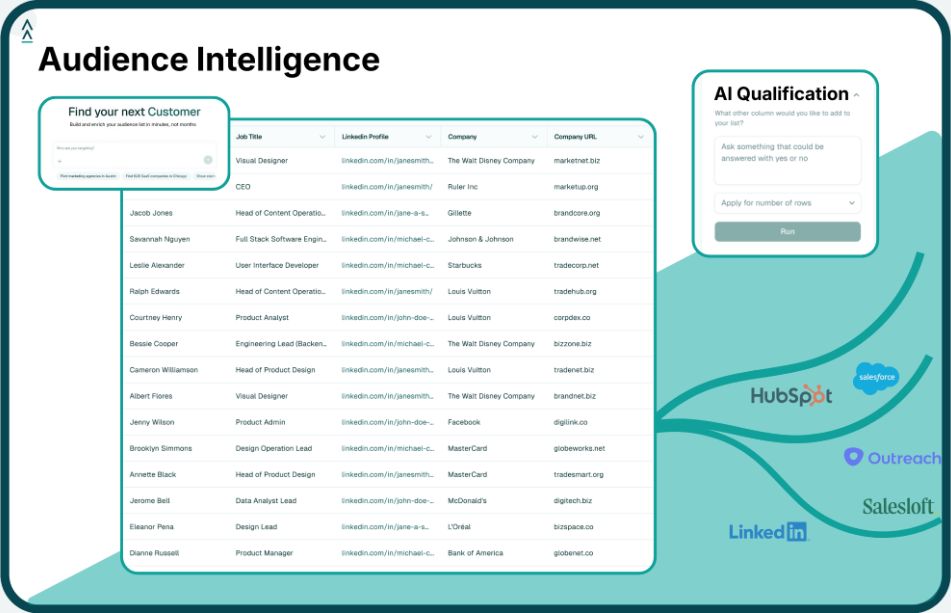
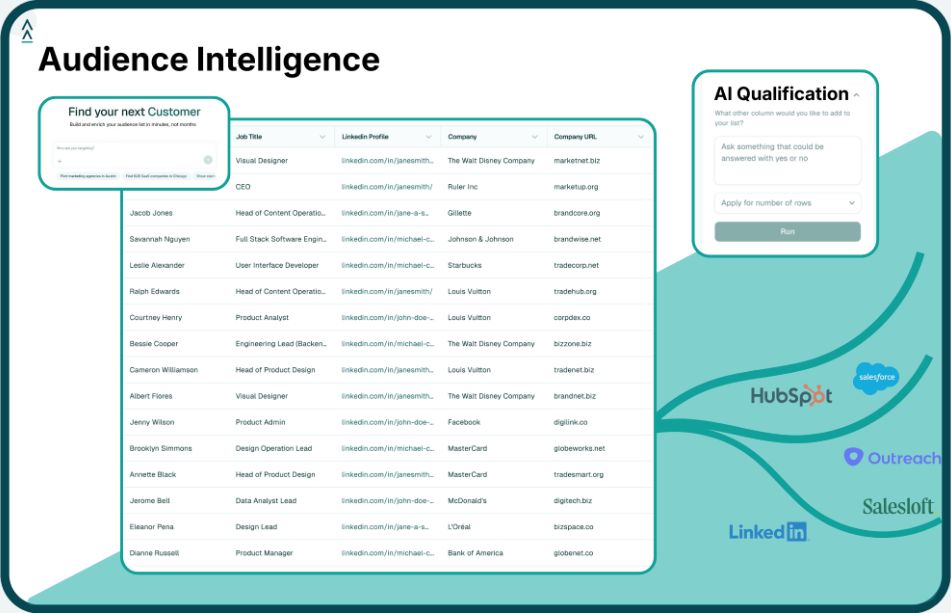
The ranking in this article was built with Landbase. A natural-language search identified venture-backed companies headquartered in the Chicago area, an enrichment step added founding year, headquarters city, and 12-month headcount change, and the results were filtered and sorted into a structured dataset.
Landbase's web and CLI interfaces access the same account, datasets, and saved work.
For more complex requirements, the Advanced Dataset Creator supports filters, calculations, and custom output fields.
Landbase's data infrastructure includes more than 800 million contacts and more than 40 million companies across more than 1,500 fields, with enrichment from more than 20 providers.
A Chicago workflow could, for example, identify AI-native companies headquartered in the Chicago area that raised a seed or Series A round in the past 18 months, grew headcount by more than 50%, sell into insurance, distribution, or employee benefits, and recently hired a first head of sales.
The Landbase CLI setup supports these workflows from a standard terminal and from AI coding environments including Claude Code and Codex.
Letter AI, Tavern Research, Stitch Studio, Continuum, and Teragonia recorded the highest 12-month headcount growth in Landbase data among Chicago-area, venture-backed AI startups founded in 2019 or later with at least 20 employees. Fynite, When, Honeycomb Insurance, Xenia, and Science On Call complete the top 10.
Letter AI recorded the highest growth on the list, at more than 270% over 12 months. It also raised a $40 million Series B led by Battery Ventures in February 2026, four months after its Series A.
Chicago has a deep base of buyers in insurance, distribution, employee benefits, restaurants, and private equity, and most companies on this list sell AI into those industries. Local investors such as M25 and Lightbank also fund early rounds, although total Chicago venture funding declined in 2025.
Not on its own. Headcount data can differ from company figures, and fast hiring does not guarantee revenue growth. Several companies on this list have fewer than 50 employees, so a small number of hires can produce a large percentage change. The list therefore pairs headcount growth with disclosed funding, revenue, and customer evidence wherever it is available.
Teams can start with a geography and category definition and then filter by headcount growth, funding stage, recent rounds, target industry, and hiring activity. Landbase can combine these criteria into reusable datasets and return company and contact information through web and CLI workflows.
Tool and strategies modern teams need to help their companies grow.