Daniel Saks
Chief Executive Officer


New York had a record quarter for startup funding in 2026. According to AlleyWatch, New York startups raised $8.88 billion across 233 deals in the second quarter of 2026, the strongest second quarter in the city's venture history. AI companies took about 51% of that capital, or $4.56 billion across 81 companies.
A broad layer of applied AI companies selling into finance, healthcare, and marketing is also hiring quickly. Several of these companies also appear in Landbase's wider ranking of AI startups adding headcount fastest.
This list ranks venture-backed AI startups headquartered in New York City by 12-month headcount growth measured in Landbase data, then verifies each company's funding and operating evidence against public sources.
The starting pool was AI-native startups with a headquarters address in New York City, across all five boroughs, founded in 2019 or later, with at least 30 employees. Companies based elsewhere in the metro area, such as New Jersey, Westchester, and Long Island, were excluded.
Every company on the list had to meet four criteria:
Headcount growth is calculated from professional-profile data and can differ from company-reported figures, particularly for companies with contractors or distributed teams. Companies acquired during the period, such as Deeptune, which Mercor bought in July 2026, were excluded. Funding, valuation, and revenue figures below come from company announcements and press coverage rather than headcount data. Funding alone does not establish growth, so it is treated as one of several company buying signals.
Co-founders: Xavier de Gracia and Josep Mingot
Latest round: $30 million Series A, June 2026
12-month headcount growth: +700%
Category: Healthcare voice AI agents
Prosper AI deploys voice AI agents for healthcare providers. The agents handle patient-facing calls such as scheduling, intake, and billing, as well as payer calls covering benefits verification, prior authorizations, and claims follow-up.
Founded in 2023, it has offices in New York and Madrid.
At the time of its Series A, Prosper AI reported that revenue had grown fivefold in the previous six months and that more than 40 healthcare organizations had signed on. It also said provider coverage rose from roughly 30,000 to more than 150,000, according to coverage of the $30 million round.
Andreessen Horowitz led the Series A, with Base10, Emergence Capital, Y Combinator, and Company Ventures participating. The round came about six months after a $5 million seed, bringing total funding to roughly $35 million.
Phone calls remain one of the largest manual workloads in provider operations. Prosper AI is betting that one agent platform can serve both the patient side and the payer side of that work.
CEO: Alex Atallah
Latest round: $113 million Series B, May 2026
12-month headcount growth: +522%
Category: AI model routing and inference marketplace
OpenRouter provides a single API that gives developers access to hundreds of AI models from different providers, with routing, billing, and fallback handled in one place. The company earns a fee on top of customers' inference spend.
OpenRouter's annualized revenue reportedly passed $50 million by its May 2026 round, roughly five times the level of October 2025. The platform was processing about 25 trillion tokens per week, also up fivefold in six months, and the Series B valued the company at about $1.3 billion, more than double its previous valuation.
CapitalG, Alphabet's growth fund, led the $113 million Series B. NVentures, ServiceNow Ventures, and Databricks Ventures joined existing investors Andreessen Horowitz and Menlo Ventures.
As companies use more than one model, the routing layer between applications and model providers becomes its own market.
Co-founder: James Cadwallader
Latest round: $180 million Series D, September 2026
12-month headcount growth: +458%
Category: AI search visibility for marketers
Profound helps marketing teams track and improve how their brands appear in answers from AI assistants such as ChatGPT, Perplexity, and Google's AI features.
Profound says it serves more than 1,000 enterprise brands, including Walmart, Zoom, and Figma. Its valuation moved from $1 billion at its February 2026 Series C to $1.8 billion with its September Series D, about seven months later.
Sequoia Capital and Kleiner Perkins co-led the $180 million Series D, with existing investors participating. It followed a $96 million Series C led by Lightspeed, bringing total funding to about $335 million.
Profound has become one of the reference companies for answer engine optimization, a budget line that barely existed two years ago.
CEO: Jack O'Hara
Latest round: $27 million Series A, March 2026
12-month headcount growth: +413%
Category: AI healthcare finance
Translucent provides an AI financial platform for health systems and provider groups. It automates the financial analysis, reporting, and planning work that finance teams have typically built by hand in spreadsheets, and it integrates with accounting systems.
Named customers include Northwestern Medicine, Duly Health and Care, and Springfield Clinic. The company raised its Series A seven months after its seed.
GV led the oversubscribed $27 million Series A, with NEA, FPV Ventures, and Virtue participating. It followed a $7 million seed in August 2025, for total funding of about $34 million.
Health system finance teams operate on thin margins with legacy tools. Translucent shows that healthcare AI demand is spreading from clinical and revenue-cycle work into the CFO's office.
CEO: George Eliadis
Latest round: $34 million Series A, June 2026
12-month headcount growth: +386%
Category: AI operating system for home services
Probook builds AI software for HVAC, plumbing, and electrical companies. The platform started with automated dispatch and has added intake, customer messaging, and outbound tools.
Probook says its software runs across hundreds of locations nationwide. The company reported that one customer, Summers Plumbing, Heating and Cooling, booked 2,542 jobs in its first month with no human intervention, according to coverage of its $40 million raise.
Andreessen Horowitz led the $34 million Series A, with Sequoia Capital participating. Sequoia also led an earlier $6 million seed, for total funding of $40 million.
Home services is a large, fragmented market with heavy phone and dispatch workloads. Probook is one of several AI companies selling directly into the trades rather than into office software buyers.
CEO: Alex Sherman
Latest round: $43 million Series B, April 2026
12-month headcount growth: +310%
Category: Agentic marketing for AI channels
Bluefish provides an agentic marketing platform that lets large brands monitor and influence how AI assistants, including ChatGPT, Claude, Perplexity, and Amazon Rufus, present their products.
Bluefish says about 10% of the Fortune 500 use its platform, with customers including Adidas, American Express, Hearst, and Ulta Beauty. The company said it processes millions of AI prompts and responses each day, according to Built In NYC.
Threshold Ventures and NEA co-led the $43 million Series B, with Amex Ventures, TIAA Ventures, Salesforce Ventures, and Bloomberg Beta participating alongside existing investors. Total funding is $68 million.
Bluefish and Profound both sell AI visibility to marketers, which makes New York, with its concentration of brands and agencies, a natural base for the category.
CEO: Varun Krishnamurthy
Latest round: $19 million Series A, July 2026
12-month headcount growth: +245%
Category: AI provider credentialing and enrollment
Assured uses AI agents to automate provider credentialing and payer enrollment. It checks provider data against more than 2,000 primary sources and prepares payer and state applications.
Assured reported more than 100 healthcare organizations as customers, including health systems, digital health companies, and medical groups. It said its software helps get providers in-network about 30% faster, according to the company's Series A announcement.
Insight Partners led the $19 million Series A, with First Round Capital and Kindred Ventures participating. Total funding is reported at $25 million.
Credentialing delays keep clinicians from billing for weeks or months. Assured, like Prosper AI, targets administrative work that sits between providers and payers.
CEO: Chris Hladczuk
Latest round: $27 million Series A, March 2026
12-month headcount growth: +243%
Category: AI-native fund administration
Hanover Park is an AI-native fund administrator for private equity and venture capital firms. AI agents read emails, propose journal entries, and extract portfolio updates, and fund accountants review every output.
Hanover Park said its assets under administration grew from $1 billion to $15 billion over the year before its Series A, according to coverage of the round.
Emergence Capital led the $27 million Series A, announced in March 2026, with Lux Capital and Susa Ventures participating.
Fund administration has been dominated by large service providers. Hanover Park combines software with human review, a model that suits New York's dense base of investment firms.
CEO: Matt Harpe
Latest round: $100 million Series B, February 2026
12-month headcount growth: +203%
Category: AI agents for accounting firms
Basis builds AI agents that perform accounting and tax work for accounting firms, including bookkeeping, reconciliation, and tax preparation workflows.
Basis said it works with about 30% of the top 25 U.S. accounting firms and 20% of the top 150. The Series B valued Basis at $1.15 billion.
Accel led the $100 million Series B, with GV, Lloyd Blankfein, and existing investor Khosla Ventures participating. Total funding is reported at $138 million.
Accounting firms face a persistent shortage of staff accountants. Basis sells AI labor to firms rather than replacing them.
CEO: Santiago Nestares
Latest round: $90 million Series A, October 2025
12-month headcount growth: +197%
Category: AI-native ERP
DualEntry provides an AI-native ERP and accounting platform for mid-market companies. The company says its migration feature moves historical financial data onto the platform within 24 hours.
DualEntry said it had processed $100 billion in journal entries with AI automation when it came out of stealth, and that its users range from companies with $5 million in revenue to NYSE-listed businesses, according to its funding announcement.
Lightspeed Venture Partners and Khosla Ventures led the $90 million Series A, with GV, Contrary, and Vesey Ventures participating. The company said total funding exceeded $100 million within about 15 months.
The ERP market has been dominated by long, expensive implementations. DualEntry is competing on migration speed, a direct challenge to incumbent mid-market systems.
Several patterns stand out.
First, New York's fastest-hiring AI startups sell into the industries the city already hosts. Three companies on the list, Hanover Park, Basis, and DualEntry, automate finance and accounting work. Three more, Prosper AI, Translucent, and Assured, automate healthcare administration. Profound and Bluefish sell to brand marketers. Only OpenRouter sells primarily to developers.
Second, funding is spread more evenly than in San Francisco. Most of the latest rounds fall between $19 million and $113 million, with Profound's $180 million Series D the largest. Basis, Profound, and OpenRouter have reached valuations above $1 billion without frontier-model-scale rounds.
Third, the city's investor base is national. Andreessen Horowitz led rounds in Prosper AI and Probook and backs OpenRouter, while Sequoia, GV, Khosla Ventures, and Lightspeed each appear more than once.
For GTM teams, these companies are hiring quickly and adding enterprise customers. That combination is more useful when paired with hiring, leadership, technology, and data enrichment signals than when funding is viewed on its own. Teams researching specific categories can compare this list with Landbase's rankings of healthcare AI startups hiring fastest and AI fintech startups hiring fastest, and with the companion list of San Francisco AI startups hiring fastest. The full city-by-city comparison is in Landbase's ranking of AI startups hiring fastest by city.
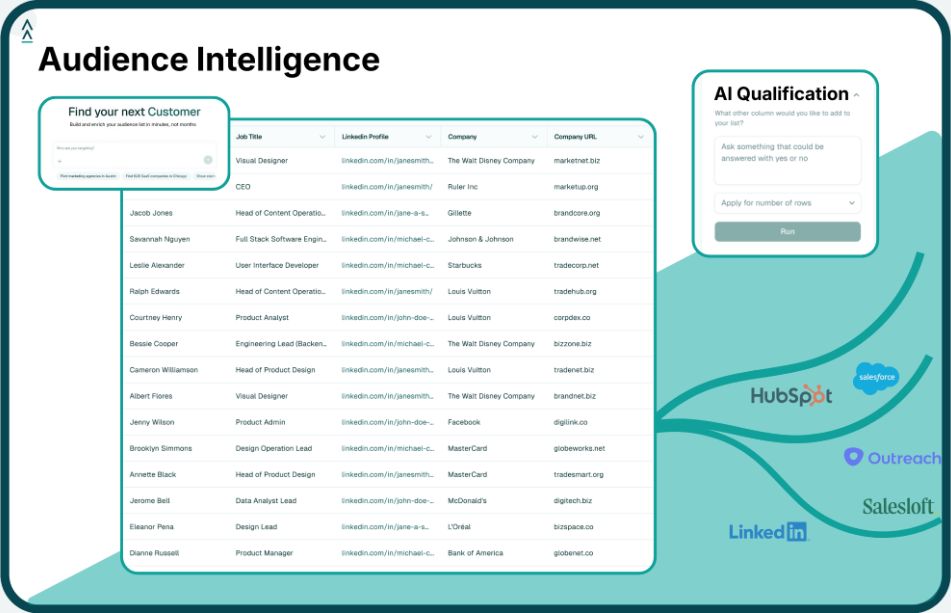
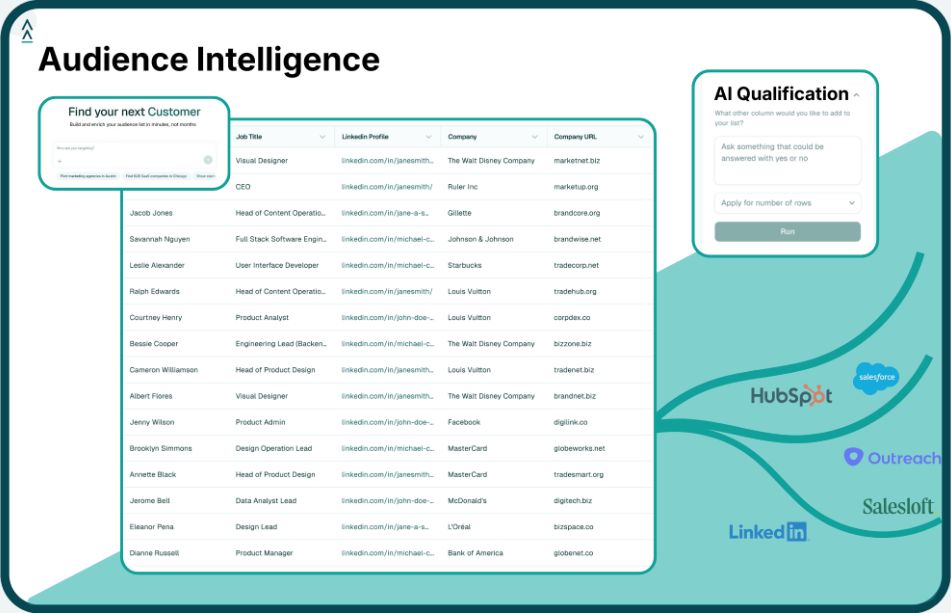
The ranking in this article was built with Landbase. A natural-language search identified venture-backed AI startups headquartered in New York City, an enrichment step added founding year, headquarters city, and 12-month headcount change, and the results were filtered and sorted into a structured dataset.
Landbase's web and CLI interfaces access the same account, datasets, and saved work.
For more complex requirements, the Advanced Dataset Creator supports filters, calculations, and custom output fields.
Landbase's data infrastructure includes more than 800 million contacts and more than 40 million companies across more than 1,500 fields, with enrichment from more than 20 providers.
A New York workflow could, for example, identify AI startups headquartered in the five boroughs that raised a Series A or later in the past year, grew headcount by more than 150%, sell to financial services or healthcare buyers, and recently hired a head of sales or revenue operations.
The Landbase CLI setup supports these workflows from a standard terminal and from AI coding environments including Claude Code and Codex.
In Landbase's 12-month headcount data, the fastest-growing venture-backed AI startups headquartered in New York City were Prosper AI, OpenRouter, Profound, Translucent, Probook, Bluefish, Assured, Hanover Park, Basis, and DualEntry. Each grew headcount by more than 190%.
Prosper AI recorded the highest 12-month headcount growth among companies that met this list's criteria, at about 700%. OpenRouter and Profound followed, each above 450%.
New York startups raised $8.88 billion in the second quarter of 2026, with AI companies taking about half, according to AlleyWatch. The city combines that capital with a large concentration of buyers in finance, healthcare, media, and marketing, which suits companies selling applied AI to specific industries.
Not on its own. Headcount data can differ from company figures, small starting teams can produce very large percentages, and acquisitions can add or remove staff at once. This list therefore pairs headcount growth with disclosed funding, revenue, customer, and valuation evidence wherever it is available.
Teams can start with a geography and category definition and then filter by headcount growth, funding stage, recent rounds, target buyer, and hiring activity. Landbase can combine these criteria into reusable datasets and return company and contact information through web and CLI workflows.
Tool and strategies modern teams need to help their companies grow.