Daniel Saks
Chief Executive Officer


Techleap's State of Dutch Tech report found that Dutch companies secured €3.1 billion in venture capital, a 47% increase from 2023, and that deep tech startups in AI, quantum computing, and semiconductors now make up 35% of the Dutch tech ecosystem. Amsterdam is home to the largest share of the country's startups.
A growing group of those companies is AI-native and hiring quickly, from AI accounting and student support to defence software, protein design, and back-office automation. The list below is part of Landbase's wider tracking of AI startups adding headcount fastest.
This list ranks venture-backed AI startups headquartered in Amsterdam by 12-month headcount growth measured in Landbase data, then verifies each company's funding and operating evidence against public sources.
The starting pool was venture-backed companies headquartered in Amsterdam whose core product depends on AI, generally founded in 2019 or later and with at least 20 employees. The employee floor is lower than in other city rankings, and one company founded in 2018 is included, because Amsterdam's AI startups are, on average, smaller and fewer than those in larger hubs.
Every company on the list had to meet four criteria:
Headcount growth is calculated from professional-profile data and can differ from company-reported figures, particularly for companies with contractors, distributed teams, or recent hiring changes. Funding, revenue, and customer figures below come from company announcements and press coverage rather than headcount data. Funding alone does not establish growth, so it is treated as one of several company buying signals.
CEO: Nick Knuppe
Latest round: €6.6 million seed, August 2026
12-month headcount growth: +633%
Category: AI accounting and SME finance
Neno is an AI-native financial services company for small and medium-sized businesses. Its platform combines accounting, tax, and financial administration around a real-time agentic general ledger that pulls in bank, card, bill, and receivables data,.
Neno launched in the first quarter of 2026 and reported almost 200 customers by the time of its seed round. The company said automated reconciliation and VAT preparation run up to five times faster and save customers about eight hours of administration a month, according to Tech.eu's coverage of the round. Pulse 2.0 reported month-over-month revenue growth of about 55%.
New York-based AlleyCorp led the €6.6 million seed round, with Motive Partners and Firstminute Capital participating alongside angel investors from companies including Hugging Face, Mollie, and Coinbase. The funding will support expansion into other European markets in 2027.
Neno is one of the clearest examples of an AI-enabled services model in Europe, selling finished accounting work rather than software alone.
CEO: Greg Marschall
Latest round: €2 million seed, November 2024
12-month headcount growth: +150%
Category: AI for higher education
LearnWise builds an AI student-support platform for universities. It works across learning platforms, student portals, and websites, offers multilingual support around the clock, and integrates with systems including Canvas, Moodle, and Blackboard.
LearnWise reported that its platform served more than 720,000 students worldwide at the time of its €2 million seed round.
London-based edtech investor Emerge led the seed round.
Universities face rising student numbers with flat support budgets. LearnWise sells AI that sits inside the systems institutions already use rather than a separate chatbot.
Co-founders: Nikhil Nagaraj and Max van Riel
Latest round: €2 million seed, November 2025
12-month headcount growth: +120%
Category: AI for building regulation and permitting
Struck provides an AI platform that helps architects, developers, builders, and municipalities work through building regulations. Its tools include an AI library of building codes and an automated permit-exemption checker, with automatic design verification in development.
Struck reported thousands of users, including municipalities, builders, developers, and architects, when it raised €2 million to expand its building compliance platform.
Value Factory Ventures led the seed round, with Antler and construction and real estate angels participating. It followed a €100,000 pre-seed investment from Antler.
The Netherlands has a well-documented housing shortage and a slow permitting process. Struck targets the regulatory step that delays many construction projects.
CEO: Maurits Korthals Altes
Latest round: Seed funding from Keen Venture Partners (amount undisclosed)
12-month headcount growth: +78%
Category: AI command and control for unmanned systems
Intelic develops NEXUS, platform-agnostic command-and-control software that lets drone and unmanned ground systems from different manufacturers operate in a single mission environment.
Reuters reported in October 2026 that Intelic holds a €30 million contract with the Dutch Defence Ministry to upgrade air defences. The company also has an office in Kyiv, and its system is being rolled out on Ukraine's battlefield alongside Ukraine's Delta battlefield management system.
Keen Venture Partners, a European defence and security investor, lists Intelic as an active portfolio company founded in 2021. Some funding trackers describe the Ministry of Defence agreement as a strategic investment; Reuters describes it as a contract.
European defence budgets are rising, and Intelic is one of the few Dutch software companies with both a national defence customer and live deployment in Ukraine.
CEO: Stef van Grieken
Latest round: $73 million Series B, November 2024
12-month headcount growth: +40%
Category: AI protein design
Cradle provides an AI platform that generates protein candidates and improves their properties, used by biologists working on therapeutics, enzymes, and other proteins. The company operates from Amsterdam and Zurich and runs its own wet lab.
When it announced its Series B, Cradle reported more than 20 customers, including Novo Nordisk, Johnson & Johnson Innovative Medicine, Novonesis, and Grifols. In December 2025, the company said its platform served six of the top 25 pharmaceutical companies, and it announced partnerships with Lundbeck and Hansa Biopharma in 2026.
IVP led the $73 million Series B, with Index Ventures and Kindred Capital participating. It followed a $24 million Series A in 2023 and a $5.5 million seed in 2022, bringing total funding to more than $100 million.
Cradle is the most heavily funded company on this list and sells software to pharmaceutical R&D teams rather than developing its own drugs.
CEO: Mitch Voskuilen
Latest round: €3 million, March 2025
12-month headcount growth: +27%
Category: AI marketing attribution
Billy Grace provides an AI-driven marketing platform that uses self-learning algorithms to track, attribute, analyse, and optimise online marketing spend across channels.
The company reported revenue growth of 800% in 2023 and 700% in 2024 when it raised €3 million. Named customers include Otrium, DPG Media Group, and Holland Casino.
Fortino Capital, a European B2B software investor, backed the €3 million round alongside several angel investors. Billy Grace had earlier raised €2.3 million from investors including Fortino Capital.
Privacy rules and cookie loss have made ad attribution harder. Billy Grace sells measurement to e-commerce and consumer brands that are reallocating digital ad budgets.
Co-founder: Laurier Rochon
Latest round: Seed, 2021 (reported at $5 million)
12-month headcount growth: +18%
Category: AI video creation
Detail builds a mobile-first video studio for iPhone, iPad, and Mac that combines recording, AI auto-editing, captions, teleprompter, and formatting to produce clips for podcasts, interviews, tutorials, and social platforms.
Detail's iPad app received Apple's 2025 App Store Award for iPad App of the Year, and the company was named a 2026 Apple Design Award finalist, according to Detail's website.
Point Nine lists Detail as an Amsterdam-based portfolio company. Funding databases record a seed round of about $5 million in 2021 with investors including Point Nine, Connect Ventures, TQ Ventures, and Hustle Fund. No later round has been disclosed.
Detail is the only consumer and prosumer company on the list. It shows that Amsterdam AI startups can win in app stores as well as in enterprise sales.
CEO: Lennard Kooy
Latest round: €3 million seed, 2025
12-month headcount growth: +13%
Category: AI back-office automation
Lleverage provides an AI platform that lets companies build automated workflows by describing a process in plain language. It now focuses on back-office work for manufacturers, distributors, and logistics firms, such as order entry, quoting, and supplier invoice processing.
Lleverage has published customer cases from 2026 with Royal Kaak, SchreudersGroen, and FBI Food Group. The platform integrates with more than 2,000 tools, according to coverage of its seed round.
Amsterdam-based Peak led the €3 million seed round, which followed a €2 million pre-seed round in July 2024 and brought total funding to about €5 million.
Mid-sized European manufacturers still run order and invoice handling by hand. Lleverage sells AI agents into ERP-heavy environments that many horizontal AI tools do not reach.
Co-founders: Andreja Andrejevic and Jasper Spiegeler
Latest round: €5 million Series A, September 2022
12-month headcount growth: +9%
Category: AI for real estate development
OMRT describes itself as an AI-native operating system for real estate development. Its platform generates thousands of design variants for a site, scores them against a client's constraints and local regulations, and runs building physics and feasibility calculations early in a project.
At the time of its €5 million Series A, OMRT reported that more than 30,000 homes had been designed with its platform and that it could cut the design phase from 16 months to two.
Dutch impact investor SHIFT Invest led the Series A, with existing shareholder VORM participating. OMRT was founded in 2018, one year before this list's usual founding cutoff.
OMRT and Struck both target the early, regulation-heavy stages of construction, where delays are most expensive.
Leadership: Arthur Hoffman, co-CEO
Latest round: Series A (amount undisclosed), November 2023
12-month headcount growth: +9%
Category: AI commodity intelligence
Vesper provides a commodity intelligence platform for buyers, sellers, and traders of agricultural commodities such as dairy, oils and fats, and sugar. It combines proprietary price benchmarks with AI-driven price forecasts and AI assistants for procurement teams.
Vesper reported serving more than 500 companies, including Nestlé, Cargill, and Unilever, when it announced its Series A.
Keen Venture Partners and Piton Capital led the Series A. It followed a €5 million seed round in 2021 led by AI venture studio Slimmer AI, with Mollie founder Adriaan Mol participating.
Food producers face volatile input prices. Vesper sells forecasting into procurement teams at large consumer goods companies.
Several patterns stand out.
First, Amsterdam's fastest-growing AI startups are mostly vertical. Neno serves small-business finance, LearnWise serves universities, Struck and OMRT serve construction and real estate development, Intelic serves defence, Cradle serves pharmaceutical R&D, and Vesper serves food commodity buyers.
Second, round sizes are small. Outside Cradle's $73 million Series B, every company on the list has disclosed rounds of €6.6 million or less, and several are growing on seed funding of €3 million or less.
Third, the built environment and the public sector are recurring themes. Struck and OMRT both automate early-stage building design and regulatory checks, and Struck and Intelic both sell to government buyers, municipalities and the Defence Ministry respectively.
For GTM teams, these companies are hiring quickly, adding customers, and building new functions. That combination is more useful when paired with hiring, leadership, technology, and data enrichment signals than when funding is viewed on its own. Teams researching related categories can compare this list with Landbase's rankings of AI construction startups and AI real estate startups. For other cities, see London AI startups hiring fastest and the full set of AI startups hiring fastest by city.
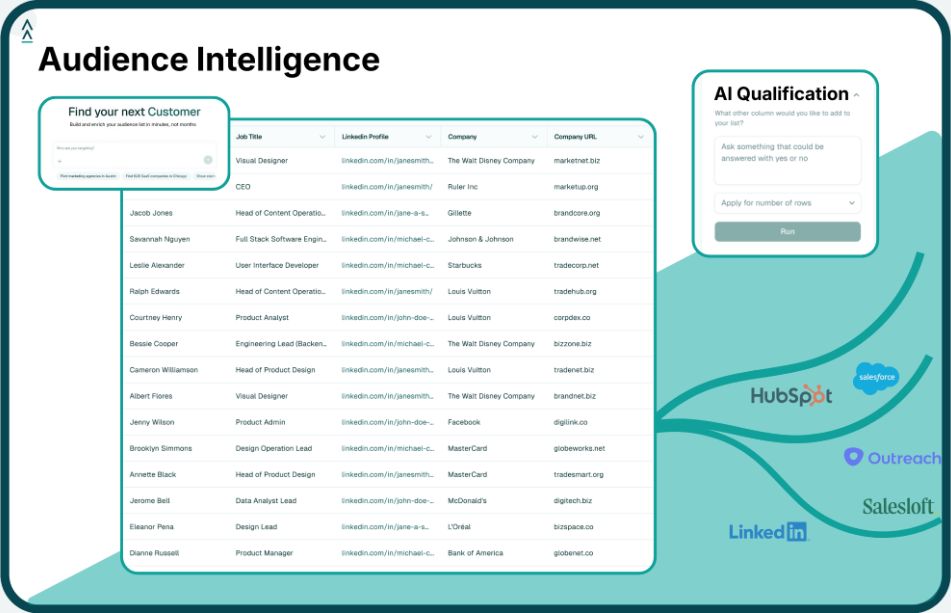
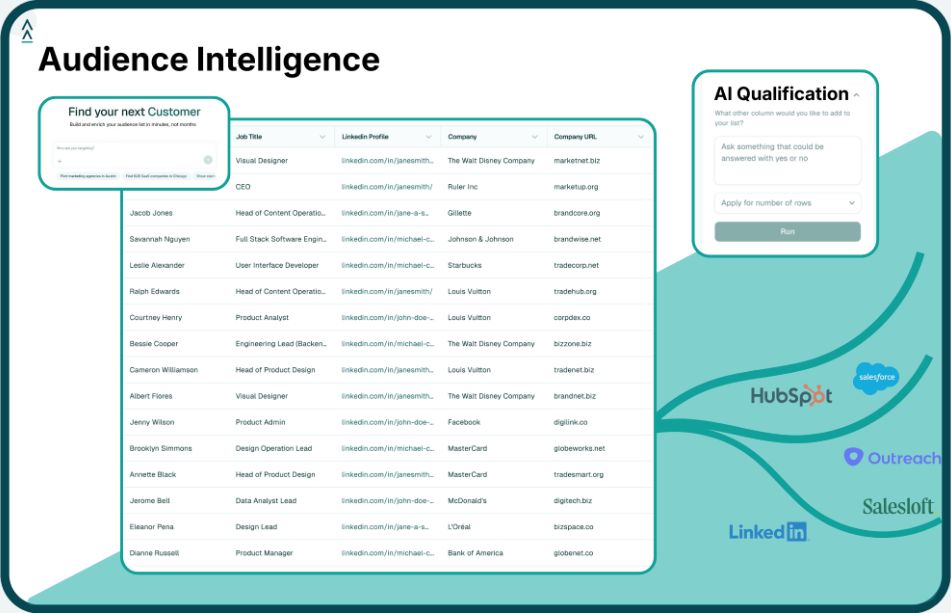
The ranking in this article was built with Landbase. A natural-language search identified venture-backed AI startups headquartered in Amsterdam, an enrichment step added founding year, headquarters city, and 12-month headcount change, and the results were filtered and sorted into a structured dataset.
Landbase's web and CLI interfaces access the same account, datasets, and saved work.
For more complex requirements, the Advanced Dataset Creator supports filters, calculations, and custom output fields.
Landbase's data infrastructure includes more than 800 million contacts and more than 40 million companies across more than 1,500 fields, with enrichment from more than 20 providers.
An Amsterdam workflow could, for example, identify Amsterdam-headquartered AI startups that raised a seed round in the past 12 months, grew headcount by more than 50%, and recently hired their first sales leader for Germany or the United Kingdom.
The Landbase CLI setup supports these workflows from a standard terminal and from AI coding environments including Claude Code and Codex.
Among venture-backed, AI-native startups headquartered in Amsterdam, the ranking is led by Neno, LearnWise AI, Struck, Intelic, and Cradle, each with at least 40% 12-month headcount growth in Landbase data. Billy Grace, Detail, Lleverage, OMRT, and Vesper complete the top 10.
Neno recorded the highest 12-month headcount growth in Landbase data among the companies that met this list's criteria, at more than 600%. The AI-native accounting company launched in early 2026 and raised a €6.6 million seed round led by AlleyCorp in August 2026.
Amsterdam combines an international, English-speaking workforce, strong university research, and a base of local investors such as Peak, SHIFT Invest, Fortino Capital, and Keen Venture Partners. Techleap reports that deep tech, including AI, now makes up 35% of the Dutch tech ecosystem.
Not on its own. Headcount data is based on professional profiles and can differ from company-reported figures, and small teams can show large percentage changes from a few hires. This list therefore pairs headcount growth with disclosed funding, revenue, and customer evidence wherever it is available.
Teams can start with a headquarters location and category definition, then filter by headcount growth, funding stage, recent rounds, target industry, and hiring activity. Landbase can combine these criteria into reusable datasets and return company and contact information through web and CLI workflows.
Tool and strategies modern teams need to help their companies grow.