April 25, 2026

Unify Pricing 2026: Plans, Costs & TCO Guide

Unify pricing in 2026 starts at $1,740/month on the annual Growth plan, with Pro and Enterprise tiers custom-quoted. Discover how Landbase's agentic AI platform delivers end-to-end GTM automation with 4–7x higher conversion rates and no credit-model guesswork.
  • Button with overlapping square icons and text 'Copy link'.
Table of Contents

Major Takeaways

How much does Unify actually cost in 2026?
Unify's Growth plan starts at $1,740/month billed annually (approximately $20,880/year) and is the only tier with published pricing. Pro and Enterprise tiers are custom-quoted and require annual contracts. Unify does not publish list pricing for Pro or Enterprise, and costs vary by credits, seats, and mailboxes.
What are the biggest cost factors beyond Unify's base subscription?
Beyond the base subscription, teams budget for seat expansion at $100/seat/month on annual Pro and Enterprise plans, mailbox expansion at $25/mailbox/month, credit overages when signal volume spikes, and external intent data licenses such as 6sense or Clearbit that Unify does not include natively. These compounding line items mean the real cost of running Unify is materially higher than the base contract value alone.
How does Landbase compare to Unify for GTM teams?
Landbase takes a fundamentally different approach. Rather than requiring teams to layer external intent data, a separate contact database, and a sales engagement tool on top of a signal-triggered platform, Landbase combines 300M+ verified B2B contacts, AI qualification, and multi-channel outreach execution in a single agentic platform. Customers report 4–7x higher conversion rates, with outcomes including $400K MRR added by P2 Telecom and 33% more meetings booked by Digo Media without additional headcount.

If you're evaluating Unify for warm outbound, here is the direct answer: Unify pricing in 2026 starts at $1,740/month on the annual Growth plan (approximately $20,880 per year), with Pro and Enterprise tiers custom-quoted and requiring annual contracts. Unify does not publish list pricing for Pro or Enterprise; costs vary by credits, seats, and mailboxes. Those numbers are before you add seats, mailboxes, credit overages, or the tool stack most teams end up pairing with Unify to hit their pipeline targets.

This guide walks through every tier, the credit model, the real costs teams report after 12 months of usage, and the signals that indicate whether Unify is the right fit for your go-to-market motion  or whether a different approach makes more sense.

Key Takeaways

  • The Growth plan starts at $1,740/month billed annually, the only self-serve tier, including 50,000 credits per year, 1 platform user, and 8 managed Gmail mailboxes.
  • Pro and Enterprise are custom-quoted and require annual contracts, Unify does not publish list pricing for these tiers, meaning every deal is negotiated; costs vary by credits, seats, and mailboxes.
  • The credit-based usage model means every action (company reveal, email enrichment, phone number, agent run, new-hire alert) draws from a shared credit pool, which makes monthly cost forecasting more complex than flat per-seat pricing.
  • Additional seats and mailboxes add up quickly, extra platform users are $100/seat/month on annual Pro and Enterprise plans, and extra mailboxes are $25/mailbox/month.
  • Unify offers an application-based free trial (currently advertised as 14 days); paid plans begin at the Growth tier.
  • Implementation time varies by integrations and play complexity; teams should expect onboarding time plus configuration of plays before the first campaign runs at scale.
  • Total cost of ownership over three years is typically well above the base contract value once seats, mailboxes, credit top-ups, and external intent data tools are factored in.

What Unify Sells in 2026

Unify, marketed as Unify GTM, is a warm outbound platform co-founded by Austin Hughes (CEO) and Connor Heggie, with public sources indicating a launch around 2023. The company raised a $40M Series B led by Battery Ventures in July 2025, following a Series A that included Thrive Capital, Emergence, and the OpenAI Startup Fund.

The product combines three workflows that B2B teams typically buy separately:

  • Intent data aggregation: Unify aggregates roughly 25 signal types, including person-level website visitor identification, G2 review activity, funding announcements, new hires, job postings, and integrations with third-party intent sources like 6sense and Clearbit.
  • AI research and messaging agents:  When a signal triggers, Unify's AI agents enrich the account, research the prospect, and generate personalized outreach copy.
  • Email sequencing and Plays: "Plays" are multi-step workflows that execute outreach via Unify's managed Gmail infrastructure, with task hand-offs to reps as needed.

Unify's customer roster includes Cursor, Perplexity, Flock Safety, Airwallex, and Together AI, primarily Series B–D software companies with mature RevOps functions. That customer profile is a useful signal for pricing: Unify is priced and packaged for teams with existing outbound programs, not first-time SDR org builds.

Why Unify Pricing Matters in 2026

Three market shifts in 2025–2026 make Unify pricing worth understanding in detail before you sign.

The credit model is becoming the default in GTM tooling

Credit-based pricing (Clay, Unify, Apollo's usage-based plans) has replaced flat per-seat pricing as the dominant model for data-heavy platforms. Credits are flexible, but they make it structurally harder to forecast monthly spend when signal volume fluctuates, a common discussion point in G2 reviews.

Warm outbound budgets are growing but scrutinized

B2B go-to-market teams are investing more in signal-based outbound tooling, but finance teams are also asking harder questions about signal-to-meeting conversion rates before renewals. Understanding Unify's true total cost of ownership (TCO) matters when you're defending the line item at budget time.

AI GTM platforms are consolidating

The category has narrowed from 40+ point solutions in 2023 to a handful of full-stack platforms in 2026. That means the tools still standing can command higher prices  but it also means teams need to evaluate whether they're paying for a single-purpose tool inside a stack, or a true platform that replaces three or four line items. For broader context on how GTM teams are thinking about this shift, see Landbase's analysis of agentic AI in revenue operations.

Plan Breakdown: Growth, Pro, and Enterprise

Unify publishes three tiers on its pricing page. Here is what each one includes at list price.

Growth Plan  $1,740/month (annual)

The Growth plan is the only tier with published pricing and is designed for teams getting started with signal-based outbound.

  • List price: $1,740/month billed annually (approximately $20,880/year)
  • Credits: 50,000 per year
  • Platform users included: 1
  • Managed Gmail mailboxes: 8
  • Add-on user cost: $100/seat/month (annual); $40/seat/month (legacy monthly)
  • Add-on mailbox cost: $25/mailbox/month (annual); $20/mailbox/month (legacy monthly)
  • Support: Standard onboarding and chat support

Best fit: Teams of 1–3 SDRs running 1–2 targeted outbound Plays with moderate signal volume. Most teams outgrow Growth within 12 months if they have more than four reps or want to run more than three concurrent Plays.

Pro Plan  Custom pricing

Pro is where most mid-market GTM teams land. It unlocks enough credits and mailbox infrastructure to run multiple concurrent Plays across a broader ICP.

  • List price: Custom (annual contract required)
  • Credits: 200,000 per year
  • Platform users included: 2
  • Managed Gmail mailboxes: 20
  • Active Plays: Unlimited
  • Add-on user cost: $100/seat/month
  • Add-on mailbox cost: $25/mailbox/month
  • Support: Tailored onboarding and customer success

Best fit: Mid-market teams of 5–15 reps with an existing RevOps function, a defined ICP, and intent data signals flowing from multiple sources. Pro is not a self-serve tier; expect a sales cycle with security review.

Enterprise Plan  Custom pricing

Enterprise adds SSO, a dedicated Growth Consultant, and a substantially larger credit allocation.

  • List price: Custom (annual contract required)
  • Credits: 600,000 per year
  • Platform users included: 5
  • Managed Gmail mailboxes: 40
  • Active Plays: Unlimited
  • SSO (SAML 2.0): Included
  • Add-on user cost: $100/seat/month
  • Add-on mailbox cost: $25/mailbox/month
  • Support: White glove onboarding and dedicated Growth Consultant

Best fit: Enterprise GTM organizations with 15+ reps, compliance requirements (SOC 2, SAML SSO), and outbound programs already generating meaningful annual pipeline.

Cost by Team Size

Unify's real cost depends heavily on how many reps you run on the platform and how much you exceed the included mailbox count. Below is an annualized view at list price, assuming standard usage patterns.

1–2 reps (early-stage startup)

  • Plan: Growth (annual)
  • Base: $20,880/year
  • Additional users: Typically 1 extra user at $1,200/year
  • Additional mailboxes: Usually within the 8 included
  • Estimated total: $22,000–$24,000/year

3–5 reps (growing Series A–B startup)

  • Growth path: $20,880 base + 4 extra users ($4,800) + 4 extra mailboxes ($1,200)  approximately $26,880/year
  • Pro path: Custom base + 3 extra users ($3,600)  pricing confirmed during the sales cycle
  • Most teams at this stage should model Pro; Growth plan credit allocation becomes the bottleneck around 4–5 active reps.

6–10 reps (mid-market scale-up)

  • Plan: Pro
  • Additional users and mailboxes, plus credit top-ups, add meaningfully to the Pro base contract
  • Estimated additional costs beyond base: $12,000–$20,000/year

10–20 reps (enterprise outbound team)

  • Plan: Enterprise
  • With 15 extra users, 20 extra mailboxes, and credit top-ups, expect $34,000–$44,000/year above the Enterprise base contract

20+ reps

At 20+ reps, pricing becomes entirely a function of negotiated terms and typically includes multi-year commitments, committed credit consumption, and custom contract language.

Additional Costs to Plan For

Beyond the base subscription, there are several additional costs to budget for when deploying Unify. These are standard across enterprise GTM platforms but worth modeling explicitly.

  • Seat expansion: At $100/seat/month on Pro and Enterprise ($1,200/year per additional user), seat costs compound quickly as teams grow. A mid-sized team adding 5 reps over 12 months adds $6,000 to the annual run rate.
  • Mailbox expansion: At $25/mailbox/month, an extra 10 mailboxes adds $3,000/year. Mailbox count matters because Unify's deliverability model distributes sends across managed Gmail inboxes  more mailboxes mean more daily send capacity.
  • Credit overages: Unify sells additional credit packs when the annual allotment runs out. Per-credit rates for add-on packs are not publicly disclosed, so teams typically discover overage pricing only after hitting the cap. Budget approximately 5–10% of base contract value for credit top-ups if your signal volume is above average.
  • Implementation and onboarding: While Growth includes standard onboarding, teams frequently engage consultants or internal RevOps time for Play configuration. Budget 40–80 hours of internal RevOps time in the first month, or $5,000–$15,000 for external implementation support if you do not have in-house expertise.
  • Integrations and data sources: Unify integrates with external intent sources (6sense, G2, Clearbit, Bombora), but each of those platforms carries its own licensing cost. If you are not already paying for those signal sources, expect to budget separately.
  • Renewal increases: Year-over-year renewal increases are standard in the SaaS GTM category. Negotiate a price lock or cap at contract signing to protect against uncapped increases at renewal.
  • Tool-stack costs that Unify does not replace: Unify does not include a large proprietary contact database. Most teams layer Unify on top of a primary data provider, a CRM, and a sales engagement layer for phone and LinkedIn, each of which carries its own annual cost. For a primer on the downstream impact of data quality across that stack, see Landbase's guide on how to fix data quality issues before they break your GTM funnel.

Total Cost of Ownership: A 3-Year View

  • List price only tells you year one. Here is a realistic 3-year TCO framework for a 10-rep mid-market team on Unify Pro, including the ecosystem costs most teams incur.
  • Unify Pro base subscription compounds with annual renewal increases across years two and three, as negotiated at signing.
  • Additional seats (8 users at $100/seat/month) adds approximately $9,600 in year one, scaling with any renewal increase in subsequent years.
  • Additional mailboxes (10 at $25/mailbox/month) adds approximately $3,000 in year one.
  • Credit overages typically run 5–10% of the base contract value annually, scaling with signal volume as the program matures.
  • Implementation (year one only) commonly runs $10,000 for teams without dedicated RevOps expertise.
  • Ongoing RevOps admin time  approximately $15,000/year  is a consistent carrying cost for Play configuration, signal tuning, and performance monitoring.
  • External intent data (such as 6sense) and a primary contact database (such as Apollo or ZoomInfo) each represent significant separate annual line items that most Unify teams carry. These costs are not included in Unify's subscription and must be modeled independently.

The Unify platform costs alone  base, seats, mailboxes, and credit overages  compound meaningfully over three years before any ecosystem tools are added. Teams defending the full budget to finance should model the complete stack, not just the Unify contract value. For context on scaling pipeline without proportional headcount increases, see Landbase's resource on scaling B2B prospecting without increasing headcount.

How to Get the Best Deal on Unify

If you are going to buy Unify, there are legitimate ways to reduce your first-year cost and protect yourself on renewal. These are standard B2B SaaS negotiation tactics.

  • Negotiate on the annual commitment, not just monthly. Pro and Enterprise tiers already require annual contracts. The real leverage is in multi-year commitments with a price lock. A two-year contract with a fixed renewal rate is typically worth more than a year-one discount alone.
  • Lock your renewal rate in writing. Insist on contract language that caps the renewal increase at a specific percentage. Without this, you are exposed to market-rate increases at each renewal cycle.
  • Time your purchase around quarter end. Sales teams at venture-backed companies operate on quarterly quotas. End of quarter  especially Q4 (December 31) and Q2 (June 30)  is when deal desks have the most flexibility on discount approval.
  • Bundle credits you will actually use. Run a 30-day usage audit during your trial or pilot and negotiate the credit tier that matches your actual consumption pattern, not your aspirational one.
  • Ask for implementation credits, not discounts. Sales teams frequently have budget for professional services credits (10–40 hours of implementation support) that do not affect their discount approval process. These are often easier to secure than a direct price reduction.
  • Pilot on Growth before committing to Pro. Starting on the Growth annual plan as a 12-month pilot lets you learn the platform, build Plays, and generate a data-driven case for the Pro upgrade, giving you negotiating leverage at renewal.
  • Benchmark against comparable platforms during negotiation. Having written quotes from comparable platforms provides concrete negotiating leverage. Being transparent with Unify's sales team that you are evaluating alternatives is a standard and effective tactic.
  • Push back on seat-based expansion fees. If you are hiring aggressively, negotiate committed seat tiers upfront (for example, pricing locked for up to 15 users) rather than paying $100/seat/month for each incremental hire.

Unify Alternatives for AI-Native GTM Teams

Signal-triggered warm outbound platforms address one layer of the GTM stack but still require separate tools for list building, contact data, and execution at scale. The comparison below highlights where Unify sits relative to other platforms in the market.

Landbase  Agentic AI Go-to-Market Platform

What They Do: Landbase is an AI-native GTM platform that automates the end-to-end work of targeting, qualifying, and engaging accounts through agentic, multi-agent workflows. The platform combines a 300M+ verified B2B contact database, 1,500+ enrichment and signal fields, AI qualification, and multi-channel outreach execution in a single system, removing the need to stitch together separate prospecting, data, and sequencing tools.

Why They're Important: Landbase is the only platform that takes a team from a natural-language prompt to a verified, scored account list to a launched multi-channel campaign without switching tools. GTM-2 Omni, trained on 40M+ B2B campaigns and 175M+ sales conversations, continuously qualifies and prioritizes accounts across the full TAM. Customers report 4–7x higher conversion rates, with outcomes including $400K MRR added by P2 Telecom and 33% more meetings booked by Digo Media without additional headcount. Gartner recognized Landbase as a Cool Vendor 2025 in AI-driven GTM automation.

Key Stats / Metrics:

Leadership: CEO: Daniel Saks (co-founder, formerly co-CEO of AppDirect, Forbes 30 Under 30)

Founded: 2020

Recent Funding: Series A: $30M (January 2026) Investors: Picus Capital, 8VC, Sound Ventures

Apollo.io  AI-Powered Sales Intelligence and Engagement Platform

What They Do: Apollo.io provides an AI-powered platform combining sales intelligence, prospecting, and engagement capabilities in a single solution. The platform offers a large B2B contact database with AI-driven insights for identifying and engaging ideal prospects across multiple channels.

Why They're Important: Apollo.io offers an all-in-one platform combining prospecting, outreach, and analytics, making it a widely used option for teams seeking a consolidated engagement and data tool. The platform provides integrations with 50+ tools and a freemium entry point accessible to smaller teams.

Key Stats / Metrics:

  • 50+ tool integrations
  • Freemium model with paid plans starting at $49/user/month

Leadership: CEO: Tim Zheng

Founded: 2015

Recent Funding: Series D: $100M (August 2023) Valuation: $1.6B

ZoomInfo  Enterprise Sales Intelligence Platform

What They Do: ZoomInfo provides deep enterprise intelligence with advanced features, including org charts, technographics, and buying signals. The platform specializes in comprehensive B2B data for large sales organizations with complex targeting requirements.

Why They're Important: ZoomInfo offers extensive enterprise intelligence with 321 million professional contacts and an integration ecosystem of 100+ tools. The platform excels at detailed company hierarchies and decision-maker mapping for enterprise teams pursuing complex, multi-stakeholder deals.

Key Stats / Metrics:

  • 321 million professional contacts
  • 100+ tool integrations
  • Annual pricing: $15K–$40K+

Leadership: CEO: Henry Schuck

Founded: 2000

Recent Funding: Public company (NASDAQ: ZI) IPO: June 2020

How Landbase Redefines the GTM Stack

For go-to-market teams rethinking their outbound motion from the ground up, Landbase was purpose-built to address the core gap that signal-triggered warm outbound platforms leave unfilled: the intelligence, qualification, and activation work that requires a separate database, separate intent tool, and separate sequencing layer when using point solutions like Unify.

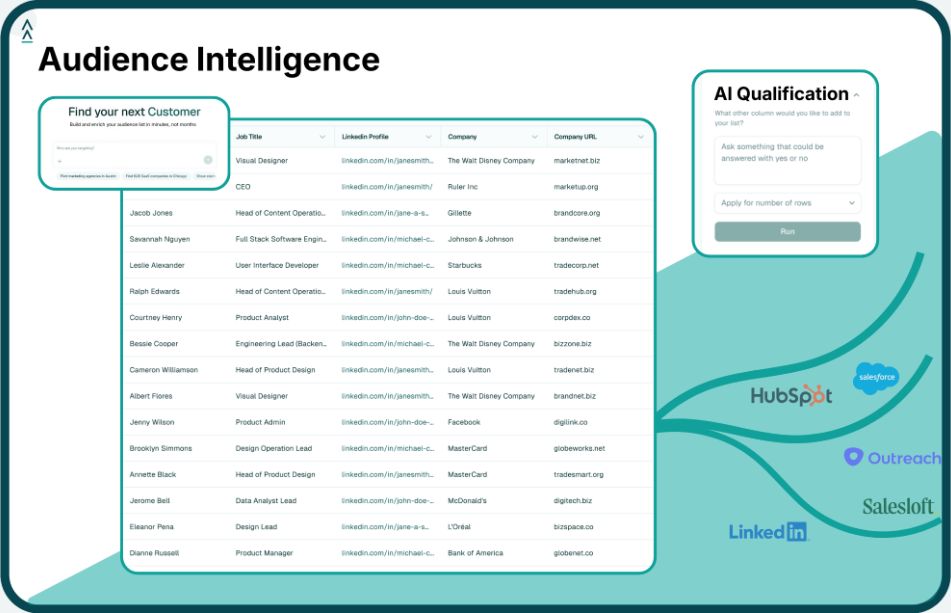
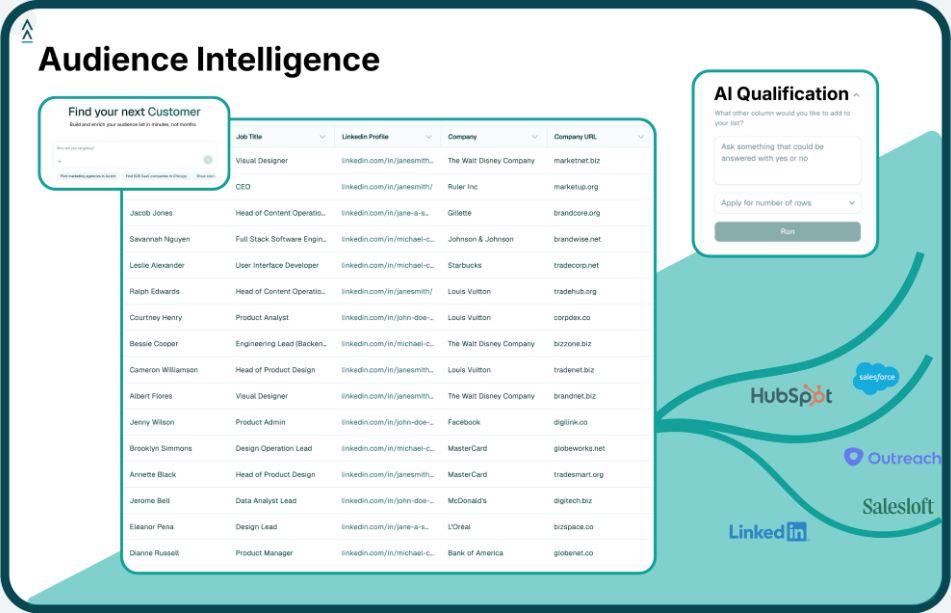
With Landbase, teams describe their ideal customer in plain English and receive a verified, AI-qualified audience list enriched across 1,500+ signal fields, ready for CRM sync and immediate campaign activation. The GTM-2 Omni agentic AI, trained on 40M+ B2B campaigns, handles targeting, scoring, enrichment, and multi-channel outreach coordination autonomously, reducing manual research effort by approximately 80%.

Unlike Unify's credit-based model that requires pairing with a separate contact database and intent data provider, Landbase consolidates the entire stack into one platform with predictable costs and no credit management overhead. The result is a system where machines handle the repetitive work so revenue teams can focus on building relationships and closing deals. See how Landbase works.

Frequently Asked Questions

How much does Unify cost per month in 2026?

Unify's Growth plan starts at $1,740/month billed annually, which comes to approximately $20,880 per year, as published on Unify's pricing page. Pro and Enterprise tiers are custom-quoted and require annual contracts; Unify does not publish list pricing for these tiers, so costs vary by credits, seats, and mailboxes. Teams should model the full cost including seat expansion, mailbox expansion, credit overages, and any external intent data licenses before comparing against alternatives. The total annual spend for a mid-market team on Pro is typically well above the base contract value once all line items are factored in.

Does Unify offer a free trial or free plan?

Unify offers an application-based free trial, currently advertised as 14 days, which interested teams can apply for on the Unify website. There is no self-serve free tier available in 2026; paid plans begin at the Growth tier. Evaluation for Pro and Enterprise typically happens through a sales-led process, with a paid commitment required to begin using the platform at scale. Teams with specific signal environments and RevOps resources are the best fit for a productive trial experience.

What is Unify's credit system and how does it work?

Every billable action in Unify draws from a shared credit pool allocated annually at each plan tier. Actions include company reveals, B2B email enrichment, phone number lookups, champion tracking events, new-hire alerts, and AI agent runs, each consuming credits at different rates depending on the action type. Credits are allocated annually and can be topped up when the allotment runs out, though add-on credit pack pricing is not published publicly. Teams with high signal volume or heavy phone enrichment usage should model credit consumption carefully before committing to a plan tier, as overages are a common source of cost variance after the first year.

What are the biggest hidden costs of Unify?

The most significant additional costs beyond the base subscription are seat expansion ($100/seat/month on annual Pro and Enterprise), mailbox expansion ($25/mailbox/month), credit overages (typically 5–10% of base contract value), and the external tool stack that Unify does not replace. Most teams running Unify also pay separately for a primary contact database and a third-party intent data source, both of which carry their own annual licensing costs. Annual renewal increases are also standard in enterprise SaaS contracts; negotiating a renewal cap at signing is the most effective way to control multi-year spend. Modeling the full TCO across all these line items gives a far more accurate picture than the base subscription price alone.

How does Landbase compare to Unify for outbound teams?

Landbase takes a fundamentally different approach to the GTM stack. Rather than providing a signal-triggered warm outbound layer that teams must pair with a separate contact database, intent data provider, and engagement tool, Landbase combines all of these into a single agentic platform. Teams start with a natural-language prompt, receive a verified and AI-qualified audience enriched across 1,500+ signal fields, and launch multi-channel outreach without switching tools or managing per-credit costs. Customers report 4–7x higher conversion rates, making Landbase the stronger choice for teams that want end-to-end automation with predictable costs rather than a layered point-tool stack.

Build a GTM-ready audience

  • Button with overlapping square icons and text 'Copy link'.

Turn this list into a GTM-ready audience

Match this list to your ICP, prioritize accounts, and identify who to contact using live growth signals.

Stop managing tools. 
Start driving results.

See Agentic GTM in action.
Get started
Our blog

Lastest blog posts

Tool and strategies modern teams need to help their companies grow.

Intently pricing in 2026 starts with a free plan and paid tiers from $149 to $499 per month, with Enterprise custom-quoted. See how Landbase's agentic AI platform delivers end-to-end GTM automation with 300M+ verified contacts in one unified system.

Daniel Saks
Chief Executive Officer

Lemlist pricing in 2026 runs from $63 per user per month on the annual Email Pro plan to $87 per user per month on annual Multichannel Expert, with Enterprise custom-quoted. See how Landbase's agentic AI platform delivers end-to-end GTM automation with 4–7x higher conversion rates.

Daniel Saks
Chief Executive Officer

FullEnrich's 2026 credit-based pricing starts at $29/month for 500 credits, with a pay-for-success model that only charges on verified finds. See how Landbase combines contact enrichment, AI qualification, and multi-channel outreach in one agentic GTM platform.

Daniel Saks
Chief Executive Officer

How GTM teams turn this list into pipeline

See how GTM teams use fastest-growing lists to define TAM, prioritize accounts, and launch campaigns.