.png)
.png)

Daniel Saks
Chief Executive Officer


FullEnrich pricing is published, credit-based, and built around a pay-for-success model — you only spend credits when the waterfall successfully finds contact data. Entry pricing starts at around $29 per month for 500 credits on the Starter tier, with the Pro plan at approximately $55 per month for 1,000 credits. Scale and Agency/Enterprise plans are custom-quoted for buyers with higher monthly volumes. One credit buys one verified business email; a mobile phone number costs 10 credits.
This guide breaks down what FullEnrich really costs in 2026, how the credit model translates to a real contact budget, what additional costs to plan for, a full three-year total cost of ownership (TCO) example, and how to negotiate the best deal. It is written for RevOps, sales ops, and GTM leaders evaluating B2B contact enrichment and waterfall tooling in 2026.
FullEnrich is a B2B contact enrichment platform built around a waterfall methodology. It queries 15 or more data providers in sequence to find a verified business email or mobile phone number for a given prospect, and only charges when the lookup succeeds. FullEnrich addresses a persistent GTM problem: no single data provider has complete coverage, so single-source enrichment tools often report materially lower hit rates depending on region and role.
The core product is a credit-based lookup engine that sits behind three interfaces: a web app for manual and CSV enrichment, a REST API for programmatic enrichment, and native integrations with Clay, Zapier, Make, n8n, HubSpot, and popular outbound tools like Lemlist and Smartlead. According to Quota Engine's review, customers use it to enrich CSVs, connect the API to their CRM, and build custom pipelines that run enrichment on newly created lead records.
The waterfall queries providers including Apollo, Hunter, Dropcontact, Snov.io, Clearbit, Kaspr, and Prospeo, with the sequence algorithmically determined based on historical success rates for different segments. Teams use FullEnrich as a single interface that automatically queries 15 or more sources in the optimal order, rather than maintaining separate subscriptions to each provider. Outreach Ark's 2026 hands-on review notes that the platform makes waterfall enrichment straightforward for teams that would otherwise need engineering time to orchestrate multi-provider lookups.
Three forces make 2026 a pivotal year to understand B2B contact enrichment pricing carefully.
As LinkedIn continues to tighten third-party data rules, single-source tools are experiencing coverage gaps, particularly for senior executives and non-North-American prospects. FullEnrich itself was affected in June 2024 when its LinkedIn Chrome extension was discontinued effective June 16.. Waterfall tools that aggregate many providers at once have become the pragmatic response, and that has reshaped pricing expectations across the category.
After a wave of seat-based, database-style enrichment contracts, RevOps buyers are asking sharper questions about cost per verified contact rather than cost per seat. FullEnrich's pay-for-success credit model makes that math easier. According to ColdIQ's review, that transparency is the main reason teams move from bundled seat-based enrichment to credit-based waterfall providers.
Pure database plays, orchestration layers, and waterfall specialists now overlap. That means pricing comparisons are messier and buyers have to look carefully at what is being sold raw lookups, an orchestration workspace, or a full sales-engagement stack before comparing sticker prices.
The FullEnrich pricing model is built on three simple principles.
Each verified business email returned by the waterfall costs one credit. Mobile phone numbers cost 10 credits per successful find, reflecting the higher cost FullEnrich pays upstream providers for mobile data. If the waterfall cannot surface a verified result, no credits are deducted the failed lookup is free.
This pay-for-success model is materially different from seat-based or consumption-on-request pricing, where you pay for the attempt rather than the result. For sales teams, the effective cost per verified contact equals the published credit rate, not a diluted rate accounting for failed lookups.
FullEnrich publishes monthly credit bundles at distinct tiers. Based on the current FullEnrich pricing page and third-party summaries on G2 and Prospeo, the confirmed published tiers in 2026 are:
Different sources report slightly different price points, reflecting ongoing adjustments to tier credit allocations. The G2 pricing page is typically the fastest-updating third-party reference.
Unused monthly credits roll forward for up to three months on monthly plans, meaning a slow month does not cost you the full allocation. One-time credit packages expire six months after purchase, per Prospeo's pricing review. Annual plans prepay the full 12 months of credits up front, with potential savings compared to monthly billing.
The breakdown below reflects the most commonly reported plan structure in early 2026, cross-referenced across the FullEnrich pricing page, G2, and Prospeo.
Per-credit economics typically improve at higher tiers, per Prospeo's analysis:
The credit model means total monthly cost depends on two variables: how many contacts you enrich per rep per month, and what share of those are phones versus emails. The estimates below model typical consumption for different team sizes, assuming an outbound motion of 800 enriched contacts per rep per month at roughly 80 percent emails and 20 percent phones.
For 800 contacts per rep with 640 email finds and 160 phone finds, the math works out to approximately 2,240 credits per rep per month (640 email credits plus 1,600 phone credits).
Applied to common team sizes:
These figures are directional and will shift based on your phone-versus-email mix, hit rate on your specific ICP, and whether you buy annually. Phone-heavy motions can triple credit consumption relative to email-first motions because of the 10x credit cost for mobile finds.
Beyond the published plan price, several additional costs are worth budgeting for when modeling a realistic FullEnrich deployment.
For a realistic mid-market example, consider a Series B SaaS company with a six-person outbound team enriching about 4,800 contacts per month (800 per rep, 80/20 email/phone split). The company wants to run FullEnrich for three years as the enrichment layer under Clay and Smartlead.
Year 1 total: approximately $16,080
Year 2 total: approximately $12,080
Year 3 total: approximately $24,312
Three-year TCO total: approximately $52,472 for a six-rep team scaling to ten reps. FullEnrich's share of that total is approximately $23,676, or about 45 percent of the three-year spend. For smaller teams (1 to 3 reps) on Pro, three-year TCO typically lands closer to $8,000 to $18,000. For larger enterprise deployments with 25 or more reps and heavy phone prospecting, three-year TCO can comfortably exceed $250,000.
Because FullEnrich publishes most of its pricing and uses transparent credit metrics, the negotiation surface is narrower than with enterprise database tools, but there are still meaningful levers.
Contact enrichment tools address a specific layer of the GTM stack, but teams increasingly need a platform that handles targeting, qualification, and outreach execution as well. The comparison below highlights where FullEnrich sits relative to other platforms in the market.
What They Do: Landbase is an AI-native GTM platform that automates the end-to-end work of targeting, qualifying, and engaging accounts through agentic, multi-agent workflows. The platform combines a 300M+ verified B2B contact database, waterfall enrichment across 20+ providers, 1,500+ enrichment and signal fields, AI qualification, and multi-channel outreach execution in a single system.
Why They're Important: Landbase is built to take a team from a natural-language prompt to a verified, scored account list to a launched multi-channel campaign without switching tools. GTM-2 Omni, trained on 40M+ B2B campaigns and 175M+ sales conversations, continuously qualifies and prioritizes accounts across the full TAM. Customers report 4–7x higher conversion rates, with outcomes including $400K MRR added by P2 Telecom and 33% more meetings booked by Digo Media without additional headcount. Gartner recognized Landbase as a Cool Vendor 2025 in AI-driven GTM automation.
Key Stats / Metrics:
Leadership: CEO: Daniel Saks (co-founder, formerly co-CEO of AppDirect, Forbes 30 Under 30)
Founded: 2020
Recent Funding: Series A: $30M (January 2026). Investors: Picus Capital, 8VC, Sound Ventures
What They Do: Apollo.io provides an AI-powered platform combining sales intelligence, prospecting, and engagement capabilities in a single solution. The platform offers a large B2B contact database with AI-driven insights for identifying and engaging ideal prospects across multiple channels.
Why They're Important: Apollo.io offers an all-in-one platform combining prospecting, outreach, and analytics, making it a widely used option for teams seeking a consolidated engagement and data tool. The platform provides integrations with 50+ tools and a freemium entry point accessible to smaller teams.
Key Stats / Metrics:
Leadership: CEO: Tim Zheng
Founded: 2015
Recent Funding: Series D: $100M (August 2023). Valuation: $1.6B
What They Do: ZoomInfo provides enterprise-grade B2B intelligence with advanced features including org charts, technographics, and buying signals. The platform specializes in comprehensive data for large sales organizations with complex targeting requirements.
Why They're Important: ZoomInfo offers extensive enterprise intelligence and an integration ecosystem of 100+ tools. The platform excels at detailed company hierarchies and decision-maker mapping, making it well-suited for enterprise teams pursuing complex, multi-stakeholder deals.
Key Stats / Metrics:
Leadership: CEO: Henry Schuck
Founded: 2000
Recent Funding: Public company (NASDAQ: ZI). IPO: June 2020
For go-to-market teams rethinking their outbound motion from the ground up, Landbase was purpose-built to address the core gap that contact enrichment tools leave unfilled: the qualification, signal tracking, and outreach execution that happens after a contact record is found.
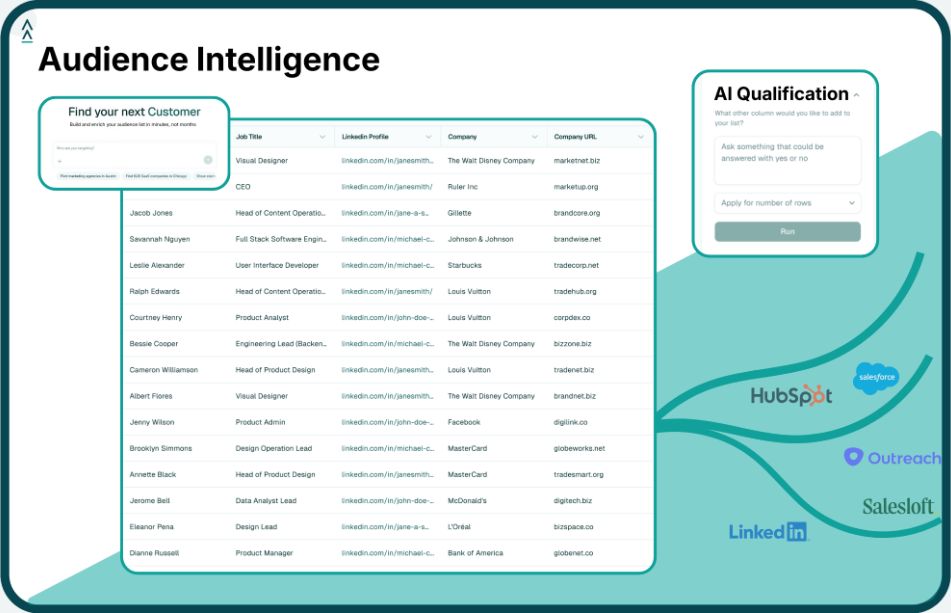
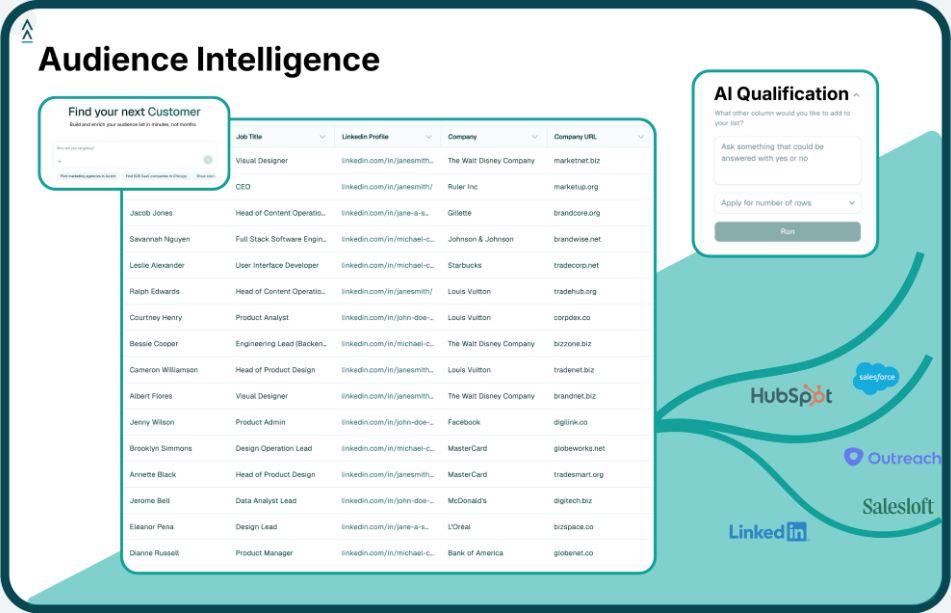
With Landbase, teams describe their ideal customer in plain English and receive a verified, AI-qualified audience list enriched across 1,500+ signal fields, ready for CRM sync and immediate campaign activation. The GTM-2 Omni agentic AI, trained on 40M+ B2B campaigns, handles targeting, scoring, enrichment, and multi-channel outreach coordination autonomously, reducing manual research effort by approximately 80%.
Where FullEnrich is a specialized enrichment layer requiring downstream tools for sequencing, CRM sync, and reporting, Landbase consolidates targeting, enrichment, qualification, and outreach into one platform. The result is a system where machines handle the repetitive work so revenue teams can focus on building relationships and closing deals. See how Landbase works.
FullEnrich pricing starts at approximately $29 per month for 500 credits on the Starter plan and approximately $55 per month for 1,000 credits on the Pro plan. Scale and Agency/Enterprise tiers are custom-quoted directly with FullEnrich based on monthly volume requirements. One credit covers one verified email, and 10 credits cover one mobile phone number. Teams should model their phone-versus-email enrichment split carefully, as phone-heavy motions consume credits significantly faster.
FullEnrich charges only on successful enrichment. If the waterfall cannot surface a verified email or phone number, no credits are deducted for that lookup. One credit buys one verified email; 10 credits buys one mobile phone number; personal emails cost 3 credits; and reverse email lookups cost 1 credit. This pay-for-success model means your effective cost per contact is the published credit rate, not a rate diluted by failed lookups.
Credits are bundled into monthly plans and consumed per successful find: 1 credit for a business email, 10 credits for a mobile phone, and 3 credits for a personal email. Unused monthly credits roll forward for up to three months on monthly plans, and one-time credit packs purchased outside monthly plans expire after six months. Annual plans prepay the full 12 months of credits up front with potential savings versus monthly billing. The credit rollover buffer gives teams some flexibility during slower prospecting months without losing their full allocation.
Yes. FullEnrich offers a free trial that includes 50 credits to test the platform with no credit card required. That allocation is enough to benchmark hit rate on a representative sample of ICP prospects before committing to a paid plan. Running the trial on a realistic list of target accounts is the most effective way to assess enrichment quality for your specific market segment. Hit rates vary by ICP, region, and seniority, so a hands-on sample delivers more reliable data than any published benchmark.
FullEnrich is a focused contact enrichment layer: it finds verified emails and phone numbers using a waterfall of 15 or more providers, but does not send sequences, qualify leads, generate AI-drafted messaging, or execute multi-channel outreach. Landbase combines all of these into a single agentic platform, so teams move from ICP definition to launched campaign without assembling separate enrichment, sequencing, dialing, and reporting tools. The GTM-2 Omni AI, trained on 40M+ B2B campaigns, continuously qualifies and prioritizes accounts while executing outreach. Customers report 4–7x higher conversion rates, making Landbase the stronger choice for teams seeking end-to-end GTM automation rather than a standalone enrichment layer.
Tool and strategies modern teams need to help their companies grow.