.png)
.png)

Daniel Saks
Chief Executive Officer


Most revenue leaders think of RevOps as just process optimization, but honestly, AI is transforming it into something entirely different—a predictive, strategic growth engine. More and more organizations are finding that AI-powered audience discovery can unify revenue operations across sales, marketing, and customer success, especially for teams drowning in manual data work or struggling with forecast accuracy. Revenue operations consumes massive resources, with sales reps spending only 34% of their time actually selling—the rest goes to administrative work, research, and CRM updates. AI RevOps helps reclaim that lost time by automating the repetitive tasks that prevent strategic thinking.
Now, implementing AI in RevOps is a little trickier than just buying a new tool. It requires clean data foundations, cross-functional alignment, and careful change management. Still, AI RevOps transformation shows that organizations implementing AI-powered RevOps achieve 36% more revenue growth and up to 28% more profitability when properly aligned. That extra efficiency might mean shorter sales cycles, higher forecast accuracy, and an edge when you're competing for the same accounts.
The science behind AI in RevOps is still evolving, but so far, the results look promising for accelerating revenue growth. If you're thinking about implementing AI RevOps, it's worth learning about the four key transformation areas, implementation sequencing, and selecting the right AI capabilities for your specific needs—plus, you want to avoid the common pitfalls that derail most AI initiatives.
Revenue Operations (RevOps) emerged as a response to the growing complexity of B2B go-to-market strategies and the need to break down silos between sales, marketing, and customer success. At its core, RevOps is about aligning people, processes, and technology to drive predictable, efficient revenue growth across the entire customer lifecycle.
Traditional RevOps focuses on manual process optimization, data governance, and cross-functional alignment. Teams spend countless hours reconciling data between CRM, marketing automation, and customer success platforms, creating reports, and managing operational workflows. This manual overhead prevents strategic work and slows down decision-making.
The foundational elements of RevOps include:
The challenge with traditional RevOps is that it's largely reactive—it responds to problems after they occur rather than preventing them. This is where AI transforms the function from operational maintenance to strategic intelligence.
As organizations scale, the complexity of managing revenue operations grows exponentially. Manual processes that worked at $10M ARR become impossible bottlenecks at $100M ARR. This creates the perfect conditions for AI to step in and handle the repetitive, data-intensive work that humans shouldn't be doing.
AI automation fundamentally changes RevOps from a manual, reactive function into a predictive, strategic growth driver. Instead of spending weeks cleaning data and creating reports, teams can focus on strategic initiatives that directly impact revenue outcomes.
The transformation happens across four critical areas, and successful implementation requires following this specific sequence: data operations first (highest ROI, lowest complexity), then scoring, then forecasting, then optimization.
Four Core AI Transformation Areas in RevOps:
By 2028, 75% of RevOps tasks in workflow management, data stewardship, and revenue analytics will be executed by AI agents. This represents a fundamental platform shift from manual operations to autonomous, AI-powered revenue engines.
The key insight is that AI doesn't replace humans—it amplifies their strategic capabilities. When machines handle the mundane data work, humans can focus on what they do best: building relationships, crafting strategic messaging, and making complex judgment calls that require emotional intelligence.
AI specifically transforms the sales arm of RevOps by addressing the biggest time sinks and accuracy gaps in traditional sales operations. Sales teams spend 66% of their time on non-selling activities, creating massive inefficiency that AI can directly address.
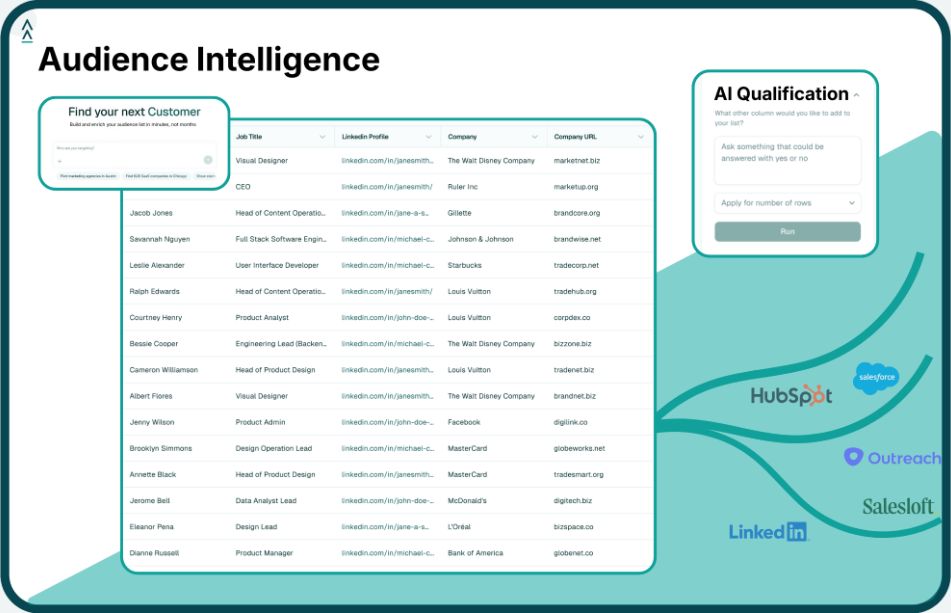
AI-powered prospecting eliminates the manual research that traditionally consumed hours of SDR time. Instead of scrolling through LinkedIn and company websites, teams can use natural language queries to discover and qualify prospects instantly.
AI prospecting capabilities include:
The Landbase Platform helps outbound teams and Account Executives by building qualified prospect lists and discovering engaged buyers, reducing time spent hunting and increasing closing time. This directly addresses the core pain point of sales teams spending too much time on research and not enough on selling.
Traditional forecasting achieves only 50-70% accuracy due to reliance on subjective rep self-reporting. AI forecasting analyzes historical data, pipeline velocity, engagement signals, and deal progression patterns to predict outcomes with 80-95% accuracy—a 30-50% improvement over manual methods.
AI forecasting benefits:
This level of forecast accuracy directly impacts strategic decisions about hiring, territory planning, and resource allocation, giving leadership confidence in revenue projections.
AI transforms marketing and customer success operations by enabling hyper-personalization at scale and proactive intervention before problems occur.
Marketing teams achieve 40% higher ROI through personalized experiences at scale. AI agents coordinate communication across email, social, and in-app messaging, personalizing content based on buying stage, industry, and behavior signals.
The VibeGTM Interface allows marketing teams to set their direction, leverage AI Qualification using 1,500+ signals, and export up to 10,000 contacts for activation, boosting efficiency and ROI. This eliminates the technical barriers that traditionally prevented marketers from building sophisticated audience segments without engineering help.
AI marketing optimization includes:
AI transforms customer success from reactive support to proactive health monitoring. Instead of waiting for renewal conversations to discover problems, AI identifies churn risks 3-6 months in advance, enabling meaningful intervention.
AI customer success capabilities:
This proactive approach improves net revenue retention and reduces the time-to-first-value during onboarding, creating stronger customer relationships and higher lifetime value.
Successful AI RevOps implementation requires careful planning, sequencing, and change management. The biggest mistake organizations make is attempting complex AI implementations before establishing the data foundation required for success.
The right implementation sequence follows this progression: data management first (highest ROI, lowest risk), then add intelligent scoring (30-50% accuracy improvement), then predictive forecasting (requires clean data foundation), then process optimization.
30-60-90 Day Implementation Roadmap:
This approach prevents the "garbage in, garbage out" failures that doom most AI initiatives. Organizations need data governance frameworks and standardized processes before AI implementation, which many mid-sized companies struggle to establish without dedicated resources.
Technical AI implementation may take weeks, but organizational adoption takes months. The Landbase Partner Program helps agencies elevate their AI capabilities for GTM innovation, improve team efficiency, and gain support and training to empower clients in implementing AI-driven RevOps strategies.
Key change management principles:
The most successful implementations focus on augmenting human capabilities rather than replacing them, positioning AI as a tool that frees teams from mundane work to focus on strategic, relationship-building activities.
Revenue Operations leaders in the AI era must evolve from process managers to strategic orchestrators who can align technology, data, and human capabilities to drive revenue growth.
RevOps leaders must ensure that AI initiatives align with broader business objectives and create value across all revenue functions. This requires a deep understanding of both technical capabilities and business needs.
Key leadership responsibilities:
As AI moves from assistive to autonomous, RevOps leaders must establish strong governance frameworks that ensure ethical use, explainability, and human oversight.
AI governance requirements:
Organizations establishing strong AI governance now will scale autonomous revenue operations faster and more safely than competitors who rush implementation without guardrails.
Quantifying the impact of AI in RevOps requires tracking both operational efficiency metrics and strategic business outcomes.
Key operational KPIs:
These metrics demonstrate the immediate efficiency gains from AI automation and help justify continued investment.
Key strategic KPIs:
The Landbase Intelligence provides GTM insights including growth signals and Trust Scores, which are crucial for monitoring and improving the performance of AI-powered RevOps initiatives. These strategic metrics demonstrate the long-term business impact of AI RevOps transformation.
The biggest disruption in AI RevOps is the shift from assistive AI (providing recommendations) to agentic AI (autonomously executing workflows). This represents a fundamental platform change that democratizes sophisticated GTM capabilities previously requiring technical expertise.
Agentic AI systems can interpret natural language prompts and autonomously execute complex workflows across multiple systems. The GTM-2 Omni is the first agentic AI model specifically built for Go-to-Market, pioneering autonomous GTM systems that drive real revenue impact.
Agentic AI capabilities:
As Gartner experts predict, "By 2028, 75% of RevOps tasks in workflow management, data stewardship, revenue analytics, and RevTech administration will be executed by AI agents. This rapid adoption will be essential for organizations seeking to stay competitive in a landscape where speed and accuracy of insight are critical differentiators."
The next frontier is hyper-personalization at scale and predictive resource allocation that optimizes human and AI resources in real-time.
Emerging capabilities:
These capabilities will create truly autonomous revenue engines that can adapt to changing market conditions and customer needs in real-time, maintaining human relationships while eliminating operational friction.
Landbase stands out in the AI RevOps landscape by pioneering autonomous go-to-market through its GTM-2 Omni agentic AI model. Unlike traditional data providers that require complex filtering and technical expertise, Landbase enables revenue teams to discover and qualify their next customer in seconds using natural-language targeting.
The platform's core innovation is eliminating the technical moat that has historically protected established players. Instead of learning complex query languages or relying on data analysts, teams can simply type plain-English prompts like "CFOs at enterprise SaaS companies that raised funding in the last 30 days" and receive AI-qualified exports ready for immediate activation.
What makes Landbase uniquely valuable for AI RevOps:
Landbase's approach directly addresses the core RevOps pain points identified in research: data fragmentation, manual operational overhead, and technical complexity. By providing an intuitive interface powered by sophisticated agentic AI, Landbase enables teams to focus on strategic relationship-building rather than data wrangling.
For revenue leaders looking to implement AI RevOps, Landbase offers a low-risk starting point with immediate time-to-value. The free tier allows teams to test the platform's capabilities without upfront investment, while the underlying GTM-2 Omni model provides enterprise-grade sophistication for complex requirements.
The primary goal is to transform RevOps from a manual, reactive operational function into a predictive, strategic growth driver that unifies sales, marketing, and customer success through intelligent automation and data-driven decision-making. AI enables teams to focus on high-value strategic work instead of repetitive administrative tasks. This transformation helps organizations achieve 36% more revenue growth and up to 28% more profitability. The shift creates a foundation for sustainable, scalable revenue generation.
AI forecasting analyzes historical data, pipeline velocity, engagement signals, and deal progression patterns to predict outcomes with 80-95% accuracy—representing a 30-50% error reduction compared to traditional methods that rely on subjective rep self-reporting. This improvement enables early identification of slippage risks weeks before deals stall, provides confidence scoring on every pipeline line item, and supports strategic scenario modeling. The enhanced accuracy directly impacts hiring decisions, territory planning, and resource allocation. Leadership gains confidence in revenue projections, enabling better strategic planning.
The primary barriers include data quality issues requiring clean, structured data before AI can deliver value; organizational silos creating resistance; technology integration complexity with fragmented tool stacks; change management challenges around team fears of job displacement; and skill gaps in AI literacy within RevOps teams. Many mid-sized companies struggle to establish data governance frameworks and standardized processes without dedicated resources. Technical implementation may take weeks, but organizational adoption takes months. Success requires following the right implementation sequence: data operations first, then scoring, then forecasting, then optimization.
No—AI automation amplifies human capabilities rather than replacing them. When machines handle mundane data work, humans can focus on strategic activities like building relationships, crafting messaging, and making complex judgment calls that require emotional intelligence. The most successful implementations position AI as a tool that frees teams from repetitive tasks to focus on high-value work. Sales teams currently spend 66% of their time on non-selling activities; AI reclaims that lost time for strategic engagement. This augmentation approach creates stronger teams and better outcomes than either humans or AI working alone.
Tool and strategies modern teams need to help their companies grow.