.png)
.png)

Daniel Saks
Chief Executive Officer


Regie.ai's current product, RegieGO, is an agentic sales workspace built around prospecting, enrichment, messaging, dialing, and multichannel sales workflows.
Rather than functioning only as an AI writing assistant or conventional sales sequencer, RegieGO combines several parts of the prospecting process in one interface. Agents can research accounts, identify prospects, enrich contact information, draft messages, prepare calls, monitor selected signals, and execute scheduled workflows according to user-defined instructions.
For teams evaluating AI sales agents, the more relevant questions concern how much of the prospecting workflow RegieGO covers, what still requires seller oversight, how reliable the underlying prospect data is, and whether the bundled approach fits existing CRM and sales processes.
RegieGO is positioned as an agentic workspace for outbound prospecting.
Its current capabilities include:
The workspace can take targeting and workflow instructions in natural language. A seller can define an audience, have the system identify and enrich prospects, prepare outreach, and schedule recurring work around those prospects.
This moves the product beyond content generation into broader sales workflow execution.
RegieGO can run prospecting tasks on schedules rather than requiring every action to be initiated manually.
Examples of current workflows include:
The level of automation remains configurable.
Users determine which workflows can run automatically and which actions should remain available for review. Current product materials indicate that nothing sends or dials unless the user has either instructed the system to do so or configured the relevant workflow to run.
This distinction matters when evaluating agentic sales systems. Automation can reduce repetitive prospecting work, but organizations still need controls around targeting, messaging, data quality, and the actions an agent is permitted to take.
Broader guidance such as the NIST GenAI profile provides useful context for evaluating generative AI systems, including questions around reliability, human oversight, and output quality.
RegieGO includes contact enrichment rather than requiring every user to bring a separate data provider.
Current product materials describe a waterfall model in which multiple data providers are queried sequentially until information is found. Regie.ai currently describes this process as using seven providers, with additional verification applied to email information before sending.
Available enrichment can include:
RegieGO charges credits when enrichment returns data rather than charging for unsuccessful enrichment attempts.
Data accuracy is one of the recurring considerations in current Regie.ai reviews.
G2's review summary surfaces themes involving:
These concerns do not indicate that every RegieGO record is inaccurate. They indicate that teams using the enrichment layer for outbound prospecting may benefit from testing data quality against representative accounts and contacts.
This is particularly relevant for organizations where CRM data quality directly affects routing, territory ownership, personalization, or outbound efficiency.
Messaging remains another significant part of the Regie.ai product.
RegieGO can research an account and use available company and prospect context to prepare:
The system can also learn from a seller's existing sent email to create a voice profile for subsequent drafts.
Current G2 feedback indicates that AI-assisted messaging can save time, but output quality varies.
G2's review analysis surfaces concerns involving:
The pattern supports treating AI-generated outreach as content that still benefits from review, particularly when the message includes specific claims about a prospect or company.
Human review becomes more important as personalization becomes more specific because an incorrect detail can make a highly personalized message less credible rather than more relevant.
RegieGO sends through a user's connected Gmail or Outlook account rather than requiring a separate vendor sending domain.
The platform also handles functions such as:
Sending through an established mailbox does not by itself guarantee deliverability. Domain authentication, complaint rates, sending behavior, message quality, and recipient engagement still affect whether email reaches the inbox.
Google's current email sender guidelines specify requirements such as SPF or DKIM authentication for all senders and additional SPF, DKIM, DMARC, and unsubscribe requirements for qualifying bulk senders.
Commercial email is also subject to applicable legal requirements. The CAN-SPAM compliance guide explains requirements for commercial messages in the United States, including business-to-business email.
Calling is built directly into RegieGO.
The current dialer supports:
Integrating dialing with prospect research and enrichment can reduce the amount of preparation required before a call block.
It also gives the workspace additional context after a conversation because call outcomes can feed subsequent tasks and follow-up workflows.
Dialer automation does not remove the need to evaluate applicable calling rules.
Requirements vary according to location, recipient type, calling method, consent, and other circumstances. The Telemarketing Sales Rule provides federal guidance for covered telemarketing activities, including Do Not Call requirements, calling restrictions, and rules affecting automated or abandoned calls.
Organizations using parallel or automated dialing may therefore need compliance controls alongside productivity features.
RegieGO coordinates activity across email, phone, and LinkedIn within its prospecting workflow.
Email and calling can execute directly through the platform once configured.
LinkedIn operates differently. Current RegieGO product examples show social actions being prepared within the workflow, with drafts or tasks presented for the seller to complete rather than suggesting unrestricted automated LinkedIn sending.
This creates a multichannel workflow while preserving different levels of automation across channels.
For teams evaluating sales engagement tools, this distinction matters because "multichannel" does not necessarily mean that every channel is executed autonomously in the same way.
Current RegieGO product materials emphasize a built-in CRM that allows prospecting to begin without connecting an external system.
For organizations using HubSpot, RegieGO supports synchronization of contacts and activity, including backfilling existing information.
Current plans also distinguish between individual and enterprise integration requirements:
This is narrower than some legacy Regie.ai integration claims that continue to appear in older product materials.
For organizations with highly customized CRM environments, integration requirements may therefore be an important part of the evaluation.
Regie.ai currently publishes three pricing levels for RegieGO.
Price: $0
The Free plan includes:
Price: $49 per month
The Pro plan is designed for an individual seller and includes:
Price: Custom
Enterprise adds capabilities for larger teams, including:
Credits are used for activities such as:
Enrichment that does not return data does not consume a credit.
This credit model means the $49 subscription price should not be evaluated independently from expected prospecting volume.
Review profiles provide useful context beyond the product feature list.
The Regie.ai profile on G2 currently shows 4.4 out of 5 from 355 reviews.
G2's review analysis highlights positive themes involving:
Recurring concerns include:
The review profile therefore points to a fairly consistent trade-off: users often value the speed and productivity benefits while still encountering cases where data or AI-generated outputs require correction.
The Regie.ai profile on Capterra currently shows 4.0 out of 5 from 13 reviews.
Capterra reports:
The Capterra sample is much smaller than G2’s, so its rating reflects a narrower set of user experiences.
Some reviewers report wrong numbers, incorrect job information, or other inaccuracies in prospect data.
The practical effect depends on the target market and the percentage of records that require manual correction.
Representative testing remains useful before a team relies on the enrichment layer at larger scale.
Generated messaging can require editing for tone, accuracy, and specificity.
Review feedback indicates that some drafts can sound generic, overly stylized, or based on incomplete prospect information.
RegieGO is designed to reduce setup compared with assembling multiple prospecting tools, but deeper use still involves configuring audiences, personas, messaging, agent instructions, and workflow behavior.
Some reviewers report a learning curve when moving beyond basic sequence or campaign creation.
Current review feedback also indicates that certain users want deeper reporting, customization, or manager-level visibility.
These considerations become more relevant as deployments move from individual sellers toward larger teams.
Outreach platforms can coordinate campaign execution, but the effectiveness of those workflows also depends on the data feeding them. Before a prospect enters an email sequence or sales workflow, teams still need to determine which companies fit the target market, identify the right contacts, enrich incomplete records, and account for changes such as hiring, funding, leadership moves, or technology adoption.
For RevOps and technical GTM teams, these requirements often extend beyond a single outreach platform. The same audience and account data may need to support prospecting, CRM operations, analytics, enrichment, and AI-assisted workflows across multiple systems.
This creates a separate data layer focused on building, refining, and maintaining the audiences that downstream GTM tools use.
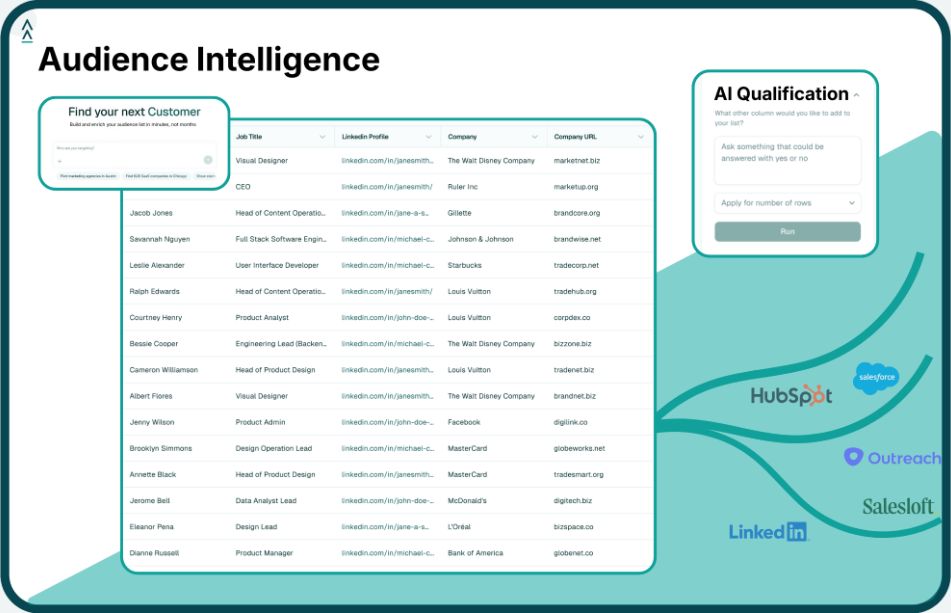
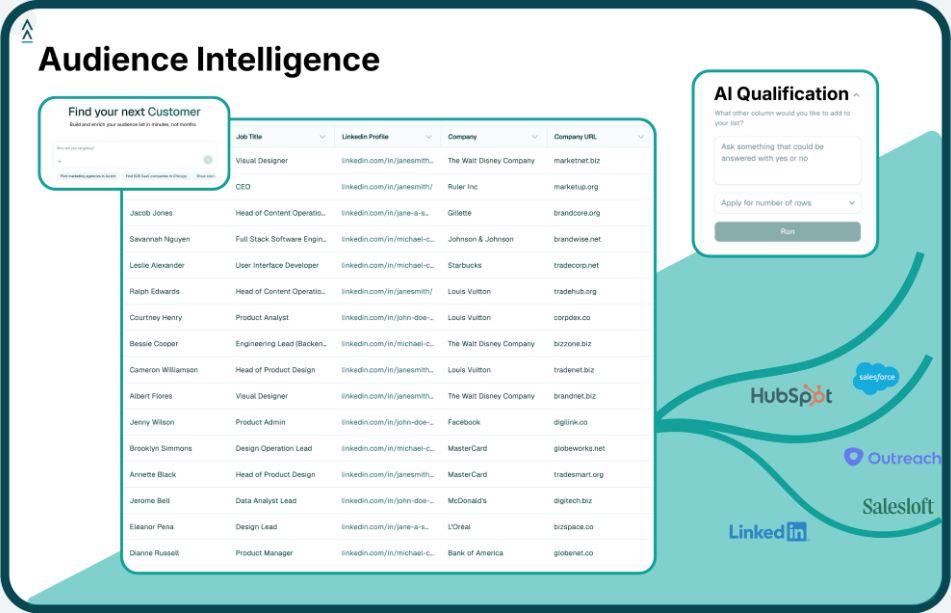
Landbase supports this data layer through B2B audience creation, enrichment, buying signals, and structured data operations.
Its web application and CLI are two Landbase interfaces into the same underlying data and agent. Teams can use the web experience for interactive audience research and move the same data into repeatable technical workflows through the CLI.
Landbase agentic search allows teams to describe an ideal customer profile in plain language and translates the request into structured qualification criteria.
Landbase currently reports:
Natural-language search can also be combined with structured filters when an audience requires additional precision.
Existing company and contact records can move through matching and enrichment workflows to:
This allows CRM, spreadsheet, or operational data to be reconciled with Landbase data before it moves into prospecting, analysis, or other GTM workflows.
Landbase tracks company changes including:
Landbase reports tracking more than 1,500 signal types across 24M+ companies.
These signals can be combined with company, contact, firmographic, and technographic criteria to refine audiences and identify accounts that meet more specific GTM requirements.
The Landbase CLI provides terminal access to the same underlying data and agent available through the web platform.
It can run inside AI-assisted environments such as Claude Code and Codex and supports repeatable operations involving:
This gives technical GTM teams a way to reuse the same B2B data across scripts, AI-assisted processes, CRM workflows, and downstream execution systems.
An agentic sales workspace combines AI agents with tools used for prospecting and seller workflows. Depending on the platform and configuration, agents can perform research, enrich data, draft messages, prioritize prospects, prepare calls, and execute scheduled tasks while users control which actions are permitted to run automatically.
RegieGO currently offers a Free plan with 250 one-time credits, a Pro plan at $49 per month with 5,000 monthly credits, and custom Enterprise pricing for teams requiring additional volume, shared workspaces, CRM synchronization, analytics, and enterprise support.
G2 reviews frequently mention ease of use, automation, personalization, and time savings. Recurring concerns include inaccurate prospect information, inconsistent messaging, content quality, and learning curve.
RegieGO includes its own built-in CRM and currently documents HubSpot synchronization for contacts and activity. Its Enterprise offering includes custom CRM sync for organizations with additional integration requirements.
Landbase supports natural-language audience creation, company and person matching, enrichment, buying signals, structured datasets, and terminal-based workflows through its CLI. Its web application and CLI access the same underlying Landbase data and agent, allowing teams to move between interactive and technical GTM workflows.
Tool and strategies modern teams need to help their companies grow.