Go-to-market teams are drowning in data and busywork. Studies show sales reps waste up to 50% of their time on unproductive prospecting, and they spend about 70% of their work hours on non-selling tasks like researching contacts or updating CRM records. Marketing and RevOps teams face similar inefficiencies dealing with stale or siloed data – B2B contact information decays at roughly 20–30% per year (even up to 70% in some industries), quickly rendering databases outdated. It’s no surprise that 84% of reps missed quota last year amid these challenges. To hit their numbers, GTM organizations need a new way to find and engage customers that doesn’t involve weeks of manual research or fighting bad data.
Enter AI agents. In the past two years, autonomous AI “workers” have emerged to take on many go-to-market tasks, from lead research to outreach. These aren’t sci-fi robots, but software programs powered by AI that act like virtual team members – searching, reasoning, and executing tasks on their own. Adoption is already accelerating: 74% of B2B organizations have deployed AI agents in their sales and marketing workflows (and another 14% plan to). Early adopters report faster pipeline growth and higher productivity as these agents shoulder the heavy lifting of GTM operations. In this blog, we’ll unpack what AI research agents are in a GTM context, how they automate market and contact discovery, and why they’re poised to transform prospecting and data enrichment for sales, marketing, and RevOps teams.
What Are AI Agents in GTM?
AI agents in go-to-market are goal-driven AI programs that autonomously perform tasks and make decisions to support sales and marketing objectives. Unlike basic chatbots or analytics tools, these agents exhibit “agentic” behavior – meaning they can perceive information, take actions, and learn from outcomes with minimal human guidance. In practice, a GTM AI agent might act as a digital Sales Development Rep (SDR) or researcher: it can analyze vast datasets, identify promising prospects, generate personalized outreach, and even schedule follow-ups, all on its own. Forrester describes them as “goal-oriented, self-improving, sometimes autonomous” assistants for B2B buying and selling that will soon touch every stage of the customer journey.
Crucially, AI agents don’t just provide insights – they execute entire workflows. In a sales context, an AI agent can handle the end-to-end process: autonomously researching and identifying high-fit leads, qualifying those opportunities, engaging prospects with tailored messages, and handing off interested buyers to humans. In marketing, agents might optimize campaign targeting or personalize content at scale. These systems act as extensions of your team, working 24/7 without fatigue. And because they are powered by advanced AI (often large language models and custom algorithms), they can reason through complex tasks akin to a human. The benefit is a GTM engine that never sleeps – an AI agent team that finds and nurtures prospects continually, allowing your human reps to focus on strategic conversations and closing deals.
How AI Research Agents Automate Market and Contact Discovery
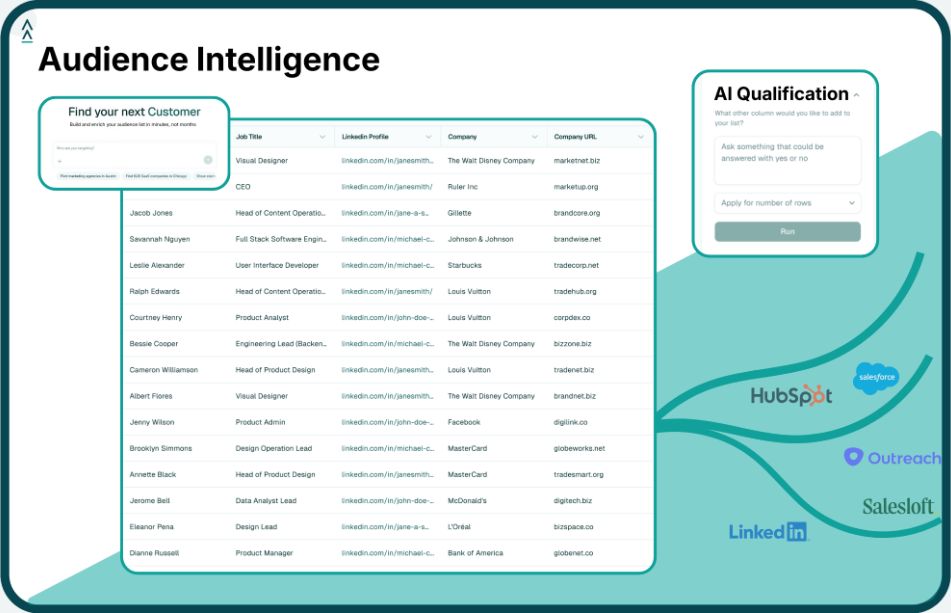
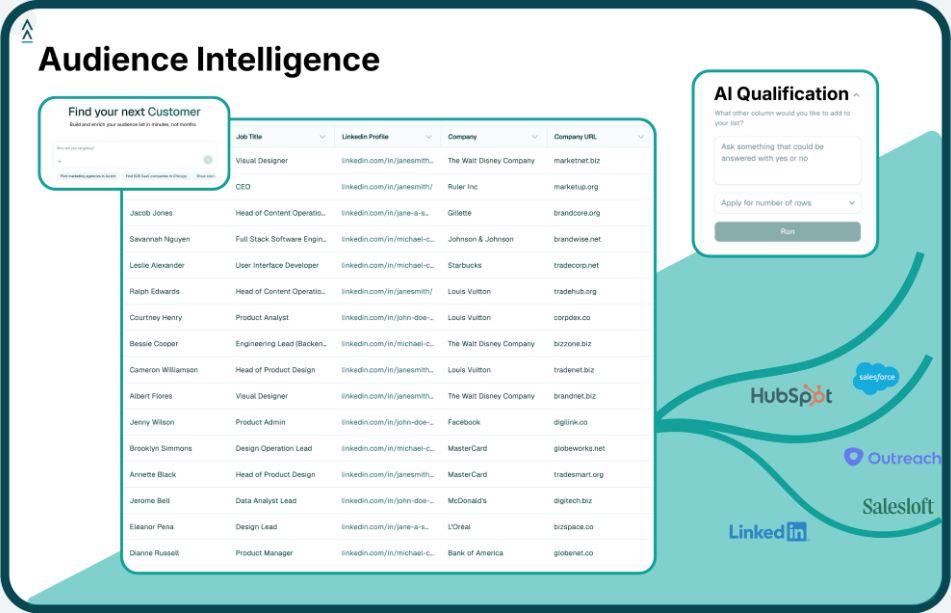
Within the universe of GTM AI agents, research agents play a pivotal role in automating market and contact discovery. A research agent is essentially an AI-powered researcher that scours multiple sources for relevant data, then extracts and structures that information for your GTM needs. Instead of a human spending hours on Google or digging through databases, the AI research agent can do it in minutes or seconds. Here’s how these agents work to streamline prospect and market research:
- Industry Data Extraction: AI research agents can pull information from large public datasets and directories automatically. For example, a research agent can retrieve conference attendee lists, academic research databases, patent filings, or grant records relevant to your market. It will not only collect the raw lists, but also parse out structured details – e.g. company names, attendee titles, emails, topics of interest – and present them as a ready-to-use prospect list. This means if you need contacts from, say, a niche trade show or a list of authors of industry whitepapers, the agent can gather and compile that data far faster than manual methods.
- Web Crawl & Signal Analysis: These agents continuously crawl websites and online sources to detect buying signals and new contacts. They might scan company websites, news articles, social media, and job boards for indicators like recent funding announcements, key hires, product launches, or geographic expansion. By analyzing such real-time signals across the web, an AI agent can discover companies that fit your ideal customer profile and may have current needs for your solution. For instance, if your ICP is “retail companies expanding e-commerce operations,” the agent could crawl press releases and hiring pages to find retailers opening e-commerce roles or deploying new online platforms, flagging them as high-potential targets. This web-driven research goes beyond static databases, giving you up-to-the-minute intelligence on who to reach out to.
- Data Structuring and Enrichment: A huge advantage of AI research agents is their ability to turn unstructured data into actionable insight. They don’t just dump raw text; they use natural language processing to extract key facts and populate your records. If a web page lists a contact’s name, title, and bio, the agent can parse those into structured fields. If it finds a list of companies in a PDF report, it can convert that into a spreadsheet with clean columns. Research agents also cross-reference and enrich data – for example, linking a person to their LinkedIn profile or adding firmographic details (industry, size, revenue) about a company it found. By structuring data on the fly, the agent builds a richer picture of each prospect or account. This automated enrichment saves RevOps teams countless hours and ensures that when leads flow to sales, they come with context (like “this contact attended XYZ conference and recently commented about looking for cybersecurity solutions”). In short, research agents not only find the needles in the haystack; they also label and package those needles so your team can use them immediately.
By automating these functions, AI research agents dramatically accelerate what used to be tedious groundwork. They can compile comprehensive target lists in a fraction of the time, continuously update your CRM with fresh intelligence, and surface “hidden” prospects that traditional tools might miss. For GTM teams, this means no more starting from scratch on market research – your AI agents hand you a running start.
AI Agents for Data Extraction, Web Crawling, and More
To illustrate the impact of AI research agents, let’s look at a few concrete GTM use cases where they shine:
- New Market Identification: Imagine a marketing team wanting to break into a new vertical or region. An AI agent can rapidly crawl industry databases and news to identify all the key companies in that niche, along with relevant contacts. For example, if you’re targeting “FinTech startups in Europe with Series A funding”, the agent can search startup directories, funding announcements, and databases like Crunchbase to output a list of companies that match the criteria (and even find the decision-makers at each). What might take an analyst weeks to research is delivered almost instantly by the agent.
- Competitive Intelligence & Signal Tracking: Sales teams can deploy research agents to monitor competitor and prospect activities. The agent might continuously scan for web updates, press releases, or job postings from a set of target accounts. Say your sales reps want to know when a target account shows buying intent – an AI agent could alert them when a target company hires a new CTO, publishes a job opening for a tool you integrate with, or gets mentioned in an article about digital transformation. These real-time insights (derived from web crawling and text analysis) let reps strike while the iron is hot, reaching out with timely relevance. Traditional contact databases wouldn’t catch these nuanced signals, but an AI agent will.
- Data Cleaning and Enrichment at Scale: RevOps teams often struggle with maintaining data quality. AI agents can automatically enrich or refresh records by cross-verifying them against live sources. For instance, a research agent could take an old contact list and update each entry’s current company, title, and email by intelligently querying the web and professional networks. It can also fill in missing fields (like phone numbers or industry classification) by finding that info online. This use case essentially gives you an always-on data steward: instead of manually cleaning spreadsheets or buying one-off enrichment, the AI agent continuously keeps your lead and account data complete and up-to-date. Given that sales and marketing departments waste up to 32% of their time dealing with data quality issues, this kind of automated enrichment is a game-changer for productivity.
Each of these use cases demonstrates the versatility of AI research agents. Whether extracting niche lists, monitoring real-time buyer signals, or structuring data for analysis, these agents act as tireless research assistants. The result is a GTM operation fueled by richer data and insights, without the manual drudgery.
Advantages of AI Agents vs. Traditional Enrichment Tools
AI research agents offer several distinct advantages over traditional data enrichment tools or static databases:
- Real-Time, Dynamic Data: Legacy sales intelligence platforms (think big static databases) rely on data that might be weeks or months old, often only updated periodically. In fact, many B2B data providers operate with only ~70% accuracy in their records due to data decay. AI agents, by contrast, pull real-time information from live sources. They continuously crawl for the latest signals and updates, ensuring your targeting data is current. This dynamic approach mitigates the data decay problem – instead of using a list that’s stale the day after purchase, your AI agent is always refreshing the info. In fast-moving markets, this currency of data means fewer bounced emails, fewer outdated contacts, and more relevant outreach.
- Flexible, Natural Queries: Traditional tools often force you to use rigid filters and Boolean logic to build lists (e.g. selecting industry codes, employee count ranges, etc.). AI agents can interpret natural-language queries and complex concepts to find exactly what you ask for. You can ask for “mid-stage biotech companies in the Midwest researching AI for drug discovery” and the agent will understand the intent and comb through multiple data sources to assemble that list. This flexibility lets GTM teams target more precisely without needing a data scientist – the AI’s semantic search and reasoning do the work. It’s a stark improvement over the old way of guessing which database filters approximate your ICP.
- Breadth of Signal Coverage: Traditional enrichment might give you basic firmographics and contact info. AI research agents cast a wider net, leveraging thousands of data points – from technographic data (what software a company uses) to intent signals (like content engagement or ad clicks) to hiring trends. For example, a conventional tool might tell you a company’s size and industry, while an AI agent can tell you that the company recently adopted a specific technology, expanded its sales team by 30%, and just opened a new office in Asia. By aggregating such diverse signals, AI agents provide a multi-dimensional view of each account. This depth of insight leads to better prioritization – you can focus on prospects showing multiple positive signals – and more personalized outreach.
- Continuous Learning and Improvement: One overlooked benefit of AI-driven agents is that they learn and improve over time. A static database stays static, but an AI agent can incorporate feedback. If certain types of prospects convert well, the agent can adjust its criteria to find more like them (a form of look-alike modeling). Many agent systems use reinforcement learning, so as your team engages with the agent’s output, the underlying model refines its understanding of what “good” prospects look like. Over months of use, the AI agent becomes increasingly accurate and tailored to your business – something a traditional data vendor cannot replicate for each customer. This learning loop means your prospecting only gets sharper with time, essentially building an ever-improving competitive advantage.
- Cost and Efficiency Gains: Finally, AI research agents can replace or augment multiple tools and manual processes at once. Instead of paying separately for a database subscription, a list-building contractor, and an intent signal feed – and still needing your team to stitch it all together – an AI agent handles it in one workflow. This consolidation can dramatically cut costs. For example, some companies have reported up to 70% lower data and outreach costs by using autonomous GTM agents versus maintaining traditional SDR teams and tool stacks. Even more importantly, the speed is unmatched: what used to take weeks of human effort is delivered in seconds or minutes. In a world where faster response to leads means higher win rates, that agility is priceless.
In summary, AI agents bring a level of timeliness, precision, and scale to GTM data operations that legacy tools struggle to match. By leveraging live data, understanding natural language, and constantly learning, they ensure your go-to-market strategy is always working with the best possible information. This translates to higher conversion rates and a more efficient revenue engine – key advantages in today’s competitive B2B landscape.
Transforming GTM with AI Agents
The rise of AI research agents is reshaping what’s possible in go-to-market execution. GTM teams no longer have to accept that half their time will be lost to list building, data entry, and hunting for prospects. By deploying AI agents, organizations can turn GTM into a high-speed, data-driven machine – one that identifies and qualifies the best opportunities automatically, around the clock. The statistics and use cases we’ve explored show a clear pattern: companies that leverage AI agents are achieving more pipeline with less effort, reducing wasted spend on bad data, and enabling their sales and marketing talent to do what humans do best (engage creatively and build trust), while the machines handle the rote work.
For go-to-market leaders looking to stay ahead, the message is clear: now is the time to explore what AI agents can do for your team. The technology has matured rapidly, and early adopters are already outpacing competitors by responding faster to market signals and personalizing outreach at scale. The beauty of AI agents is that they can start delivering value quickly – often layered on top of your existing systems – and then continuously improve your GTM results over time.
Build a GTM-ready audience
See Landbase AI Agents in Your GTM Motion
.png)
.png)


.png)