.png)
.png)

Daniel Saks
Chief Executive Officer


Sales teams evaluating B2B data platforms need to look beyond database size alone. Data freshness, accuracy, coverage, pricing mechanics, and how easily information moves into existing workflows all affect how useful a prospecting platform becomes in practice.
Lusha is a B2B sales intelligence and data platform used for contact discovery, prospecting, enrichment, and account research. The company provides access through its Workspace, browser extension, CRM integrations, APIs, and AI-connected workflows. These capabilities make it important to evaluate Lusha based on the specific data and workflows a team requires rather than database size alone.
This is where modern approaches to B2B database management become relevant. Comparing browser-based, API-connected, AI-connected, and terminal-native approaches can help revenue teams determine which data architecture aligns with their prospecting and operational requirements.
Lusha operates as a B2B sales intelligence and data platform designed to help sales, marketing, recruiting, and RevOps teams identify prospects and access business contact and company information.
The platform provides business emails, phone numbers, company information, technographic data, and buying signals. Lusha makes these capabilities available through several interfaces, including its Workspace, browser extension, CRM integrations, API, and supported AI environments.
Lusha currently holds a 4.3 out of 5 rating on its G2 review profile, based on more than 1,600 reviews. Review-site ratings represent aggregated customer experiences rather than independent measures of contact-data accuracy.
Lusha supports B2B lead generation by helping teams locate business contacts, research companies, enrich records, and identify potential buyers.
Lusha currently reports a database of more than 290 million verified contacts and 26 million companies. The company also states that records are checked and refreshed continuously. These figures and freshness metrics are company-reported rather than independently verified benchmarks.
The usefulness of these capabilities still depends on record-level accuracy within the audience being targeted. Vendor-reported database metrics provide one reference point, while actual match rates, deliverability, and phone-connect rates can vary across industries, geographies, and job functions.
For teams comparing more advanced targeting capabilities, the distinction is broader than filters versus natural-language search. Evaluation can also include qualification logic, enrichment depth, dataset operations, structured outputs, and how easily data moves into downstream GTM systems.
Lusha's approach to prospect identification combines contact and company data with search, enrichment, and signal-based information.
Lusha currently reports 98% email accuracy and 86% phone accuracy. These figures are Lusha-reported platform metrics rather than independently verified benchmarks, so teams should interpret them alongside their own testing and operational results.
For sales teams comparing prospecting tools, database-level metrics can provide useful context, but actual performance depends on the specific contacts, regions, and data fields required.
The B2B data provider market now includes traditional search interfaces, APIs, AI integrations, enrichment workflows, and terminal-based data access. Lusha operates across several of these categories.
Lusha's credit-based model uses credits for selected data reveals and other paid actions. Total consumption depends on the types of contact data and workflows being used.
Integrated sales intelligence platforms typically combine databases with search interfaces, CRM connections, enrichment, and other prospecting functionality. Commercial terms and data-update practices vary by provider.
Terminal-native GTM data infrastructure uses a different interface model. Landbase CLI, for example, allows GTM engineers, RevOps operators, and AI coding agents to work with GTM data directly from terminal environments.
The appropriate model depends on team size, prospecting volume, data requirements, preferred interface, and downstream workflows.
One important consideration is B2B data freshness. Lusha states that its contact and company records are checked, deduplicated, cross-referenced, and refreshed continuously rather than through quarterly batch updates.
Data governance is another consideration. Organizations evaluating B2B data platforms should assess how vendors address applicable privacy and security requirements. The European Commission's data protection guidance explains GDPR requirements, while the California Attorney General's CCPA guidance outlines California consumer privacy rights and related business obligations.
Lusha's browser extension remains one of its prospecting interfaces, alongside Workspace, CRM integrations, APIs, and AI-connected workflows. The extension can surface available contact information while users work in supported web environments.
This workflow gives teams control over which contact information they reveal, but usage volume affects how quickly available credits are consumed. Higher-volume teams should therefore estimate likely email, phone, enrichment, export, and API activity before selecting a plan.
For teams evaluating different sales workflows, pricing is only one consideration. Data operations, automation requirements, integrations, and downstream portability can also affect platform fit.
Email discovery remains a core use case within Lusha's contact-data platform.
Lusha reports 98% email accuracy across its data platform. Because this is a vendor-reported metric, individual organizations should evaluate results against their own audiences rather than treating the figure as a guaranteed deliverability rate.
Contact accuracy is also only one part of email deliverability. Authentication, sending behavior, complaint rates, unsubscribe handling, and domain reputation affect whether messages reach inboxes. Google's email sender guidelines outline authentication, spam-rate, and other requirements that organizations should consider when operating larger outbound programs.
Teams building larger enrichment workflows may therefore compare contact availability alongside batch processing, matching, validation procedures, and data enrichment workflows before selecting a provider.
Lusha provides native integrations with several CRM and sales engagement systems.
Lusha also documents REST APIs, automation connectors, webhooks, and an MCP server for supported AI clients. Available actions, limits, and plan requirements can vary by integration or technical workflow, so teams should confirm that the required capabilities are included in the plan being evaluated.
For RevOps teams, this means Lusha should not be characterized solely as a browser-based prospecting product. The more relevant architectural comparison involves how each platform exposes data, handles batch operations, supports automation, and connects to the rest of the GTM stack.
Lusha operates on a credit-based pricing structure in which selected contact-data and workflow actions use credits.
Lusha currently offers free and multiple paid plan options, with credit allocations, seats, features, and usage limits varying by tier. Higher-volume and enterprise requirements may involve customized commercial terms.
Lusha's pricing structure assigns different credit costs to different types of contact information and actions. Phone-focused prospecting can therefore consume available credits differently from email-focused workflows, while API and enrichment activity may involve additional usage considerations.
Because pricing structures and promotional rates can change, teams should evaluate current vendor terms alongside anticipated data volume rather than relying on older published monthly prices.
For a broader explanation of these variables, the Lusha pricing breakdown covers plan structure, credits, and evaluation considerations without requiring the comparison to rest solely on headline subscription prices.
Landbase CLI uses a different interface model for GTM data. It provides command-line access to Landbase from AI-assisted environments such as Claude Code and Codex, allowing GTM engineers and RevOps operators to incorporate data operations into terminal-based workflows.
Rather than positioning the distinction around pricing alone, the more relevant difference is how the workflow is operated. Landbase CLI can support audience creation, matching, enrichment, dataset processing, and multi-step GTM workflows from the terminal.
The Landbase B2B database currently reports 300M+ contacts across 24M+ companies with 1,500+ enrichment fields. Landbase states that records are continuously verified using live signals. These are Landbase-reported database metrics rather than independent guarantees.
For technical teams, Landbase CLI workflows can combine audience creation, enrichment, dataset operations, and other GTM steps in the same AI-assisted environment. The workflow is particularly relevant to GTM engineering use cases where data operations increasingly intersect with scripts, agents, and repeatable processes.
Landbase also supports natural-language audience search. Natural-language search itself is not unique to Landbase. The distinction is the combination of search with a dedicated CLI, matching and enrichment operations, dataset workflows, and the ability to coordinate Landbase with other tools inside environments such as Claude Code and Codex.
Credit-based pricing makes usage forecasting important because different data and workflow actions can consume different amounts of capacity. Teams evaluating Lusha should estimate email, phone, enrichment, API, and export activity against the credit allocation of the relevant plan. Comparisons with other platforms should use the same principle because pricing models and billable actions vary.
Data freshness should be evaluated through both the provider's documented update process and actual results within the target audience. Lusha states that its database is continuously refreshed, while Landbase describes its database as continuously verified using live signals. Neither claim eliminates the need to assess record-level quality for the markets a team targets.
A dedicated command-line interface allows data operations to run alongside scripts, coding agents, and other technical tools. Landbase CLI is designed around this model and can operate inside Claude Code and Codex. Other platforms may provide APIs or AI connectivity without using the same dedicated CLI workflow.
Natural-language interfaces let teams describe an audience without translating every requirement into a manual filter configuration first. Because this capability now appears across multiple GTM platforms, teams should compare the precision of the resulting audience, available refinement options, enrichment operations, and how the data can be used downstream.
Total cost can include subscriptions, seats, credits, enrichment volume, API consumption, exports, validation requirements, and the operational work required to move data between systems. Teams should evaluate those costs against usable contact volume, data quality, workflow requirements, and the amount of manual processing required rather than comparing subscription prices alone.

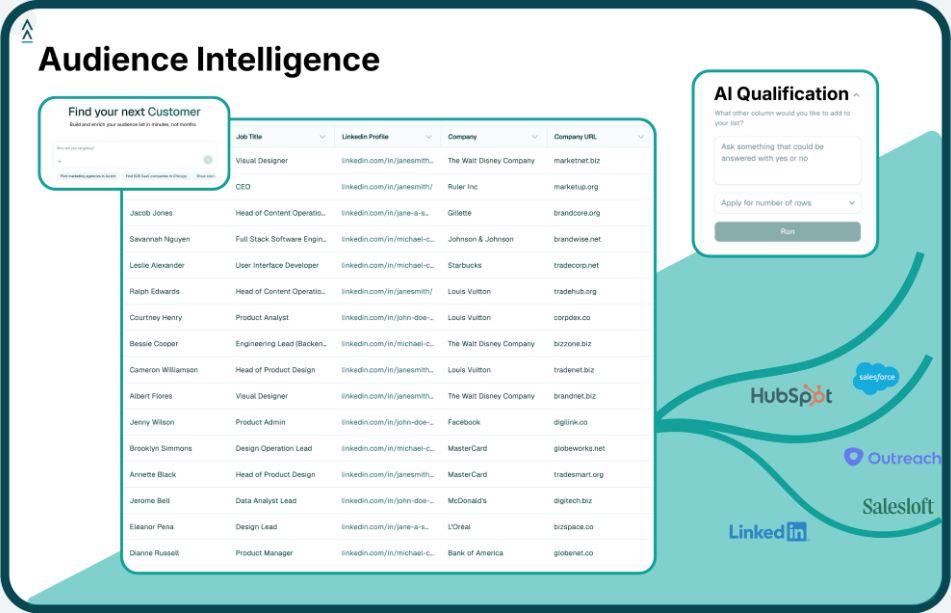
Tool and strategies modern teams need to help their companies grow.






