.png)
.png)

Daniel Saks
Chief Executive Officer


.png)

High-quality B2B data is the lifeblood of modern sales and marketing – but it has many dimensions. When evaluating B2B data providers or managing your own database, you’ll often hear about three critical attributes: coverage, accuracy, and freshness. Each plays a distinct role in go-to-market success. Coverage refers to the breadth and completeness of the data (how much of your target market it includes). Accuracy measures correctness – are the contact details and firmographics error-free and verified? Freshness gauges how up-to-date the information is, given how quickly business data can change.
These pillars of data quality are sometimes in tension. What good is having coverage of 300 million contacts if half of them are outdated or incorrect? Conversely, an extremely accurate list that only covers a small slice of your market leaves revenue on the table. And even a once-accurate database quickly loses value if it’s not fresh. In fact, B2B data decays rapidly – contacts change jobs, companies get acquired, phone numbers and emails go inactive. It’s a continuous challenge to keep data comprehensive, correct, and current all at once.
It’s no surprise, then, that improving data quality has become a top priority for B2B teams. Two-thirds of B2B marketers say better data quality is among their most critical go-to-market priorities. In this blog, we’ll break down coverage vs accuracy vs freshness in B2B data, why each matters, and how to balance them. We’ll also look at eye-opening stats on data decay and quality from industry research.
With these stakes in mind, let’s examine each of the three pillars – coverage, accuracy, and freshness – in detail and how they impact your go-to-market success.
Coverage in B2B data refers to how comprehensive and wide-ranging your database is – essentially, does it cover all the companies and contacts you might want to reach? A high-coverage data source will include a large portion of your Total Addressable Market (TAM). This matters because missing chunks of your TAM means missing potential customers. In fact, 58% of B2B marketers are focused on expanding their audience into new segments – an impossible task if your data provider doesn’t list those new industries, regions, or company types. Nearly two-thirds (63%) of marketers say that simply reaching the right audience is one of their top challenges. Having broad, deep data coverage is the first step to solving that problem.
It’s easy to be impressed by headline numbers for database size. Some B2B data platforms claim hundreds of millions of contacts on file. (For perspective, there are an estimated 359 million companies worldwide as of 2023, though not all are in every provider’s database.) However, raw volume isn’t the whole story. What really matters is coverage within your target market. As one guide notes, a provider’s total of “245 million records” isn’t very relevant if your ideal customer profile is, say, manufacturing companies in Europe – you need to know how many of those it has. In practice, data coverage tends to vary by niche: one vendor might excel at tech startups, another at healthcare companies, etc.
No data source will cover 100% of every niche – and if one claims to, be skeptical. In fact, experienced users find that even top vendors might only match around 60% of the contacts in a given ICP list, and that’s considered good performance. A provider boasting near-100% matches could be padding their results with stale or guessed data, which hurts accuracy. The goal is to find a data source that gives broad and relevant coverage of your market while still meeting quality standards. Ask providers for specifics: for example, how many companies and contacts can they return that meet your criteria (size, industry, region, etc.), rather than just their total counts. High coverage ensures your sales team isn’t blind to large swaths of potential customers. But coverage alone won’t fill your pipeline – not if the data points are wrong or out-of-date, as we’ll see next.
Accuracy is all about data quality – are the entries in your B2B database correct, verified, and trustworthy? This includes basic contact info (emails, phone numbers, job titles) as well as firmographic details (industry, employee counts, revenue tiers) and any other fields you rely on. Inaccurate data is more than an annoyance; it has serious consequences for go-to-market execution and the bottom line. Consider these impacts of bad B2B data:
The takeaway is clear: data accuracy is not optional. It directly affects your ability to reach prospects, the effectiveness of your campaigns, and the efficiency of your team. This is why improving data quality is a top priority for so many GTM leaders. Achieving high accuracy requires rigorous verification and validation processes. Top data providers use techniques like email/mail server pings, phone validation, AI-based cross-referencing, and human research to verify records. They might even guarantee accuracy levels (for example, some claim 95%+ email deliverability on their contacts, meaning very few bad addresses) as a selling point.
However, accuracy isn’t a static achievement – it’s a moving target because business data doesn’t stay still. A phone number that was valid last quarter might be disconnected now; an email might start bouncing next month when someone leaves their job. This leads us to the third pillar: freshness.
Freshness (or recency) measures how up-to-date the data is. In the B2B world, data can get stale frighteningly fast. Why? People change jobs, get promoted or switch roles; companies pivot, rebrand, relocate, get acquired; new startups launch while others shut down. All these changes mean the information in your CRM or prospect list is continuously aging. B2B contact data can go out-of-date within weeks if not refreshed.
In fact, B2B data decay has reached what some call epidemic levels. Multiple studies show a baseline decay rate of around 2% per month for B2B contacts. That compounds to roughly 22–25% of records going bad every year. And that’s just an average – the past few years have seen even faster churn. Increased workforce mobility (job hopping, remote work) and economic shifts have accelerated data decay. One analysis noted that in late 2024, B2B email data was decaying at 3.6% per month – nearly double the historical rate.
To put this in perspective, consider a few stats on how frequently contacts change:
B2B data is perishable. You might start with great data, but without continuous updates, it will rot like produce on a shelf. This is why data freshness is as important as initial accuracy. Stale data becomes inaccurate data over time.
Maintaining freshness requires ongoing data maintenance processes. It’s not enough to do a one-time cleanup or buy a list once a year. Best practices include scheduling regular data enrichment or verification cycles. Many organizations now aim to refresh critical fields (like emails and titles) every 30–90 days. Leading B2B data providers often advertise how frequently they update their datasets – for example, some verify their entire database every 60 days or even continuously in real-time. The goal is to shrink the lag between a real-world change (e.g. a prospect gets a new job) and that change being reflected in your systems. The shorter the lag, the higher your data freshness.
Modern techniques to improve freshness include automated web scraping for company news, email activity monitoring (to catch bounces quickly), and real-time “signal” feeds that alert you to events like funding announcements or job changes. For instance, intent data providers track weekly web research behavior; others provide real-time job change alerts so you can update a contact as soon as they move. Ultimately, investing in freshness pays off by keeping your outreach relevant – if you know John Doe left ABC Corp yesterday, you won’t waste time emailing him there, and you might even follow him to his new company as a warm lead.
By now it’s clear that coverage, accuracy, and freshness are all essential to a successful B2B data strategy. But optimizing all three can feel like a juggling act. These dimensions often trade off against each other if you’re not careful. For example, maximizing coverage (getting more and more contacts) can introduce more inaccurate entries if the data isn’t thoroughly vetted – a case of quantity over quality. Conversely, a strict focus on accuracy could lead you to exclude any records you aren’t 100% sure about, potentially shrinking coverage. And you might refresh data monthly for freshness, but without broad coverage or strong accuracy, frequent updates alone won’t deliver results.
The key is to strike the right balance and leverage tools and practices that enhance all three. Here are some strategies and insights for balancing coverage vs. accuracy vs. freshness:
Ultimately, the organizations that excel in go-to-market are those that refuse to compromise on any of the three pillars. They insist on robust coverage of their target market, high accuracy through rigorous quality control, and continuous freshness via automation and process. Achieving this is challenging, but it’s increasingly possible with modern data solutions.
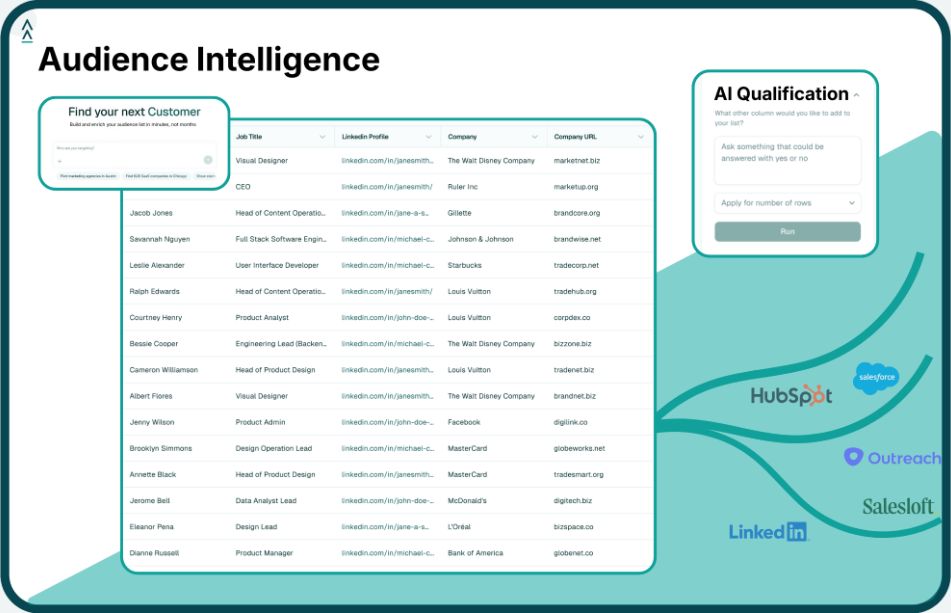
Ensuring great coverage, accuracy and freshness in your B2B data doesn’t have to be an uphill battle. The right data partner can deliver all three. Landbase is one such solution – it offers a unified B2B database with verified data on over 300 million contacts and 24 million companies, updated continuously to stay current. By combining comprehensive coverage with ongoing signal updates and human-in-the-loop verification, Landbase lets you build pipeline with confidence. Your team gets complete market visibility without the typical data headaches: fewer bounces, fewer dead leads, and more actionable intel on each account.
Tool and strategies modern teams need to help their companies grow.