April 10, 2026

Account Scoring vs Lead Scoring: Which One Your Team Actually Needs

Lead scoring scores individuals. Account scoring scores companies. Learn which one fits your sales motion and why most B2B teams need account scoring in 2026.
Comparison
  • Button with overlapping square icons and text 'Copy link'.
Table of Contents

Major Takeaways

What is the difference between account scoring and lead scoring?
Lead scoring evaluates individual contacts based on their engagement and demographic fit. Account scoring evaluates entire companies based on firmographic fit, technographic signals, buying intent, and organizational readiness. Lead scoring tells you who is interested. Account scoring tells you which company is worth pursuing.
Which one should B2B teams use in 2026?
Most B2B teams selling deals above $10K ACV should use account scoring as the primary method and lead scoring as a secondary signal. B2B buying decisions are made by committees, not individuals, so scoring at the account level captures the full picture.
How does AI change scoring in 2026?
AI scoring analyzes 1,500+ data points per account including firmographic, technographic, intent, hiring, and funding signals. This is fundamentally different from rule-based scoring that assigns static point values to individual fields. AI scoring is dynamic, multi-dimensional, and significantly more accurate.

Most B2B teams start with lead scoring because their marketing automation platform includes it out of the box. They assign points to job title, company size, email opens, and form fills. It works well enough for marketing-qualified-lead (MQL) handoffs. Then they try to use it for pipeline prioritization and everything breaks.

The problem is that lead scoring evaluates individuals while B2B buying decisions are made by committees. According to 2026 sales data, enterprise deals average 13 decision-makers. Scoring one person out of 13 tells you very little about whether the account is a real opportunity.

Account scoring solves this by evaluating the company as a whole: firmographic fit, technology stack, buying signals, funding stage, hiring activity, and committee-level engagement. This guide explains when to use each approach and why account scoring is winning in 2026.

Key Takeaways

  • Lead scoring evaluates individuals. Account scoring evaluates companies. B2B buying involves committees, so account scoring captures more signal.
  • 67% of lost sales come from improper qualification. Scoring at the account level catches fit issues that contact-level scoring misses.
  • Lead scoring works best for high-volume SMB motions where one person makes the decision. Account scoring works best for mid-market and enterprise where committees decide.
  • AI account scoring analyzes 1,500+ data points per company, far beyond what rule-based lead scoring can handle.
  • Most teams in 2026 use both: account scoring for prioritization and lead scoring for engagement-based routing within qualified accounts.

How lead scoring works

Lead scoring assigns point values to individual contacts based on two categories:

Demographic scoring: points for job title, seniority, department, company size, industry. A VP of Sales at a 500-person SaaS company scores higher than a marketing coordinator at a 10-person agency.

Behavioral scoring: points for engagement actions. Opening an email, clicking a link, visiting the pricing page, downloading a whitepaper, attending a webinar. Each action adds points.

When a contact crosses a threshold score, they become a marketing-qualified lead (MQL) and get passed to sales.

Where lead scoring works well

  • High-volume SMB motions where one person makes the buying decision
  • Product-led growth (PLG) motions where individual usage signals indicate purchase intent
  • Marketing-to-sales handoff for inbound leads that need routing

Where lead scoring breaks

  • Enterprise deals where 13 people influence the decision and scoring one of them misses the picture
  • ABM motions where targeting happens at the account level, not the contact level
  • Outbound motions where the prospect has not engaged yet and behavioral scoring is zero
  • Any scenario where firmographic fit matters more than individual engagement

How account scoring works

Account scoring evaluates the entire company across multiple dimensions:

Firmographic fit: industry, company size, revenue, geography, funding stage. Does this company match your ICP?

Technographic fit: what tools does the company use? Are they running competitors or complementary products? Is their tech stack compatible with yours?

Buying signals: is the company hiring for roles relevant to your product? Did they recently raise funding? Are they adopting or dropping technologies that signal a buying cycle?

Engagement signals: across all contacts at the account, how many are engaging with your content, visiting your site, or responding to outreach?

The account score combines all of these into a single number that represents how likely the company is to buy and how well they fit your ICP.

Where account scoring works well

  • Mid-market and enterprise sales where multiple stakeholders influence the decision
  • ABM campaigns where accounts are the unit of targeting
  • Outbound motions where you need to prioritize target accounts before any engagement happens
  • Pipeline prioritization where reps need to know which accounts to focus on

Why account scoring is winning in 2026

Three trends are driving the shift from lead scoring to account scoring:

First, buying committees are getting larger. The average enterprise deal involves 13 decision-makers in 2026. Scoring individuals when 13 people matter is structurally incomplete.

Second, AI has made account scoring practical. Scoring an account across 1,500+ data dimensions was impossible with rule-based systems. AI agents can evaluate firmographic, technographic, intent, and signal data simultaneously and produce a score that reflects the full picture.

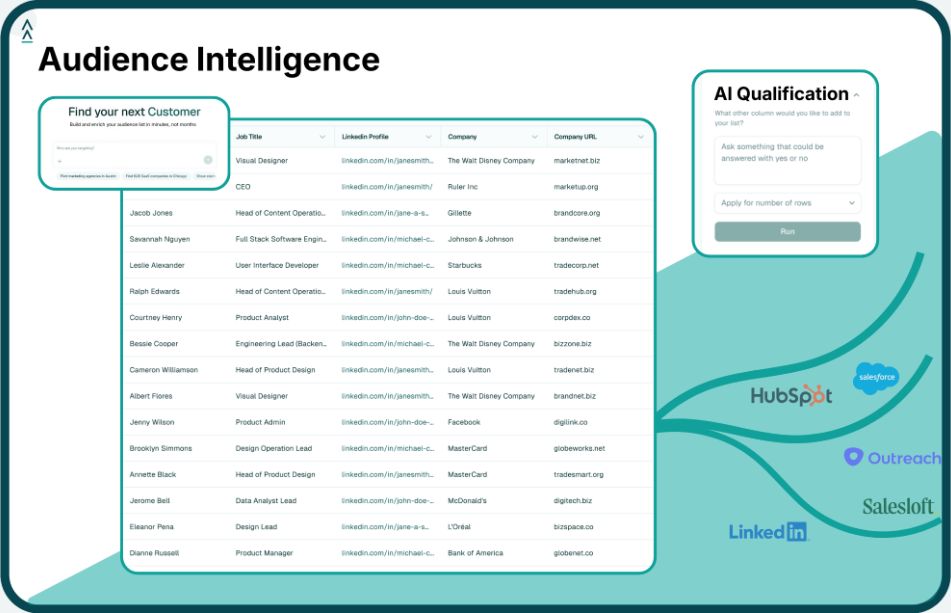
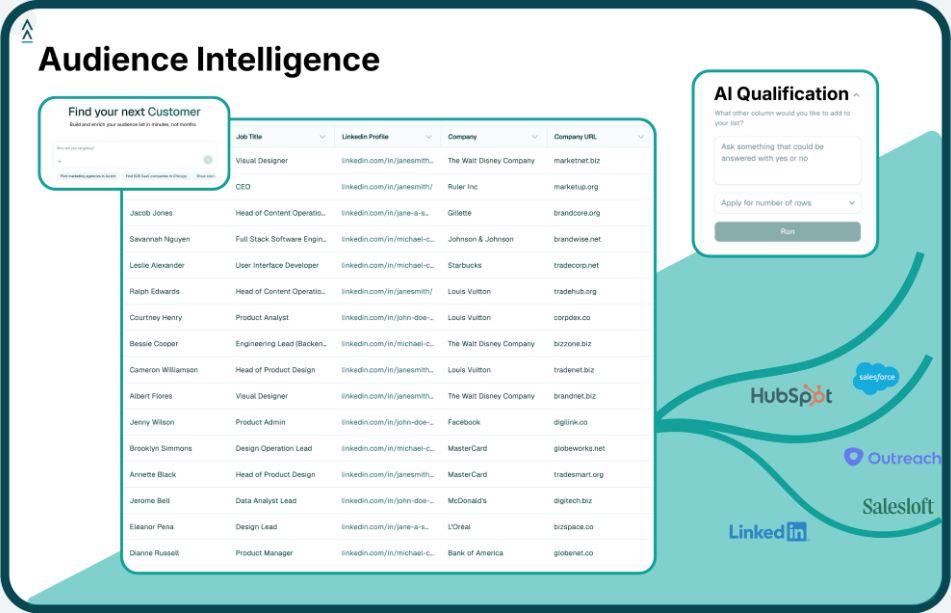
Third, data platforms deliver account-level enrichment. Platforms like Landbase deliver accounts with 1,500+ enrichment fields and AI-powered qualification that evaluates each account against your custom ICP criteria. This makes account scoring accessible to teams that do not have data science resources to build it themselves.

The hybrid approach most teams use

The best-performing teams in 2026 use both methods in combination:

  1. Account scoring determines which companies to target and prioritize. Accounts that score above the threshold go into the target list.
  2. Lead scoring determines which contacts within those accounts to engage first. Contacts showing engagement get routed to reps ahead of contacts who have not engaged.
  3. Account score determines pipeline priority. When a rep has 200 open accounts, the account score tells them which 20 to focus on this week.

This combination captures both the who (lead scoring) and the where (account scoring) of B2B buying.

Frequently asked questions

Can I replace lead scoring entirely with account scoring?

For outbound and ABM motions, yes. For inbound lead routing, you still need contact-level scoring to determine which individuals to route to sales. Most teams keep both and use account scoring for prioritization and lead scoring for routing.

How many data points does AI account scoring use?

Modern AI account scoring evaluates 1,500+ data points per account including firmographic, technographic, intent, hiring, funding, competitive, and engagement signals. This produces dramatically more accurate scores than rule-based models that use 10-20 data points.

What is the accuracy improvement from AI scoring?

Teams using AI-powered qualification report 50% better ICP accuracy compared to rule-based scoring. The improvement comes from evaluating more dimensions and applying consistent criteria across every account.

Do I need a data scientist to build account scoring?

With modern platforms, no. Tools like Landbase handle the scoring using AI agents that evaluate accounts against your ICP criteria. You define the criteria in plain language. The platform handles the data science. No models to build or maintain.

Build a GTM-ready audience

See AI-powered account scoring

  • Button with overlapping square icons and text 'Copy link'.

Turn this list into a GTM-ready audience

Match this list to your ICP, prioritize accounts, and identify who to contact using live growth signals.

Account scoring with AI agents

Landbase evaluates every account against your ICP criteria using AI. No scoring models to build or maintain.

Stop managing tools. 
Start driving results.

See Agentic GTM in action.
Get started
Our blog

Lastest blog posts

Tool and strategies modern teams need to help their companies grow.

Insight

87% of B2B marketers say demand gen is their top priority. But 68% are increasing volume while only 32% are improving quality. Here is what actually works in 2026.

Daniel Saks
Chief Executive Officer
Insight

Sending 100 emails with zero replies is now a negative signal. Learn how to warm up domains, protect reputation, and maintain deliverability for B2B outbound.

Daniel Saks
Chief Executive Officer
Comparison

Lead scoring scores individuals. Account scoring scores companies. Learn which one fits your sales motion and why most B2B teams need account scoring in 2026.

Daniel Saks
Chief Executive Officer

How GTM teams turn this list into pipeline

See how GTM teams use fastest-growing lists to define TAM, prioritize accounts, and launch campaigns.

AI account scoring built in

Landbase scores entire accounts against 1,500+ data points using AI agents. Define your ICP in plain language, get scored results.